electrodacus

New Member

Posts:88

 |
| 26 Jun 2012 03:41 PM |
|
Hi, I'm new on this forum seems like a great one. I started to build a small 65sqm house about 700sqft it will be on a 20 acre lot in Saskatchewan Canada. The design is a bit different from a wood frame is more similar to a log house . You can see some rendering and the structural drawing PDF on greensask.com
I just made a video with the house is still under construction but you can see how the walls look like
Link to Video
This is the current status as of 15 December 2012
This is a rendering of how the house will look like is a simple construction nothing fancy since I need to build everything.
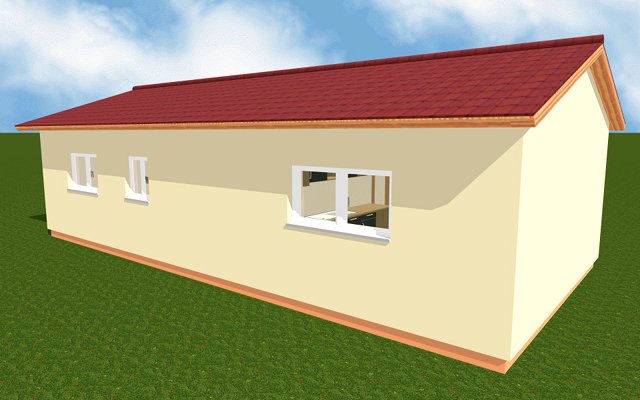
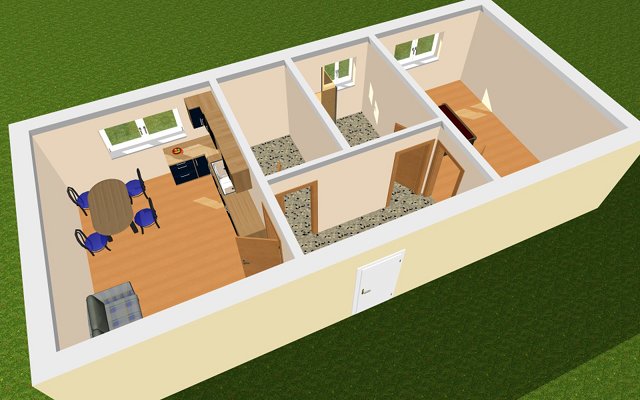
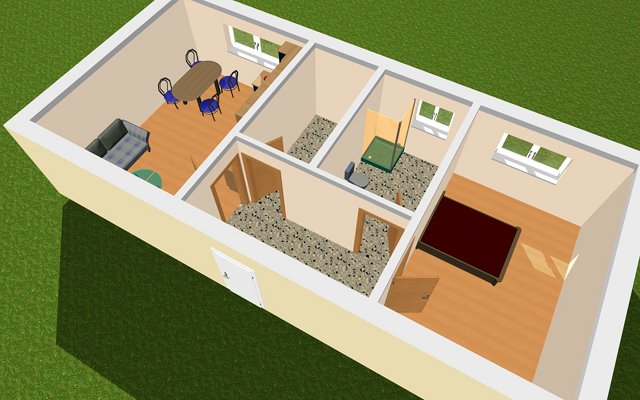
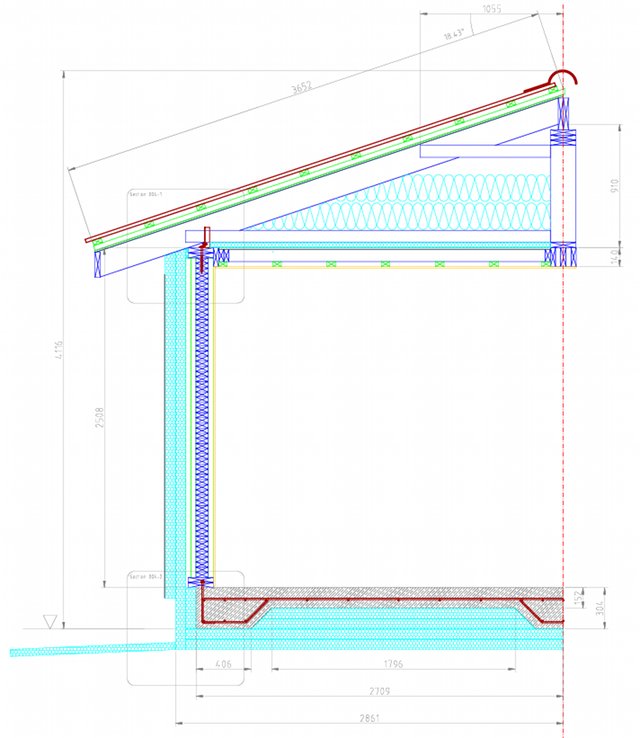
You can see the details of my design if you click on below image you will download an 8 page PDF.
|
|
|
|
|
|
|
whirnot

Basic Member
Posts:186
|
| 28 Jun 2012 05:06 PM |
|
Whoa! I never thought I would see a crib House! That is what we used to call this technique when it was used for grain elevators 50+ years ago. I would guess most engineers today would not have the resources to clculate the walls as no one builds this way anymore.
But a terrible waste of resources, in my opinion. |
|
|
|
|
greentree

Advanced Member
Posts:587
|
| 28 Jun 2012 10:01 PM |
|
You know if you removed 75% of the exterior wall wood you could heat that little place for several years. |
|
|
|
|
electrodacus
New Member
Posts:88
|
| 28 Jun 2012 11:34 PM |
|
@ whirnot I will not call someone an engineer if it will not be able to calculate that wall or any other wall :) I can even do that with my limited mechanical engineering skills since I'm an electrical engineer but I think there are no calculation needed since that is a really solid construction especially compared to the 2x6 frame walls. Of course it can be done with less materials but then you will need calculations and that can cost more than the additional materials. I used 2x4 the short 92" in this project since they are available at hardware store and are 30% less expensive by volume than any other structural wood. I made a spread sheet calculation and all building materials for this house including foundation, windows, doors, roof, thermal insulation and drywall will get to about $28000 even if my target price is under 25k so for now is a bit over budget. If I chose to replace this wall with a 2x6 standard frame wall I will only save probably around 1000$ since the 2x6 is less but a bit more expensive and you also need OSB. There are a few problems for me with 2x6 walls. One is that is less strong and the other big problem is the fiberglass insulation that I hate to work with or have in my lungs is also quite inefficient for walls. I opted to isolate this with 9" of EPS so the wall will be about R40 including the 3.5" wood wall. The highest cost and complexity seems to be the foundation about 9000$ in materials and now I try to investigate the other solution I just heard about steel screw piles there are some 18ft (5.5m) long with double helix of 14" or 16" available at 400$/piece and I think for my house about 15 of those will work. Dose anyone has experience with this type of foundation? I'm not sure they can be installed in the type of soil I have that is a sort of gravel with a lot of round rocks some quite large. In the end the steel will probably corrode but they can probably be easily replace if required somewhere in the future. I'm an engineer and normally we calculate close to the limit to save on the initial cost but I like to oversize. PS: I searched about "crib house" but did not find anything. Anyway I will say is more similar to a log house just that the wood is not round and only less than 4" not 8" or so on some log cabins (they use that much wood mostly to met a minim of insulation value since they do not use additional insulation to be able to showcase the wood). |
|
|
|
|
electrodacus
New Member
Posts:88
|
| 29 Jun 2012 12:04 AM |
|
@ greentreeI can not remove 75% of the wall wood since I will then need OSB that is probably more expensive that the wood I remove. There are about 90sqm of eternal wall at at about 12cm width including vertical wood that is just under 11 cubic meters most of this is 38x89mm or 2x4" (1.5x3.5" in reality) and 92" long this is less expensive then other size since is shorter than standard 96" and cost about 225$ including taxes / cubic meter so the entire wood for the external wall will cost about 2500$ you can not get a much better price if you build with standard 2x6" and OSB since OSB is quite expensive maybe you save 500$ to 1000$ but form the house total this is not that significant and you get a stronger house. As for 75% of the wood about 8 cubic meters and if is Douglas Fir has a weight of about 500kg/cubic meter a total of 4 metric tones for that 8 cubic meter that will help keep my house better on the ground in high winds :) Now the energy that I can get by burning that wood will be about 5kWh/kg maybe even a bit less so about 20MWh for the 8 cubic meters. So since the house is well insulated that energy will last me a long time assuming I have a high efficiency burning stove and the house is quite well insulated. Now not considering the burning efficiency that will be about 9 cent/kWh :) |
|
|
|
|
arkie6

Veteran Member
Posts:1453
|
| 29 Jun 2012 10:54 PM |
|
Posted By electrodacus on 26 Jun 2012 03:41 PM
...it seems hard to find an structural engineer to check an approve my drawings...
Why do you need a structural engineer to approve your drawings for a simple single family home? Is this some sort of requirement to be able to build a home? Is this something peculiar about Canada or just your particular location? |
|
|
|
|
arkie6
Veteran Member
Posts:1453
|
| 29 Jun 2012 11:40 PM |
|
Are you sure OSB is that expensive? It is not that expensive here in the US even though the price has increased at least 50% in the past 2-3 years. 2x4 studs have also increased approximately the same amount. I remember buying studs for $2.00 each ~2 years ago. Now they are $2.88.
I just checked online prices at the local www.lowes.com
OSB, 7/16" x 4' x 8' is $9.42/sheet. That is $9.42/32 sq ft = ~ $0.30/sq ft
2 x 4 x 92-5/8" wood studs are $2.88 ea. Using the 1.5" face, that is $2.88/(1.5 x 92.5)/144 = ~ $3.00/sq ft.
Down here, 2 x 4 x 96" full 8' studs cost the same as the 92-5/8" pre-cut studs.
To build a 4'x8' wall section using 2x4 @ 16" on center studs with a single bottom plate and a double top plate covered with 7/16" OSB would cost approximately $ 22.38 in lumber or $0.70/sq ft.
To build the same 4' x 8' wall section using 2x4 stacked horizontally on top of each other (I'm going to use the 8' studs to make it easier) would take 32 2x4 studs at $2.88 each for a total lumber cost of $92 or $2.88/sq ft which is 4 times more expensive than 2x4 vertical studs with OSB exterior.
If you don't like using fiberglass insulation for the fill in the stud cavities and plan on doing the work yourself, you could cut 3" or so thickness EPS foam down to 14.5" wide and fit it in the stud cavities and then seal the edges with spray foam in a can. This would give you an overall higher R value for the wood part of the wall, ~R11 whole wall vs. ~R5 for the solid stacked 2x4 wall. With this arrangement, you could reduce the exterior foam by 1.5" and still have the same effective R value.
By the way, what kind of exterior wall covering are you planning and how were you planning on attaching it with all of that exterior foam? |
|
|
|
|
electrodacus
New Member
Posts:88
|
| 30 Jun 2012 04:39 AM |
|
First, thanks for your replay. A 2x4 frame wall for a house will not be allowed at least in Canada from what I know so you will need 2x6" that is more expensive not sure is even allowed for a garage. The 2x4x92" at local Lowes is 1.79$ now but was at one point even 1.59$ and the 2x6x96" is somewhere close to 4$ this dose not include 10% tax. My calculations are for volume and the particular 2x4x92" is the least expensive by volume (real volume 1.5x3.5x92") I do calculation here in metric and one cubic meter of that is 225$ including tax compared to about 300$ for any other size. One 2x4x92" will be about enough to build 1sqft of wall on my design so about 1.79$ + tax /sqft that is much more than 0.7$ on your calculation but if you use 2x6" that is required here then it will be much close to the 1.79$ but probably still a bit less not enough to make me want to use that since the difference in structural and health is to big. OSB is not that great and fiberglass will be necessary since EPS is only allowed inside if you have dual drywall over for fire protection. The R value of my wall will be R40 because I have on the outside 3 x 3" EPS boards that is 9" of EPS in total and will be fixed with screws to the wood wall. On the outside a 1/4" of stucco with fiberglass mesh will be applied on top of the EPS I've done that before on the first house I build but that was in Europe. Here is a photo of that house
 PS: to be honest I do not know for sure if an stamped project is required it what I understood from the administrator at the rural municipality and I think it make sense. Is it really possible in your area to build a house without engineering drawings? I'm sure the building inspector will not accept that. There are strong winds sometimes here I will not want to have a 2x6 frame building here. |
|
|
|
|
JohnyH
Basic Member
Posts:114
|
| 30 Jun 2012 05:53 AM |
|
Arkie6
All drawings are reviewed and stamped by your own structural engineer, then the citiy or municipality has to review it and approve them (Im assuming by engineers also, maybe not) then the building inspector whatches it being built and puts his stamp on it after it is deemed built to drawings. The roof truss drawings are also done seperately and the same way, lots of checks and balances!
This is in Ottawa, Canada.
|
|
|
|
|
arkie6
Veteran Member
Posts:1453
|
| 30 Jun 2012 10:23 AM |
|
He said he had 20 acres, so I assumed he was not in a city or municipality.
|
|
|
|
|
arkie6
Veteran Member
Posts:1453
|
| 30 Jun 2012 10:42 AM |
|
Posted By electrodacus on 30 Jun 2012 04:39 AM
...Is it really possible in your area to build a house without engineering drawings? I'm sure the building inspector will not accept that...
Yes, in my rural area, no engineering review of drawings is required. No building permits or inspections are required either. You are pretty much on your own, unless you get bank financing, then the bank may impose some restrictions. If you build in
town, then you have to get a permit and inspections performed during
construction. I don't think any engineering review of drawings is required for homes built in the nearby town of 25,000+ for homes that are single family residence. |
|
|
|
|
arkie6
Veteran Member
Posts:1453
|
| 30 Jun 2012 11:02 AM |
|
Have you looked at blown cellulose as a cavity insulation rather than fiberglass? That is commonly used here in the US and is very effective. Cost for blown wall cavity cellulose insulation (a small amount of water and adhesive is typically added to make it stick in the cavity) is ~$1/sq ft for either 2x4 or 2x6 walls (that is the finished installed price). This is on par cost wise with the material costs alone of filling the cavity with rigid EPS insulation. Cellulose insulation is fire retardant, so no special measures would be required on the inside other than covering with drywall or similar product.
What type of insulation do you plan on installing in your ceiling? Loose fill cellulose is commonly used here in the US due to its effectiveness and relatively low cost.
If you want to make a really strong stud wall, you could enclose both sides of the stud cavity with OSB. And that would still likely be less expensive than stacking 2x4s horizontally. And probably as strong or stronger.
Another approach is the double stud wall to get additional depth of cavity insulation while significantly reducing the thermal bridging of the relatively low R value wood members.
How do you plan on installing electrical wiring including outlet receptacle boxes and light switch boxes in that solid 2x4 wall? |
|
|
|
|
arkie6
Veteran Member
Posts:1453
|
| 30 Jun 2012 11:09 AM |
|
Posted By electrodacus on 30 Jun 2012 04:39 AM
First, thanks for your replay.
A 2x4 frame wall for a house will not be allowed at least in Canada from what I know...
Then why do you think they will let you use 2x4s stacked horizontally like a log home? |
|
|
|
|
electrodacus
New Member
Posts:88
|
| 30 Jun 2012 02:42 PM |
|
@arkie6
Not sure where to start there are many suggestions from you.
Yes the 20 acres are not in a city they are in a rural municipality. I think there are very few houses there maybe a few hundred in the entire municipality.
I will love to live in your area :) I hate this part with the papers is even harder than the work itself. I do not need financing but I have a really small budget.
I do not like cellulose either is basically paper and I do not think is even close in fire rating as the fiberglass also probably they add some chemicals to make it a bit more resistant to fire.
I will use fiberglass for the roof since I need R80 and the EPS is to expensive but the roof will be 100% sealed from the house so there is zero chance the fiberglass will get in to the house.
Not sure you looked inside the PDF in the first post (last photo is a link to an 8 page PDF) there you can see that the wall is made out of 2x4 staked + on the inside there is a 2x4 or 2x3 at 16" on center but mounted flat so there is a 1.5" gap between the solid wood wall and the drywall.
I will have very lithe wiring and it will be all 24V DC for low power devices like computers and other electronics + some wiring for LED lighting.
The house will be off grid and I will have about 700W of solar panels + a small 300W wind turbine that will generate in worst case a bit over 100kWh/month and I will have some LiFe batteries for energy storage.
You can see the batteries http://www.youtube.com/watch?v=VxZF8J7wrww I have an youtube channel with the same user name as here and I will make some videos mostly about the electric part of the house.
About your last comment, I think there is a large difference between a 2x4 frame wall and a solid wall made of staked 2x4 and there also like I mentioned 2x3" or 2x4" at 16" on the inside but mounted with the 4" facing the wall and also on the outside there are two 2x4" again the 4" facing the wall and that will help with the EPS and in strong winds the wall will not be lifted since this 2x4" inside and outside are connected using wood screws.
This is not the most cost effective house or as strong as ICF but for sure way stronger than 2x6 or even 2x8" frame wall.
By using frame wall I can save only about 1000$ at best on the entire house and that is a small proceed of the house building materials that will be about 25k total so for me it dose not worth saving 1000$ for the entire house and ending with a less stronger house.
|
|
|
|
|
electrodacus
New Member
Posts:88
|
| 30 Jun 2012 02:58 PM |
|
@JohnyH
Thanks for your comment.
Unfortunately the Rural Municipality where I build is quite small so they do not have an structural engineer or an Inspector. They only care about the architecture and size of the house it was complicated to convince them accepting a 65sqm (about 700sqft) house (I actuality wanted to have even a smaller one) but is not allowed.
So they just recommend me a structural engineering firm they work with in the past and an building inspector. I called the structural engineer send him the PDF with what I want to build and he called me back in about two hours saying that he will refuse the job and he can not help me because they have to much work and do not have time for my little project.
I contacted some other engineering firms and most only work for commercial clients only and others do not want to get involved with my little house.
So I fill a bit lost. The most I got was a engineered foundation for 1000$ but not even the one I proposed saying that they do not design that type of foundation I have in my drawings (I was a bit shocked since is a classic footing + wall foundation that is under the freezing point). Anyway after I asked about the approval for the rest of the house I got no communication.
Someone suggested to find structural engineers that work for the government to check and approve my project but I have no idea where to find them if there is such a thing.
I think the house I designed mets or exceed the Canadian building code that I read but I'm a bit lost to where will I get the approvals.
I think I will change the foundation type to a steel screw piles type since that is a bit more accepted and there is not much in terms of load calculations since is an engineered product they are 5.5m 18ft deep and have dual helix of 14 to 16" I will need about 15 of those for my house and will be done in a day that is important since I already lost some time.
I just need to order 4 of them to see if they can properly be installed on my terain since is full of gravel (they actually wanted to make a gravel pit on that land before I purchased) but probably the gravel quality was not that great so they abandoned.
|
|
|
|
|
MikeSolar
Basic Member
Posts:376
|
| 30 Jun 2012 03:16 PM |
|
Have you thought of using concrete block filled with sand. You will get your thermal mass and can strap it for drywall. It should be cheaper than all that wood.
I know in rural Nova Scotia that if you are building a house, no engineer is required for standard stuff especially if you can befriend a local contractor to work with.
|
|
| www.BossSolar.com |
|
|
electrodacus
New Member
Posts:88
|
| 30 Jun 2012 03:48 PM |
|
@MikeSolar
Yes thermal mass is great and my first choice was ICF but it seems a bit more expensive at at 700Sqft it gets out of my budget.
Concrete blocks at lest the one I've seen that you wind at hardware store are expensive. Also that will for sure require engineering.
The first house I build (actually the only one) was made out of aerated concrete block they are used a lot for building in Europe.
They where like Lego with interlocks and only needed little cement adhesive very similar to what you use for ceramic tiles but there also reinforced concrete columns at corners and every 10 to 12ft in all directions + reinforced concrete ceiling.
The great stuff about the aerate concrete blocks (sort of concrete sponge) is that they are also great thermal insulators and have good thermal capacity at the same time but I do not see them available in North America or at lest not that popular.
I will not use a contractor. I do not have any job currently and want to do everything myself. I build that last house myself and I also had a full time job then and it took me close to 3 years. Now I hope that I can move this winter but I have a lot of delay with the paper work.
I will try to change the project for the foundation so I use steel screw piles to save on time and maybe to skip the engineering part and see If I can convince one building inspector to accept my design since I think is quite a bit stronger than 2x6 standard frame wall.
In this project if you look at the foundation I have inside a space reserved for a 2 cubic meter sand box for thermal energy storage with copper coils to transfer and remove the heat from there.
But now if I change the project I will need to make a much smaller thermal storage inside the house probably in the mechanical room I hope for at least one cubic meter so half of what I had planed.
This isolated storage box will be heated with propane (water loop) at the beginning and used for hot water and one radiator will be used on the Heat recovery unit to compensate for the temperature loss and heat the house.
I will need to make the calculations but I hope for at least 12h of heat storage in worst case -30C outside temperature.
Later I will probably try to make part of that heat from solar vacuum tubes and only use propane as backup.
|
|
|
|
|
MikeSolar
Basic Member
Posts:376
|
| 30 Jun 2012 04:40 PM |
|
If you want to get the same Ytong blocks as you had in Europe, they are available through Hebel in the US. I'm sure they will sell them here.
http://www.hebel-usa.com/#_sub2103
|
|
| www.BossSolar.com |
|
|
electrodacus
New Member
Posts:88
|
| 30 Jun 2012 08:51 PM |
|
How did you knew it was Ytong what I used in Europe? :) I do not think I mentioned that and there are more manufacturer of this block there.
Anyway I was trying to find some local here in central Canada but I did not found anything. I'm sure importing from US will be quite expensive not to mention the engineering design since is not that popular here.
I took a look at the hebel website their block are simple rectangle not as nice as the one from Ytong that also seems to have factory in US.
They are also great when you need thermal insulation that is rigid and can work at high temperature.
I that Europe and North America should exchange their house technology since there are a lot of earthquakes in EU and a lighter and more flexible wood house will work better and in North America where there a lot of strong winds and tornado a heavier reinforced concrete will work better :)
|
|
|
|
|
MikeSolar
Basic Member
Posts:376
|
| 01 Jul 2012 02:09 PM |
|
Posted By electrodacus on 30 Jun 2012 08:51 PM
How did you knew it was Ytong what I used in Europe? :) I do not think I mentioned that and there are more manufacturer of this block there.
Anyway I was trying to find some local here in central Canada but I did not found anything. I'm sure importing from US will be quite expensive not to mention the engineering design since is not that popular here.
I took a look at the hebel website their block are simple rectangle not as nice as the one from Ytong that also seems to have factory in US.
They are also great when you need thermal insulation that is rigid and can work at high temperature.
I that Europe and North America should exchange their house technology since there are a lot of earthquakes in EU and a lighter and more flexible wood house will work better and in North America where there a lot of strong winds and tornado a heavier reinforced concrete will work better :)
Haha, It was just an educated guess. Ytong is so popular over in Europe that I probably had a 75% chance of being correct. The product from Hebel is the same as Ytong but, as is usual when importing products, only a limited number of choices will come over. The market is not quite here yet. I don't think there is an "Ytong" company in the US (actual corporate company) and the name Ytong is like Kleenex, good for many companies. I would like to find one for the Toronto are as well but and It might be a good investment opportunity. |
|
| www.BossSolar.com |
|
|