|
|
|
water heater help!
Last Post 13 Sep 2011 08:08 PM by rikmeister. 9 Replies. |
Sort:
|
|
 Prev Next Prev Next |
You are not authorized to post a reply. |
|
jerkylips

Basic Member

Posts:359

 |
| 07 Dec 2009 03:25 PM |
|
trying to figure out what makes the most sense for our new house. At this point, we have decided against tankless. My first thought was to look at the most efficient tank heater I could find, which seems to be the AO Smith Vertex. What I've discovered, though, is that it's about double the cost of the "normal" AO Smith water heater (ProMax). I haven't been able to track down the actual numbers on the Vertex but for the ProMax, the annual operating cost (based on the yellow "energy guide" sticker) is about $150/year. Even if the Vertex cuts that in half, it's about a 20 year payback on that upgrade.
What have others done? I'm trying to find that "sweet spot" between green & what makes financial sense.. |
|
|
|
|
|
|
Dana1

Senior Member
Posts:6991
|
| 07 Dec 2009 04:25 PM |
|
How are you heating the place, and what is your design-day heat load? In many instances a well-designed combined heat/hw system makes sense.
What are your fuel options, and what do they cost per kwh/therm/ccf/gallon or whatever?
It's impossible to do an analysis of what makes financial sense without it.
How many people? Any big-time hot water hogs, like 20gpm surround-showers or 50 gallon soaking tubs?
What made sense for me (and maybe I was either a bit extravagant, or not aggressive enough, making the presumption that natural gas costs will rise, but not quadruple over the next 10 years- it's actually fallen 30% since I installed the system), was a combi heating/HW system based around a reverse-indirect HW tank, using a Takagi tankless as a modulating boiler, with a drainwater heat recovery system to be able to get endless showering capacity still keep an average heating-mode burner modulation more appropriate to my ~30KBTU/h heating load. How green is it? Beats me- I haven't put anything like a whole season on it yet, but I'm hopeful that the math will work out present-value positive in under 10 years. I expect I'll have a good handle on it's real world efficiency in a coupla months. But that was me- your situation is probably not the same as mine, and the details make a difference.
The EnergyGuide is a lousy way to compare HW heaters, as is relying on the raw EF numbers. How, and how MUCH hot water you use makes a very big difference in the performance of each:
http://www.aceee.org/conf/08whforum/presentations/1a_davis.pdf
(Heater #4 is Vertex, which dramatically underperformed heater #6, a condensing tankless in ANY use profile or volume of use.)
But whatever you use for a HW heater, true efficiency is about far more than just the heater itself. Insulating all of the near-tank plumbing (cold water feed & temperature/pressure safety valve downtube included) to at least R4 (the 5/8" foam pipe insulation) is cost effective in ANY HW heating system for cutting down standby loss. Insulating the entire HW distribution plumbing will be a net double-digit reduction in fuel cost for heating HW. Drainwater heat recovery heat exchanger will usually reap a bigger return on investment than going from a standard to a condensing hot water heater.
Also, going to a direct-vent/sealed-combustion gives you a 3-5% (or more) cut in utility costs over an atmospheric-drafted version by not continously drafting away conditioned-air. This is a very squishy but real number that never shows up in an EF test, since it's adding a heating/cooling load to other equipment, whereas EF only tracks the fuel BTUs used by the heater itself. In very cold heating dominated climates it'll be more than 5%. (I'd guess 5% would be about right ballpark to use for Green Bay, assuming a reasonably tight but not super-tight house.)
Also, WHERE you put the hot water heater makes a difference. Standby losses of a direct vented tank heater located within conditioned space in a heating dominated 8000HDD climate like Green Bay WI basically come off the heating bill, 8 months of the year, whereas it would add to the cooling bill in, say, Tampa Bay FL. In Green Bay, keep it inside, not out in the garage or in an unconditioned basement/crawl space. Also locating it such that distribution runs to the most frequently used taps are minimized reduces the amount of heat abandoned in the piping between draws.
|
|
|
|
|
jerkylips
Basic Member
Posts:359
|
| 07 Dec 2009 04:40 PM |
|
wow, thanks so much for the detailed response We're still in the design stages but I'll tell you what we know so far. Wife & I are still deciding, but almost positive that we are going with ICF for the basement & SIPs for the above-grade, so it should be a very tight, very energy efficient house. We are heating with geothermal, desuperheater, and a buffer tank to pre-heat water for the water heater. I'm thinking that if it's a very efficient system to begin with, the gains of a super-efficient heater may not be that dramatic. I could be wrong, though.
It will be installed in a conditioned basement. I hadn't given much though to your point about direct vent, but now that I'm hearing it, it makes sense. Sounds like the way to go. It's just my wife & I. None of us are real water hogs - no baths, long showers, etc. Since it will be new construction, all of the appliances (washer, dishwasher) should be pretty water-efficient. We both work, so the water usage is pretty much 2 showers in the morning, then laundry, cooking, etc., at night.
Honestly, for our needs I still think tankless might make more sense, but the builder scared my wife off of those. It took some work to talk her into the SIP construction, and I don't know if I can talk her into that one.
Until I found this site, I had never even heard of the drainwater recovery system. I don't know much about them yet, but that's one that I am going to research. |
|
|
|
|
Dana1
Senior Member
Posts:6991
|
| 08 Dec 2009 01:32 PM |
|
Posted By jerkylips on 12/07/2009 4:40 PM wow, thanks so much for the detailed response We're still in the design stages but I'll tell you what we know so far. Wife & I are still deciding, but almost positive that we are going with ICF for the basement & SIPs for the above-grade, so it should be a very tight, very energy efficient house. We are heating with geothermal, desuperheater, and a buffer tank to pre-heat water for the water heater. I'm thinking that if it's a very efficient system to begin with, the gains of a super-efficient heater may not be that dramatic. I could be wrong, though.
It will be installed in a conditioned basement. I hadn't given much though to your point about direct vent, but now that I'm hearing it, it makes sense. Sounds like the way to go. It's just my wife & I. None of us are real water hogs - no baths, long showers, etc. Since it will be new construction, all of the appliances (washer, dishwasher) should be pretty water-efficient. We both work, so the water usage is pretty much 2 showers in the morning, then laundry, cooking, etc., at night.
Honestly, for our needs I still think tankless might make more sense, but the builder scared my wife off of those. It took some work to talk her into the SIP construction, and I don't know if I can talk her into that one.
Until I found this site, I had never even heard of the drainwater recovery system. I don't know much about them yet, but that's one that I am going to research. Whats the minimum anticipated temp on the pre-heat from the desuperheater buffer? You many not need much of water heater at all. If the temp is high enough, an electric tankless to provide finish-heat could do it. But if it's well under room temp you'll need something. Drainwater heat recovery, in a nutshell:  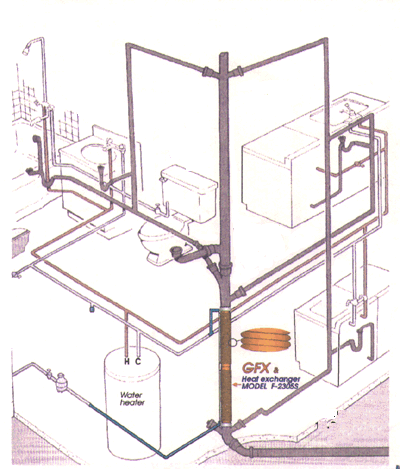 They're not all created equal- bigger & fatter versions return more energy than skinnier/shorter, and there is significant performance differences between different vendors. Natural Resources Canada has devised a standardized test, and lists the performance of different models here:
http://oee.nrcan.gc.ca/residential/personal/retrofit-homes/questions-answers.cfm#q45IIRC the state of Wisconsin has a srebate for those who heat their water with electricity and I guess the program is popular enough that MA-based EFI stocks PowerPipes in WI:
http://www.efi.org/wholesale/pdfs/power_pipe.pdf
"National distributor shipping direct throughout the United States
to place orders or for more information:
800/876/0660 � fax 888/440/4219
Wisconsin 800/962/7015 � Wisconsin fax 920/757/6452"
(^^It doesn't take too much to open an acct. with EFI and get the wholesale price. They're reasonable people to deal with.^^)
I'm not sure if this is the most current, but it looks like the kickback was only $100 (I thought it had been bumped to $300, like MN)
http://www.focusonenergy.com/files/Document_Management_System/Residential_Programs/focusonenergyeligibility_summaryreport.pdf
Beyond efficiency, it adds showering capacity, since it reduces HW energy use by ~50%, which lets you get away with lower tank volume. Recovery times are lower too, but in your case you'd be feeding most of the heat from the drain water into your desuperheater buffer (the rest into the cold-water feed to the house- don't worry- it's never hot- barely tepid in coldwater states like WI, but it's WAY over 50F). It's still half the energy, on what's likely to be 50% of your water use. In raw dollar terms it may be a 15 year payback for you, but you could spend a lot more money on high efficiency water heaters for far less return.
Since it's much easier to deal with as a design-in than to retrofit, think about it now rather than 3 months after you move in. It may affect where you place drains, the water heater & desuper-buffer, plumbing chases, etc. DO plumb it to feed both the cold water distribution to the whole house, not just the hot water heating systems- it's a ~15-20% boost in performance if you do.
A decent-quality tank (30 gallons is fine if direct-vented gas/propane, 40gal if electric, due to the slower recovery times of electric tanks) and drainwater heat exchanger will outperform any super-efficiency HW heater, and for less money up front. With a fossil fired tank, even without the desuper-buffer you'd be able to get nearly endless 2.5gpm showers with drainwater heat recovery in the mix, and the fuel used would be less than a $1500-2000 condensing-tankless. (An average apparent efficiency factor greater than EF1.0, just by not throwing away most of the heat from showers down the drain.)
|
|
|
|
|
rykertest
Basic Member
Posts:202
|
| 14 Dec 2009 07:27 AM |
|
if memory serves, the ao smith (while it is an efficient water heater no doubt) only has a 10 year warranty right? How hard is your water? If it is hard thats another reason IMHO to not use a tankless. |
|
|
|
|
rykertest
Basic Member
Posts:202
|
| 14 Dec 2009 07:28 AM |
|
if I may ask, what is the reason for not using ICF for the whole house and using sips for the top half? Why not just continue up with the icf? |
|
|
|
|
jerkylips
Basic Member
Posts:359
|
| 14 Dec 2009 08:52 AM |
|
Posted By rykertest on 12/14/2009 7:28 AM
if I may ask, what is the reason for not using ICF for the whole house and using sips for the top half? Why not just continue up with the icf? To answer your questions, I believe the AO's are a 10 year warranty--that was the reason I wanted to know about replacement of heating elements on the marathon. The fact that they are replaceable makes me lean that direction. And yeah, the spaceship thing doesn't hurt.. ;) The reason for SIPs above grade is cost. The contractor we're working with does both ICF & SIP. He said that with the cost of concrete, ICF's aren't as cost-effective as SIP's. |
|
|
|
|
rykertest
Basic Member
Posts:202
|
| 16 Dec 2009 07:32 PM |
|
Posted By jerkylips on 12/14/2009 8:52 AM Posted By rykertest on 12/14/2009 7:28 AM
if I may ask, what is the reason for not using ICF for the whole house and using sips for the top half? Why not just continue up with the icf? To answer your questions, I believe the AO's are a 10 year warranty--that was the reason I wanted to know about replacement of heating elements on the marathon. The fact that they are replaceable makes me lean that direction. And yeah, the spaceship thing doesn't hurt.. ;) The reason for SIPs above grade is cost. The contractor we're working with does both ICF & SIP. He said that with the cost of concrete, ICF's aren't as cost-effective as SIP's.
You will be happy with a marathon no doubt. I won't claim to know everything but what on earth does concrete cost per yard where you are at? Everytime I've priced sips and icf's the sips are quite a bit more cost wise. They are a great system for some parts of the nation and if I lived in say New Mexico or Arizona it would be bad, but if you are in tornado or hurricane or earthquake areas, icf's deserve a second look in my humble opinion.
Besides you need a strong house to protect your "spaceship". lol |
|
|
|
|
Volleyball

New Member
Posts:73
|
| 04 Apr 2011 07:20 AM |
|
Since you are going geo, an electric water heater is your best option. Any fuel system will actually hurt you because of the flue, eve a power flue.
As for the sip vs icf question, your contractor is looking at it short term. The added mass and air infiltration benefit will pay back the entire life of your home. |
|
|
|
|
rikmeister
New Member
Posts:46
|
| 13 Sep 2011 08:08 PM |
|
i would look at a ge geospring hybrid water heater. they are on sale now at lowes and most utilitiy companies give 300.00 more back. they have a ten yr warranty are very efficient. nordyne makes one too which is more efficient but the element is sealed and cannot be changed. it is slightly cheaper home despot has those. i have the ge one and am pleased with it. you can get 0% for 12 months sometimes 18 at the box stores on them. |
|
|
|
|
| You are not authorized to post a reply. |
|
Active Forums 4.1
 |
Membership: |
 |
Latest:
croccohvacusa |
 |
New Today:
0 |
 |
New Yesterday:
0 |
 |
Overall:
35027 |
 |
People Online: |
 |
Visitors:
875 |
 |
Members:
0 |
 |
Total:
875 |
|
|
|