|
|
bpnkrtn

New Member

Posts:60
 |
| 07 Oct 2011 11:07 PM |
|
It's interesting to note that in Australia new construction must have rainwater collection ... I believe (not absolutely sure), at least in some areas. |
|
|
|
|
Lee Dodge

Advanced Member
Posts:714
|
| 08 Oct 2011 02:27 PM |
|
rainwatergeek states: "New laws are being passed in Colorado that allows homeowners to collect rain for use on their own property."
He/she may be aware of legislation that I am not aware of, but on the Colorado State University website last updated on August 29. 2011, it is stated that rainwater collection is limited to landowners that have wells. Specifically, they say:
"Senate Bill 09-080, which was passed and signed during the 2009 legislative session, allows limited collection and use of precipitation for Colorado landowners. The changes apply only to residential properties that are supplied by a well (or could qualify for a well permit). Landowners will complete a permit application, supplied by the Division of Water Resources, that will provide notice of their intent to collect precipitation and a description of how they intend to do it."
"To qualify for a permit, you must meet a minimum of the following criteria:
The property on which the collection takes place is residential property.
The landowner uses a well, or is legally entitled to a well for the water supply.
The well is permitted for domestic uses according to Section 37-92-602 or Section 37-90-105, C.R.S..
There is no water supply available in the area from a municipality or water district.
The rainwater is collected only from the roof.
The water is used only for those uses that are allowed by, and identified on, the well permit."
"In addition, HB 09-1129, is also a new law that allows developers to apply for approval to be one of ten statewide pilot projects that harvest rainwater and put it to beneficial, but non-essential, use in the subdivision. These projects may only operate according to an engineered plan, submitted to the state engineer for approval and eventually, to the water court. This new law does not apply at all to individual homeowners."
Thus, those of us that live in urban and suburban areas on city water systems in Colorado are not allowed to harvest rainwater. (I am not a proponent of this position, but am obligated as a resident to pay attention to the law.)
|
|
Lee Dodge,
<a href="http://www.ResidentialEnergyLaboratory.com">Residential Energy Laboratory,</a>
in a net-zero source energy modified production house
|
|
|
Clark

Basic Member
Posts:248
|
| 10 Oct 2011 07:53 PM |
|
As an owner-builder of an ICF house, was able to incorporate many energy efficiency features into the design. I also added provision for rainwater harvesting knowing that its cost would be much higher as an after thought. My house is in the city, so the system had to be unobtrusive. I haven’t finished the rainwater collection system yet because the cost of water from the city is only about a 1/2 cent per gallon. So a thousand gallons of water costs $5. That adds up in the summer when I use larger amounts of water outdoors, but it’s still hard to justify the investment when I calculate the long payback period.
When I built the ICF foundation, I included an underground concrete walled cistern measuring 15’ x 5’ x 7’ (LxWxD) for a gross capacity of about 4000 gallons. The roof collection area is about 3500 sf with gutters and downspouts delivering the water through 4” buried Schedule 40 PVC pipes to the tank. A first flush diverter (picture) is also underground which diverts about 30 gallons of water to a drywell before allowing water to flow into the tank.
My investment in the system so far has been minimal. It includes the cost of the collection drain piping and the first flush diverter. The tank itself is formed by the reinforced foundation walls supporting the rear porch. Access to the interior of the tank is through a 2’ x 2’ hatch located in the poured concrete floor of the porch. The additional investment needed to put the system into operation includes the cost of pouring a concrete floor in the tank, lining the tank, and installing the pump and plumbing to extract the water.
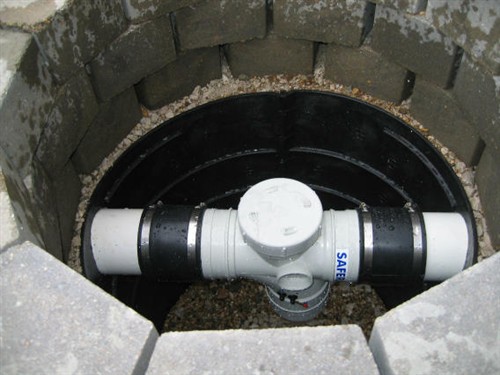 |
|
|
|
|
ICFHybrid

Veteran Member
Posts:3039
|
| 11 Oct 2011 01:47 AM |
|
Clark, that looks and sounds like a quality system you put together there. What kind of filtration or diversion do you have above ground? Is that in ground diverter the only filtering component you have? Are you going to have the pump in or out of the cistern? How did you handle the downspout to pipe connections where they meet the ground? |
|
|
|
|
Clark
Basic Member
Posts:248
|
| 11 Oct 2011 09:32 AM |
|
Posted By ICFHybrid on 11 Oct 2011 01:47 AM
Clark, that looks and sounds like a quality system you put together there. What kind of filtration or diversion do you have above ground? Is that in ground diverter the only filtering component you have? Are you going to have the pump in or out of the cistern? How did you handle the downspout to pipe connections where they meet the ground? At present, there is no filtration above ground because there's no danger of leaves getting into the system. Eventually, I will install leaf guards on all the gutters. So, yes the underground diverter is the only means for filtering the water of dirt, bird poop, and sand from the shingles. I expect to clean the cistern from time to time to remove other sediment that builds up. Since I don't plan to use the rainwater for household use, only landscape watering, I'm not too concerned about water quality. Since the cistern is below grade, it fills by gravity flow. I will install a submerged pump to push the water through my lawn and garden irrigation system if and when I decide to invest further. The 4" rectangular downspouts connect to the 4" PVC piping with an adapter coupling. The fit is loose, however, so that in a torrential downpour, water will spill out at ground level, not over the tops of the gutters. The picture shows a section of piping and the downspout connection.  |
|
|
|
|
ICFHybrid
Veteran Member
Posts:3039
|
| 11 Oct 2011 07:56 PM |
|
Hey, thanx for the nice pic! The fit is loose, however, so that in a torrential downpour, water will spill out at ground level Do you mean that you expect the 4" PVC runs might be over capacity in a big rain event? Your cistern has an overflow outlet, doesn't it? Have you thought about using the rainwater inside to fill toilets and washing machine, or would that entail too much plumbing retrofit? |
|
|
|
|
Clark
Basic Member
Posts:248
|
| 12 Oct 2011 12:08 AM |
|
There have been some heavy rains that caused the water to escape at the downspout connection to the underground drain pipes. I guess you would classify it as an "open system".
Yes, there is an overflow outlet at the tank which directs excess water onto the lawn at the rear of the property. Presently, the tank inlet is connected back to the outlet so that no water is captured in the tank.
I never intended to use the rainwater for inside plumbing fixtures. It could still be done, however. My water distribution system is all 1/2" PEX tubing in a 'home run' configuration. That means that each fixture has a separate supply line for hot and/or cold water leading from one of two manifolds in the utility room (see pictures). Rerouting the toilet lines (for example) to the cistern water source would be straight forward.
 
|
|
|
|
|
ICFHybrid
Veteran Member
Posts:3039
|
| 12 Oct 2011 01:12 AM |
|
My water distribution system is all 1/2" PEX tubing in a 'home run' configuration. Oh, yeah. Very nice. That's darn near perfect for putting the rainwater to various fixtures. I'm going to set mine up just like a well with a shallow well pump and a pressure tank so it doesn't run all the time. I've been calculating for more than a year and it's true that about 1/3 to 1/2 of your water use goes into toilets and washing machine. |
|
|
|
|
Clark
Basic Member
Posts:248
|
| 12 Oct 2011 10:12 AM |
|
I hear you. Your plan makes a lot of sense. In my case, however, the city charges each household a minimum amount which buys 50 gallons of water a day on average. With water saving dual-flush toilets, a front loading washing machine, water saver showerheads, and only the two of us, we rarely exceed that usage except in the summer months. Unlike cellphone minutes, the water credits do not roll over from one billing period to the next. Still, having another source of water in case of a disruption to city water service would be nice. Keep us informed of your progress. |
|
|
|
|
Springtime
New Member
Posts:23
|
| 20 Oct 2011 02:34 PM |
|
Ive built two simple ones for about 500$ including my time for labor.
Sounds like your diverter was the only filtration on your systems. Did you ever get a chance to look at what kind of sediment the tanks had accumulated? Sediment and debris seems to vary widely with mine as well. Algae growth has been the bigger problem as the tanks are above ground and white, although well shaded by a maple. Its still not too big of a deal since its used for the garden and house plants only. I rinsed it out with a garden hose this season after 3 years of use. I do have it attached to a drip irrigation system and its inline filter needs to be cleaned every three weeks or so. The 6000$ bid I received from a rainwater contractor included no diverters or pre-tank filters. He says that his other similarly installed systems have still not needed cleaning in four years. A below ground tank would be cleaned with a sump type pump as needed. |
|
|
|
|
Clark
Basic Member
Posts:248
|
| 20 Oct 2011 03:15 PM |
|
I've just finished installing gutter guards to filter out junk that is carried off the roof into the rainwater collection drain pipes. Products like Gutter Glove or Clean Mesh are very effective at filtering rainwater runoff from the roof. Both products incorporate a fine, stainless steel mesh over an aluminum perforated plate that installs over the gutter. The mesh is fine enough to keep even roof aggregate from entering the system. I purchased the Clean Mesh product and tested it before installing it on all the gutters (DIY). Only when excessive amounts of water were dumped on my 9-12 sloped roof did I observe any water overflowing the face of the gutter. The screens also appear to be self cleaning. I paid $1.66 a foot for the Clean Mesh on sale at Menards home center. With my SafeRain first flush diverter, I think this is all the filtering I'll need to keep my cistern relatively clean. Clark |
|
|
|
|
bpnkrtn
New Member
Posts:60
|
| 24 Oct 2011 01:16 PM |
|
I just saw/read this. Thought it might be of interest to the folks who have participated in this thread. "The American Society of Landscape Architects recently released a comprehensive handbook of 479 case studies of successful “green rainwater infrastructure” projects." ..... http://www.smartplanet.com/blog/design-architecture/asla-releases-database-of-8220green-rainwater-8221-projects/1345?tag=nl.e660 |
|
|
|
|
jonr

Senior Member
Posts:5341
|
| 24 Oct 2011 04:06 PM |
|
Those policies give a whole new meaning to "keep your head down and your mouth shut". You might accidently steal someone's water. |
|
|
|
|
calvinml
New Member
Posts:7
|
| 28 Oct 2011 09:05 AM |
|
Tank -- Not necessarily. We are considering this company http://www.aquabank.net/ Basically they create an aquifer-- could be under your driveway or slab or simply in your backyard. Makes sense to me usually the underground tank is the most expensive part of the system. According to their webstie the cost for an above ground storage tank normally runs $2.50 to $3 per gallon for systems of 500 to 1,500 gallons. For underground storage, costs escalate to about $4 - $5 per gallon. Aquabank’s underground installed structural storage cost is between $1.25 -$2.00 per gallon. I would love to get feedback from anyone who has installed such a system. |
|
|
|
|
jonr
Senior Member
Posts:5341
|
| 28 Oct 2011 09:28 AM |
|
I see $.50 per gallon for above ground:
http://www.northerntool.com/shop/tools/product_200323189_200323189?cm_mmc=Google-pla-_-Grounds%20Maintenance-_-Sprayers-_-282720&ci_sku=282720&ci_gpa=pla&ci_kw={keyword}
|
|
|
|
|
bpnkrtn
New Member
Posts:60
|
| 28 Oct 2011 09:39 AM |
|
Posted By jonr on 28 Oct 2011 09:28 AM
I see $.50 per gallon for above ground:
http://www.northerntool.com/shop/tools/product_200323189_200323189?cm_mmc=Google-pla-_-Grounds%20Maintenance-_-Sprayers-_-282720&ci_sku=282720&ci_gpa=pla&ci_kw={keyword}
This price is more in line with what I see at Tractor Supply for opaque or black fiberglass tanks. They have quite a range of tanks, both in terms of capacity and dimensions (height and diameter.) This is not to say that I didn't find the 'Aquabank' site very interesting. |
|
|
|
|
calvinml
New Member
Posts:7
|
| 28 Oct 2011 09:56 AM |
|
I see $.50 per gallon for above ground: ....
That's the price for the tank-- The $1.50- $2.00 is a completely installed system. Gutters, diverters, filters & pipes. |
|
|
|
|
bpnkrtn
New Member
Posts:60
|
| 28 Oct 2011 10:14 AM |
|
Posted By calvinml on 28 Oct 2011 09:56 AM
I see $.50 per gallon for above ground: ....
That's the price for the tank-- The $1.50- $2.00 is a completely installed system. Gutters, diverters, filters & pipes.
Oops ... I missed that ... thanks for the information! All very interesting to me. |
|
|
|
|
Clark
Basic Member
Posts:248
|
| 18 Nov 2011 09:07 PM |
|
When I planned and built my house recently, I anticipated the possibility of a rainwater harvesting system for lawn and garden irrigation. It was fairly easy at that time to incorporate a water storage tank within the ICF foundation walls supporting the back porch. Typically, this space, which measures 15' x 6', is filled with earth prior to pouring a concrete slab for the porch floor. It was not difficult or costly to construct a form to support the floor with an access opening to a future cistern with inlet and overflow for storing rainwater collected from the roof. To create a usable cistern with a capacity of 3500 gallons, I have only to pour a concrete floor, seal the interior against leakage (using a product like Ames Research's Blue Max), and install the needed plumbing. The total cost of the tank (3500 gallons capacity) amounts to about $600 or $0.17 per gallon. The cost of the buried 4" Schedule 40 PVC drain pipes and SafeRain first flush diverter came to about $700. I expect to spend an additional $700 for a pump, bladder tank and piping to supply the irrigation system. The total out-of-pocket cost will total approximately $2000, or $0.57 per gallon. The payback is estimated at 14 years based on the current city water rates. The justification on an economic basis is poor, even at these lower DIY costs. Fun project though. |
|
|
|
|
WindowsonWashington
New Member
Posts:96

|
| 20 Nov 2011 08:56 PM |
|
Very cool system. |
|
| The difference is clear |
|
|