Posted By Boontucky-girl on 10/28/2009 10:49 AM
Thanks for the reply Dana1.
What would be considered good shading on the south facing windows? We have 2 ft overhangs all around our house (except gables), and our south windows face SE and SW. On the SE ones we have four 50 ft tall oak trees about 50 ft away from the house, that do give quite a bit of shading, but I can't remember what % of the day the shade actually falls on the house.
This past summer, our eaves were open since we don't have most of the soffit and no ceiling installed, and in the basement (ICF) those few days we had that were really humid and hot it was nice and "cool" down there. It was the upstairs (2x6, no insulation) that felt stuffy, but not really hot. So what you said really makes sense.
So depending on the cooling loads, if our sensible load is small, we might be able to get away without an A/C unit and just have an HRV and something to deal with the humidity. Or do I still need to have some sort of A/C unit in the setup?
About the HRV, how do you decide if it is an HRV or ERV what we need to look into?
So we might be lucky enough that we wouldn't really need AC, and we should focus on ventilation and dehumidifying the house? That would be sweet.
Seasonal exterior shades are best (got any large deciduous trees to plant? :-) ) The 2' over hangs are good, but if they don't shade all of the S-facing glazing for most of the middle of the day in July you'll still be getting significant solar gain when you want it the least. (I have 2' overhangs, and they shade my kitchen windows optimally, but living room, not so much.) Getting it to fully shade the very bottom of the windows usually requires a bit more.
Some people build vine trellises, grape arbors, etc for semi-automatic seasonal shading, others use exterior roll down shades:
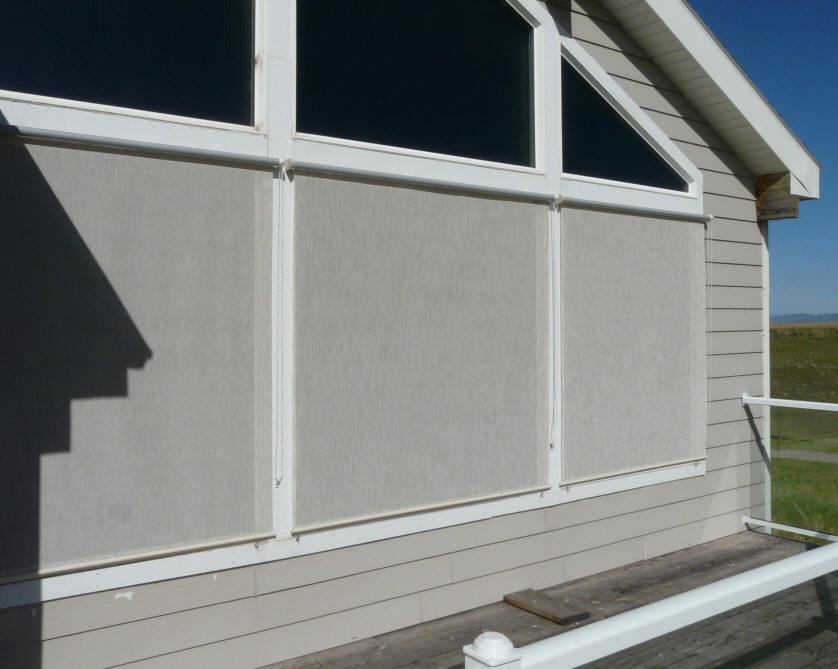
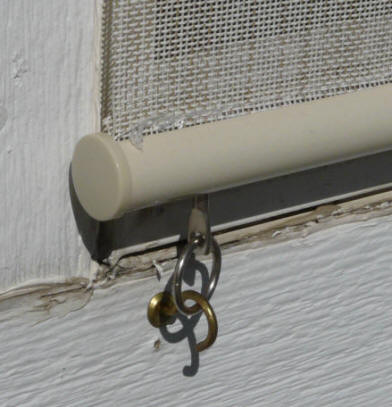
ERVs have slowly rotating dessicant wheels to exchange humidity between
the incoming & outgoing flows. HRVs have heat-exchangers only. ERV will lower the load on your dehumidifier in summer, but will make it more humid in winter. In very tight houses in IA it's rare that you'd ever drop below 30% RH in winter anyway, so HRV may be a better choice- depends on just how tight the house REALLY is. (Using humidity sensing control you can have it automatically slow the ventilation rate if the humidity drops too much in winter. Or you can adjust duty-cycles as-needed.) At only ~1000 annual cooling degree-days in a moderately humid environment you're somewhat on the edge of ERV vs. HRV- there's no clearly "right" answer. But either way, get the smallest one that meets the ventilation requirements, and one with high efficiency motors. ERV/HRVs are a constant background load to the power grid, and they're not all created equal.
A small window AC unit may be a good fallback position. If solar gains are well controlled and it's a well insulated tight place, your average temps are not super hot in any given month, but they can soar for any given week in the summer. If you do go central AC, undersizing it and running it with both temperature & dehumidistat control will optimize efficiency & comfort. (I suspect a 2 ton unit would be overkill here, 1-ton is about as low as central AC goes, and even that might be too big.) It's fine if it doesn't keep up with the sensible load, since it probably won't break 85F on the worst day, and with a 100% duty cycle the RH will be well under 40% when it does.
Whether whole-house dehumidifer or central AC, if you have dust-mite allergies setting the dehumidistat to 50%RH is good, otherwise 60% is comfortable enough up to ~78-80F, and sufficient to mitigate mold hazard.