mmacgowa

Basic Member

Posts:166
 |
| 18 Aug 2007 05:38 PM |
|
For those of us out in the sticks, it would sure be nice to have someone invent a poor man's crane. I invision a cable reinforced mast that might fit into a trailer hitch that could be attached to pickups parked at the four corners of a site. A master control of four winches or a couple winches wound with opposite leads could be used like a bridge crane to manipulate panels into place. Perhaps this is a pipe dream but with a jumbo panel only weighing 1000 lbs and a pickup weighing thousands of pounds the numbers should probably work.
Any innovative contractors out there with a welder? |
|
|
|
|
|
|
Dick Mills
Basic Member
Posts:217
|
| 19 Aug 2007 12:55 AM |
|
mmacgowa,
When you lift 1000# straight up, then a 5,000# truck can probably handle it, unless you are in a high wind. But if you have a boom and are moving the load in any direction out away from the truck, then the weight of the load gets amplified significantly - which is why cranes are expensive. An alternative would be something like a moving scissor lift where you load the panel onto it, and then manover it so that it is adjacent to the location where the panel needs to go, and then use the scissor lift to raise it up. You would probably want to raise the panel using straps at the top and probably swinging from one pivot point so that the bottom could be leveled up and lowered into place easily.
Another idea is to look at used cranes. http://www.cranenetwork.com/search/reduced_price_results.asp
Dick Mills
|
|
|
|
|
mmacgowa
Basic Member
Posts:166
|
| 19 Aug 2007 08:33 AM |
|
A crane or scissor would be nice, but I was thinking more of anchoring four corners and having the lift act more like a bridge crane. The issue would be stress on the end of the mast rather then on the overturn on the center of gravity of a boom. If a panel is 800# then the weight at the top of the mast would be less then 800 lbs as the remaining masts would be used to put tension n the panel to keep it in the air.
Here is a 2d pic of what I am suggesting. http://www.ezbuildus.com/images/crane.jpg
I am guessing you could get each mast made for less then $1000 so you would only have $4000 in the whole project with a radio controller that could operate the four masts in concert. Perhaps it could even be made to reach high enough to lift trusses. |
|
|
|
|
chrisgorde

New Member
Posts:20
|
| 19 Aug 2007 12:22 PM |
|
This option worked for us, re: the placement of our roof panels. We have a 1728 sq ft, 1 storey, ranch style home with a full, walk-out basement. We were first time homebuilders that had YEARS of remodeling experience and had the benefit of a semi-retired brother-in-law who was a home building subject matter expert but this was his first SIPS home project. It took us approx. 3 1/2 days to set the roof and our crew numbers ranged from 2-4 people at different times. We moved our roof panels from our staging area to the house using a flat bed truck, moved them on a furniture dolly and PVC stick rollers to an area on the floor where we installed the lifting plates (provided by FISCHER SIPS out of Louisville, KY), attached thin rachet straps from the plates to around the lifting arms of two DUCT LIFTS (sp?). A duct lift is basically a hand cranked forklift and is available at most equipment rental centers. We positioned a duct lift at either end of our 20' roof panels and raised the panel on an angle (the end in the middle of the house that attached to the ridge beam was raised higher than the wall end). Once we cleared the wall end, we shifted the two duct lifts towards the wall, in order to clear the ridge beam, raised the lifts and then shifted back towards the beam for final positioning. We seated the panels with a few "love taps" via a 12# sledge and/or used two ratchet straps on the roof, secured to temporary "eye bolts" secured to adjacent 2x splines. The last two panels were tricky to place. We pre-positioned the last two panels on the 4:12 roof (held in place by 2x4's). We installed temporary gable supports since our 48" wide panels were positioned as such to leave 24" overhanging the gables. We slide the panels off of the 2x4's towards the gables and, in order to keep them from sliding down, we used a come-along at the ridge. And, as before, the panels were slide back snuggly against the adjacent roof panel with two ratchet straps. In case you're wondering how we placed our ridge beam, read on. We installed a 48' laminated beam with the same duct lifts! Since we have 1 storey ranch style home so this made it SO much easier to position, assemble and lift the beam in place. This phase of construction was by far the most dangerous and stressful. Once the beam was ready, we positioned a duct lift at either end with the lifts OPPOSITE of one another! In other words, one set of forks was facing North and the facing South. The side stablizer outrigger arms were also deployed. The length of the beam dictated that we had to begin the lift at the NW and SE corners. Once we cleared the 8' walls, we SLOWLY rotated the beam on a WEST- EAST axis, simultaneoulsy lifting the beam to "walk up" the gable end walls. We have 14' gable end panels and had to raise the 16" wide ridge beam approx. 16' in order to line it up and then lower it into the gable pockets. In the final analysis, if we would've used a crane, we would've paid an operator at least $4000. The lifts cost us $400 for the week that we had them on site. If you want to see a few pictures, my email address is [email protected] My 2 cents worth. C.G. |
|
|
|
|
JohnCujie
New Member
Posts:30
|
| 19 Aug 2007 06:29 PM |
|
They are called Genie Lifts.
|
|
|
|
|
Dick Mills
Basic Member
Posts:217
|
| 19 Aug 2007 06:57 PM |
|
John,
Does Genie make a lift specifically for SIPs?
Used scissor lifts are relatively inexpensive, even the rugged terrain models. They all seem to be for 15' to 60' of lift though. For SIPs lifting, a considerably lower lift might be more appropriate.
I would think that a scissor lift company like Genie would be able to see the potential in a model that only lifts maybe 10 feet max, but that has a longer platform, and has some SIPs friendly lifting / uprighting / manovering capabilities off of the long axis (axese) of the platform.
Dick Mills |
|
|
|
|
mmacgowa
Basic Member
Posts:166
|
| 20 Aug 2007 05:21 PM |
|
The Genie looks pretty cool, but is more of a solution to a different problem. What I am suggesting would consist of four pillars set to the outside of the property so that the panels could be suspended inside the perimeter like a bridge crane. This way you would solve the problem of unloading the panels and placing them at the right location as well as the hoisting solution offered by the genie. |
|
|
|
|
cmkavala

Veteran Member
Posts:4327

|
|
mmacgowa
Basic Member
Posts:166
|
| 20 Aug 2007 08:30 PM |
|
Chris,
Do you have his name to get some specs? That looks like what I was thinking about. I was thinking 4 to have more flexibility in moving the wall panels, but this looks like the cat's meow. I didn't think it would take much. |
|
|
|
|
Dick Mills
Basic Member
Posts:217
|
| 20 Aug 2007 09:15 PM |
|
Chris,
That's pretty cool! I love enginuity. You could probably mount a mast of some sort on each of two trucks, and use the weight of the trucks to stabilize it.
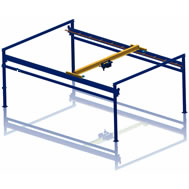
Mmacgowa, is this the kind of bridge crane that you are talking about? And you are just looking for a means of offloading the panels from a flat-bed?
Dick Mills |
|
|
|
|
mmacgowa
Basic Member
Posts:166
|
| 21 Aug 2007 08:34 AM |
|
Dick, My idea is exactly like the picture of the 2 mast system in Chris' post but using 4 masts like that in your post. Presume a rectangular flat lot (ok that is saying a lot). Now you can off load the panels by parking a trailer in the front yard or garage. In my situation, I would park a trailer and then lift the panels one at a time into place. If you have a common carrier, perhaps the masts could first be assembled over the parking area so that a bigger load could be off loaded. Then with the masts at each corner of the house and presuming the panels are somewhere inside the perimeter you could postition the cable line ie bridge above a panel and then position it anywhere within the perimeter of the house. Here is a rude pic of what I envision:  |
|
|
|
|
mmacgowa
Basic Member
Posts:166
|
| 21 Aug 2007 08:42 AM |
|
It would probably work better to fasten to the panel at each end. Each mast would have a winch. Preferably a remote control would have a joystick controlling n/s/e/w. With 22' masts you could probably build most any two story house if using trusses and attaching the trusses from each end. A two story house with a panel roof would probably still require a crane. |
|
|
|
|
cmkavala
Veteran Member
Posts:4327
|
| 21 Aug 2007 03:55 PM |
|
I thought it was cool too!, check out this next attachment. since the steel sips were relatively smooth he devised a vacuum pad to lift it with in the center leaving edges expose to be able to snap together |
 Attachment: File0034.pdf Attachment: File0034.pdf
|
| Chris Kavala<br>[email protected]<br>1-877-321-SIPS<br /> |
|
|
Dick Mills
Basic Member
Posts:217
|
| 21 Aug 2007 04:59 PM |
|
Chris,
That is cool too! You can actually get vacuum lift pads that don't require a vacuum pump. They have a skirt at the bottom that colapses when it lands on the target, and then as it is lifting away, the weight of the target pulls the vacuum. Then to drop the load, you just need a valve to allow air into the skirt.
Dick |
|
|
|
|
Dick Mills
Basic Member
Posts:217
|
| 21 Aug 2007 09:33 PM |
|
Talk about cool!
Have you guys seen this? A USC professor has developed a method for robotically erecting a concrete structure. He uses a large gantry crane with 3 axes to move a robotic cement placement device which builds up layers of concrete in successive passes where each pass lays down 3 to 4 inches of concrete. Only works with concrete using what they refer to as a contour-crafting technique, but the entire process is computerized.
All of this talk about cranes made me remember this. It seems to me that a crane like this one would be a great way of manuvering SIPs off of trucks, and into place.

A model of a structure Behrokh Khoshnevis thinks his mechanized construction process will be capable of building. (Courtesy of Contour Crafting)
http://www.cbsnews.com/stories/2007/02/16/business/realestate/main2487598.shtml
Dick Mills
|
|
|
|
|
aziansenzation
New Member
Posts:8
|
| 21 Aug 2007 11:18 PM |
|
You can use 1 or 2 1/2ton (or less??) manual automobile engine lifts (hand pulley type) mounted on an overhanging truss. In fact it may come with a small metal truss..That's simple and cheap. You can probably get that from (insert favourite large auto supply chain here)..use your library card.. good ol' V*sa or Am*rican *xpress |
|
|
|
|
mmacgowa
Basic Member
Posts:166
|
| 22 Aug 2007 06:58 AM |
|
The auto house is cool. They could probably adapt it to accomodate for adding foam. Eliminating labor would be awesome as well. We had a guy to a timberframe/SIP/stick hybrid. The framer brought in a portable bridge crane. It had to be moved with large equipment so wasn't practical for anything but large customs, but it was quiet as it ran on electric and he worked by himself because all the lifting could be done with a remote control. He said that when he was working on the roof, he didn't even use his nail bags any longer! |
|
|
|
|
Kevin_in_Denver
New Member
Posts:28
|
| 31 Aug 2007 06:57 PM |
|
Check into "Ladder Hoists". Someone sells a kit for under $500
|
|
| Passive Solar House, built 2004, ongoing solar thermal experiments |
|
|