|
|
|
Radiant extreme design for low BTU load
|
Sort:
|
|
 Prev Next Prev Next |
You are not authorized to post a reply. |
|
Unretarded

New Member

Posts:16
 |
| 08 Jul 2019 11:11 AM |
|
See post 4 for non wall of text version, same as this post, just easier to read...…...
Hello all, my name is Shawn.
I am in the design process of my own personal house. I did carpentry/construction/remodeling for many years and now have the opportunity to redo my own farm house from scratch/remodel.
I have read, mostly good material, and shoved all the information in my head I can. It is now time to talk to people and figure out what is the best practices for this project.
Goals are reduce monthly operating costs as much as possible while staying in a very frugal budget. Advanced DIY friendly , low initial costs, user friendly, highly efficient.
I can or will provide any details as needed, will be here for the duration of the project, most likely a few years and not be just in the radiant forum section.
I plan to do pictures, possibly some youtube exposure ,so time will not be wasted in helping me as decisions, progress, updates and closure will happen.
Hopefully this will add value for me to contribute as a member as much as I receive and help further to main stream adoption of green building practices and hydronics.
Some helpful information/outline of goals for those helping me...…..this project is about performance, looks are a very low priority, they will come into play, but nothing is set in stone and performance will always come before looks on this project.
I am not fixated on any materials, while I do like looks,..... performance, value per dollar and operating costs are the goal.
This is a existing approx. 30x30 raised stone foundation structure of 1.5 story design. 1380 total square feet with approx. 480 of that the second story.
As many understand, smaller super insulated low BTU load housing is not the norm, so most calculators such as Manual J and equipment is grossly over sized for such housing.
Maxing out the manual J to the most efficient options is fairly easy when doing a super insulated/sealed/passive style house. Having said that, my BTU load is approx. 11000 BTUh for the coldest day.
While I will have supplemental heat with a small wood burner and a large home entertainment center, I would like to disregard those as contributing to the BTU`s and look at them as a real world bonus when they lower my load, rather than rely on them for heat load additions.
I would like in floor radiant, sealed loop, electric fired, zoned pex ,......but that's not set in stone if other alternatives save money in operating costs and equipment costs.
I would like some ideas from everyone on what they might do in a blank slate situation like this as I am not fixated on any other criteria than lowering monthly bills and upfront costs with comfort included and a eventual shift end goal towards passive house standards.
While I am outside of any zoning building inspection areas and can do whatever, I will not entertain unsafe ideas as one of the other goals outside of this radiant is extremely high safety standards. I do not mind deviating outside of some codes if they do not pose risks to safety. But this will be mostly code compliant.
This is very rural with the only grid source being electricity, it does/will have on site propane, but I can not generate propane myself . viable renewable options are solar and wind.
I prefer no storage at this time and plan to use the grid as storage by spinning the meter backwards to zero out the bill at some point, just not initially.
I appreciate any help advice and most of all want to have fun with this project and go outside of the box with it, while still not making it a frankenstien that requires a masters degree to use and operate...…
,...…..feel free to run wild with the suggestions keeping in mind, monthly operating costs and my frugal self imposed up front costs restrictions.
I am a happy medium type person who will push it to extremes if it makes sense and sometimes even if it does not if it makes a better end outcome, I will also reduce/cut corners if it does not hurt or create safety concerns.
Thanks !
PS.... sorry for the long read, but a minimal amount of details are required to give viable input and not waste every ones time.
EDIT:
OH NO, it turned my well spaced paragraphs into a wall of text |
|
|
|
|
|
|
newbostonconst

Advanced Member
Posts:778
|
| 08 Jul 2019 05:49 PM |
|
Use Chrome next time for the paragraph spacing problem. You can also see how to add carriage returns by quoting someone else's text and adding the <.br /.> to your paragraph.
You seem like you are on your way to figuring out what you want. I think if is easier if you ask certain questions and get reply to them.
People will want to know where you are building to be able to help you. |
|
| "Never argue with an idiot. They will only bring you down to their level and beat you with experience." George Carlins |
|
|
Unretarded
New Member
Posts:16
|
| 08 Jul 2019 09:26 PM |
|
Thanks,.....zip is 67574
Basically, for this section of the forum, I want to heat as cheap as possible with the lowest up front costs...…...radiant, VRF,geo,.....no set fixations.....
From my minimal calculations based on my load, it seems radiant might be the cheapest operational wise, with a high comfort level and minimal equipment costs.
But that is why I am seeking help on here, I am smart enough to know I can never know it all. |
|
|
|
|
Unretarded
New Member
Posts:16
|
| 08 Jul 2019 09:27 PM |
|
Hello all, my name is Shawn.
I am in the design process of my own personal house. I did carpentry/construction/remodeling for many years and now have the opportunity to redo my own farm house from scratch/remodel.
I have read, mostly good material, and shoved all the information in my head I can. It is now time to talk to people and figure out what is the best practices for this project.
Goals are reduce monthly operating costs as much as possible while staying in a very frugal budget. Advanced DIY friendly , low initial costs, user friendly, highly efficient.
I can or will provide any details as needed, will be here for the duration of the project, most likely a few years and not be just in the radiant forum section.
I plan to do pictures, possibly some youtube exposure ,so time will not be wasted in helping me as decisions, progress, updates and closure will happen.
Hopefully this will add value for me to contribute as a member as much as I receive and help further to main stream adoption of green building practices and hydronics.
Some helpful information/outline of goals for those helping me...…..this project is about performance, looks are a very low priority, they will come into play, but nothing is set in stone and performance will always come before looks on this project.
I am not fixated on any materials, while I do like looks,..... performance, value per dollar and operating costs are the goal.
This is a existing approx. 30x30 raised stone foundation structure of 1.5 story design. 1380 total square feet with approx. 480 of that the second story.
As many understand, smaller super insulated low BTU load housing is not the norm, so most calculators such as Manual J and equipment is grossly over sized for such housing.
Maxing out the manual J to the most efficient options is fairly easy when doing a super insulated/sealed/passive style house. Having said that, my BTU load is approx. 11000 BTUh for the coldest day.
While I will have supplemental heat with a small wood burner and a large home entertainment center, I would like to disregard those as contributing to the BTU`s and look at them as a real world bonus when they lower my load, rather than rely on them for heat load additions.
I would like in floor radiant, sealed loop, electric fired, zoned pex ,......but that's not set in stone if other alternatives save money in operating costs and equipment costs.
I would like some ideas from everyone on what they might do in a blank slate situation like this as I am not fixated on any other criteria than lowering monthly bills and upfront costs with comfort included and a eventual shift end goal towards passive house standards.
While I am outside of any zoning building inspection areas and can do whatever, I will not entertain unsafe ideas as one of the other goals outside of this radiant is extremely high safety standards. I do not mind deviating outside of some codes if they do not pose risks to safety. But this will be mostly code compliant.
This is very rural with the only grid source being electricity, it does/will have on site propane, but I can not generate propane myself . viable renewable options are solar and wind.
I prefer no storage at this time and plan to use the grid as storage by spinning the meter backwards to zero out the bill at some point, just not initially.
I appreciate any help advice and most of all want to have fun with this project and go outside of the box with it, while still not making it a frankenstien that requires a masters degree to use and operate...…
,...…..feel free to run wild with the suggestions keeping in mind, monthly operating costs and my frugal self imposed up front costs restrictions.
I am a happy medium type person who will push it to extremes if it makes sense and sometimes even if it does not if it makes a better end outcome, I will also reduce/cut corners if it does not hurt or create safety concerns.
Thanks !
PS.... sorry for the long read, but a minimal amount of details are required to give viable input and not waste every ones time.
EDIT:
OH NO, it turned my well spaced paragraphs into a wall of text |
|
|
|
|
Unretarded
New Member
Posts:16
|
| 10 Jul 2019 03:44 AM |
|
Maybe this will spur more activity...…
I plan on a electric tankless like this....https://www.homedepot.com/p/EcoSmart-11-kW-Self-Modulating-Electric-Tankless-Water-Heater-ECO-11/203316215
3/8ths pex, approx. 1200 feet, 4 zones with a 6 zone manifold, one of the large areas will need 2 zones/circuts due to run length.
I plan to lay it on top of the subfloor, cut some 5/8ths osb to do the fill in, grout it level, then lay tile on top.
Based on my load max of 11k btuh, a planned temp of 90 degrees water, a delta of approx. 20...……..that leaves 1660 BTU or 500 watts to raise approx. 10 gallons from 70 to 90 to maintain 90 degree water temp...,...should be considerably less than 1k in materials , operate at .5 kwh while running based on running non stop, plus the pump should fall in the 2 buck a day costs to operate range, that's the coldest day of the year load and I seriously doubt it will run 24/7...…. I can live with a 60 buck heat bill per month.
I would do propane and might to compare as it pencils out much cheaper.....at 40k btu per day , that's under a half gallon or about 80 cents where this is located a day. Keep in mind this is based on the coldest day a year, when its not 0 outside, it will be considerably cheaper to run.
This also does not factor in, body heat, cooking or the large entertainment system I have going most of the day...…...I am a home theater enthusiast, so a projector and rack of audio equipment which probably puts out 1660 BTUh…….
A sealed system with the tankless at 200 bucks, switching it between electric and propane will not be hard and it will be cheap and easy...…...I plan a second one for the household hot water anyway...…
Not much to go wrong or maintain with the piping below a ceramic tile floor, the only connections are at the manifold which I plan on installing a pan under with a drain in case of leaks ,...…...it should be a pretty bulletproof system with easy installion, low up front costs and the ability to be run from solar and on propane it could be a 32 buck a month bill in the dead of winter, with it being sealed with antifreeze and distilled water, it should be about 0 worries.
Above the cheap equipment costs and minimal maintenance , it should make for a very comfortable building with toasty floors and some heated towels and warm shoes...……
Now shoot it down and pick it apart, so we can build it back up in any weak areas...……
Thanks. |
|
|
|
|
ChrisJ

Basic Member
Posts:277
|
| 10 Jul 2019 12:40 PM |
|
A $200 DHW tankless will probably not last very long using it for radiant heat. Should use an electric boiler.
In a super insulated house the floors will not be "toasty". They will be room temp. |
|
|
|
|
Unretarded
New Member
Posts:16
|
| 14 Jul 2019 06:04 AM |
|
I never thought about floor temps, you could be right.
Calculated load at 20 degree delta with a input temp of 90 and return of 70 degrees calculates to 1660 BTU or right at .5 kwh when running at operating temp...…..11000 btu load on the coldest day 1%, so normally it will be way under those requirements. I might have to adjust that temp much lower for the super insulation,...just not much info on these types of homes.
I know when I ran the numbers using a 50 gallon water heater I was way way below the average daily usage for a normal house which was 80 gallons of hot water a day, so the duty cycle for radiant in my application is super low. In my usage scenario it is about 10 gallons of hot water a day personal,......I am guessing as best as I can calculate a instant on will see about 50% less duty as a radiant unit than for domestic usage. I just can`t see where I need the duty cycle and cost of a boiler,......now if I was exceeding the published duty cycle of a tankless with the radiant, then yes, it would make sense to get a boiler.
But with standard tank or tankless, I am below 50% of the average duty cycle in radiant for a super insulated house.
That's becoming a problem is finding equipment that is rated very low output,...……..even the smallest heater/ central air unit will short cycle like crazy in my anticipated loads .
I am starting to see normal sized houses, approx. 1500 square feet, in the 3 bedroom 2 bath category and super insulated are very rare...….I had one guy want to put a 3 ton unit in the 1.5 story place and when I tried to reason with him, he called it crazy, I showed him the manual J calcs and had him check them and he concluded they we very close and indeed it looked like 6000 btu cooling on a max day 1% event was indeed the load.
So on the worst case day of the year its 6000 btu cooling, most times it will be half of that ……...the smallest tiny cheap window unit is 5000 btu…...lol, rated at 150 square feet, I am almost 10 times that sizing.
Same with the heating,...radiant seemed like the easiest way to fine tune such a low btu load...…..
If it was easy, everyone would be doing it......lol,...it is easy, kinda…... |
|
|
|
|
sailawayrb

Veteran Member
Posts:2283

|
| 14 Jul 2019 03:23 PM |
|
ACCA Manual J is typically about 20% overly conservative if done well. Usually way more if done by a typical HVAC company. However, as you are learning, your problem won’t be the Manual J. Your problem will be finding a small heat source for your low load energy efficient building. You will need to use a heat source that modulates well below its maximum heat output. NextGen electric boilers use to be a good option for plug and play hydronic radiant heated floors in energy efficient homes, but it is becoming increasingly harder to source the smaller 4 and 6kW models. I am not sure where you are located, but you may be able to use a whole house fan in lieu of AC, especially if you do a passive solar cooled/heated building design. If you are not familiar with this, perhaps check out the info and calculators on our website. |
|
| Borst Engineering & Construction LLC - Competence, Integrity and Professionalism are integral to all that we do! |
|
|
newbostonconst
Advanced Member
Posts:778
|
| 15 Jul 2019 01:04 PM |
|
3/8th tubing use is not recommended. Most use 1/2 inch with 200' lengths being the max. We also like to keep the tube spacing in concrete to less then 1 foot apart. This gives you 1 foot of tubing per square foot.
3/8 will require to run substantially shorter tubing runs before the water is to cold to be useful.
You also stated to put the tubing between cutup plywood. You need away to spread the heat evenly or you will have tons of warm and cold spots. A couple options are to use aluminum plates (expensive) but most of us now are putting tubing down and then laying at least 1-1/2 inches of concrete over the tubing which is by far the cheapest. There are other options.
Hope everything turns out for you. The key to get info out to this site is to ask lost of questions, just not all at once. And of coarse search. You can search this site by using google and just adding greenbuildingtalk into you search string. |
|
| "Never argue with an idiot. They will only bring you down to their level and beat you with experience." George Carlins |
|
|
thescottcav
New Member
Posts:46
|
| 22 Jul 2019 12:32 AM |
|
If you have a boiler tank and a mixing valve you can run your boiler to heat the tank and then pump out of the tank and mix the water down as low as needed. The mixing valve on my system goes down to 70F. I run 95F water to the floors and keep my boiler tank around 165. Menards sells electric boilers as small as 3kW. |
|
|
|
|
Unretarded
New Member
Posts:16
|
| 22 Jul 2019 01:05 AM |
|
Posted By newbostonconst on 15 Jul 2019 01:04 PM
3/8th tubing use is not recommended. Most use 1/2 inch with 200' lengths being the max. We also like to keep the tube spacing in concrete to less then 1 foot apart. This gives you 1 foot of tubing per square foot.
3/8 will require to run substantially shorter tubing runs before the water is to cold to be useful.
You also stated to put the tubing between cutup plywood. You need away to spread the heat evenly or you will have tons of warm and cold spots. A couple options are to use aluminum plates (expensive) but most of us now are putting tubing down and then laying at least 1-1/2 inches of concrete over the tubing which is by far the cheapest. There are other options.
Hope everything turns out for you. The key to get info out to this site is to ask lost of questions, just not all at once. And of coarse search. You can search this site by using google and just adding greenbuildingtalk into you search string.
Thanks,...lots of useful info there ! |
|
|
|
|
Unretarded
New Member
Posts:16
|
| 22 Jul 2019 01:15 AM |
|
Posted By thescottcav on 22 Jul 2019 12:32 AM
If you have a boiler tank and a mixing valve you can run your boiler to heat the tank and then pump out of the tank and mix the water down as low as needed. The mixing valve on my system goes down to 70F. I run 95F water to the floors and keep my boiler tank around 165. Menards sells electric boilers as small as 3kW.
Thanks...
I plan on using concrete ,...well actually grfc structural mortar in between the plywood strips. My plan for 3/8ths was I do not need 300 foot runs and my BTU load is soo low, 3/8ths puts out more than enough BTU in my application.
I also plan to install ceramic on top of it...…..its a 2 fold attack, by reducing the concrete needed with plywood strips it allows less structure to support the weight and the ceramic will further help radiate and give a bit more heat sink effect.
I am working in a 900 square foot total first floor, so the rooms are pretty small and the .5 story upstairs I am not even going to worry about, I will have I plan on a heat pump A/C unit up there, when people are up there,....which will probably be close to never. |
|
|
|
|
Unretarded
New Member
Posts:16
|
| 22 Jul 2019 01:18 AM |
|
Posted By sailawayrb on 14 Jul 2019 03:23 PM
ACCA Manual J is typically about 20% overly conservative if done well. Usually way more if done by a typical HVAC company. However, as you are learning, your problem won’t be the Manual J. Your problem will be finding a small heat source for your low load energy efficient building. You will need to use a heat source that modulates well below its maximum heat output. NextGen electric boilers use to be a good option for plug and play hydronic radiant heated floors in energy efficient homes, but it is becoming increasingly harder to source the smaller 4 and 6kW models. I am not sure where you are located, but you may be able to use a whole house fan in lieu of AC, especially if you do a passive solar cooled/heated building design. If you are not familiar with this, perhaps check out the info and calculators on our website.
Thanks ! I will be using that frequently.....great info! |
|
|
|
|
Unretarded
New Member
Posts:16
|
| 22 Jul 2019 01:19 AM |
|
Sorry for the mixed replies,....the quote button is at the top of the posts and I do not see well,....thought I was quoting the posts below the quotes...…. |
|
|
|
|
Unretarded
New Member
Posts:16
|
| 22 Jul 2019 01:26 AM |
|
Posted By thescottcav on 22 Jul 2019 12:32 AM
If you have a boiler tank and a mixing valve you can run your boiler to heat the tank and then pump out of the tank and mix the water down as low as needed. The mixing valve on my system goes down to 70F. I run 95F water to the floors and keep my boiler tank around 165. Menards sells electric boilers as small as 3kW.
Thanks....
I was coming to the conclusion due to my BTU load that a tank and mixing valve would be the best way, probably due a large electric tank since I want to net zero this out with solar.
Such a small load, I do not see any other way to eliminate short cycling a standard set up.
I am thinking a standard electric water heater, since at peak demand my usage will be below the standard water heater rating and usage.
Another upside is 240 4500 watt elements are almost ideal for solar already, so no modification needed......well minimal anyway. |
|
|
|
|
newbostonconst
Advanced Member
Posts:778
|
| 22 Jul 2019 11:15 AM |
|
I have used regular hot water tanks on my last two homes. They work great and are cheap. They may not last 10 years but you can easily buy two with the savings/simplicity and upgrade to the latest and greatest when they go bad. One house is 3100 sqft and the new one is almost 7000. Both are run off 70k btu water heaters. Both houses have Geo but it only used for cooling because Natural Gas is cheaper for heating.
I would still stick with the 1/2 tubing. Then you can use the excess for your plumbing. Cement slabs are self supporting(that is why bridges are concrete and not asphalt) so they actually stiffen the floor. Our new house used floor trusses and I told the guy there was going to be cement. From my pre design to what we ended up with the truss size didn't change after I told him I was using cement.
Good Luck |
|
| "Never argue with an idiot. They will only bring you down to their level and beat you with experience." George Carlins |
|
|
rcmcdee
New Member
Posts:12
|
| 04 Oct 2019 08:03 AM |
|
I would keep all wood based products out of this mix. I would substitute a tile backer board for the OSB. |
|
|
|
|
burn_your_money
New Member
Posts:8
|
| 29 Oct 2019 05:10 PM |
|
It looks like your plans are very similar to how I build my in floor heat. I have 700 ft^2 per floor and 15000 Btu/hr heat loss (due to a full basement). Here is how I installed my pex for the main floor. It's all pine. I also covered it with pine flooring.  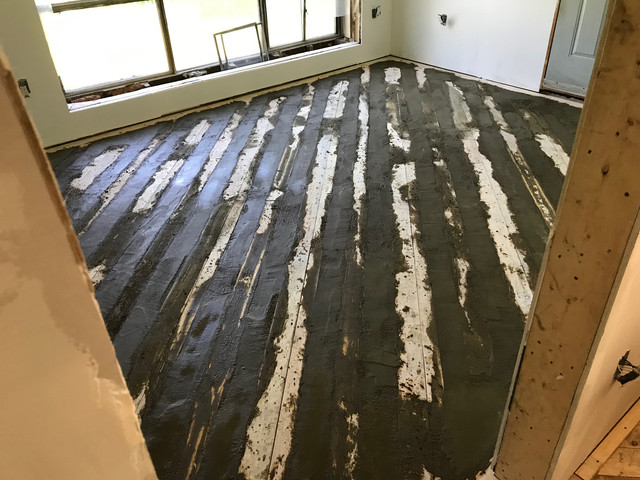  |
|
|
|
|
| You are not authorized to post a reply. |
|
Active Forums 4.1
 |
Membership: |
 |
Latest:
croccohvacusa |
 |
New Today:
0 |
 |
New Yesterday:
0 |
 |
Overall:
35027 |
 |
People Online: |
 |
Visitors:
252 |
 |
Members:
0 |
 |
Total:
252 |
|
|
|