Heating Alternative to Oil Boiler and DHW
Last Post 03 Mar 2010 09:36 PM by WoodNotOil. 10 Replies.
Printer Friendly
Sort:
PrevPrev NextNext
You are not authorized to post a reply.
Author Messages
thomassargentUser is Offline
New Member
New Member
Send Private Message
Posts:17

--
21 Jan 2010 12:14 PM
I have a turn of the century single story cottage.  There are two one bedroom apartments that have been combined/added over the years.  All three units are served by a Weil-Mclain WGO oil boiler through hot water baseboard, one zone per unit.  This boiler is approximately 10 years old and serves the domestic hot water as well (4 people total).  We currently rent the two smaller (450 sq.ft. each)  apartments and live in the larger (900 sq.ft.).  We are using approximately 1800 gallons of oil per year.  This seems steep to me.  Insulation is r-13 walls, r-30to 60 ceiling, windows are new Anderson 200's.  All three units use programmable thermostats (we keep ours at 63 if we use it when were are home, 60 during the day.  Two servicemen have called the unit, "really not a bad boiler".  In addition we added a wood stove which heats the entire larger unit from late afternoon through the evening, but have seen little difference in our oil consumption.  This is also true when tenants are away or units are vacant.  I understand that the boiler fires to stay up to temperature even when heat of hot water is not being called for, but could it really be using THAT much oil.  There is the additional problem of not being able to charge each unit for their heat use.  There are a few options that we have talked about.
1)  Invest in a separate source of DHW (be it solar or a more efficient water heater) that would allow us to shut down the boiler in the summer.
2)  Remove the boiler and invest in a separate heater for DHW and install Rinnai direct vent propane heaters in each unit (making the renters responsible for their own heat).  The units are quite open, so I believe heat distribution would not be a big issue (although obviously not comparable to that of baseboard).  When we use our wood stove it is very comfortable in all the rooms.
3)  Invest in a super-efficient boiler.  This really doesn't seem to make much sense given the long return on investment and still not solving the problem of being able separate the heat use of each unit.

I look forward to anyone's thoughts and opinions.
Thanks,
-Thomas


Eric AndersonUser is Offline
Basic Member
Basic Member
Send Private Message
Posts:441
Avatar

--
21 Jan 2010 01:23 PM

Where is the cottage located? 

Have you done anything to help air sealing?  Does it feel drafty? 

Could you have a leaking tank or line to the furnace?

 Is it a basement or slab on grade etc.  We need a few more details  to make sense of this, but is sounds like a very high heat load for 1800 ft^2 of housing especialy with suplimental wood heat in 1/2 the area. 

What is the btu rating on the boiler?

ERic

Think Energy CT, LLC Comprehensive Home Performance Energy Auditing
Dana1User is Offline
Senior Member
Senior Member
Send Private Message
Posts:6991

--
21 Jan 2010 02:34 PM
If the hot water is an embedded coil in the boiler it's efficiency is going to be a worst-case scenario due to high standby losses.  Buying an indirect-fired hot water tank will help that aspect a lot.  If the boiler is way oversized for the smallest unit (which it might be), it's likely short-cycling on that zone and losing 10-15% efficiency off the batt.  In that case, installing a "reverse-indirect" buffer to provide both the hot water and serve as a system buffer-

A: stops the short cycling and

B: lowers the standby loss. 


A crude system diagram of how that works is here:

http://www.ergomax.com/Radiant.jpg

Odds are pretty good that this topology would reduce your fuel consumption by at least 10%, but possibly by as much as 25%.  You'd set the aquastat on the tank (Ergomax, in the drawing, but it could be TurboMax or the Everhot EA series as well) to the temperature required by radiation, but not lower than 140F with an oil boiler to avoid corrosion in the flue.(and not below 125F due to domestic hot water needs.)

The high-limit on the boiler must be set at least 10-15F higher than the tank or it'll short-cycle (just setting the boiler's high limit to 180-200F is probably fine.) Most of these tanks have 180F as their highest operating (storage) limit, but lower is better (lower standby loss, lower distribution loss.)

It's not a cheap project, but if it saves 200-300gallons/year it'll make financial sense.
egouinUser is Offline
Basic Member
Basic Member
Send Private Message
Posts:126

--
21 Jan 2010 04:20 PM
Personally, I'd start with an energy audit.  Sometimes you can get them for free from the utility companies.  If not, it is likely worth the $300-$500.  Make sure they have/use an IR camera to look for insulation issues.  The IR study is most useful when there is at least a 20F temperature differential from inside to out.  A blower door test would also be useful, but I am not sure how they would handle it/charge you for 3 separate units.

Ed

http://www.GouinGreen.com<br>Superinsulated SIP/Modular House (HERS = 30)<br>GSHP w/SCW, ERV, Passive Solar, Solar HW
Dana1User is Offline
Senior Member
Senior Member
Send Private Message
Posts:6991

--
22 Jan 2010 08:59 AM
Posted By egouin on 01/21/2010 4:20 PM
Personally, I'd start with an energy audit.  Sometimes you can get them for free from the utility companies.  If not, it is likely worth the $300-$500.  Make sure they have/use an IR camera to look for insulation issues.  The IR study is most useful when there is at least a 20F temperature differential from inside to out.  A blower door test would also be useful, but I am not sure how they would handle it/charge you for 3 separate units.

Ed


Yep- while improving the efficiency of the heating system may still be worthwhile, it's highly likely that the first round of money can be better spent elsewhere.  (This was true in the retrofit upgrades at my place.)
Dana1User is Offline
Senior Member
Senior Member
Send Private Message
Posts:6991

--
22 Jan 2010 09:26 AM
...that said, you can get a LOT more out of your oil fired system by adding mass, and managing it well.  Controls that purge heat into an indirect fired water heater at the end of every burn cycle can dramatically improve system performance even on systems where the boilers are 3-4-5x oversized.  Look at the part load performance of system # 3 in this set of tests done at Brookhaven Nat'l Labs:

http://www.nora-oilheat.org/site20/uploads/FullReportBrookhavenEfficiencyTest.pdf

I believe #3 is an Energy Kinetic System 2000 boiler/indirect, but similar performance can be retrofitted onto any oil boiler with a Beckett Heat Manager (tm) or similar with an indirect HW heater for thermal mass.  By purging boiler heat from a high mass boiler at the end of every burn into a well-insulated tank, standby losses drop off a cliff, and average efficiency remains high. 

This is the opposite of using just the (much smaller) thermal mass of a hot boiler to provide hot water via an internal coil.  Look at the hot water heating efficiencys of the systems tested that had  "tankless" internal coils.)  The tankless-coil approach maximizes standby loss and short-cycles the boiler regularly when the primary load is hot water.

My home's heating system uses a low-mass gas-fired boiler without heat purging in conjunction with a reverse-indirect/buffer to deal with micro-zoning issue, which should also provide good performance. It would be curious to see how well that stacks up against the high-mass boiler heat-purging approach in the Brookhaven tests, but that wasn't a configuration they tested.  The heat abandoned in the boiler at the end of every burn in my case is a small fraction of that of a high mass boiler, and it's high limit is running ~160F with the existing radiation, but I'll be able to run it lower after ongoing modifcations to the radiation are in place, which will further reduce the amount of abandoned heat in every cycle. Since in this case it's a sealed-combustion/direct vent boiler fully within conditioned space, the heat isn't truly abandoned during the heating season, as most of it ends up in the conditioned space.  Some of it is lost in flue purges however.  During the summer the abandoned a net loss adding a small cooling load, but with less than a quart of 160F water in the boiler it's quite small number of BTUs compared to the gallons of water and 100s of lbs. of iron in a cast iron boiler.
Green_Eyed_MonsterUser is Offline
New Member
New Member
Send Private Message
Posts:3

--
03 Feb 2010 11:47 AM
Have you heard of the Intellicon HW+? It's a microprocessor-controlled, fuel-saving device for hot water (hydronic) heating systems. This unitreduces fuel consumption, wear on parts, flue emissions and electrical usage, when installed on any new or existing gas or oil burner. We have had great success providing savings for our customers with these units. We carry the entire Intellidyne product line and this is our 3rd best performing economizer.

Sounds like this product might be your solution as it utilizes a method of "outdoor-air temperature reset control," but does not require an outdoor-air temperature sensor or the need to profile the building in order to adjust the "reset" controller properly. Therefore, it determines the "heat load" by using an easily installed strap-on temperature sensor that monitors the boiler's out-flow water temperature and the rate that this temperature is changing.

Hope this helps!
Dana1User is Offline
Senior Member
Senior Member
Send Private Message
Posts:6991

--
04 Feb 2010 12:18 PM
Posted By Green_Eyed_Monster on 02/03/2010 11:47 AM
Have you heard of the Intellicon HW+? It's a microprocessor-controlled, fuel-saving device for hot water (hydronic) heating systems. This unitreduces fuel consumption, wear on parts, flue emissions and electrical usage, when installed on any new or existing gas or oil burner. We have had great success providing savings for our customers with these units. We carry the entire Intellidyne product line and this is our 3rd best performing economizer.

Sounds like this product might be your solution as it utilizes a method of "outdoor-air temperature reset control," but does not require an outdoor-air temperature sensor or the need to profile the building in order to adjust the "reset" controller properly. Therefore, it determines the "heat load" by using an easily installed strap-on temperature sensor that monitors the boiler's out-flow water temperature and the rate that this temperature is changing.

Hope this helps!

The Beckett is an Intellicon design.   Calling it's algorithms equivalent to an outdoor reset is a bit a of a stretch, but since it's a learning controller it can achieve similar economy.  Outdoor reset is a really crude model of heat load at best- it could be that the Intellicon or Beckett outperforms ODR in some situations since it's attempting to sense the heat load in real-time, remaining agnostic of the conditions that are creating that load.  10F outdoor temps on a calm sunny day is a very different heat load than during a dark windy night, yet ODR delivers the same water temp in both instances, but the Intellicon/Beckett would or should adjust the burn lengths to accommodate the difference in actual load.

BTW:  Do you have any first/second-hand experience or relevant data on the hot-air furnace Intellicons?  I have a project where the building has ~6x more force-hot air burner than they have design-day heat load, and I'm being pressed for more info before they'll sign off. (Use private messaging rather than pasting it all over this thread.)

thomassargentUser is Offline
New Member
New Member
Send Private Message
Posts:17

--
05 Feb 2010 06:41 AM
Dana, that looks to the best solution for my situation. The domestic hot water is supplied through an embedded coil, so it is a candidate for an Ergomax type system. What is the ballpark cost of that unit? The intellicon seems very reasonably priced, but would not make my system any more efficient at supplying dhw.
Dana1User is Offline
Senior Member
Senior Member
Send Private Message
Posts:6991

--
05 Feb 2010 11:28 AM
Posted By thomassargent on 02/05/2010 6:41 AM
Dana, that looks to the best solution for my situation. The domestic hot water is supplied through an embedded coil, so it is a candidate for an Ergomax type system. What is the ballpark cost of that unit? The intellicon seems very reasonably priced, but would not make my system any more efficient at supplying dhw.

A ~30 gallon ErgoMax (or Turbomax) runs about a grand + shipping.  A ~50 gallon version runs more. The Everhot EA series is also worth considering.  Anything over 25 gallons will work.  The amount of hot water flow you can get out of the thing is a function of the tank size, storage temp, the boiler's output and the size of the heat exchanger. If it's serving 3 bathrooms @5gpm each for 15+ minutes at a time you may need to bump up one or more factors. But it'll crank considerably more hot water than any internal coil on a boiler.

To keep flue-condensation from becoming an issue, set the tank no lower than 140F, but set up the controls for cold-starting the boiler for cold start rather than maintaining a standby temp.   You'll need a mixing valve/tempering valve on the output to reduce the output temps to non-scald levels (but that's probably true in your current installation.)

Which model WGO is it?  The 2-plate version might have issues running 3 showers and a the heating load simultaeously  but the -03 & -04 would give you some margin.

The Ergomax has separate heating & boiler ports built into the tank, making plumbing it for hydraulic separation, but with the TurboMax & Everhot EA you'll need to use Tees. 

The topology you want is:
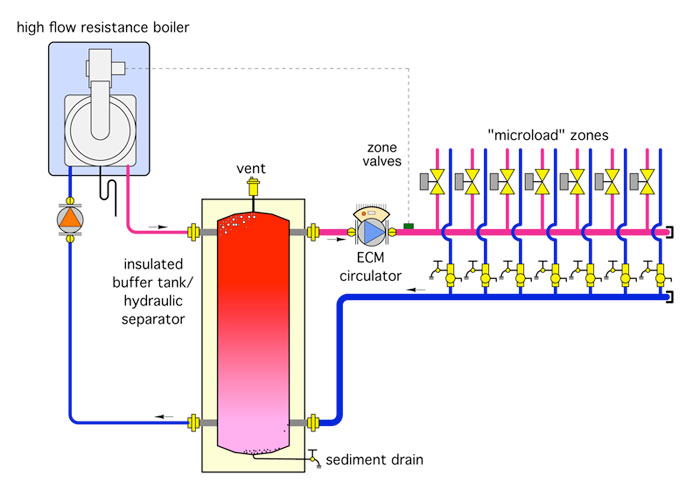
http://www.pmengineer.com/SHT/Home/Images/PME_0907_Feat2Fig10Lg.jpg

(It doesn't have to be an ECM circulator & valves, it could be separate circulators for the different zones with check valves.) 

The Tees would essentially be narrwings at the top bottom of the tank, with the boiler output Teed with the radiation supply, and the boiler return Teed with the radiation return.

The boiler control is then slaved to the tank's aquastat as it's only zone, and heating zone thermostat calls control the radiation circulators or zone valves.  The boiler remains agnostic about the the state of the heating zone calls, only responds to drops in tank temp.  The flow on the boiler loop needs to be high enough to keep the delta-T across the boiler under 25-30F, but neither the head of the boiler nor the head of the tank is very high, you might think about using a 3-speed circulator on the boiler loop if you can't come up with the actual head & flow numbers in your design.  If the delta-T across the boiler is under 15F you can probably save a bit of electricity running the pump slower.

The radiation will run at about the tank's setpoint, not the boiler's output temp.  The lower the temp, the higher the efficiency (figure on ~3% fuel savings for every 10F you can drop the temp.) But below 140F you run into condensation hazard conditions. If the flue has a stainless liner and a condensate drain/disposal you can get away with running cooler, but under no circumstances should you run it as low as 130F unless you plumb in a separate "boiler bypass" to keep the water entering the boiler at 140F or above. At 130F input water you can damage the heat exchangers of the boiler with condensation.

A cheaper alternative would be to use a standard indirect plumbed as a separate zone, and letting the boiler cold-start, but that wouldn't lengthen the burns on the heating calls from the smaller zones, which reduces operating efficiency below what it would be with a "reverse indirect" plumbed as a buffer/hydraulic separator.

WoodNotOilUser is Offline
New Member
New Member
Send Private Message
Posts:11

--
03 Mar 2010 09:36 PM
Since you are already accustomed to burning wood in a wood stove, you might want to consider putting in a gasification wood boiler to heat all the units. Gasification boilers operate at 85%+ efficiency by burning the emisions at 2000 degrees and release such little carbon and particulate matter they are often called "smokeless." They consume 1/2 as much wood as traditional wood boilers would. They start at about 5 grand in price, but if you also invest in a heat storage system you can actually burn wood even in the summer to provide DHW and become 100% oil free. I own a Tarm gasification wood boiler and constructed my own 1000 gallon heat storage tank. Like you I was burning a LOT of oil to heat my house+DHW and now I burn NONE! Just thought I would throw it in the mix as an option. Sounds like it would pay for itself in just a couple years with your application...
<A HREF="http://WoodNotOil.com">WoodNotOil.com</A>
You are not authorized to post a reply.

Active Forums 4.1
Membership Membership: Latest New User Latest: IntegratedHomes New Today New Today: 0 New Yesterday New Yesterday: 1 User Count Overall: 35026
People Online People Online: Visitors Visitors: 209 Members Members: 0 Total Total: 209
Copyright 2011 by BuildCentral, Inc.   Terms Of Use  Privacy Statement