|
|
|
What is the best (correct) way to install a reverse-indirect DHW system?
Last Post 15 Jun 2010 03:36 PM by Dana1. 15 Replies. |
Sort:
|
|
 Prev Next Prev Next |
You are not authorized to post a reply. |
|
Rip-Winkle

New Member

Posts:17
 |
| 24 Jan 2010 01:16 PM |
|
So I finally got my reverse indirect hot water system installed this week, but I am not sure it is installed in the most energy efficient way. Perhaps I misunderstood the plumber's explanation of how it operates or maybe it is not installed correctly.
My boiler is a HydroTherm C-125E that produces 125K BTUH. The space heating system is all one zone and uses a circulating pump to get water through to the radiators. It has a bypass so that in the case of a power failure, the water will still circulate by gravity.
My reverse indirect system is a Turbomax 23 and it also has a circulating pump.
Prior to installing the Turbomax, my space heating operated like this:
- if space heat was required by thermostat, the boiler would be activated
- when the water temperature in the boiler reached a certain temperature (150°F ?), the circulating pump would start.
My new installation, with the Turbomax installed, operates like this (or at least this is what I understood from the plumber):
- the boiler is controlled by an aquastat and the temperature of the water in the boiler must be maintained at 150°F at all times (24/7/365). If the water goes below this, the boiler fires up.
- for space heating, the space heating circulation pump will activate when the thermostat demands heat. As the water starts circulating, the temperature in the boiler goes below 150°F and the boiler fires up.
- for domestic hot water, its circulating pump will activate when the aquastat on the Turbomax demands heat. As before, when the water starts circulating, the temperature in the boiler goes below 150°F and the boiler fires up.
(SEE PHOTO)
I understand that this configuration works perfectly in terms of providing both space heating and DHW. However, I have two concerns:
1. Won't this result in excessive short cycling by the boiler if it must constantly maintain a temperature of 150°F, even in the summer of or low-usage periods?
2. In this configuration, am I optimizing my heating system by using the Turbomax as a buffer?
|
 Attachment: Photo of system.jpg Attachment: Photo of system.jpg
|
|
|
|
|
|
Dana1

Senior Member
Posts:6991
|
| 27 Jan 2010 02:15 PM |
|
It's a bit hard to follow looking at the plumbing pic, but from the description it sounds as if it's plumbed like standard indirect as a seperate rather than a heating system buffer!?! It's a bit confusing, since there's a both a zone valve as well as 2 circulation pumps.
To work optimally,
A. The circulation pump for the heating system radiation draws & returns from the TurboMax whenever there's a demand for heat
and
B. The boiler is allowed to get cold, and fires whenever the TurboMax's aquastat calls for heat (in much the same way that it had fired in response to the room thermostat previously.)
This might be relatively simple to do with 2 pumps and a the zone -valve (or possibly just check valve-TBD).
At the top of the tank:
<
[middle of tank lives here]
At the bottom of the tank you have:
>>from radiators----------T ( to the tank's boiler return port)------boiler loop circulation pump>>-----boiler's return pipe
When just the boiler loop is running (for a hot water load) the zone/check valve limits flow to/from the radiators. Both pumps are pumping away from the tank, and toward a higher impedance (the boiler in one case, the radiation in the other), and it may be just fine without the valves.
From a control point of view the room thermostat turns on the radiation pump (and opens up the zone valve). With just the radiation pump running it will pull some return-water through the boiler even though the boiler isn't firing, but most of the water will be pulled from the lower-impedance of the tank. When the temp in the tank falls below the tanks setpoint the boiler fires, but doesn't actively start pumping until it reaches it's internal control's setpoint. (If the flow through the boiler is too high causing the boiler to take forever to come up to temp an isolating zone valve in parallel with the boiler pump might be required, but I'm thinking it probably won't be needed.)
During the summer season, the boiler cools off between calls for heat from the tank's aquastat, runs the pump once the boilers internal low-limit aquastat is satisfied. The valving on the heating zone keeps the boiler's pump from inducing flow during hot-water-only cycles.
Configured this way, you set the tank's aquastat to whatever you need for the radiators during the heating season, but back it off to ~55C/130F for the summer. If you have enough radiation that it heats the place fine with 55C water, you can just "set it and forget it". The high limit on the boiler should be set for ~12-15C (20-25F) above the setpoint of the tank to avoid thermal stress to the boiler, but given the relatively low impedance of the tank it'll probably never trip the high-limit.
You may have to keep the tank's setpoint a bit higher than 55C if the boiler's response time from cold-start is slow enough to cause a noticable dip in the DHW temperature before the boiler's circulator kicks on. That would likely only happen under high-flow conditions (filling a tub while someone is taking a shower elsewhere, etc.). |
|
|
|
|
Dana1
Senior Member
Posts:6991
|
| 27 Jan 2010 03:25 PM |
|
It occurs to me you also need at least a check-valve on the boiler-loop to keep the cool boiler from convecting backwards, robbing heat from the TurboMax.
Staring at the picture a bit, it may be plumbed schematically correctly, but might not- it's a bit hard to untwist in 3d, and not all of the connections are in the picture. A 2-D schematic would be easier than a picture. There are a few ways it could be plumbed & pumped and still involve the entire thermal mass of the TurboMax on every boiler-burn (which is a primary goal.) Your description of how it operates makes me think it's not right though. |
|
|
|
|
Rip-Winkle
New Member
Posts:17
|
| 28 Jan 2010 12:25 AM |
|
Dana1, I think I am able to follow your configuration. I have tried to the best of my ability to draw the 2D schematic of the way my system is setup now as well as the configuration you are proposing. (see below)
Your design makes a lot of sense. Did I get it right?
I have some questions:
1) Can I add a manually-controlled bypass around the radiation circulation pump so that hot water can still circulate through my system by gravity during a power failure? It does this today with the other bypass that I have drawn.
2) If there is a demand for radiation (space heating), followed by a demand for DHW, as I understand BOTH circulation pumps would function simultaneously. How can I be sure that hot boiler water will get to the Turbomax (to heat DHW) and not just bypass the Turbomax altogether?
3) Where in the boiler loop would you put the check valve?
4) Can the temperature in the boiler safely go down room temperature when there is no demand for heat? (for example in the summer months, if there is little demand for DHW)
5) If I go away on vacation in the summer, would I just set the Turbomax aquastat down to a very low temperature? In your design, it controls the burner so how do I turn it off if I am away for some time?
Thanks for your help!
|
Attachment: 2D schematic.jpg
Attachment: Dana1's plan.jpg
|
|
|
|
Dana1
Senior Member
Posts:6991
|
| 28 Jan 2010 10:06 AM |
|
Close- I'm not sure what the point of the pump bypasses are, but as-drawn it would need a check valve on the boiler pump to keep from just whizzing water round in circles when the that loop pump is running.
The direction of water flow in the tank ports does change direction &/or speed depending on the state of the system:
A. When just the zone pump is operating water is leaving the top of the tank, entering the bottom.
B. When just the boiler loop pump is running water is entering the top of the tank, leaving the bottom.
C. When both pumps are on it may be flowing in either direction or not at all, depending on the flow & pressures of the system, but most likely it'll be flowing into the top of the tank, but at reduced volume (TBD.) Either way it's not likely to be a disaster- if the flow continues to be out of the top of the tank with both pumps running the radiation is getting 100% of the boiler output and it'll satisfy the thermostats sooner. The DHW temp will drop a bit, but assuming say 150F radiation water with 130F return, it's still keeping the tank at reasonable DHW temps. Then once the zone T-stat is satisfied it's back to "B", and the boiler continues to burn until the tank's aquastat is satisfied.
D. no pumps are running, (back flow needs to be inhibited on the boiler loop to prevent convective losses from the tank through a cold boiler. Either a check valve or a zone valve controlled in sync with the boiler pump should do it.)
It may be necessary to add a ball valve right at the boiler output to able to increase the impedance to guarantee that when the zone pump is running most of the water is being drawn from the tank, but a small amount of return-water flow through the non-firing boiler isn't a disaster, it's a heat-purge. (Alternatively a zone-valve shutting off that flow entirely whenever the boiler pump is off maximizes the heating flows through the TurboMax.) Ball-valves are better technology for adjusting flows than gate valves, since partially open gate valves wear out/erode, and lose their ability to shut completely off. Without the data in front of its we have to assume that it's possible that head backpressure of the boiler is the same or lower than the tank, so having the ability to increase the head of the boiler so that the vast majority of heating draw is from the tank under state condition "A".
For summer away times, killing the power to the entire system is better than cranking the aquastat way down. (Mine's all controlled by a single wall-switch next to the boiler.) But if the aquatstat on the TurboMax goes, but if it goes down to 68F/20C or lower, that would pretty much do it in the summer, eh? Still, one switch to kill power to the whole thing is probably a good idea. |
|
|
|
|
Rip-Winkle
New Member
Posts:17
|
| 28 Jan 2010 09:56 PM |
|
This is great stuff. I have revised the configuration (see below). To recap: A. SPACE HEATING: - The thermostat activates the Zone Valve (Z1).
- When the valve is open, the Zone Pump (P1) starts.
- Hot water is drawn from the top of the TurboMax. The cool return water from the radiators enters the Turbomax at the bottom.
- When the temperature drops in the Turbomax, its aquastat (A1) fires the boiler.
- When the temperature in the boiler reaches the set temperature, the boiler Zone Valve (Z2) opens
- When the valve is open, the boiler pump (P2) starts.
- Cool radiator water, perhaps mixed with cool Turbomax water flows into the boiler.
- Hot boiler water is drawn upwards by the Zone Pump (P1) to the radiators, with perhaps some hot water going to the Turbomax.
- When the space heating temperature is hot enough, the thermostat closes the Zone Valve (Z1) and the Zone Pump (P1).
- The boiler keep running, with the water now fully directed to the Turbomax.
- When the Turbomax reaches its set temperature, the boiler's burner goes off.
- When the temperature in the boiler drops below its set temperature, the boiler Zone Valve (Z2) closes and the boiler Pump (P2) stops
B. DHW - Steps 4-7 (above), followed by steps 11-12
C. Neither Space Heating nor DHW required - Check Valve installed just before boiler intake prevents backflow (is this the right place?)
D. During a power failure (in the heating season) - Manually open the two Zone Valves (Z1, Z2)
- Two bypasses allow hot water to flow slowly upward by gravity. Check valves ensure no back flow.
(Not sure if the aquastats function during power failure. Unfortunately, though the thermostat works, it is useless since it is connected to the Zone Valve (Z1). So while I can heat the house this way, I can't really control the temperature except by manually opening and closing the Zone Valves. I don't know if there is a better solution, but it is a rare occurrence anyway.)
Any other comments? Thanks a million. |
Attachment: Dana1's plan v2.jpg
|
|
|
|
Dana1
Senior Member
Posts:6991
|
| 29 Jan 2010 10:50 AM |
|
I think you've got it. The basic architecture is now using the TurboMax as a hydraulic seperator: 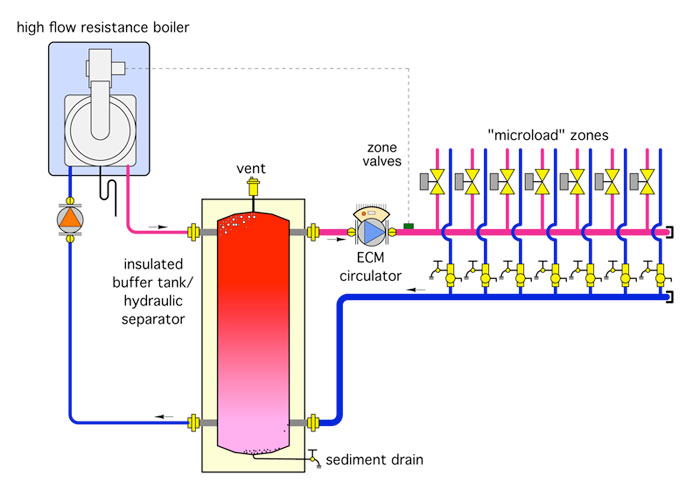 Because the TurboMax doesn't have 2 top ports and 2 bottom ports for the boiler water, you have to use Tees (and spacing DOES matter somewhat- the longer the pipe is between the Tee and the Turbomax on either/both ends, the higher it's impedance is, and we want to make it as low as possible, to maximize flow through the tank. The operational difference between the TurboMax and any other buffer tank as the point of hydraulic separation is that the loops are controlled separately to temperature-limit the buffer tank, and be use the heat exchanger in the tank for DHW. During heating zone calls the boiler loop may not be running at first, but as heat is drawn from the tank by the zone pump the temp in the tank drops and starts up the boiler. The burn may continue for the full extent or the heating call or if the temps in the tank get's ahead of it there may be some cycling involved, but mass & hysteresis of the tank defines an absolute minimum burn time- none of the cycles can be short. There will be some tweaking to optimize things. If the boiler is cycling a lot during heating calls, raising the setpoint of the tank will both lengthen the cycles and shorten the call for heat, since hotter radiators deliver the heat to the space more quickly, satisfying the thermostat sooner, and pulling the heat out of the tank at a faster rate make is take longer for the boiler to raise the tank back up to the aquastat's upper limit. Flows to the radiation can be adjusted back a bit with a ball-valve as well, if the combined heating + DHW load is much higher than the boiler's output and you need more DHW during heating zone calls. (It can't be cut TOO low or you'll end up with a huge delta-T on the heating and it may not adequately heat every space.) With the buffer in place it's now possible to micro zone the house to improve heating balance or have the ability to run rooms at very different temperatures, etc. without losing efficiency due to short-cycling, since the thermal mass of the tank is involved in every burn (More plumbing projects, oh boy!  ) Small zone calls under light load may not need the boiler to fire at all, and when it does it'll be at least as long as the minimum burn defined by the tank. If the burns turn out to be unduly short because of a narrow hysteresis on the tank's aquastat, you can either replace it with one with higher hysteresis, or use the tank's aquastat as a low-limit to start the burn, and use a separate aquastat on the return line as a high limit to end the burn, to deliver a very high hysteresis (eg. Set the tank to 130F, and the and the additional high-limit to 170F. That would make the minimum burn what it takes raise a 26 gallon tank ~40F, which is ~8700btus. (work backwards from the boiler's BTU/hour output figures to convert that into minutes. If the hysteresis on the TurboMax is only 5F that is much shorter, but still way more than a temperature-maintenance burn on just the boiler. |
|
|
|
|
Dana1
Senior Member
Posts:6991
|
| 29 Jan 2010 10:52 AM |
|
BTW: not to worry- aquastats are purely mechanical devices with switch contacts- they open & close whether the power is on or not. |
|
|
|
|
rcevan
New Member
Posts:12
|
| 11 Jun 2010 10:41 PM |
|
I found this thread by searching on "reverse indirect"
The 1/29/10 drawing posted by by Dana1 is exactly what I was looking to ask about.
I have a Vertex 100 water heater. Can I do a "reverse indirect" tank like in Dana's drawing using a standard indirect water tank? What makes the TurboMax special?
Weil-Mclain said I could use their indirect in the normal mode rather than a flat plate heat exchanger but I am wondering if one can be used in reverse. The tank would be a buffer, adding to the 40 gallons of the Vertex.
I'm asking b/c there's a reasonably priced new unit for sale on Craigslist. |
|
|
|
|
rcevan
New Member
Posts:12
|
| 11 Jun 2010 10:44 PM |
|
I should have said:
I'm installing a radiant sandwich system in my house and am looking at how to heat the water.
Thanks |
|
|
|
|
rcevan
New Member
Posts:12
|
| 12 Jun 2010 12:22 AM |
|
One more edit / clarification
we have hard water and I'm concerned that a flat plate heat exchanger will foul
how can i assess if a Superstore Ultra 45 can be used in the typical indirect fashion as y heat exchanger?
there may not be a difference between running the tank "standard" or "reverse", since it would still have the buffering effect. Correct?
Thank you. |
|
|
|
|
Dana1
Senior Member
Posts:6991
|
| 14 Jun 2010 12:00 PM |
|
The buffering effect is the same, but using a standard indirect in reverse mode may give you less than satisfactory DHW performance. Standard indirects count on the turbulence generated by the boiler loop pump to break up laminar flows on the inside of the heat exchanger tubing. Reverse-indirects use multiple smaller-diameter tubing coils and a tight radius on each coil to induce sufficient turbulence on the interor (potable) side.
But if you're using a Vertex 100 as your "boiler" it already has a substantial thermal mass, and can't short-cycle no matter what- you don't NEED a heating system buffer bigger than that, but you do need to store up domestic hot water in a separate buffer with a burner that size, if a significant fraction of the burner output is supporting the space-heating load.
Using a standard indirect plumbed in the conventional fashion should be fine. Your only limitations will be the size of the burner- this won't be an "endless shower" situation, but most 3 & 4 person families can do fine with 40 gallons of 125F DHW storage, if they're at all conservative in their HW use. |
|
|
|
|
rcevan
New Member
Posts:12
|
| 14 Jun 2010 01:23 PM |
|
Thanks Dana
Design day heat loss is about 30,000 BTUs/hr - - I think some bad R values were used by the person who did it, but its close.
The Vertex 100 is 100,000 BTUs (input or output?)
Since I need to transfer the heat to the closed system, and I'm unsure about flat plate exchangers plugging, I'm asking Q about Indirect Water Heaters.
Questions:
Why did you say "you do need to store up domestic hot water in a separate buffer burner that size, if a significant fraction of the burner output is supporting the space-heating load"
Are you thinking that if my load was too close to the Vertex 100 output, I need more buffer?
Tom Tesmar says he turns the pump on the goes to the flat plate heat exchanger and leaves it running for the heating season. I figured I'd use the aquastat of the indirect to turn on the pump.
Then perhaps use an ECM (alpha?) on the radiant side pumping through a mixing valve w/ outdoor reset.
Have you any knowledge of an indirect heated with 140 degree water?
I can use a flat plate and have 140 degree water from the vertex heat the radiant side just fine (sized using the flatplate.com interactive software). I am just hoping that the indirect could basically do the same.
I'd think I'd disconnect (w/ valves) the tank for the summer and drain it.
Comments?
Thank you.
|
|
|
|
|
Dana1
Senior Member
Posts:6991
|
| 15 Jun 2010 11:16 AM |
|
Posted By rcevan on 14 Jun 2010 01:23 PM
Thanks Dana
Design day heat loss is about 30,000 BTUs/hr - - I think some bad R values were used by the person who did it, but its close.
The Vertex 100 is 100,000 BTUs (input or output?)
Since I need to transfer the heat to the closed system, and I'm unsure about flat plate exchangers plugging, I'm asking Q about Indirect Water Heaters.
Questions:
Why did you say "you do need to store up domestic hot water in a separate buffer burner that size, if a significant fraction of the burner output is supporting the space-heating load"
Are you thinking that if my load was too close to the Vertex 100 output, I need more buffer?
Tom Tesmar says he turns the pump on the goes to the flat plate heat exchanger and leaves it running for the heating season. I figured I'd use the aquastat of the indirect to turn on the pump.
Then perhaps use an ECM (alpha?) on the radiant side pumping through a mixing valve w/ outdoor reset.
Have you any knowledge of an indirect heated with 140 degree water?
I can use a flat plate and have 140 degree water from the vertex heat the radiant side just fine (sized using the flatplate.com interactive software). I am just hoping that the indirect could basically do the same.
I'd think I'd disconnect (w/ valves) the tank for the summer and drain it.
Comments?
Thank you.
That's basically it- when going with a combi system that's using most it's output for space heaing you may need more thermal mass for the DHW end. But if you have 60K-70K of burner above the design day heat load you should be just fine with just the Vertex in a 3-6 person household. Compare first-hour-gallons performance with other HW heaters, then de-rate the Vertex by ~30-35% for the space heating load. A Vertex used just for DHW is rated for 164 first-hour gallons , so figure on only getting ~100-115 first-hour gallons out of it even when it's wicked cold out, but more when it's nice. If your design-day heat load was 60K instead of 30K you'd have to derate the first-hour gallons by at least half. If you're heating a standard indirect to 120F with 140F water you'll still get decent performance out of the heat exchanger, but at smaller delta-Ts the rate of heat exchange would begin to suffer noticeably. What are your design goals here? More showering time? Big tub fills? Higher space-heating efficiency? |
|
|
|
|
rcevan
New Member
Posts:12
|
| 15 Jun 2010 02:30 PM |
|
Thanks for the dialog
I have a brother w/ a Lochinvar Knight that short cycles, he's talking of adding a water heater tank to get more buffer.
With a low heat loss, I was steering away from the complexity and horsepower of a boiler (and I'm not too keen on maintenance).
Given the layout of the house, I needed a power vent unit.
I want a system that is simple to understand and control.
I was originally aiming to solely have radiant heat (with my old fireplace as the standby - have used it solely for 26 years). The contractor said it would only cost $500 more to add a furnace, given that I wanted a/c and ventilation. so we now have a furnace (which was WAY oversized!).
So my goals are 1) warm feet, 2) radiant heat most of the winter (rarely furnace - but will use for HRV ventilation), 3) reasonable cost - - probably in that order
I sheathed my house w/ 1" xps and
have closed cell spray foam for the walls (2.5" min) and ceiling (5" plus)
with ok windows - nice Marvin
we were living in woods and a developer built hundreds of homes around us. I got permission to harvest some trees before they bulldozed them and had them made into tongue-and-groove flooring (maple). it will be installed in a few weeks.
I like the Taco x-block for simplicity but 1) it is close to the BTU limit, 2) it is more $ than the individual parts (even w/ getting an ECM circulator, i hope) and 3) i don't know about flat plate heat exchangers - their scaling over / plugging.
Our city has had problems w/ sediment in the lines. Do you have any field knowledge about flat plates clogging?
Thanks. |
|
|
|
|
Dana1
Senior Member
Posts:6991
|
| 15 Jun 2010 03:36 PM |
|
In your situation you can probably tolerate a 10-15% design-day BTU shortfall, since design conditions occur typically only for a few hours at time, just before dawn on the coldest days of the year. Your floors will still be warm, but the room air temp may below your setpoint for a few hours under worst-case conditions, and if you've zoned the house you could always keep at least one up to temp by letting another fall short, etc. I wouldn't worry about the X-block's BTU rating being a show stopper. (In a once in a millenium cold snap scenario you could always fire up the furnace or fireplace, eh?) You'll spend far more hours at 1/4 of full rated design load than at 3/4 load. Full design conditions only account for 1-3% of hours in a heating season, and most of the heat loss tools overshoot by 25%, so what the heck do you care if you're nearing the full rating of the X-block the probably-overestimated heat load, with multiple oversized "hail mary" systems backing you up? Your real peak heat load is probably only half the rated ~50KBTU/hr of the X-Block, and your seasonal average will be half that.
Scale is different from sediment. Sediment you can limit with in-line filtration. Scaling issues are related to hard-water chemistry, which can be treated with water-softeners. ANY heat exchanger can have issues with scaling if there's a constant replenishment of fresh but hard water. I don't have any direct experience with flat-plate heat exchangers having issues with sediment clogging- purging the bottom of your HW heater until it runs clear once/year or so will keep the Vertex from building up sludge if your city-water has chronic issues. Flat plate collectors are a lot less money than an indirect though, and indirects are not at all immune from scaling issues.
If your brother's Lochinvar is short-cycling, a common solution is to put a cheap electric HW heater (not wired up) in series with the heating loop to provide the necessary thermal mass. If the output temps need to be DHW temps or higher, using a reverse-indirect as the buffer & hydraulic separator works. With a mod-con that would limit the average combustion efficiency to ~ 90% and will be giving up some condensing hours but reducing cycling losses. With in-series buffer he can still use outdoor reset control to run lower temps==more condensing time & higher average efficiency. Which approach makes the most sense in his situation depends on whole lot of factors. Simply adding an indirect as a separate zone may raise the AFUE, but won't stop the short cycling. |
|
|
|
|
| You are not authorized to post a reply. |
|
Active Forums 4.1
 |
Membership: |
 |
Latest:
croccohvacusa |
 |
New Today:
0 |
 |
New Yesterday:
0 |
 |
Overall:
35027 |
 |
People Online: |
 |
Visitors:
110 |
 |
Members:
0 |
 |
Total:
110 |
|
|
|