|
|
|
Final insulation decisions
Last Post 09 Dec 2010 07:50 AM by Bob I. 25 Replies. |
Sort:
|
|
 Prev Next Prev Next |
You are not authorized to post a reply. |
|
kschweitzer69

New Member

Posts:64
 |
| 05 Dec 2010 10:37 PM |
|
As previously posted with great feedback from others. My house is constructed with 2" polyiso all around exterior upper level walls and 2" XPS foam below grade walls. I'm to the point of needing to make final decisions on wall cavity insulation, attic insulation, and rim band joist insulation. I've had bids done different ways, but full cellulose seems most cost effective. Full foam walls is about 2k more on my project and I just don't know how much differnce the foam would make vs the cellulose. Here are my questions though, on the rim joist, should I open cell foam it or just have it batt insulated? I have the 2" polyiso on the exterior of it. I have a couple of vaulted ceiling areas that are 2x10 rafters. They can dense pack it with cellulose or foam it as well, but foam costs about double, is it worth it? I just don't want those rooms to be drafty. In the attic, I'd like to get a R50 cellulose, the installer is concerned about weight on the drywall and suggests nothing less than 5/8 drywall on the ceiling to support weight, will this be suffcient? A thought I had was R19 or higher fiberglass batts first installed across attic, then blown cellulose on top of that to finish off with R50. I thought this may better distribute weight loads and reduce the weight. Good idea/bad idea? Any concerns with this? Performance loss? Another insulation question of mine is the chimney chase, it runs up the middle of our house and we are going to have a direct vent pipe from the upper level of the house going through the chase and then a double wall class A chimney pipe going from the basement up the chase to the top of the chimney. I know the class A pipe requires a 2" clearance around it. How do I properly insulate so my conditioned air in the house is not filtering up the chase? I'm going to post some picture of the house exterior to show the polyiso around the living space of the home. Let me know your thoughts. Thanks!! 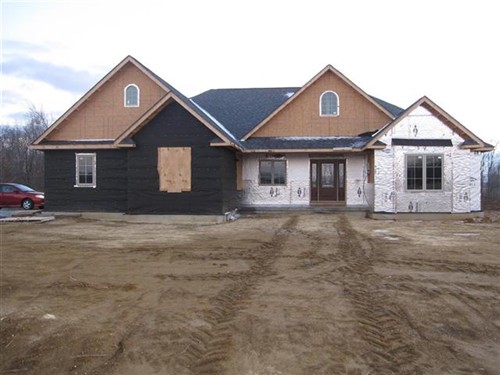 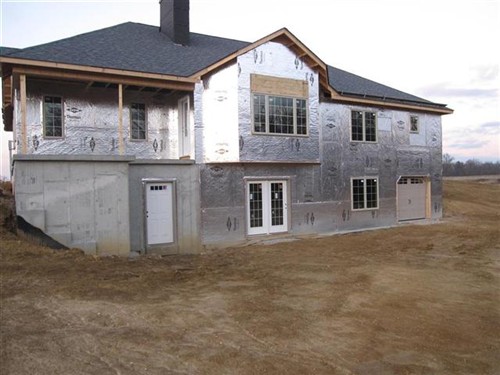 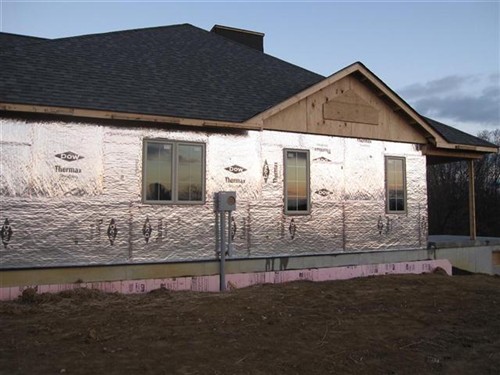 |
|
|
|
|
|
|
Dana1

Senior Member
Posts:6991
|
| 06 Dec 2010 03:52 PM |
|
Foam the rim joist- batt insulation on rim joists is a NIGHTMARE to air-seal properly on the interior.
Dense-pack the vaulted bits- there is such a thing as "tight enough", from a drafty-feeling point of view. Even low-density wet-sprayed cellulose would be enough from a feel point of view, but dense-packing gives you better moisture control.
If load ratings for trusses/joists are getting compromised with R50 cellulose in the attic you might look at going with wet-sprayed JM Spider super-fine fiberglass or Certainteed Optima blown-in-blanket at ~1.0lbs density (It'll be more expensive though.) For true zero-sag with denser insulation a combination of thin OSB + thin gypsum would get you there. The 5/8" gypsum alone is probably enough if it's 16" o.c., but may sag over a coupla decades if it's 20" or 24". If the weight of 3/4" goods doesn't break anything, that would probably be easiest for wider spans.
R19 batts with a cellulose overblow woudn't really save you much on total weight in the end if you're shooting for R50. R19 batts are pretty low density (about half a pound per cubic foot), but are more compressible than 0.8-1lb density R21/R22 batts, and would compress something like an inch under the weight of a 10" of 1.5-1.8lb cellulose, down to about R16-ish. (Try it with a 1.5lb aerobics-type hand weight or a 16oz beverage bottle on a 1' square of cardboard.) Only ~1/3 of the total volume would be at a lower density. You'll need a total of ~14.5-16" to hit R50, and the fiberglass would only be 4.5" of it. R38 batts with a 5-6" overblow of cellulose might work, but its' easier/clearer to just stick with one fiber. Low density batts suck in attic applications, so from my point of view it's either new-skool best-in-class fiberglass like Spider or Optima, or low density cellulose with a beefier ceiling material so long as the total chord loading on the trusses/joists stays within spec. (It's not usually an issue with joists except in longer spans, but can be with chord trusses.)
On the chimney chase use sheet-metal air-barriers at every floor or ceiling penetration, using a fire-rated caulk or mastic to seal the seams.
If you've done a good job of turning the foil facers of the iso into air-barriers, and sealed the seams/edges of the structural sheathing, the benefit of a foam cavity fill vs. cellulose is near nil. The benefit of the thermal mass of the cellulose is guaranteed to be a net-positive, so... |
|
|
|
|
Bob I

Veteran Member
Posts:1435
|
| 06 Dec 2010 05:43 PM |
|
kschweitzer69
I have a question: you sound like you have the thermal insulation thing pretty well under control, but looking at your photos, there seems to be a slight break in your envelope. Whats with the bare concrete? Its at the top of the foundation - exactly the place of highest foundation heat loss. Kind of like dressing for midwinter with a shirt & coat 4" too short. Sure hope you're going to fill that in! |
|
| Bob Irving<br>RH Irving Homebuilders<br>Certified Passive House Consultant |
|
|
kschweitzer69
New Member
Posts:64
|
| 06 Dec 2010 10:40 PM |
|
Bob,
You are correct I have a 1ft break between the framed walls and foundation insulation. I've been debating about what to do about this area. I cannot find a way to protect foam that I'm satisified with. I don't really care for stucco/tuff II solutions and am concerned about ants/rodents finding their way through the foam up into the framing easier. I realize I'm leaving open an exposed problem, but it really is only on my west wall and a little of the front of the house. The house design with garage and walkout basement leaves me with little area for me to address. My plan is to leave as is, insulate basement from inside in the future and if still not satisfied I'll go back and figure something out for that area. I know it's the area claimed to be most pertinant to insulate, but right now our weather is in the 20s and we have the basement insulated down to the footer and it's amazing with no heat whatsoever how much warmer it is in the basement than the upper level. |
|
|
|
|
kschweitzer69
New Member
Posts:64
|
| 06 Dec 2010 10:54 PM |
|
Dana1,
Thanks again for your professional evaluation. I'd agree on the rim joist. Spray foam seems about the only way to go on that. I'm still a bit unsure of how to handle the attic. To give you a little more information. We have 2ft on center trusses and various interior ceiling changes from room to room. Vaulted, tray, and elevated ceilings throughout the house. There really is not much area of flat ceiling that has large spans, however, the last thing I want is ceiling sag 20yrs from now. I'm not sure how practical it would be to implement 2 rounds of sheathing application to this ceiling structure OSB then drywall. Throughout this process of building since i've requested much beyond the normal for my locals I've tried to find ways to implement that would not hinder their "normal" practices too much. Insulation constractors in our area claim to have never seen anything insulated like my house with 2" foam, etc. My request for R50 in the attic seems to also be somewhat foreign to them as they were concerned about weight as well. Am I better off to just do R38 cellulose rather than R50 fiberglass or fiberglass/cellulose combination as I mentioned? The dense blown fiberglass seems like an option, but again practicality of finding someone that can do it reasonable may not be an option. As for the weight issue the bottom chord of trusses is 2x4, but again not many large spans. My concern would be more with the drywall sagging between the joist connections. We planned to use 5/8 and some think that would resolve the issue, but I'm not sure I want to take the chance without throughly researching. Thanks again for all your thoughts. |
|
|
|
|
Bob I
Veteran Member
Posts:1435
|
| 07 Dec 2010 08:11 AM |
|
I've done several houses with R-50+ blown in over netting, 1x3 strapping 16" OC and 1/2" drywall with no problems.
What is your concern about stucco? Can be very hard, looks like concrete when you're done or you can tint it. |
|
| Bob Irving<br>RH Irving Homebuilders<br>Certified Passive House Consultant |
|
|
Jere

Basic Member
Posts:106
|
| 07 Dec 2010 09:19 AM |
|
Did you get an estimate to spray 1" closed cell foam in the attic over the drywall and top plates of exterior walls, and then blow in cellulose on top of that? The 1" of closed cell foam will air seal everything very well, give a lot of rigidity and support for the cellulose on top, preventing sagging in the 5/8" ceiling drywall. |
|
I built my home with the help of Pierson-Gibbs Homes, "The Hands on House". They build the shell, you finish it.
www.p-ghomes.com |
|
|
Eric Anderson
Basic Member
Posts:441

|
| 07 Dec 2010 09:24 AM |
|
You have several options for the ceiling space. The first bombproof method is just to run mesh across the bottom cord stapled tightly, then strap the trusses with 1x3 16" OC perpendicular to the bottom cord of the truss. Then use regular ½” or 5/8 drywall. The spacing is close enough that the mesh takes most of the weight and has to deflect ¾” before the drywall has any pressure on it.
Another possibility if you have the room, is to cap staple 1” polyisocyanate to the bottom of the trusses, tape all the seams, then tape wherever the ceiling meets a wall so this becomes your air barrier. Now strap the with 1x3 16" OC perpendicular to the bottom cord of the truss. Use long screws Then use regular ½” or 5/8 drywall. You chew up 1.75” of headroom, but pick up a lot of insulation as you have an inch of r6 + a radiant barrier facing a ¾” airspace. Now put r50 if cellulose on top of that, and you have a nicely insulated, well air sealed ceiling.
One warning I will give you as you are still in the planning stages. Completely wrapping your house with foil faced iso and using windows with low E coating really screws up radio and cell reception in the house. I get 5 bars outside my house and 1 bar inside on my cell phone.
Cheers, Eric |
|
| Think Energy CT, LLC Comprehensive Home Performance Energy Auditing |
|
|
Dana1
Senior Member
Posts:6991
|
| 07 Dec 2010 10:22 AM |
|
Posted By Bob I on 07 Dec 2010 08:11 AM
I've done several houses with R-50+ blown in over netting, 1x3 strapping 16" OC and 1/2" drywall with no problems.
What is your concern about stucco? Can be very hard, looks like concrete when you're done or you can tint it.
That should work. If you wanted to take it to the next level, doing the 1" of 2lb foam over the sheet rock & strapping for air-seal/vapor-retarder/mechanical rigidity you'd then be looking at only about 12-13" of cellulose rather than 15", over a more rigid structure. As for the thermal break on the foundation, copper Z- channel flashing extending from the foundation sill out & over (borate-loaded for ant & termite resistance) EPS drip-edge style with a cement-board + parge exterior sheathing would be rodent/ant/termite-free: http://www.nrc-cnrc.gc.ca/obj/irc/i...Fig4-3.jpgor
http://www.nrc-cnrc.gc.ca/obj/i...Fig4-4.jpgYou could also use cheaper galvanized Z-channel, but copper is very durable, and toxic to ants & termites. |
|
|
|
|
FBBP
Veteran Member
Posts:1215
|
| 07 Dec 2010 10:31 AM |
|
Posted By kschweitzer69 on 06 Dec 2010 10:54 PM
Dana1,
Thanks again for your professional evaluation. I'd agree on the rim joist. Spray foam seems about the only way to go on that. I'm still a bit unsure of how to handle the attic. To give you a little more information. We have 2ft on center trusses and various interior ceiling changes from room to room. Vaulted, tray, and elevated ceilings throughout the house. There really is not much area of flat ceiling that has large spans, however, the last thing I want is ceiling sag 20yrs from now. I'm not sure how practical it would be to implement 2 rounds of sheathing application to this ceiling structure OSB then drywall. Throughout this process of building since i've requested much beyond the normal for my locals I've tried to find ways to implement that would not hinder their "normal" practices too much. Insulation constractors in our area claim to have never seen anything insulated like my house with 2" foam, etc. My request for R50 in the attic seems to also be somewhat foreign to them as they were concerned about weight as well. Am I better off to just do R38 cellulose rather than R50 fiberglass or fiberglass/cellulose combination as I mentioned? The dense blown fiberglass seems like an option, but again practicality of finding someone that can do it reasonable may not be an option. As for the weight issue the bottom chord of trusses is 2x4, but again not many large spans. My concern would be more with the drywall sagging between the joist connections. We planned to use 5/8 and some think that would resolve the issue, but I'm not sure I want to take the chance without throughly researching. Thanks again for all your thoughts.
I have used ceiling board (has additional fibres in it) with no sagging (R65 cellulose and trusses @ 24o/c) My house went through a period of very high humidity and still did not experience any sagging. |
|
|
|
|
Dana1
Senior Member
Posts:6991
|
| 07 Dec 2010 10:32 AM |
|
Posted By eric anderson on 07 Dec 2010 09:24 AM
One warning I will give you as you are still in the planning stages. Completely wrapping your house with foil faced iso and using windows with low E coating really screws up radio and cell reception in the house. I get 5 bars outside my house and 1 bar inside on my cell phone.
Cheers, Eric
But it gives you a slight security edge on your home's wireless network, eh? ;-) In shielded buildings any wire penetrating, but not capacitivly or DC coupled to the shielding foil provides an RF pass-through. If you need more signal to use your phone it wouldn't be tough to boost that without compromizing the thermal/humidity integrity of your house with a very few well-placed passive antenna pass-throughs. |
|
|
|
|
kschweitzer69
New Member
Posts:64
|
| 07 Dec 2010 11:55 AM |
|
Thanks to all for all the suggestions/experiences.
Stucco in our area is not percieved well. We have hot humid in the summer and very cold dry days in the winter. Very sesonal with temperature extreme's both ways. Perhaps there is a good way to stucco so their is no problems, but I'm a little skeptical and quite honestly need to live in the house to determine if I feel I'm loosing enough energy to justify messing with that area. Getting a professional to come in and stucco that little bit would be costly and I don't trust my limited knowledge on the subject.
Insulation wise, I really like the closed cell/cellulose suggestion and not yet priced that, but I expect it to be at least double what full R50 cellulose would cost probably 1500-2000 more, none the less probably the most superior way to insulate the attic. The polyiso idea did cross my mind, but the point about cell phone recpetion is well appreciated. I'm building in a rural farming community and it is likely my internet service will be coming from the cell tower. Quite likely we may abandon landlines for cell phones. Hopefully the polyiso walls does not cause us problem with this plan. The netting 1x solution seems effective, but costly from a labor perspective, particularly considering the complexity of my internal ceilings in the house. Various heights and pitches and lots of truss supports to work around. I'd be interested to hear more about the ceiling board that FBBP posted about. Who manufactures this, what is it called? Does it claim to have higher load ratings? Does it cost much more than standard drywall? Do many of you out there think I'll have problem with 5/8 on my ceiling with R50 cellulose? What are thoughts of R30 fiberglass batt with remaining cellulose blown in?
Another question I have is about ventilation. This is another area that seems to be somewhat mysterious to my contractors. HRV or ERV in Cincinnati? What is most simple/practical? Do I need either? I've known people to build ICF in my area with no ventilation setups, although I know them to have fiberglass fill attics so maybe that is keeping their air situation managed.
Thanks again for all the assitance. |
|
|
|
|
Dana1
Senior Member
Posts:6991
|
| 07 Dec 2010 12:39 PM |
|
A blower door test would tell you if it's absolutely necessary but active ventilation is always a good idea from an indoor air quality point of view. Control it with a dehumidistat in winter, keeping the humidity down to ~30-35%. In summer you may need to cycle it with a timer.
In Cincinatti, ERVs will take the load off the dehumidifier in summer. A well insulated low-summertime solar gain home will have a much higher "latent load" (humidity) than "sensible load" (temperature only ) air conditioning load, and mechanical dehumidification will likely be necessary to keep it under 60% relative humidity when the indoor temps aren't high enough to run the AC. With an ERV operating on an interval timer the amount of outdoor humidity you'll be introducing to the conditioned air will be minimized- something like half or less what an HRV would bring in. |
|
|
|
|
kschweitzer69
New Member
Posts:64
|
| 07 Dec 2010 01:07 PM |
|
Dana1- When do you suggest the blower door test, upon completion of insulation? Am I correct in thinking that cellulose will make the air changes per hour less frequent than fiberglass. Essentially cellulose is a tighter insulation option, correct? From a performance perspective you don't like the hybrid fiberglass/cellulose approach in the attic? As for humidity issues, I'm not sure I understand, right now my house in the winter is terribly dry, static electricity everywhere. I think humidity is good in the winter. Helps make air in house feel warmer. Are you basically saying that because my house will be tight that humidity will be high in the winter? It sounds like you are suggesting the ERV for my climate. Are they more simplistic? Where do those get installed in the house? What is your recommendation HRV/ERV for my situation based on what you know? |
|
|
|
|
arkie6
Veteran Member
Posts:1453
|
| 08 Dec 2010 12:08 AM |
|
Here is a thread I started about stabilized cellulose attic insulation that might be of interest: Stabilized Cellulose |
|
|
|
|
kschweitzer69
New Member
Posts:64
|
| 08 Dec 2010 12:21 AM |
|
Good info arkie6, I wondered why the wall spray cellulose was not promoted for attics. Makes sense to me as well. What did you ever decide on doing? Around the web it seems most people say 5/8 drywall with dry cellulose will yeild no problems, but perhaps the 1/2 no sag drywall would be better. Wonder if it cost more than 5/8. The only other options I can see to consider is a hybrid fiberglass/cellulose option or 1" closed cell with cellulose ontop would be perfect, but costly. The closed cell foam adds strength to the structure and seals up those pesky can lights. Perhaps this would allow one to get away with standard 1/2 drywall. |
|
|
|
|
arkie6
Veteran Member
Posts:1453
|
| 08 Dec 2010 07:48 AM |
|
I'm still building my ICF basement. This is a DIY project in my free time.
I'm still planning on using the stabilized cellulose in the attic with the 1/2" no sag ceiling board.
I checked into spray foaming a 1" layer in the attic and then covering with cellulose. 1" of 2# density foam (~R6 long term) costs more per square foot installed (almost $1/sq ft) than 10" of settled loose fill cellulose (~R38) in the attic ($0.60/sq ft). Spray foam is no doubt a good product, but it just doesn't make economic sense to me. |
|
|
|
|
Dana1
Senior Member
Posts:6991
|
| 08 Dec 2010 11:17 AM |
|
Posted By kschweitzer69 on 07 Dec 2010 01:07 PM
Dana1- When do you suggest the blower door test, upon completion of insulation? Am I correct in thinking that cellulose will make the air changes per hour less frequent than fiberglass. Essentially cellulose is a tighter insulation option, correct? From a performance perspective you don't like the hybrid fiberglass/cellulose approach in the attic? As for humidity issues, I'm not sure I understand, right now my house in the winter is terribly dry, static electricity everywhere. I think humidity is good in the winter. Helps make air in house feel warmer. Are you basically saying that because my house will be tight that humidity will be high in the winter? It sounds like you are suggesting the ERV for my climate. Are they more simplistic? Where do those get installed in the house? What is your recommendation HRV/ERV for my situation based on what you know?
It's better to blower-test before insulation, running around with a foam gun fixing all the leaks you can find. At ~1.5-1.8lbs open blow density cellulose will slow down convection within the insulation by a LOT, but it can't stop air-infiltration from real leaks. It will pretty much stop convection losses in horizontal fiberglass with as little as 3" of overblow too. In wall cavities even 2.5lb density slows infiltration by quite a bit compared to low-density batts, but it takes 3lbs+ to really NAIL it. Yes, I AM saying that with a much tighter house- the tighter your house is, the more humidity will build up in the house. The higher the humidity of the indoor air, the higher the dew point, and the more likely you are to get condensation events in your sheathing and studs. The exterior foam helps (a LOT), by raising the temp of the wood, but that doesn't mean you can get away with 60% RH at 70F all winter long. An RH of 30% is not AT ALL staticky, cool,or dry feeling, but it's near the lower limit for human health & comfort (ASHRAE says 25% RH, allergists put the lower bound at 30% RH.) If your house is all dry & staticky it is an indication that your ventilation rates are too high. (You apparently live in a leaky house.) I live in a colder (==drier in winter) climate than you, in not the tightest house house on the block (but I'm working on it) and my interior RH never dropped below ~30-32% @ 70F last winter. I'll know it's time to install an ERV (even without the blower-door test) when the interior RH stays above 35% @ 70F even on the coldest cold-snap of the winter. ERVs are not more simplistic than HRVs- they're more complex (but not hugely so). An ERV will exchange both sensible (temperature) heat and humidity (latent heat) between the air streams. This means that in the summer when the dew points are high it'll be removing some of the moisture from the incoming air as it comes int, and in the winter it'll be adding some of the interior-air humidity to the incoming air. This means you can run higher, healthier ventilation rates in winter without drying out the place too much, and it'll relieve the load on the dehumidification somewhat in summer. If you run it with a dehumidistat in winter set to 30-35% RH in winter you'll never feel too dry, but you'll keep the moisture out of the structural wood, and it'll be enough ventilation air. In summer when the outdoor air dew points are higher than indoor dew points you can't use that strategy- use an interval timer instead. In the shoulder seasons when it's consistently above 40F you can bump the dehumidistat control up to 40% or 50% RH without risk to wood or health. In summer you need to keep it under 65% to avoid mold, but 60% feels better and gives you more margin. (I keep the cooler basement at 60%, which pretty much holds the line for the whole house.) If anybody in the house is allergic to dust mites, keep at 50% or lower (which corresponds to a dew point of 55F for 75F air. Much of the time in summer the outdoor dew points are well above 55F in Cincinnati.) |
|
|
|
|
Dana1
Senior Member
Posts:6991
|
| 08 Dec 2010 11:22 AM |
|
Arkie: Closed cell foam is indeed a premium product at a premium price, to be used sparingly! The economics of going high R with 2lb foam aren't there. It's air-sealing capacity and vapor-retardency make it the product of choice for certain layers & application though. That application will NEVER be an all-foam R50 attic, but as the interior vapor retarder & air barrier to an R50 attic an inch or so is often justifiable (more so in colder climates than Cinci though.) |
|
|
|
|
kschweitzer69
New Member
Posts:64
|
| 08 Dec 2010 02:04 PM |
|
Dana1- Sounds like I could build the house and monitor the situation to determine if I later need to add HRV/ERV. I know HRVs typically install in the basement near the furnace, are ERV's more of a attic installation? Where would I place the ERV? Center area of the house? Is it going to be a pain to go back and add this later? It may be worth mentioning that we will have a wood furnace installed in the basement attached to the central HVAC system. This will be used for 6-12wks out of the year that we get below freezing temperatures on average. Just to keep the electric heat sticks from running. This is not a high combustion EPA unit, just run of the mill wood furnace, could not justify additional cost for EPA unit since I'd use 2-3mos out of the year at most. Don't know if I need extra caution because of this and lack of HRV/ERV. In addtion to this we will have a direct vent gas fireplace.
What are your thoughts on "stablized" cellulose for attic, why not just use the wall spray cellulose in the attic? Do you think the no sag 1/2 drywall is going to do the job with R50 cellulose? Better than 5/8? I agree that the econmics to closed cell foam the attic then cellulose are probably not there. In the end you have R50 either way. It's just that the foam is going to seal the ceiling better, but alot of that can be fixed with a can of spray foam around cann lights and other pentrations. In my situation I'd expect the 1" closed cell to add at least $1500 to installation cost. Would take several years to probably pay for the difference. And I could use that $1500 for something more beneficial like a heat pump water heater which should pay for itself in two years or less. |
|
|
|
|
| You are not authorized to post a reply. |
|
Active Forums 4.1
 |
Membership: |
 |
Latest:
croccohvacusa |
 |
New Today:
0 |
 |
New Yesterday:
0 |
 |
Overall:
35027 |
 |
People Online: |
 |
Visitors:
380 |
 |
Members:
0 |
 |
Total:
380 |
|
|
|