|
|
|
Payback period for energy efficient houses?
Last Post 10 Dec 2014 07:44 AM by uerling. 75 Replies. |
Sort:
|
|
 Prev Next Prev Next |
You are not authorized to post a reply. |
|
seiyafan

New Member

Posts:72
 |
| 20 Apr 2014 01:27 PM |
|
I bought a 200k house in upstate NY, I think an energy efficient house in this neighborhood would cost north of 300k (please correct me if I am wrong). Last year I changed boiler, added more insulation in the attic, changed windows and did air seal myself, that totaled about $14000, and my winter heating bill was $1000. So if you take the difference of 200k and 300k, subtract 14k, then assume the heating bill for efficient house is only $300, it would take 123 years to pay back the difference in heating bill. I don't think even my children will live to see that day, is there something wrong with this calculation?
p.s. I didn't include cooling bill because summer here is very short and I already have mini split AC in the house, which is very efficient. |
|
|
|
|
|
|
Bob I

Veteran Member
Posts:1435
|
| 20 Apr 2014 02:42 PM |
|
not necessarily with the calculation, but perhaps with the assumption that the identical home, but airtight with better insulation would cost 100k more. Replacement windows have a poor record of repaying their investment, except to the window dealer.
|
|
| Bob Irving<br>RH Irving Homebuilders<br>Certified Passive House Consultant |
|
|
jonr

Senior Member
Posts:5341
|
| 20 Apr 2014 08:26 PM |
|
Financially, I'd use ~12 years or when you think will move, whichever is shorter. But every situation is different. |
|
|
|
|
McFish
New Member
Posts:77
|
| 21 Apr 2014 12:37 AM |
|
Here are my own numbers on a house still under construction.. As you will see, better windows are very costly in terms of payback. I spent $17,650 on 2x 6 walls, R21/24/50 insulation package, and an air-sealing package. For that amount I am saving a minimum of 2808 KW Hr annually, maybe more. That's a payback of 31.5 yrs; not great. With added window costs of $15,000, the payback jumps to 58 yrs; total cost of energy adds is $32,650. The 2808 KWhrs is based on BeOpt modeling; neighbors with recent construction code minimum, similar house size are spending $250/month and my bill will be $100. We are all electric.
Based on observed bills of neighbors, I would predict an 18 year payback. That is about 5.5% return, without adding any increase in electric rates. I haven't factored solar costs in as the above reflect only costs of the energy efficient house spending to get energy costs to$100/month. my window costs (an added 15000) reflect colored frames, fiberglass construction, 20 yr life expectancy rather than 10. The standard vinyl window is just marginally inferior energy wise to the more expensive one I bought. |
|
|
|
|
joe.ami
Veteran Member
Posts:4377

|
| 21 Apr 2014 10:06 AM |
|
If you sell the house and it is worth more, that is part of the ROI equation. |
|
Joe Hardin
www.amicontracting.com
We Dig Comfort!
www.doityourselfgeothermal.com
Dig Your Own Comfort! |
|
|
BadgerBoilerMN
Veteran Member
Posts:2010
|
| 21 Apr 2014 10:23 AM |
|
Posted By joe.ami on 21 Apr 2014 10:06 AM
If you sell the house and it is worth more, that is part of the ROI equation.
If you sell the house for more than you invested in it...please let me know. It would be one for the record books. |
|
| MA<br>www.badgerboilerservice.com |
|
|
McFish
New Member
Posts:77
|
| 21 Apr 2014 04:11 PM |
|
'If you sell the house for more than you invested in it...please let me know. It would be one for the record books."
I appraise for a living. See almost any house in SF Bay area, especially SF or Santa Clara county. Almost anything sells for more than it was purchased for. Price levels surpassed 2007 highs last year and are up 15% or more since January. Not every place has the same market.
Of course, a knowledgeable investor/buyer would only pay current cost of a PV system; since PV costs are declining rapidly, that component is getting smaller. |
|
|
|
|
BadgerBoilerMN
Veteran Member
Posts:2010
|
| 21 Apr 2014 04:50 PM |
|
Naturally, I was referencing current value in inflation adjusted dollars, accounting for the difference in the installed cost of GREEN upgrades, more especially those with questionable "economic" ROI.
I am fine with all private investment in legal goods, but appreciate the distinction so seldom offered sans Dana's cogent remarks. |
|
| MA<br>www.badgerboilerservice.com |
|
|
Dana1
Senior Member
Posts:6991
|
| 21 Apr 2014 07:23 PM |
|
The "payback" on high performance windows in an upstate NY climate is in comfort & convenience, not dollars.
A code-max U0.35 window still feels noticeably cool standing next to it on a 20F day and has condensation puddling issues on colder nights if you let the interior RH rise above 35%. A U0.18 window raises the average radiant temperature of the room, and won't have condensation issues unless you use insulating curtains. But unless there is SERIOUS energy price inflation there is little likelihood of it paying off financially within it's anticipated lifecycle. That's not to say it wasn't the "right" thing to do, only that it can't be rationalized on a purely financial basis, the way a boiler upgrade sometimes can.
Regarding energy price inflation pressures...
The future price of space heating energy will vary, but there is reason to believe that both propane and heating oil will have a long term inflationary trend due to the rise in demand for oil by the developing world. In 1980 when oil prices spiked the US was the worlds largest consumer of oil, and when you include the OECD countries + the Soviet Union (basically all the developed world ) the market share was over 90%, so when those countries got more or less serious about efficiency they were able to dial the price back to $11-12/bbl by 1998. But since then the "rise of the rest" has rendered energy policy by the OECD (including the US) and the former Soviet bloc countries fairly impotent, since they are now only roughly half the market for oil. Since Y2008 the price of oil has averaged north of $90/bbl, but that has yielded only a ~10% increase in the world supply of oil- we're at the pumping limit, and that's not likely to change. The cost of tight-shale oil production makes it uneconomic below $75/bbl, which would only bring the cost of heating oil down to about $3/gallon should they magically find enough North Dakota's every year to keep pace with the rise in demand from the developing world. Face it- whenever a soccer mom in Accra, Bangalore or Beijing is willing to spend $3/gallon or more for diesel, you won't be paying any less than that for heating oil.
Propane has a more complicated prognosis, since half of the propane is from natural gas processing, but only the high price of propane is keeping shale gas profitable at recent (historically low) natural gas pricing. The pricing of both natural gas & propane are likely to continue to be volatile, and the ultimate price of natural gas in the northeast depends upon how much of the electricity gets generated with gas, and how much money is spent on pipeline infrastructure. There is reason to believe that natural gas will be less expensive than heating oil for the forseeable future, but it can't remain at $4/MMBTU forever if the retiring coal & nuclear generating capacity gets replaces primarily with combined-cycle gas. That is a sceneario many people believe will happen over the next 25 years, but I'm not convinced. The price of wind power is significantly cheaper than cc gas when gas hits $6/MMBTU, and getting cheaper every year.
But even more bizarrely, in less than 10 years grid tied photovoltaic power will become cheaper than all other energy sources, according to analysts at both Citi Group and Sanford Bernstein. These are sober and conservative investment bankers, not starry-eyed cheerleaders with green pom-poms- if anything they are being too conservative. Sanford Bernstein has gone so far as to project broad energy price deflation setting in before 2030 due to this newly-cheap energy source. In NY that is likely to put downward pressure on electricity prices, but won't touch heating oil or propane until/unless heat pump technology gets adopted more widely in this region. At current NY electricity prices cold-climate mini-splits (the cheap way to go) and ground source heat pumps (bigger upfront costs) are already roughly on par with heating with condensing gas boilers at $4/mmbtu wholesale pricing, and will probably be less expensive going forward. How much cheaper depends on how quickly wind and cheap PV begin to dominate the regional grid power, and how quickly the personal automotive fleet becomes electrified.
Plug-in cars are already ahead of where hybrids were in the short timespan since the initial introduction, and as lithium ion battery prices break the $200/kwh floor on it's way down, the transition from $3.50-4.50 gasoline & diesel will become compelling for a large fraction of new car buyers. Elon Musk (founder of Tesla Motors) is betting a billion dollars in battery factory invesment that the $200/kwh price point will occur before 2020. That will slowly change the electricity markets by 2030, but it's anybody's guess as to whether the crashing price of PV will stay far enough ahead of the electric car surge that it won't adversely affect electricity pricing.
So, it kinda depends on what fuels that shiny new boiler whether it will actually pay off, or whether putting that money into heat pump technology would have been a better investment.
|
|
|
|
|
FBBP
Veteran Member
Posts:1215
|
| 21 Apr 2014 10:31 PM |
|
Dana - a few comments.
••• so when those countries got more or less serious about efficiency they were able to dial the price back to $11-12/bbl by 1998. •••
A complete market collapse had much more to do with $11-12 oil then any amount of "efficiency".
Wither we are pumping at capacity remains to be seen. The same thing was said in the 70's, 80's 90's.
I agree that the recent blip in nat. gas prices was short term market driven due to the wee bit of cold we had this winter, propane is always volatile. It doesn't really make sense that gas remains so much less then oil. As you mentioned, infrastructure is one of the reasons. Its just easier to move oil above ground then it is to move nat. gas. I would have though with a number of years of low gas prices and the prognoses of more, we would have seen more conversion to nat. gas. When that happens, yes, I believe we will see a steady increase in the price.
I will be very surprised if wind energy will have that kind of impact prior to 2030. I do believe that heat pump technology will take over a large part of the electric heat market, it gets better each year and adds AC for almost no cost.
How much more can pv drop? Most of the drop up until now has been in the actual making of the product. As it becomes more main stream, I believe the installed (labour) portion will continue to rise. There may be some savings as better conductor to service panel products are developed and the system become more plug and play but at some time the tax based incentives will stop.
I was paid some good money to upgrade the electric infrastructure on a GM dealership north of town because of all the plug-in cars they where going to sell. As far as I know, to date, the only car at that hitching rail is their demo. The Dealership in Calgary that we are currently working on (biggest GM in Calgary) has not even order a demo unit because there is no demand. I'm sure this varies greatly by region but I know there was a lot more hybrids sold then there is plug ins. |
|
|
|
|
agagent3

Basic Member
Posts:134
|
| 22 Apr 2014 09:32 AM |
|
Calculating payback for energy saving technologies is a very interesting topic. The ROI here is pretty much a micro economic issue. However, there is the macro economic calculation in which one should account for the hidden costs associated with environmental cleanup and global climate change. What makes sense at the micro economic level may not look at all well at the macro economic level. Whatever environmental mess we may make, we the tax payer, ends up footing the bill. |
|
|
|
|
Dana1
Senior Member
Posts:6991
|
| 22 Apr 2014 12:03 PM |
|
FBBP: "A complete market collapse had much more to do with $11-12 oil then any amount of "efficiency". The collapse wasn't complete, but was responsible for the very bottom at $11-12, but that was down from a "mere" $25 average. the combination of European & North American cutbacks in consumption was responsible for breaking OPEC by the mid- 1980s,with a continued but slower decline through the mid- 1990s. Consumption in the US fell dramatically between 1978 & 1983, and did not regain it's Y1980 level until about Y2K. The AMOUNT of US market contraction was more than India & China combined were using in 1980. We didn't stop driving, we stopped driving 12mpg type of cars (until the SUV craze of the 1990), and that's the definition of efficiency, efficiency that moved the oil market:  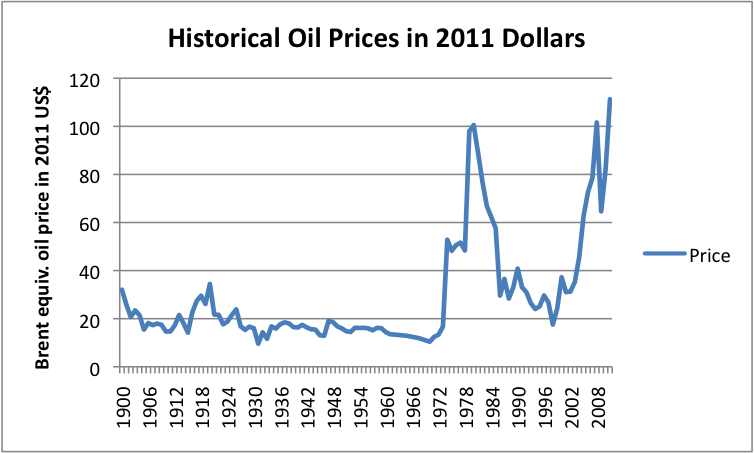 World oil production didn't exactly double in that time frame either- it's never really broken 90MBBL/day, even after the tripling/quadrupling of the price: 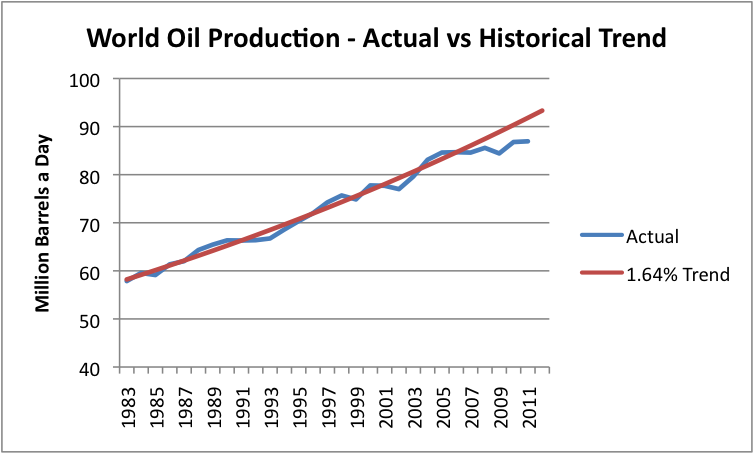 But now "the rest" are using as much as team USA, so energy policy here no longer wags the oil-market dog as much as it did then. Wind energy will likely hit a double-digit percentage of the ISO-New England grid before 2030 (it's pushing 5% now), but distributed PV (behind the ratepayer's meter, and thus not as visible to the grid operator) will be WELL into double digits by then. In the upper midwest of the US wind has already blown by 25% of all annual kwh on the grid in several states, and is cost-competitive with combined cycle gas. Propane is usually stored & shipped as liquids, and in the US it's uses (and price) track that of heating oil. Natural gas is usually pipelined, so the market is constrained by the pipeline infrastructure. The glut of natural gas from the technology development for getting it out of shale and coal seams has depressed the price, and will continue to put downward pressure on price until/unless the distribution infrastructure gets developed to ease getting it to the markets. Right now the soft-costs (marketing , permitting, inspecting etc) are more than half the cost of PV in the Northeastern US. The all-in hardware costs including inverters & racking are well under $1.50/watt and falling. The path to 25 cent/watt PV panel costs by Y2017 are well understood- some vendors will likely hit that by 2015 when the newer-tech production comes online, despite a temporary rise in panel pricing for Y2014. Inverters & racking systems have seen a slower but steady fall in cost too. Simpler racking & wiring systems are continuing to cut into the labor cost of rooftop PV- I'm dubious that the labor costs of PV will rise. In MA panels must be installed by licensed electricians (most of which are at union scale), but that too may change with more integrated racking & wiring systems. To be sure the electricians-hours per job are steadily shrinking. The investment bankers don't just sit around sipping Crown Royal in armchairs saying "What do you think?"- they look at the technology development, the investment in production, and the actual on-the-ground breakdown of the installed costs. They're fairly careful and conservative before making assertions about where the market is going, so when Citi-Group says "$1.12/watt rooftop solar by 2020" I tend to view that as a high-side estimate. Historically over the past 40 years all government & financial industry estimates of how rapidly wind & solar would develop have undershot reality by a huge margin, and there is no reason to believe they've suddenly seen the light. The tipping point on electric vehicles isn't here yet- lithium ion batteries are still north of $450/kwh, but the costs have been cut by half in less than 5 years- showing a nice smooth decline. Some analysts don't think EVs will dominate until it hits $100/kwh, but there will be a real knee in the curve at $200/kwh, at which point high performance high-range mid-sized EVS will no longer be at luxury-car prices:  Elon Musk thinks he can insert a step function into that cost curve, hitting $200/kwh well ahead of "schedule". |
|
|
|
|
FBBP
Veteran Member
Posts:1215
|
| 22 Apr 2014 12:56 PM |
|
Hey Dana - not sure I can agree with all that but incredibly interesting nevertheless. Thanks for taking the time to post it.
With EV battery technology ever expanding, will it transfer to the residential side to allow more non-tied systems to flourish? |
|
|
|
|
Dana1
Senior Member
Posts:6991
|
| 22 Apr 2014 02:00 PM |
|
Posted By FBBP on 22 Apr 2014 12:56 PM
Hey Dana - not sure I can agree with all that but incredibly interesting nevertheless. Thanks for taking the time to post it.
With EV battery technology ever expanding, will it transfer to the residential side to allow more non-tied systems to flourish?
In a word, yes. Solar City is already installing grid-tied residential storage + PV in CA using lithium ion battery packs, and after fighting it out for a year with the utilities in CA the regulators just recently sided with them, to actually turn them on. When storage is cheap enough, the grid tie becomes optional, provided you have sufficient real estate for PV to cover your needs. It's not at all clear that lithium ion will win the stationary storage battle. I'm personally betting against lithium ion in that application, given the very low price point of recently developed grid batteries using a different (and much cheaper) chemistry. The very low maintenance and very low cost of AMBRI's solution makes it attractive despite a sub-90% AC-DC-AC turn around efficiency. The efficiency hit is worth it since it's necessary to keep the metals liquid, and rather than need active cooling, it needs to be kept hot. They are being deployed in Hawaii this year (to moderate wind power output), but they are SO simple and cheap I can't imagine them not garnering market share in CA long before lithium ion becomes cheap enough, and they are easily scalable to household sized systems. The energy density and liquid-metal internals would make it a terrible choice for automotive apps. High amperage local storage like that will become a necessity for neighborhoods with high EV penetration to allow quick-charging at home without melting down the grid transformers. A 50kwh battery would be plenty of local storage for a grid tied home with an EV, but you'd want more for off-grid. If smart chargers make EV batteries two-way grid batteries whenever they are plugged in (one attractive scenario being championed out there) lithium ion may become a significant part of the total grid storage in the intermediate term, but I suspect the solution that wins will do it on cost, since high power density is a premium only worth paying for when you have to lug the battery around. Most of this stuff is flying below the radar of those not directly in the power biz, but it's already happening. The regulatory environment and utility business models are a bigger hurdle than price at this point, but there is progress on those fronts too. Vertically integrated large monopolies like Georgia Power are at some risk of grid defection when (not if) the price of PV + batteries gets cheap enough, which by most credible analysts will be a decade or less out, unless they can figure out how to make money AND allow large quantities of grid-tied PV. Given that GP is on an expensive nuclear path (and pre-charging the ratepayers for the construction) it may already be too late for them- they are likely to have some large stranded-assets to contend with by Y2030, given that you can't even fuel a nuke (let alone build one) at the projected lifecycle per-kwh cost of PV, in a state with better than average insolation levels. If those ratepayers with the sun & financing start breaking the umbilicus to the grid in any numbers the cost of maintaining the grid is left to the remaining ratepayers. If it isn't managed well it could get really ugly, with sky high utility rates for the less well off, and a utility stumbling toward bankruptcy. Many large utilities (rightly) see cheap PV as an existential threat to their business model, but if they (as some have) merely dig in and spend their money putting up roadblocks they will inevitably get crushed. The tsunami of cheap PV is arriving at a breathtaking pace. The next 15 years should be VEEEERY interesting in the utility biz, historically a downright boring business to be in. |
|
|
|
|
Dana1
Senior Member
Posts:6991
|
| 22 Apr 2014 03:11 PM |
|
The short course on why oil heating has no future can be summed up in two pictures: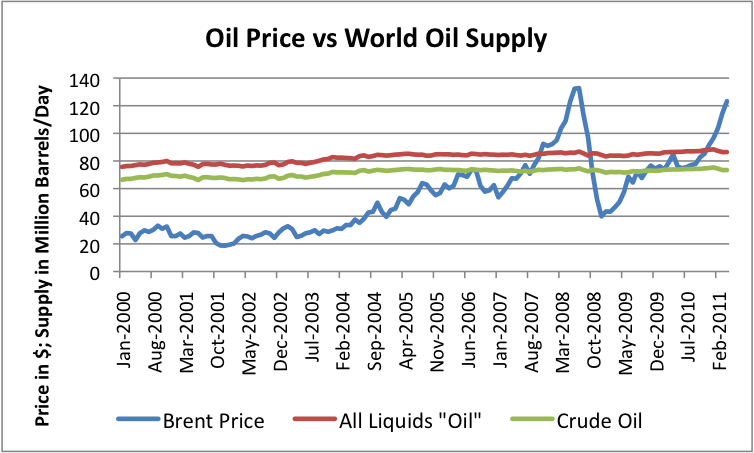 The world supply of oil is fairly inelastic to the price at the current levels. Anybody who can make a buck at $100/bbl oil is already drilling as fast as they can, and opening up drilling on public lands in the US won't much change the world supply (and thus price), only which hole in the ground it's coming out of. The world supply of oil is fairly inelastic to the price at the current levels. Anybody who can make a buck at $100/bbl oil is already drilling as fast as they can, and opening up drilling on public lands in the US won't much change the world supply (and thus price), only which hole in the ground it's coming out of.
If the Saudis or Iraqis could get it together, collectively they might be able to exert short-term downward price pressure, but don't hold your breath. The Saudis already see it in their interest to pump as much as they can, to keep the customer base from moving on to other energy sources. (But it's not clear that other OPEC nations are that clear-sighted.)
...and...

Oil use in emerging markets (primarily India and China) will soon overtake that of the former Soviet Union (FSU) and the OECD (== most of the industrialized world) countries combined.
Oil production can't be expanded at nearly the rate of worldwide increase in demand, and it's highly unlikely that the OECD countries (particularly USA), won't be able reduce consumption at a rate fast enough to keep a lid on oil prices going forward. In less than a decade the emerging market countries will be essentially holding all of the oil cards, not just half the deck like they are today or the pair of queens and a one-jack they held in 1980. If those countries still want the amount of oil most analystsTHINK they will in 2025, anybody with an oil-fired boiler is going to be paying the piper even more they have been over the past 5 years. And if gasoline prices also rise in proportion to the likely increase in crude prices, EVs at the Y2025 price of batteries are going to be seductively cheap in comparison too. Where the exact tipping point on EV is isn't easy to pinpoint, but it's getting close enough that it's no longer in the category blue-sky "some day" fantasy. |
|
|
|
|
Lee Dodge

Advanced Member
Posts:714
|
| 22 Apr 2014 03:14 PM |
|
Posted By seiyafan on 20 Apr 2014 01:27 PM
I bought a 200k house in upstate NY, I think an energy efficient house in this neighborhood would cost north of 300k ( please correct me if I am wrong).
...snip...
Please provide details on the $100k cost differential. In may case, I converted a code-minimum new house design to a more efficient, net-zero source energy house for about $28,600, including the solar PV and solar domestic hot water system necessary to approach or achieve net-zero source energy. If I had used vinyl windows in place of the wood windows that were a personal preference, then the net cost increase would have been $22,080. This cost differential includes an HRV for improved indoor air quality, and insulating shades with side seals that improved both energy efficiency and comfort. Some form of window covering would be necessary in any new suburban home.
All of the cost details are provided at http://www.residentialenergylaboratory.com/costs.html . Payback times are estimated for each of the energy-related improvements. As Dana1 states, some of the improvements also improve the comfort level in the house.
So the $100k cost adder for energy efficiency that you provided seems wildly exaggerated. |
|
Lee Dodge,
<a href="http://www.ResidentialEnergyLaboratory.com">Residential Energy Laboratory,</a>
in a net-zero source energy modified production house
|
|
|
Dana1
Senior Member
Posts:6991
|
| 22 Apr 2014 06:15 PM |
|
I dunno, some people LIKE to spend too much on efficiency measures- I could hit $200K if you asked me to! :-) (A bit more thermal mass can provide at least some energy savings- let's add a marble staircase!)
But seriously, in retrofits many measures that are cheap in new construction have prohibitive economics unless rolled into a project that was going to be undertaken for other reasons eg: Putting a couple inches of insulating sheathing on the exterior only makes sense on an already-built house when the siding is in such bad shape as to need replacing. (In some houses this won't happen for a century or more.)
Basements in existing pre-Y2K houses usually aren't insulated, but the economics of insulating a foundation in a cold climate can be pretty favorable if you do it on a least-cost methods & materials (5" of closed cell polyurethane ain't it.) There are plenty of ways to screw it up, but it doesn't take rocket science to get it right. |
|
|
|
|
joe.ami
Veteran Member
Posts:4377
|
| 23 Apr 2014 09:02 AM |
|
Posted By BadgerBoilerMN on 21 Apr 2014 10:23 AM
Posted By joe.ami on 21 Apr 2014 10:06 AM
If you sell the house and it is worth more, that is part of the ROI equation.
If you sell the house for more than you invested in it...please let me know. It would be one for the record books.
You requalified my reply. If the house is worth more than a house of lower performance, that is part of the ROI. |
|
Joe Hardin
www.amicontracting.com
We Dig Comfort!
www.doityourselfgeothermal.com
Dig Your Own Comfort! |
|
|
Bob I
Veteran Member
Posts:1435
|
| 23 Apr 2014 09:11 AM |
|
your last post begs the question: what do you see as the " least-cost methods & materials for insulating a foundation in a cold climate"? |
|
| Bob Irving<br>RH Irving Homebuilders<br>Certified Passive House Consultant |
|
|
Dana1
Senior Member
Posts:6991
|
| 23 Apr 2014 10:02 AM |
|
Posted By Bob I on 23 Apr 2014 09:11 AM
your last post begs the question: what do you see as the " least-cost methods & materials for insulating a foundation in a cold climate"?
In some instances at moderate-R ICFs work on new construction (when time= money), but for retrofits putting some rigid EPS (seams sealed) against the foundation trapped to the foundation by a non-structural studwall with unfaced batt insulation works. If using reclaimed/recycled rigid foam, all-foam solutions can sometimes be even cheaper than virgin-stock EPS + studwall & fiber solutions. The amount of foam-R to fiber-R on the foundation of at least the IRC prescriptive for above grade walls works, even though without sheathing to be concerned about you can cheat a little if necessary. (Assume R15 fiber max for 2x4 walls, R23 max for 2x6,then follow the IRC guidance for the minimum amount of foam.) It's useful to put an inch of EPS between the bottom plate of the studwall and slab (or if insulating the slab, run both the slab-foam & subfloor under the bottom plate) as both a thermal & capillary break to let the bottom plate run drier. Some amount of spray foam is useful for insulating & air sealing the
band joist & foundation sill to the foundation wall, and cheaper than cut'n'cobble on rigid foam in those areas in high-labor markets. Fattening out the band-joist R with rock wool (for better fire resistance) or high density fiberglass works too, as long as the R-ratios heed the IRC prescriptive. How much R on the foundation makes simple economic sense depends a lot on your fuel costs and the material cost of the insulation. But a good starting point to work from can be found in Table 2, p.10 of this document. Note that those are "whole-wall" R-values, with the thermal bridging of any framing accounted for. For non-structural studwalls with single wall plates and 24" o.c. framing the framing fraction is about 20%, at which a 2x4 studwall with R13 cavity fill and half-inch gypsum on the interior comes in at about R10.5+ R_foam, if R15 cavity fill it's about R11 + R_foam. For a 2x6 studwall with R21-R23 cavity fill figure on about R17 + R_foam So as an example, to hit the Table-2 recommendation of R20 foundation in climate zone 6, note that the IRC prescriptive for foam is R7.5 min with a 2x4 wall for above-grade walls, so with a 2x4 studwall w/R13s you'd be a bit shy if you went with 1.5" of Type-II EPS (R6.3), but pretty much right on the money with 2" (R8.4), and would have some dew point margin for the above grade section of wall (you won't end up with condensation running down the surface of the foam wetting the fiber or causing mold issues on the studs.) |
|
|
|
|
| You are not authorized to post a reply. |
|
Active Forums 4.1
 |
Membership: |
 |
Latest:
IntegratedHomes |
 |
New Today:
0 |
 |
New Yesterday:
1 |
 |
Overall:
35026 |
 |
People Online: |
 |
Visitors:
191 |
 |
Members:
0 |
 |
Total:
191 |
|
|
|