DAND

New Member

Posts:51
 |
| 20 Sep 2014 04:50 PM |
|
Can someone, anyone tell me when/where one reaches a point of diminishing returns on slab insulation; where the cost of adding more R's is not worth the money spent to achieve said greater R value?
I am leaning toward 2+ pound EPS, but will certainly listen to and consider all advise.
Thanks
Dan |
|
|
|
|
|
|
ICFHybrid

Veteran Member
Posts:3039
|
| 22 Sep 2014 05:21 PM |
|
You'd have to state what your location is. I have radiant floors in Climate Zone 4c and I wish I had done 4" instead of 2". |
|
|
|
|
Lbear
Veteran Member
Posts:2740

|
| 22 Sep 2014 05:54 PM |
|
Posted By ICFHybrid on 22 Sep 2014 05:21 PM
You'd have to state what your location is. I have radiant floors in Climate Zone 4c and I wish I had done 4" instead of 2".
Without radiant floors do you think 2" would suffice in a Zone4 climate? |
|
|
|
|
DAND
New Member
Posts:51
|
| 22 Sep 2014 09:51 PM |
|
My bad,
Western Colorado, 7,680 feet altitude. I don't know the zone, and I am planning a slab on grade monolithic pour with radiant heat floors.
Is it better to speak of total R values since there are different R's/inch depending on the insulation type, thickness, and weight?
|
|
|
|
|
sailawayrb
Veteran Member
Posts:2283

|
| 22 Sep 2014 10:47 PM |
|
The MINIMUM recommended R-value for hydronic radiant slab-on-grade concrete floors is:
Min R-value = 0.125 (Ti –To)
Where: Ti is the indoor air dry bulb design temp in degrees F and To is the outdoor air dry bulb design temp in degrees F. Typical indoor design temps are between 65 to 75 degrees F. You may be able to locate your outdoor design temp here:
ACCA Manual J Outdoor Design Conditions
If not, your building planning agency should be able to advise you.
So if Ti is 72F and To is 10F, your MINIMUM R-value would be R7.75. EPS is about R5 per inch thickness. Again, this is the MINIMUM R-value that should result in about 10% of your hydronic heating BTUs being lost downward into the ground. So you may want to bump up the R-value based on insulation cost versus heating operational cost. So you might want to go with 2” of EPS for this example. Or another way of looking at this, 2” of EPS is about R10 and could minimally handle a delta T of 80F (i.e., 10/0.125). So if Ti is 72F, 2” of EPS could minimally handle a To of -8F.
We typically recommend multiplying the aforementioned MINIMUM R-value by 1.5 to achieve a higher performance hydronic radiant floor (i.e., use 0.1875 instead of 0.125). You will get differing opinions on this and really only a good ROI will provide the right answer for each unique situation. Please do keep in mind that you only get one chance to make this decision...and we have never had anyone complain about having too much insulation...
|
|
| Borst Engineering & Construction LLC - Competence, Integrity and Professionalism are integral to all that we do! |
|
|
ICFHybrid
Veteran Member
Posts:3039
|
| 22 Sep 2014 11:52 PM |
|
Without radiant floors do you think 2" would suffice in a Zone4 climate? Probably. It would be adequately comfortable to the feet and the heat loss would be something you could live with. But I would follow all the recommendations for insulating any exposed or nearly exposed edges, nevertheless. I have ICF, so my slab edges are insulated, but I can't help but thinking about the unnecessary heat loss out the bottom when the radiant slabs are working. |
|
|
|
|
DAND
New Member
Posts:51
|
| 23 Sep 2014 11:21 AM |
|
Thanks Sailawayrb. |
|
|
|
|
Dana1

Senior Member
Posts:6991
|
| 23 Sep 2014 12:19 PM |
|
The "point of diminishing returns" depends on what your present and future energy costs are presumed to be, as well as the cost of the materials, and what your goals are regarding energy effiiency. A good starting point can be found in Table 2 p10 of this document. (Read the whole first chapter- it's short.) If you use reclaimed EPS/XPS from recyclers you can double those recommendations and it would still cost less than virgin stock XPS or Type IX (2lb) EPS at the table values. There is very little rationale for using Type-IX EPS under residential slabs. If it's well drained even Type-I EPS (1lb density) has adequate compressive strength for keeping 3.5-4" slabs from cracking under the loads, but in thinner sheets you're less likely to ding corners or break the sheets in handling if you bump that to Type-II (~1.5lbs nominal). Type-II EPS would be good enough even for more fragile 2" rat-slabs unless you hold polka-parties for the 400lb people on a regular basis.  Under a reiniforced 3.5-4" slab, Type-II EPS is plenty. Type-IX makes it easy to staple radiant floor tubing directly to the foam, since it has better staple retention, which is a reason some people spec it. |
|
|
|
|
sailawayrb
Veteran Member
Posts:2283
|
| 23 Sep 2014 01:34 PM |
|
You are most welcome DAND :-)
You raise a good point ICF. Since a hydronic radiant (HR) floor will operate at a temp higher than the design indoor temp (perhaps only a couple degrees higher for a high performance house with a good HR emitter design…and perhaps many degrees higher for a low performance house with a lousy HR emitter design), a HR floor will actually have a greater heat loss than an unheated floor.
The aforementioned MINIMUM R-value equation is directly from Sigenthaler. As you know, when you properly design a HR floor, you need to breakout the downward floor heat loss separately from the total room heat loss. You do this because you need to ensure that the upward floor heat gain from the HR emitter will at least be equal to the total room heat loss minus the downward floor heat loss at the outdoor design condition. Of course, the heat source will need to provide this required upward floor heat gain plus the ACTUAL downward floor heat loss.
When running Siegenthaler’s HR design software several years ago, we became aware that it only uses Manual J calculated downward floor heat loss which is based on the indoor/outdoor design temps and NOT on the ACTUAL temp of the heated floor. So when we developed our HR design software, we addressed this deficiency. Basically, the Manual J calculated downward floor heat loss is entered into our software just like other software. However, our software then uses this entered downward floor heat loss and also uses the entered indoor/outdoor design temps to reverse engineer what the effective R-value of the under-slab insulation must be. Then our software uses the ACTUAL temp of the heated floor to determine the ACTUAL downward floor heat loss and also tells you what percentage of the total BTUs being supplied to the HR emitter will be lost as downward floor heat loss. Of course, the required heat gain that the heat source will need to provide can now also be properly determined too.
Anyhow, bumping Siegenthaler’s equation up by 1.5 seems entirely appropriate to us for high performance homes and brings the percentage of downward floor heat loss down from about 10% to about 5%. Again, our HR floor design software will tell you exactly what the downward floor heat loss will be.
Fully agree Dana. We don't staple tube to EPS for all the reasons previously discussed ad nauseam. |
|
| Borst Engineering & Construction LLC - Competence, Integrity and Professionalism are integral to all that we do! |
|
|
jonr
Senior Member
Posts:5341
|
| 23 Sep 2014 02:43 PM |
|
... and what your goals are regarding energy effiiency. Yes, with a major one being how long you are going to live there. It's best to do the calculations, but "it will pay for itself in the time I'll live there" is a reasonable default rule for energy related upgrades. |
|
|
|
|
Surfsup

Basic Member
Posts:349
|
| 23 Sep 2014 03:21 PM |
|
Interesting. As I look at it, the R value for any "zone" should be about the same.
Indoor temps are consistent for most people in heating climates (let's say 68-72 degrees for most homes whether you are in zone 3 or zone 6). the sub-freezing temperature is going to be universally around 50 degrees.
So the Ti and To don't really change. R5 seems to be the minimum using 85 and 50. I used R10 in Z5 |
|
|
|
|
sailawayrb
Veteran Member
Posts:2283
|
| 23 Sep 2014 03:49 PM |
|
No, To is the outdoor air dry bulb design temp (NOT the ground temp) and it varies considerably by location. Most of the heat loss from residential slab-on-grade floors is via the exposed perimeter. This is why you use the exposed perimeter length in feet (NOT the square footage of the floor) to determine the slab-on-grade heat loss. Now, if you have a huge square-shaped commerical building, you might start factoring in ground temp and use floor area. |
|
| Borst Engineering & Construction LLC - Competence, Integrity and Professionalism are integral to all that we do! |
|
|
Dana1
Senior Member
Posts:6991
|
| 23 Sep 2014 05:29 PM |
|
Posted By DAND on 22 Sep 2014 09:51 PM
My bad,
Western Colorado, 7,680 feet altitude. I don't know the zone, and I am planning a slab on grade monolithic pour with radiant heat floors.
Is it better to speak of total R values since there are different R's/inch depending on the insulation type, thickness, and weight?
I'd somehow missed this post when I scanned the thread. At ~7700' in western CO you are probably in either climate zone 7 or the cold edge of zone 6: 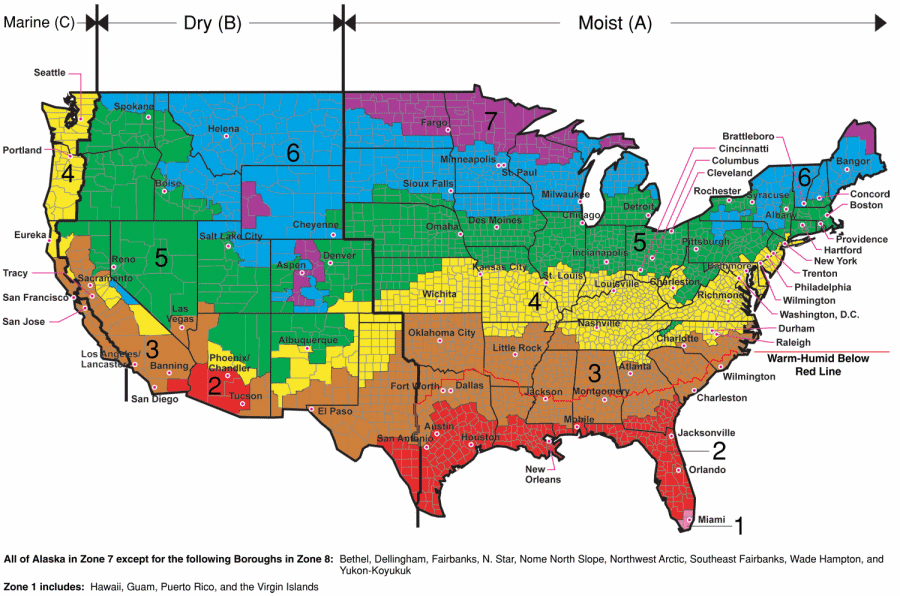 With radiant floors it would be wise to add at least R5-R8 to the recommendations for un-heated slabs in Table 2 of the BA-1005 document. So you're looking at R15 minimum (if zone 6) or R20 (if zone 7), but R25 would likely be economically rational even if using virgin-stock EPS. The note on the bottom of page 11 states: "If a slab is radiantly heated it's temperature will be much higher, and hence higher insulation levels are justified. Although little research has been conducted to date (Beaver Plastics 2000), R-values around double that of unheated slabs is recommended."
(emphasis mine) So instead of the unheated slab recommendation for R10 (climate zone 6) or R15 (climate zone 7) they suggest R20 (zone 6) or R30 (zone 7) If you use reclaimed foam R30 is a no-brainer, since it costs about the same as (often less than) virgin stock R10. That would be 7" of Type-II or Type-IX EPS. While 7" stock is kind of rare 3" and 4" are common, and double-layering with the seams staggered provides a thermal break over the potentially heat-leaky seams. Most PassiveHouse homes put considerably more foam than that even under unheated slabs. If using reclaimed foam, any density EPS or XPS would be find, but under no circumstances should you use polyisocyanurate under a slab, since it is likely to take on water over time, losing a large fraction of it's performance. |
|
|
|
|
sailawayrb
Veteran Member
Posts:2283
|
| 23 Sep 2014 09:11 PM |
|
"If a slab is radiantly heated it's temperature will be much higher, and hence higher insulation levels are justified. Although little research has been conducted to date (Beaver Plastics 2000), R-values around double that of unheated slabs is recommended."
That’s not a very definitive statement…but it does correctly draw your attention to properly considering and addressing this issue! Depending on the overall performance of the house and the performance of the HR emitter, the heated slab may only be a couple degrees higher than the indoor design temp (i.e., NOT necessarily "much higher"). So I think one really needs to work out the heat transfer…
So what do we think the outdoor design temp is at this location? Perhaps -14F? So perhaps 0.125 x (72 + 14) or R10.8 would be the Sigenthaler MINIMUM. We would normally recommend multiplying that by 1.5 for a high performance house and a high performance HR emitter to get a R16.1 MINIMUM, which would then cause us to recommend an even 4” of EPS which would be about R20.
Again, this would be for a high performance house and a high performance HR emitter. So if that’s not the case and the floor temp is actually "much higher", than R30 or 6" of EPS doesn’t seem all that unreasonable. We would still want to see the software tell us that the ACTUAL downward floor heat loss will be equal to or less than 5% of the total supplied BTUs.
Siegenthaler recommends 10% or less. A 10% loss is often commonly accepted as a reasonable engineering economic compromise. For example, sizing pipes for a 10% hydraulic friction head loss is a commonly accepted engineering practice.
|
|
| Borst Engineering & Construction LLC - Competence, Integrity and Professionalism are integral to all that we do! |
|
|
DAND
New Member
Posts:51
|
| 24 Sep 2014 02:05 PM |
|
Thanks for the zone map Dana it was a great visual help. You're right about the 6/7 zone, it is hard to see the counties from the map, but it is close enough. I'll use 7 just in case.
This house is for my brother. After visiting me in KY last year and seeing my energy bills, 12 month average of $52/month he was sold on SIP construction. I built a SIP house in 2010. I will tweek his house with Sip Walls, Msip roof, and Icf , perimeter knee walls (to achieve a 9 foot ceiling using 8' x 24' SIP wall panels plus the perimeter knee wall) with the interior portion of the top course of Icf' forms cut down 5 inches to allow for an insulated outer wall, but where the concrete will flow out to the inside edge of the outside form wall. (hope that was clear).
The difference in climate and altitude dictates the need for more slab insulation. I just did not know how to calculate it.
I'll hit Borst's software later.
I understand the cost benefit of recycled insulation.
Thanks everyone for your input, it was very helpful.
Sorry this all runs together, I cannot get the line breaks sorted out. |
|
|
|
|
Dana1
Senior Member
Posts:6991
|
| 24 Sep 2014 03:04 PM |
|
The outside design temp is probably about -10F (Leadville's design temp is -14F, and that's ~2500' further up the hill from there.) But simple formulas like Siegenthaler's don't address the widely disparate costs of energy by fuel source. Heating with propane or #2 oil is a heluva lot more expensive than natural gas or wood boilers, and that will very much affect the financial crossover point. (In my neighborhood propane costs ~4x as much as natural gas on a $/BTU basis.) The altitude has no effect on the insulation requirements, but the deep subsoil temps do. Subsoil temps vary pretty dramatically in mountainous areas, but on the western slope of the Rockies in central CO you're looking at ~40F or so, more than 15F colder than a typical Kentucky location.  To deal with the line-break/text formatting issues on this site, use a different web-browser. (FireFox and Chrome both seem to work OK.) FWIW: 4" of EPS is ~R16, not R20, and 6" of EPS is ~R25, not R30. But you get the picture anyway. |
|
|
|
|
sailawayrb
Veteran Member
Posts:2283
|
| 24 Sep 2014 03:55 PM |
|
True, type II is often rated R4, but type IX is often rated R5. And then there is XPS that is often rated R5.4…but we don’t want to go down that bunny hole do we?
Precisely and why my opening statement was:
“You will get differing opinions on this and really only a good ROI will provide the right answer for each unique situation.”
|
|
| Borst Engineering & Construction LLC - Competence, Integrity and Professionalism are integral to all that we do! |
|
|
Dana1
Senior Member
Posts:6991
|
| 24 Sep 2014 05:24 PM |
|
Type IX EPS will only be rated ~R5/inch at an average foam temp of 25F or so. For the average foam temp to be that cool under the ~80-100F bottomside of a heated slab that house would have to be located at 7200' in Antarctica. With ~40F deep subsoil temps and 80F bottom side of a heated slab you're looking at about 60F for an average foam temp, which will run about R4.4/inch, (to Type II EPS's ~R4.3/inch at that temp). Even graphite loaded Type IX NEOPOR would need to have an average foam temp of 40F to hit ~R5. There is no Type IX EPS that comes anywhere near R5/inch at the temps you would see in this application. For rough estimation purposes for sub-slab foam, refer to the FTC requirement that only value at 75F average temp through any insulation may be used for labeling purposes, which is ~R4.2/inch, very close to the performance of Type II EPS @ 75F. |
|
|
|
|
Surfsup
Basic Member
Posts:349
|
| 24 Sep 2014 05:29 PM |
|
So what do you guys think if the insulating bubble wrap? :-) |
|
|
|
|
Dana1
Senior Member
Posts:6991
|
| 24 Sep 2014 05:41 PM |
|
Posted By Surfsup on 24 Sep 2014 05:29 PM
So what do you guys think if the insulating bubble wrap? :-)
All bubble wrap needs is proper insulation!  |
|
|
|
|