3cityblue

Basic Member

Posts:111
 |
| 04 Aug 2015 09:24 AM |
|
Have a few questions regarding details related to conditioned crawl spaces.
1. Is a conditioned crawl space worth the added cost/detailing? My research doesn't necessarily fall heavily one way or the other, but Mr. Lstiburek thinks they are a good idea. My goal is to build a pretty tight, well insulated house. Build is in Boise ID, Zone 5B.
2. I am planning on using ICF for the stem wall in conjunction with Watkins or similar hangers to avoid the need for a band joist. That detail would make it hard to install drywall as the thermal barrier. Was wondering if anybody has a better idea or has had any experience with intumescent coatings. Can you recommend a product? Have any trouble getting code authorities to buy off on it? Is there a better approach?
3. Is there any reason that the HRV could not satisfy the requirement for conditioned space ventilation (20 cfm in this case)? Plan on using ducted mini-splits for HVAC with minimum duct work. Seems like a balanced HRV sized for this extra load would be a better solution than a couple of random transfer grilles.
Thanks for any help or ideas.
|
|
|
|
|
|
|
BadgerBoilerMN

Veteran Member
Posts:2010
|
| 04 Aug 2015 09:35 AM |
|
It seems you assume "conditioned" means actively e.i. with ductwork, or habitable e.i. living space. Conditioned, as it relates to a crawl space , is simply not isolated from, say the crawl space e.g. a vapor barrier between floor and crawl space. |
|
| MA<br>www.badgerboilerservice.com |
|
|
Bob I
Veteran Member
Posts:1435
|
| 04 Aug 2015 09:38 AM |
|
Basements and crawl spaces are the forgotten/ignored elements in building houses. they MUST be conditioned in order for the house to perform correctly. This is not an optional project, but is a vital part of building a good thermal envelope. Would you go outside without shoes in the winter? You could do that but it would be uncomfortable; same goes for your house. Since you are using ICF's you have the walls done so you just need to insulate and install a vapor barrier on your floor. |
|
| Bob Irving<br>RH Irving Homebuilders<br>Certified Passive House Consultant |
|
|
3cityblue
Basic Member
Posts:111
|
| 04 Aug 2015 09:45 AM |
|
This crawl space would not be used for living or storage, and no mechanical equipment to service either. Of course the required vapor barrier would be installed as well. My questions mainly relate to code requirements for thermal barriers and ventilation/conditioning.
Since you bring up insulation again, my research suggests no more insulation is needed at the floor interface or the ground as the crawl is now conditioned and part of the thermal envelope. Am I all wet here? Thanks.
|
|
|
|
|
BadgerBoilerMN
Veteran Member
Posts:2010
|
| 04 Aug 2015 09:47 AM |
|
Vapor barrier and insulation below the crawl space . The floors above with radiate heat the the slab below. |
|
| MA<br>www.badgerboilerservice.com |
|
|
Bob I
Veteran Member
Posts:1435
|
| 04 Aug 2015 09:54 AM |
|
with the crawl space conditioned, you do not need insulation or a vapor barrier in the first floor assembly. |
|
| Bob Irving<br>RH Irving Homebuilders<br>Certified Passive House Consultant |
|
|
jonr

Senior Member
Posts:5341
|
| 04 Aug 2015 10:04 AM |
|
Just don't "semi-condition" it. Ie, maintain enough air flow (warming the space) or add dehumidification to control humidity down there. |
|
|
|
|
Jelly
Veteran Member
Posts:1017
|
| 04 Aug 2015 11:17 AM |
|
Posted By 3cityblue on 04 Aug 2015 09:45 AM
...My questions mainly relate to code requirements for thermal barriers...
I think the original poster is asking whether the EPS of the ICF form needs to be covered in a conditioned crawl (thermal barrier to prevent fire spread). |
|
|
|
|
Bob I
Veteran Member
Posts:1435
|
| 04 Aug 2015 11:23 AM |
|
I would not install drywall there anyway as the paper could get moldy. Use something that will not grow mold - intumescent paint probably would be the easiest & any good paint store could help. (and the big box stores do not qualify as "good paint stores") |
|
| Bob Irving<br>RH Irving Homebuilders<br>Certified Passive House Consultant |
|
|
Jelly
Veteran Member
Posts:1017
|
| 04 Aug 2015 01:04 PM |
|
Posted By Bob I on 04 Aug 2015 11:23 AM
I would not install drywall there anyway as the paper could get moldy. Use something that will not grow mold - intumescent paint probably would be the easiest & any good paint store could help. (and the big box stores do not qualify as "good paint stores")
I assumed there would be a concrete floor/rat slab in the crawl? |
|
|
|
|
Dana1
Senior Member
Posts:6991
|
| 04 Aug 2015 03:21 PM |
|
In zone 5B it's worth putting down at least a couple inches of EPS under a rat slab in the crawl space. In some jurisdictions intumescent paint would be a sufficient to meet fire code, others would want to see a true thermal barrier such as half-inch gypsum. With a properly waterproofed foundation walls, an insulated slab with a vapor barrier, and ventilating the space with conditioned space air there shouldn't be any mold issues from using standard grade drywall down there. If you're still concerned, exterior grade half-inch fiberglass faced gypsum sheathing (eg GP DensGlass) is about as good as it gets. |
|
|
|
|
3cityblue
Basic Member
Posts:111
|
| 04 Aug 2015 04:35 PM |
|
While I'm sure some EPS and a rat slab would make for a better space, but is the added cost worth it? If my calcs are correct, the ICF wall, with a properly detailed moisture barrier gets me to about R-19 for the space and moisture should not be a concern. Budget concerns will probably make the ground EPS and rat slab for protection a no go.
Is using the HRV for conditioned air requirements feasible? Any real downsides to this?
Like most green strategies there are the inevitable tradeoffs. Budget is one of them, and if the costs get too high then it might tip the scales to not doing a conditioned crawl space at all, and using the savings for better floor insulation and a moisture barrier. Would like to do conditioned and would be satisfied with "pretty darn good" as opposed to "perfect". Thanks.
|
|
|
|
|
Dana1
Senior Member
Posts:6991
|
| 04 Aug 2015 05:48 PM |
|
Posted By 3cityblue on 04 Aug 2015 04:35 PM
While I'm sure some EPS and a rat slab would make for a better space, but is the added cost worth it? If my calcs are correct, the ICF wall, with a properly detailed moisture barrier gets me to about R-19 for the space and moisture should not be a concern. Budget concerns will probably make the ground EPS and rat slab for protection a no go.
Is using the HRV for conditioned air requirements feasible? Any real downsides to this?
Like most green strategies there are the inevitable tradeoffs. Budget is one of them, and if the costs get too high then it might tip the scales to not doing a conditioned crawl space at all, and using the savings for better floor insulation and a moisture barrier. Would like to do conditioned and would be satisfied with "pretty darn good" as opposed to "perfect". Thanks.
At Boise's 45-50F deep subsoil temps the mold hazard goes up in the crawlspace considerably unless you put down at least SOME slab insulation. 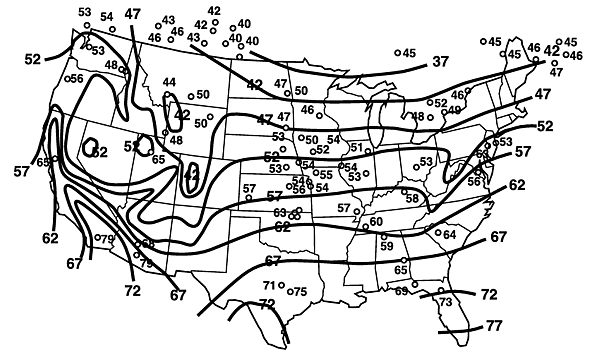 Even an inch of EPS makes a difference for the mold hazard but as much as two is probably still financially rational on energy savings over the longer term. If you use reclaimed/recycled roofing foam rather than virgin stock the cost of the foam is negligible (15-35 cents per square foot for used 2" EPS) and a rat-slab is worth having in any crawlspace. |
|
|
|
|
Lee Dodge

Advanced Member
Posts:714
|
| 06 Aug 2015 12:02 PM |
|
I use an HRV for pulling air into my conditioned crawl space through four floor vents on the four sides of the house. The stale air is exhausted by the HRV from the crawl space. Fresh air is pumped from the HRV into the air ducts on the exit side of the hot-air furnace, so the fresh air goes into the living space. This continuous circulation of air through the house and crawl space leaves the crawl space dry and clean, although this geographic area is dry anyway.
I have 1" (25 mm) XPS rigid foam under the 8" (203 mm) of gravel that makes up the floor of the crawl space. The gravel is covered with a plastic vapor barrier. More details are provided at www.residentialenergylaboratory.com/rel_description_am.html. |
|
Lee Dodge,
<a href="http://www.ResidentialEnergyLaboratory.com">Residential Energy Laboratory,</a>
in a net-zero source energy modified production house
|
|
|
BadgerBoilerMN
Veteran Member
Posts:2010
|
| 06 Aug 2015 03:32 PM |
|
Stale air is what you make it. A vapor-protected "conditioned" crawl space is not inhabited and barring elevated radon, will not be "stale" by definition. Generally stale air is constituted by elevated CO2, CO or humidity levels generated by human activity. By exhausting the crawl space you have defeated the principal purpose of any ventilation system; to remove contaminants.
One should read, understand and follow the vast and accurate information provided by the various HRV/ERV manufacturers with at least a casual glance at ASHRAE 62.1.
Since we ventilate to maintain IAQ for the inhabitants, it pays to focus on their occupancy and living habits.
|
|
| MA<br>www.badgerboilerservice.com |
|
|
Lee Dodge
Advanced Member
Posts:714
|
| 06 Aug 2015 04:40 PM |
|
BadgerBoilerMN-
If your comments about stale air are the result of my post, then I have failed to communicate to you how my HRV system works. The air in the first floor living space is considered "stale" air in that it has elevated levels of CO2 from human beings breathing (and from the natural gas range and oven that escape being exhausted by the vent fan), from kitchen and bathroom odors that are not already handled by their respective exhaust fans, and whatever other human activities might contribute to the air. It is necessary to remove that stale air from the living area, plus any buildup of radon gas that makes it past the radon remediation system buried in the gravel in the floor of the crawl space, and any excess humidity that might be present in the conditioned crawl space.
To accomplish that goal, I put the two inlets to the HRV in the crawl space, with the inlets pulling air in at two widely separated locations in the crawl space. This airflow pulls the stale air from the living area through four floor grates between the first floor and the crawl space, PLUS the air in the crawl space with its buildup of radon gas and possible excess humidity. All of this "stale" air is exhausted by the HRV after passing over the heat exchanger to pre-heat (or pre-cool) the incoming fresh air. As described above, the fresh air is first circulated in the living area by the ducts for the hot-air furnace. This establishes a continuous airflow from the first floor living area through the conditioned crawl space and then out of the house. There is a slight reduction in the continuously measured radon level when the HRV is operating. |
|
Lee Dodge,
<a href="http://www.ResidentialEnergyLaboratory.com">Residential Energy Laboratory,</a>
in a net-zero source energy modified production house
|
|
|
BadgerBoilerMN
Veteran Member
Posts:2010
|
| 06 Aug 2015 05:40 PM |
|
Too many moving parts for me.
If you have active radon remediation it should be taking the radon level to design. If another fan--the HRV is on simultaneously it would be pulling against the Radon fan.
We prefer to exhaust air at point of pollution e.g. bathrooms, kitchen and more and more, the master bedroom where two people, a TV, computer and other heat and CO2 producers may reside.
Air is rarely goes where you want it to unless you give it no choice. |
|
| MA<br>www.badgerboilerservice.com |
|
|
jonr
Senior Member
Posts:5341
|
| 06 Aug 2015 06:13 PM |
|
Fresh air is pumped from the HRV into the air ducts on the exit side of the hot-air furnace, so the fresh air goes into the living space. I'd be interested in knowing what pressure your HRV produces and what pressure your furnace produces (when on). I expect they interfere with each other. You might calculate the amount of additional negative pressure you are creating in the crawlspace and positive pressure above it and consider the effect on ACH. |
|
|
|
|
BadgerBoilerMN
Veteran Member
Posts:2010
|
| 06 Aug 2015 07:02 PM |
|
It is considered good practice to run fresh air into the return of a central heating and/or cooling system as balancing is usually required in any case.
Still, a crawl space is not considered conditioned as you are simply moving more air than you need to and perhaps not getting the right air moved...I don't care who you are :-). |
|
| MA<br>www.badgerboilerservice.com |
|
|
jonr
Senior Member
Posts:5341
|
| 06 Aug 2015 10:04 PM |
|
See here and here (full/standalone HRV ducting is best). |
|
|
|
|