Posted By abh3 on 11/18/2009 1:14 PM
So use the 275 gallon tank as a container for the working fluid from the panel or roof system, with a heat exchanger coil for potable water suspended in it? That might eliminate the need for propylene glycol, an expansion tank, etc. too if it were a drain-back system... But it seems like it would take a lot of capacity in the heat exchanger to have much hot water and/or a really efficient type exchanger, like large I.D. copper maybe.
Greywater heat recovery would be great but might get complicated getting the heat back ahead of the water heater with distant bathrooms... Are there thermostatic valves or some device to allow the water warmed by the drain to flow back to the water heater?
Some people have done OK using a coil of PEX or HDPE as the potable HX in the atmospheric-pressure drainback tank:
http://www.builditsolar.com/Experimental/PEXColDHW/TankConstruction.htm
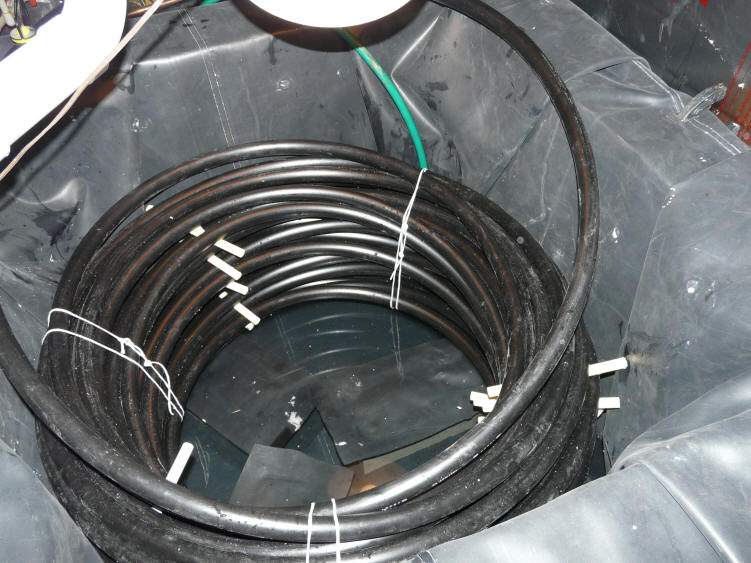
With copper you can do with a much lower volume due to the high conductivity.
Multiple small-ID coils work better than an single large diameter coils due to a more optimal surface area to internal volume ratio, but it complicates the fabrication.
This multi-coil sucker was complete overkill:
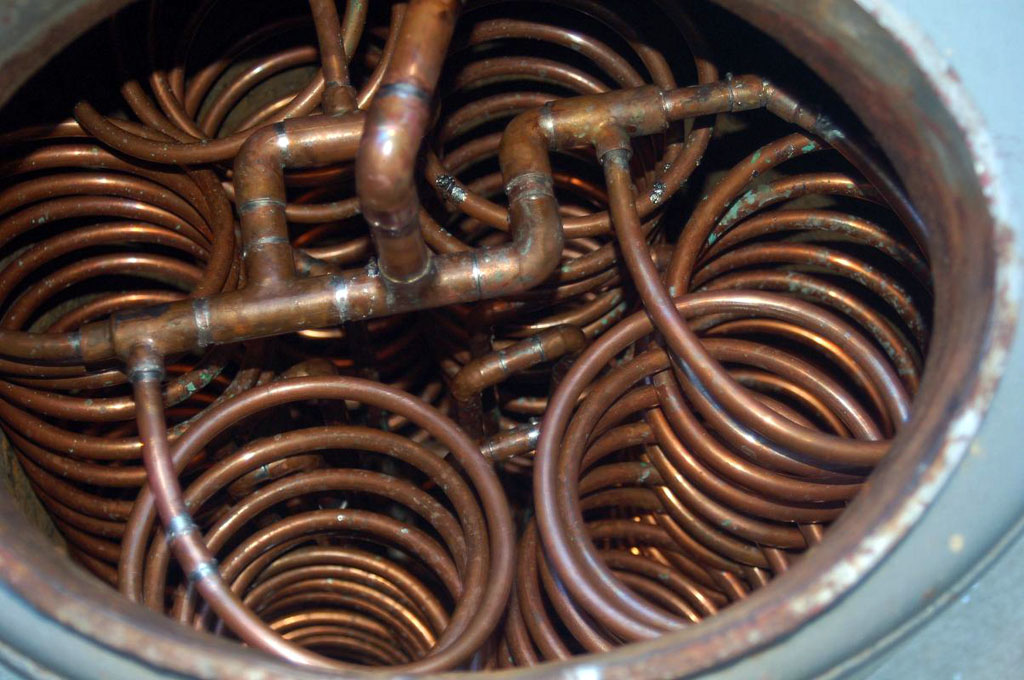
http://www.builditsolar.com/Projects/WaterHeating/Matt1KSystem/SystemPhotos.htm
http://www.builditsolar.com/Projects/WaterHeating/Matt1KSystem/solar%20panel%202-1.pdf'
The coils in a commercial
Ergomax DHW heat exchanger tanks are nowhere near this big, and 4-5 coils crank out 5+ gpm of 120F+ water out of a 130F tank just fine. (I have one of them on my heating system as DHW for my house in MA.)
You don't need valves or anything else on the greywater HX- they're plumbed in-line with the water feeds and need no controls. They are low volume on the potable side, and the output temps don't typically exceed 75-80F with 100-105F drainwater. Potable-side plumbed in-line with the cold feed to the entire house (which is by definition ahead of the cold feed to the HW heaters), and drain-side at the main drain exit of the whole house is the preferred method from a total efficiency point of view. It does mean that long cold water draws from other taps will be room-temperature-ish and never gets cold while someone is taking an endless shower. 3-5 gallons after the shower has stopped you'll be at street-water temp again. You'd be looking at something like this:
Well/street water> drainwater HX (output T to house cold)>solar tank HX> Hot water heater
If your normal late-summer water in from the street/well is already 75F you may want to T off the cold to the kitchen ahead of the drainwater HX, but feed the rest of the house with it's output.
For variations on plumbing configurations for drainwater HX see:
http://www.renewability.com/uploads/documents/en/home_retrofit.pdf
http://www.ecoinnovation.ca/en/residential-solutions/connection-types.html
The vertical type drainwater HX really need to be as close to perfectly plumb to max 'em out. Laid on their side the performance is degraded by 80-90%(!). But they're completely passive & no-maintenance, should last and perform for decades. I suspect with the horizontal Ecodrain you'll be spending some plunger-time on a regular basis (TBD).