|
|
|
A DIFFERENT RENEWABLE ELECTRIC SYSTEM
Last Post 20 Feb 2014 11:26 AM by georgec. 12 Replies. |
Sort:
|
|
 Prev Next Prev Next |
You are not authorized to post a reply. |
|
georgec

New Member

Posts:97
 |
| 17 Feb 2014 02:48 PM |
|
I am a bit away from getting into this, still working on the details of the house, but renewable electricity always have been an interest, part of the reason I decided to build new rather than convert my existing home which is completely backwards in that aspect.
That being said I never really took to the whole commercial aspect of how it is done, I see no reason for expensive inverters, nor do I see a good reason that all circuits need to be 115v AC.
Most appliances if you will run on low voltage DC, the laptop is about 10.8v, tv not sure depending on model it too has a built in SMPS, there are refrigerators available in 24v DC but mostly the lighting:
white LEDs run on 3.5v I see no reason to go from an 18v panel to a battery, inverter ( grid tie ) to an expensive LED lighting device who's most cost is in the built in PS, there is no reason why the lighting circuit for example could not be 3.5v, and the actual LEDs could be than affordable, no inverters, no power supplyes.
I got this idea watching other tinkeres build their own panels to save a buck, most commercial panels are 18v open, one could build a 5 v 10s panel to charge a LIfepo4 pack to power the lights, and done, if grid backup is desired a central meanwell power supply could be used to power the entire circuit, same principle can be applied to the laptop, tv, fried, granted on the downside you can't plug your tv in the same outlet with the fridge, but nobody does that anyway, to wire an existing house this way may not be a great idea but starting with a blank sheet it could actually be a lot cheaper, take wiring for example lot less copper required for 3.5v ma rated LEDs than the usual 14 ga.
just a thought at the moment I have other priorities SolarOH is supposed to pitch in next. all yours |
|
|
|
|
|
|
ICFHybrid

Veteran Member
Posts:3039
|
| 17 Feb 2014 03:08 PM |
|
The biggest problem with DC wiring is the voltage drops over distance. You also need to consider that LED lamps have "drivers" because they have specific current requirements. |
|
|
|
|
georgec
New Member
Posts:97
|
| 17 Feb 2014 03:39 PM |
|
that was quick I wasn't even ready to dig into this subject but one user mentioned he had some input so I figured what the heck.
granted DC works a bit differently but the voltage drop is very significant in long runs as in transmission lines, granted all these lengths need to be minimized and compensated for, I am well aware of the drivers/power supplies, think is I tinkered significantly on other projects with lithium batteries, and last fall I had a few experiments with LED's in short I needed a load to test recycled laptop batteries, the LED's prove perfect thou a laptop 18650 is about 4.1v full, 3.6v empty, a bit high for white leds, but some of that could account for transmission losses ( doubt they will be that significant have yet to run the numbers ), will shorten their life, lifepo4 varies between 3.2v and 3.5v little on the low side bit more comfortable for lifespan, and those cells are so small I debated fitting them in the fixture.
forget what it was but we can figure this real quick a 18650 is good for about 2 AH, an I forget what a led draws but at the time a 9 led array took about 10 hours to drain that cell, and that was a used laptop cell, got a box of them at the local computer shop for $15, that is just what can be done with lights, no battery management system needed, since the panel can be sized to never overcharge, the led's will still draw below 3v, lifepo4 is ok down to 2.5v, may be an issue on the low side but proper sizing to match solar input to demand would much take care of that.
granted when talking laptop, you'd have a different panel sized to charge it, and a tv can be converted and have it's own battery pack and solar panel, same with the fridge this one could probably use a couple large deep cycle lead acid, granted this approach is not for everyone, further more does not make much sense in my existing house, I am currently looking at building from scratch, at the moment I am more concerned with structure, but this is what I have in mind for electric.
for example if grid backup is intended and this is likely what I will do initially just to move in, one can pick up a reman desktop SMPS for about $5 it has a 3.3v output the older ones are capable of 25 amps more than plenty for LED lighting, the 12v output can be used for laptop, tv printer, I have to look into those last ones uncharted territory but they are low voltage dc built in PS, the fridge is a different animal, a small windmill just for water preheater no charge controllers needed there, that is basically the idea, use the power as it comes rather than transforming it a handful of times before the end result, each of those devices are expensive and some unreliable it is part of the reason why solar is not so attractive to most. |
|
|
|
|
Dana1

Senior Member
Posts:6991
|
| 17 Feb 2014 05:29 PM |
|
To get consistent color & intensity out of an LED requires running it at the appropriate current (that won't also burn it out), and this requires some local power control at the LED, whether the power feed to the LED luminaire is AC or DC. It needs to control constant current through the LED, compensating for variations in voltage drops across the LED that varies with temperature and age etc. as well as normal variances in device to device from manufacturing process control. (I have experience designing infra-red LED illuminators for both medical and scientific applications that take anything from 5-15VDC in, and need a constant intensity out.) And on the PV end, to get the rated efficiency & power out of a PV panel requires pulling the optimal amount of current out of it to keep it within a fairly narrow voltage band, and that's whether it's feeding an inverter or a DC power supply such as a battery charger. Better quality visible light LED assemblies use multiple LED dice of different LED types and different inherent forward drops inside the unit to get a broader spectrum to attain good color rendering. It's more than just a dumb AC to DC power supply- it has sometimes multiple (and variable, for the dimmable versions) current controls for the different LED sub-blocks inside the unit. A fairly simple one looks like this: 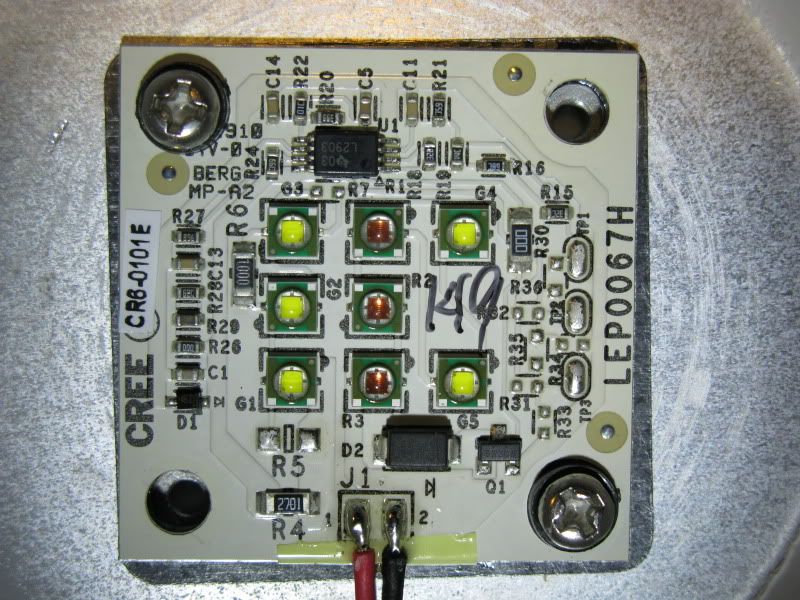 or this 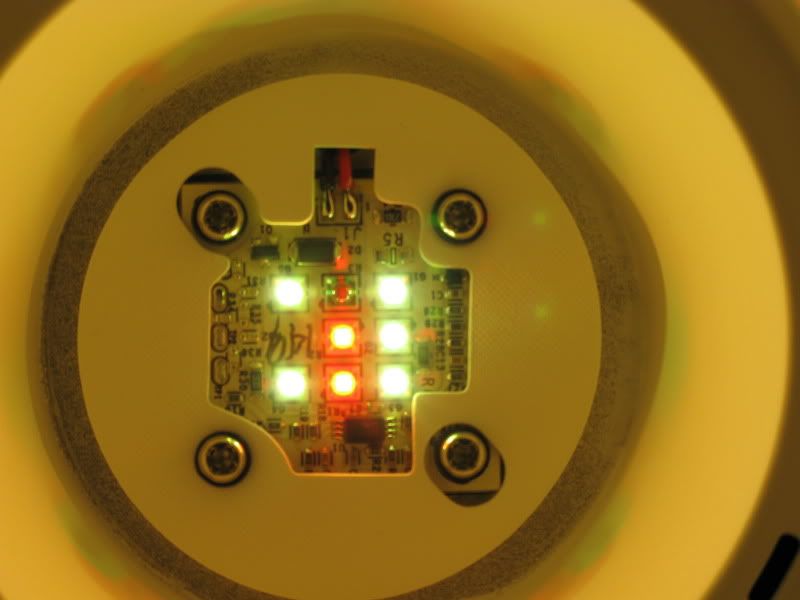 The AC-DC portion of the electronics, and even the current controllers are pretty cheap in mass-quantity, and in higher-power versions far cheaper than the mechanical heat sinking (and sometimes electronic control) of the cooling systems of the unit, since allowing the unit to run at high temp cuts into it's luminous output (and thus efficiency), shifts the color, and shortens life. The single-LED white light LEDs are all based on blue LEDs using phosphors to pump different colors out, and while they can be fairly high efficiency from a lumens per watt point of view, visual efficacy due to poor color rendering remains an issue. |
|
|
|
|
georgec
New Member
Posts:97
|
| 17 Feb 2014 06:27 PM |
|
I do appreciate your input I was hoping you'd pitch is soaked up your other post too. I haven't tore up a commercial bulb yet, bit bussy with other stuff this is on the back burner but it does not hurt to get a discussion going I guess.
like I mentioned last fall I tinkered a bit with plain white LEDs and lipos, one thing I noticed they are rather directional so some thought is required for a good diffuser or maybe the array itself could be curved rather than flat, I am well aware of the strict current and voltage required, but I believe there are ways to accomplish similar results with a lot less hardware, for example a 2 ah lipo is good for a 5 C rate at 10 amps, LEDs draw in the order of miliamps, voltage sag was rather minimal, and with lithium batteries most of their capacity is within a narrow range most conservative setups only run the cells between say 40%-80% DOD for indefinite longevity basically, that bring the voltage range rather close working with a larger cell or a parallel block of say 10 ah or 20( I have some used pouches worn out for ev use perfect for this) their voltage does not sag at all.
There are current limiting resistors to deal with the amps, and honestly I am not that picky, the color spectrum does not really concern me that much, but that is just my personal preference not everyone will agree, the way I look at it 100 years ago they were nowhere that concerned with the oil lamp spectrum or were they? maybe, its serves its purpose to be able to see in the dark that's all I am trying to accomplish, I was wondering what are all the electronics for.
for example I did not get to finish this but the wife had some pretty blue wine bottles she wanted to cut the bottom off and rig some leds in there to make some lamps, so the output would be blue in that instance, and we kind of like odd stuff like that, so for me the color spectrum of what is normally accepted as proper is kind of irrelevant anyway the one thing I noticed as I mentioned they had a rather linear almost laser like output, similar to flashlight if you will, so my next step was to see about building a half sphere shaped array see how that works.
with the solar panels they are made out of 0.5v so that gives me the possibility to build them in a range of voltages so that they can efficiently charge a pack of a certain chemistry, obviously this involves a lot of custom work but it can be done.
for the fridge a standard 2S setup to run a 24v fridge should do the trick, laptop packs if I am not mistaking theyr power supplyes are in the order of 19v or so, even if the pack is barely 11v, something to do with the high C rate of lipos I guess they can sure take a lot of amps so inherently they seem perfect for solar charging, like I said just a thought at this point not entirely sure how the building inspector may feel about it I have yet to bug him about that |
|
|
|
|
SolarOH
New Member
Posts:31
|
| 17 Feb 2014 10:48 PM |
|
George's:
Ok, so I think the first thing is to make sure that I understand the type of "traditional" commercial systems you have in mind. You state in your original post that you don't get why solar charges batteries, then goes through and inverter, just to power loads that ultimately use DC,just like most house loads ultimately need. I think that was the core of your concern, correct?
I'd say to start with that today's traditional system has no batteries. DC from the solar modules goes to a grid-tied inverter. The inverters of today are 96% efficient and up at doing that. Now, there are other losses, dirt on solar modules, DC voltage drop, etc, but those items are there even if you use the solar module for DC direct applications. But as Dana points out, if the solar module is not attached to a dedicated piece of electronics to hold it at it's maximum power point, that solar module won't have a prayer at performing at 96% of it potential. So it's entirely likely that you're efficiency gains are starting off with a significant handicap. Now, you could make sure that every solar module you make has just the right voltage characteristics, but if the load changes, or the amount of sunlight changes, then the voltage of the module will change and you're back where you started. So there are a lot more variables in the approach you describe. Cost is another issue, how much do you think a traditional system costs?
|
|
|
|
|
georgec
New Member
Posts:97
|
| 18 Feb 2014 12:58 AM |
|
I looked into it a while back at the time 1 KW system was like 6k I think, I am aware of grid tie inverters and again it has been a while things may have changed but it was simply disgusting at something like 2k each might need to and the cheaper Chinese type which were not even approved were known to fry often so that was the end of it for me enough with this nonsense, I noticed in the other thread prices may have dropped and some of the subsidies carry it further, but I still find them unnecessarily complicated.
one thing that was brought up was the optimal load to work the panels to their best that was something I did not give it too much thought, I jumped at this in a bit of a hurry just because you mentioned you had some input and I wanted to hear it, I am still a ways to get around to that part, but I can tell you this much lipos like amps and lots of it a pack of sufficient capacity should deal with that, but it requires further investigation, simple shunt circuits, I have a different background in that domain tinkering with EVs, there are other ways of doing this.
bottom line is in general I prefer simple stuff and I don't see a reason for expensive equipment that can fry occasionally to transform the same energy several times before it reaches its purpose.
the other thing with grid ties for storage, again my info may be outdated but last I checked the utility company was buying electrons for far less they were selling them back to you, another thing I don't care to keep track of so that turned me off completely from the idea.
I actually find it far simpler to run it as it comes, even a dishwasher and washing machine if I am not mistaking have universal motors, granted 110v but they'll run on DC just the same, look back at the beginning Tesla came up with AC for transmission purposes over large distances as in hundreds of miles kindof defies the purpose if you are producing local.
oh and one more thing correct me if I am wrong but a direct grid tie inverter setup, isn't that system dead in a power outage situation? I read that somewhere may be outdated by now not sure but that would be a bummer to have a nice array on a sunny day after the storm and you're without power because the transformer cooked,
so maybe they came a long way I still think they are unnecessarily overcomplicated mostly because the standards that have been practiced to this point, all electric appliances plug into the same outlet, where coincidentally some of them would run directly off a panel, well with some tweeks and I have yet to use the plug behind the fridge for anything other, if anything an entertainment system may be a bit tricky to set up, and yes obviously the average consumer will likely mix up the plugs so it's not that feasible I'm not the average consumers, and they make dumb proof connectors so the wife can't mix them up.
I saw a documentary a while back not sure if that stuff took to the market but a California inventor came up with a die like solution that could be applied to anything, I think that is the thin film I read about recently, at the time his concept was to have the appliance itself coated in the stuff, a digital camera in that example which would charge its own batteries just from the diffused light in the house, that kind of concept of having each device with its own backup and source seems more appealing to me. |
|
|
|
|
ICFHybrid
Veteran Member
Posts:3039
|
| 18 Feb 2014 09:35 AM |
|
I'm not the average consumers, Just curious as to whether you will be pulling an electrical permit and having this project inspected or whether it is one big tinkerer's workshop. |
|
|
|
|
Dana1
Senior Member
Posts:6991
|
| 18 Feb 2014 02:44 PM |
|
There are some grid-tie inverters with local AC outlets that still work when the grid is down. It's actually pretty easy to make the full AC output of the inverter available from a technical/design/manufacturing point of view. Most grid tie inverters are designed to turn off when the grid goes down due to regulations designed to avoid backfeeding the grid from distributed PV array during fault conditions. Grid tied inverters are also fairly easily re-designed to manage local battery storage, but aren't, again due to regulations. As the value to the grid operators & ratepayers of having more distributed power generation & storage (on either side of the meter) goes up, these regulatory roadblocks are bound to be modified (and already are in certain parts of CA and TX).
Like PV, grid storage is also on a moderately steep cost decline curve, but there are also some likely breakthrough products currently in the wings that would make it even MORE attractive for localized storage (on either side of the meter), eg:
http://www.greentechmedia.com/articles/read/Slideshow-Update-on-Ambris-Liquid-Metal-Grid-Scale-Battery
At once the grid storage cost $100/kwh (at any battery efficiency), the doors are going to blow off the PV market even further, since it will enable everything from 100% renewables to fast-charging of electric vehicles, to self-islanding micro-grid architectures breaking the large grid/central generator model while improving grid reliability. Most analysts believe that$100/kwh price point will be crossed with lithium ion technology in well under a decade (which will completely blow the doors off the electric vehicle market), but some of the heavier cheaper scalable grid-storage technologies like the liquid metal Ambri are likely to show up at a grid near you in under 5 years on the utility's side of the meter, but, it's a short hop from there to the PV operator's side of the meter. At $100/kwh you can buy a battery capable of supplying the entire load for your house with the grid down for a full day for under $5K even if you're a power-pig. (At my home's recent-years' daily usage it would be under $2K.)
Tinker all you want, but there is serious venture money and lots of engineering talent chasing lighting efficiency and PV system efficiency right now, and both the talent pool & effort is increasing exponentially. And the cost of the goods is falling logarithmically. Professionally installed grid tied solar for sub-10kw PV arrays in Germany is in the $2/watt range, all-in costs, and that price point is likely to be met and beaten in parts of Texas this year. By 2020 the all-in retail cost for most of the US is expected to be in the $1.50/watt range for small-scale residential, buck a watt for grid scale arrays.
Most net-metering deals with utilities at this point are a rough-justice "run the meter backwards", and not "...the utility company was buying electrons for far less they were selling them back to you..." with VERY few exceptions. Annual excess that a PV operator dumps onto the grid is zeroed-out in some locations, or compensated at grid-wholesale price in others. In Austin TX there is a more nuanced "value of solar tarriff", (VOST) paid to the PV operator that compensates them not only for the value of the spot-market time-of-day power uploaded onto the grid (which is usually far more expensive to the utility operator than the standard fixed residential rate), but also for the avoided capital costs of grid capacity upgrades that would have been needed without power sourced by the PV operator. The state of Minnesota is currently analyzing that approach for applying it there.
In some instances a VOST approach will pay considerably MORE than the residential retail fixed rate to the PV operator for the power uploaded, others not. But once PV is is in the buck-fifty/watt range, it's probably the right price-signal to send as the market saturates with copious amounts of privately owned distributed PV assets.
In Hawaii the deal is still dumb-net-metering, but at the saturation levels they're currently hitting whole neighborhoods are becoming net-positive on power in the middle of the day and back-feeding the grid, making it difficult for the grid operators to regulate the voltage on the grid. Dealing with this takes some new hardware, which comes at a cost, but they don't have the regulatory environment that makes it easy to recoup those costs. The short-term stopgap solution is to charge new PV installations on those saturated lines a hefty up-front fee, which is pretty onerous since the "problem" is the whole neighborhood's PV, not just the new guy's. Cheap grid storage (on either side of the meter) is probably going to be the right solution going forward there too. Regulations are being revised- stay tuned! The existing net metering deals will likely be grandfathered in, but the newer deals may look a bit more like a VOST approach.
No matter what, the grid in 2025 or 2030 isn't likely to more than vaguely resemble the grid we all grew up with- PV is going to be just plain too cheap, and storage costs are headed there too, which is going to break the business models of many utility companies. |
|
|
|
|
georgec
New Member
Posts:97
|
| 18 Feb 2014 11:15 PM |
|
granted I haven't been keeping up to date with this stuff, and thou some progress have been made and more is due, I'm still not into it, maybe its because at I looked into it at a bad time, or maybe because I had gotten this Idea back then, even reading through your latest post I got lost a couple times some new notions, I have to go back and read on, maybe its the ever-changing aspect of it that bothers me or all the metering involved and tariffs and than next thing you know uncle SAM wants his cut if you show a net production.
I tend to take a liking to simple things in the first place so that may have something to do with it
as for the inspection aspect and code, haven't made it that far in life yet, just a thought for now, thou in retrospect I got into a conversation with my building inspector last ( he's open door like that ) he brought up some difficulties about the commercial systems as far as meeting code so that would be a hurdle regardless, honestly I am not familiar with the book, if you are please pitch in, most I came across was something along the lines that service above a certain amperage is regulated, I forget the exact text, I could look it up again I guess, but I am actually looking to go the other way for lot less wattage, it seems to me that every time something new is brought up code compliance may prove an issue is a rule of thumb, so far I have not come across any indication of that, nor have I looked that hard, and its not the first odd idea I bring up to the inspector expecting to get shut down yet there's nothing against it just new.
I guess at the end of the day its the self reliability of a battery setup that appeals to me, for example some of those grid inverters that can cope with grid down are still only good during the daylight hours, at the same time being from Michigan, last I looked it up I believe 85% of my power is coal, and I am into EV and such mostly for the principle we all know the economy is not there considering initial costs, plugging into coal electrons is odd to say the least sure it's due to change, at some point.
bottom line even battery setups, require charge controllers inverters ................, just looking for a simpler solution, I understand lots of research has been put into it just seems like new devices are developed to cope with old devices and such to a point where it's becoming over complicated, maybe unnecessary.
Sometimes it doesn't hurt to step back clear your mind start with a blank sheet and say OK how else can this be accomplished, progress is not always linear and just as some of those new technologies seem still far away some of the existing one were not even considered a while back.
I am honestly more interested in Wind, and part of that is likely because it can be hand built I like things I can grasp rather than microscopic arrays and metering strategies but that is AC and inherently has to be rectified to store, maybe that is best for water heaters run it right into the element, all dump load, same idea keep it simple ( well to a point granted the usual HWH safeties still to be considered ), the more I think about it I think its the meter itself that bothers me the most, I grew up in a family of suits they had dreams for me sitting behind a desk in a suit and tie being the boss and doing nothing, always felt wrong about that whole concept, they made me go through the schooling too had a diploma for Accounting and Finance ( wiped my a$$ with it the day after I got it ) guess I am sick of counting in principle I think renewables should simply work and provide the user ( not operator ) just something wrong with that whole concept can't quite pinpoint it maybe you can |
|
|
|
|
WisJim
New Member
Posts:3
|
| 19 Feb 2014 09:45 AM |
|
Wind may sound good, but remember that your wind turbine should probably be 80 feet or more above the ground, never on a roof, and also in a good wind area, verified by good maps and site assessment rather than a personal judgement that "it's always windy here". I don't feel that the PV panels that I installed back in 1982 were a bad investment, even at $8 a watt or so for just the panels (they still work fine, by the way), and certainly the PVs that I have installed since then have been much cheaper to install and are expected to last for many decades.
Also, keep in mind that wind turbines require maintenance, at least annually, no matter what the literature may say, even if it is just checking and tightening connections, touching up paint, or greasing a couple of fittings. The 1940s vintage wind turbine that we have been using since the 1970s still works well for us with basic annual maintenance but a new machine wouldn't be cost effective in our area of western Wisconsin because of the average wind speeds here. |
|
|
|
|
Dana1
Senior Member
Posts:6991
|
| 19 Feb 2014 02:05 PM |
|
According to EIA data the grid fraction of all kwh moving on the MI grid from coal dropped under 50% way back in 2007, rebounded to about 65% in 2009, but has since continued to decline in the face of the insanely low cost of natural gas pricing and falling base-load demand, as well as some development of grid-scale wind. The 2013 numbers are fully in yet, but I'd be shocked if MI's grid share coming from coal exceeded 50%, let alone bumping 85%. (Base-load nukes have held a ~20-25% share for some time now.) Even t he coal industry booster pages put MI at only 54% coal-fired grid as of 2012. Pipsqueak-scale wind is almost never going to be cost-competitive with PV, even at PV prices of 5 years ago, with lower/less predictable output, and higher maintenance costs. Don't look now, but panel pricing is widely expected to hit below 50cents/watt by 2017, and some people think 35 cents is more realistic. Micro-inverters at the single-panel scale are out there now, and becoming widely used in utility-scale PV applications, which reduces the wiring & design time for grid-tied. Micro-inverters also handle the dead-panel or uneven shading issues quite nicely, since the panels not currently shaded and still functional aren't brought down by the shaded or dead panel on the string. And since the optimizing electronics are dedicated to the individual panel, power output & efficiency of the entire array has a nice uptick. By 2025 it's possible you'd be able to buy panels with integrated micro-inverters at box stores (in areas that would allow DIY installation) for something like a buck a watt. To get the power out of a PV panel requires balancing the voltage output with it's current, and that changes with the intensity of the incident light. Simply wiring a PV panel to a resistive element like a hot water heater will take a HUGE chunk out of it's operating efficiency. When optimized you can get something better than 15% efficiency out of a typical mono-crystalline PV panel, but just wired to a load you'd be lucky to hit 10%, giving up 1/3 or more of the energy that you COULD have gotten out of that panel. For heating hot water you'd be better off spending the money on a solar thermal flat panel, and get better than 30% average annual efficiency. But at current prices you can get a better bang/buck out of grid-tied PV and a heat pump water heater, which delivers a similar 30-40% average net efficiency at lower up-front cost and lower maintenance. In the world of our dreams it would all be a lot simpler than that, but the real world is much more complicated once you get down into the weeds on making it actually work. But complicated isn't always going to be expensive or unreliable, despite existence proofs that it sometimes can be. |
|
|
|
|
georgec
New Member
Posts:97
|
| 20 Feb 2014 11:26 AM |
|
obviously current solar setups have come a long way since I last looked into what was commercially available, and granted for the average joe its simpler to crunch the numbers rather than rethink the wheel, in some aspect the commercial systems are tried and somewhat true for most of the public that is the route to take.
I just proposed a different avenue, and like I mentioned at this point it was just a thought, and experimental stuff will almost always post a cost with no benefit, the idea is that I have already been involved in several EV projects I have some experience and left over parts some are recycled, or below grade for EV purposes but plenty powerful for lights, tv and computer, furthermore
for instance I have a 4 kw pack for my car it's actually made out of 2x24v blocks, I also have some spares, BMS and charge controllers, those blocks are easily swap able so a thought was to charge them by solar panels directly, it really does not make much sense to me to go from panel to grid to outlet to charger to pack, with a bit of thought into it provided the array is properly sized those 24vpacks could run a fridge also and while charging and when full can be swapped with the depleted ones in the car, completely off grid no inverters needed, there has been talk lately about evs serving as backup power for the house and the other way around some research has been done in that aspect also, there has been research around swappable battery packs to reduce charging time on EVs so that's where I got that concept from, all in all when it comes to renewables, as I mentioned before the whole concept of an individual being regarded as a "array operator" does not appeal much to me I prefer a self reliant approach, with grid backup maybe rather than having the grid as the main hub where all loads and sources plug into regardless of their individual requirements, counting electrons back and forth transforming watts at 10% efficiency several times before they actually put in the work.
I get that the inverters are 90%+ efficient, my car charger is similar to that just saying for starters if I were to invest In solar why not build an array to charge my car only, and maybe a smaller panel for my lights, etc, I guess the microinverters are kindof heading that way where a shaded panel does not affect the others, say for example if on such a setup the lighting circuit has a fault I would still be able to charge the car and run a fridge and if all fails grid backup.
Code compliance was brought up, yet no one got back into it since, and I am not the wiser, for example can you guys see an issue for example if I were to wire up the lighting on 3.5v white led, and use a central power supply hooked to grid power, with future plans to build a good size pack based on the actual usage measured off grid power over a number of months and size a panel accordingly, at that point the power supply would become a grid backup.
I have not yet come across any code that specifically requires 115vac lighting and 3.5v in the order of miliamps is much safer so just this for an example if there is a code issue I am not aware of it |
|
|
|
|
| You are not authorized to post a reply. |
|
Active Forums 4.1
 |
Membership: |
 |
Latest:
croccohvacusa |
 |
New Today:
0 |
 |
New Yesterday:
0 |
 |
Overall:
35027 |
 |
People Online: |
 |
Visitors:
184 |
 |
Members:
0 |
 |
Total:
184 |
|
|
|