kyboy1

New Member

Posts:2
 |
| 03 Sep 2011 03:31 AM |
|
So, here's the idea.
I am going to build a 24x24 gambrel roof garage on a slab, for my family and I to live in while I build our home on the same property. Since we are self financing the entire project, I am looking at roughly 4-5 years until we can "officialy" move out of the garage and into the home.
I am very comfortable with all areas of home construction except for insulation; there are too many products for me to keep up with. This is where I need some experienced help/ideas.
What are my cost efficient options for insulating the garage? I am specifically concerned with the slab floor being cold in the winter.
None of my plans are set in stone as far as construction materials, metal vs vinyl siding, traditional wood studs or pole barn style, wood vs metal studs. I am very open to ideas but please remember that this will eventually be a detached garage for our vehicles so I don't want to spend a small fortune on materials if I won't need it in the future.
Think of this as a "what would you do" type of question.
FYI
Zone 6/ Central KY |
|
|
|
|
|
|
cmkavala

Veteran Member
Posts:4327

|
| 03 Sep 2011 06:37 AM |
|
kyboy1;
4-5 years is a long time , your garage needs to be built just like a house, it will not be a waste of money if it makes your family comfortable for 5 years. Your 4-5 years could turn into 5-6+ or if your life takes a dramatic change, this could be your permanent home. Build it right the first time. |
|
| Chris Kavala<br>[email protected]<br>1-877-321-SIPS<br /> |
|
|
jonr

Senior Member
Posts:5341
|
| 03 Sep 2011 09:00 AM |
|
I would put some foam under the slab and some foam and fiberglass or cellulose in the walls. Cellulose in the ceiling (which could be removed later). Make it as air tight as possible.
|
|
|
|
|
kyboy1
New Member
Posts:2
|
| 03 Sep 2011 11:19 AM |
|
cmkalava thanks for your response.
I definetly want my family comfortable, after re-reading my post I realized it made me sound like I wanted a cheap way out. What I really want is not to spend ten thousand on insulation if five thousand will do the same job.
jonr
Please remember I am insulation dumb. When you are talking about foam, what exactly are you speaking of, from my perspective there are a lot of different types of foam out there. Could you list a couple of products so I can see what I would be working with.
For future reference, I am leaning more towards metal siding and roof for this project if this will make a difference in insulation. |
|
|
|
|
arkie6
Veteran Member
Posts:1453
|
| 03 Sep 2011 01:25 PM |
|
For underslab insulation, Expanded Polystyrene (EPS) is your best R/$ option. This is what most people typically call "Styrofoam" or bead board insulation. This comes in several densities generally ranging from a nominal 1#/cu ft to 2#/cu ft. The lower density EPS has a lower compressive strength. While 1# density EPS should be sufficient for under a typical garage slab, I opted for the 2# density stuff under my basement slab because the cost wasn't that much higher. The 1# EPS generally provides ~R3.8/inch at 75F while the 2# EPS provides ~R4.2/inch. For a home slab in your local, you would probably want 2" of EPS under your slab and around the perimeter of the slab. I would apply two layers of 1" foam and stagger the joints over a 6 mil vapor barrier. It termites are a big concern in your area, you can buy borate treated EPS that is resistant to termites tunneling through it such as Perform Guard treated EPS. http://www.performguard.com/ You can contact the above company to see if they have any manufacturers near your area. The cost of purchasing the foam from them is generally less than going to the local big box store and buying regular 4'x8' sheets of foam. Also, they can custom cut it to different thicknesses and sizes up to 4'x16' which results in fewer joints in the insulation. For walls, your best and most economical option is probably 2x4 stud walls with wet sprayed cellulose insulation with ~1" of exterior foam sheathing applied over the studs for a thermal break. Since you have a gambrel roof over the garage, I assume you will be using the space over the garage for living quarters as well. Insulating the ceiling to a moderately high R value will be trickier since you don't have much space to work with. Spray foam insulation is one option, but it is very expensive compared to other options. If you are using trusses for the roof and will be putting metal roofing over it, I would apply a 1" layer of foil faced polyisocyanurate insulation, "polyiso" for short, over the trusses prior to installing the horizontal 2x4 lath to attach your metal roof. This will give you ~R9 considering the foil facer radiant barrier and 1.5" air space. You will most likely need to use fiberglass batts between the truss chords if you want to maintain a reasonable cost. If your trusses only use 2x4 top chords then you would be limited to R15 batts. If your truss top chords are 2x6 (better option) then you can use R21 fiberglass bats. |
|
|
|
|
cmkavala
Veteran Member
Posts:4327
|
| 03 Sep 2011 01:31 PM |
|
yes performguard, it is also what is used in our SIPs |
|
| Chris Kavala<br>[email protected]<br>1-877-321-SIPS<br /> |
|
|
SimonD

Basic Member
Posts:167

|
| 21 Sep 2011 01:29 AM |
|
Here's the front elevation of a 17'-6 x 24'-6" gambrel roof utility building out of 42" wide steel SIPs going up in MA. 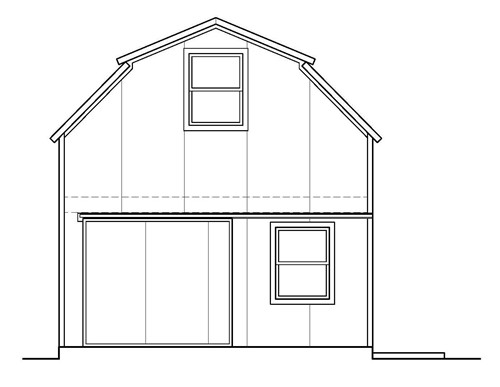 The size of it was mostly based on 12ft long panels which the contractor had in stock. 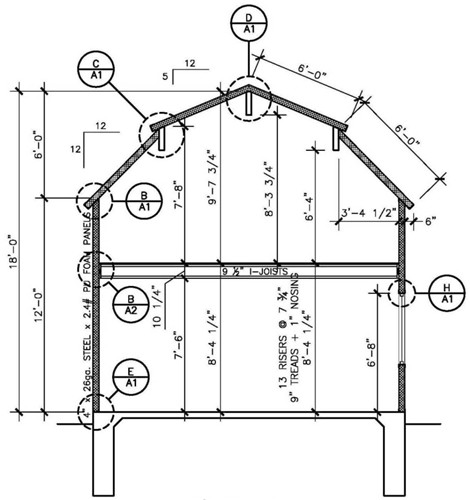 Here are some details. However, if heated exterior to interior thermal break detailing will be needed. 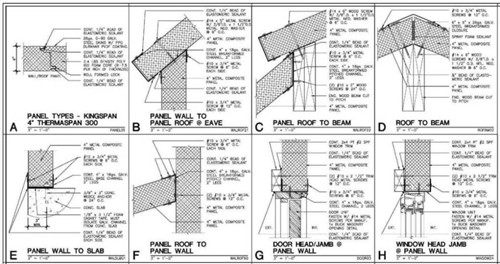 |
|
| Building Designer PANELfusion, LLC Tampa, FL [email protected] "Metal SIP Advocate" |
|
|
zehboss
Basic Member
Posts:216
|
| 26 Sep 2011 05:37 AM |
|
From the same materials you could build an oval building with an arched roof and end up with 30% more square footage for the same cost.
I could also show you how to build a modified earthen filled wall building which gives you a better end product for even less cost.
Brian |
|
ICF Solutions
Engineering, Designing, and Building Passive, Net Zero, Self-Heated, Self-Cooled, Self-Electrified, Low Cost Homes
Basic shell starting at R-50 Walls, R-80 Roof structures. for $30/square foot
(360) 529-9339
[email protected] |
|
|
UltimateAir
New Member
Posts:8
|
| 01 Dec 2011 01:47 PM |
|
A tightly built energy efficient house is going to be much more comfortable than anything that most people are used to. Energy efficient houses are more comfortable because the highest point in the house is the same temperature as the lowest point in the house. In an average house, the difference in temperature from floor to ceiling is 6 degrees! The only air movement into and out of the house is controlled and filtered efficiently by ERV. This means fewer drafts! You will no longer get a chill when standing next to your triple-pane insulated frame window. Allergy Asthma triggers will be reduced or disappear due to the high level of indoor air quality. ERV is the lungs of the house.
Fore more information about energy and cost efficient insulation and ventilation, visit http://www.ultimateair.com |
|
| UltimateAir® is the industry's leading manufacturer of <a href="http://www.ultimateair.com/air-filtration/">whole-house air filtration systems</a> and energy recovery ventilators that are energy conscious and environmentally friendly. |
|
|
BadgerBoilerMN
Veteran Member
Posts:2010
|
| 01 Dec 2011 10:56 PM |
|
We use the self-balancing RenewAire out of Madison, WI for our design and installation work which, includes specifying insulation, radiant heating systems and ERV's. |
|
| MA<br>www.badgerboilerservice.com |
|
|
Farmboy
Basic Member
Posts:356
|
| 02 Dec 2011 11:19 PM |
|
Kentucky Boy ,
Sorry, let me try again in separate entry. Dave |
|
|
|
|
jerkylips
Basic Member
Posts:359

|
| 05 Dec 2011 02:37 PM |
|
if you're living in this garage for 4-5 years, how are you planning to address bathroom(s), kitchen, etc? Also....bedrooms? A garage is going to be framed differently than a house in terms of load bearing walls, etc. Also, I didn't see a response about whether you're going to use the attic of the garage for living quarters (I'm assuming you are). 24x24 is 576 sq ft - that would be tough to manage. Using the attic would get you closer to 1000 which would be much more "do-able" I could see maybe 2 bedrooms & a bath in the attic & the garage as an open area for kitchen/living room
Here's an idea - maybe crazy but it might be worth looking at. I haven't actually priced them out but I've heard that pre-tensioned concrete panels (like Spancrete) are comparable in price to having a pad poured. What about a basement for the garage rather than on a slab? It would give you a lot more options for living space, & an awfully nice workshop/storage space once your house is done. This is something I wanted to look into at the time we built, but the idea never really go off the ground.. IF the spancrete panels are comparable in price to pouring a slab, you'd have extra expense for excavation & pouriing the "basement" walls but I think that would be about it.
Our first house was a 950 sq ft 2 bedroom & it was fine for my wife & I, but we had a basement and garage for storage. That amount of space with no extra storage would be really, really tough for 4-5 years. Just my opinion.. |
|
|
|
|
jonr
Senior Member
Posts:5341
|
| 08 Dec 2011 11:40 AM |
|
I would buy an old RV trailer (or two if the kids are noisy) and park it in the garage until the house is done (hopefully sooner rather than later). Then sell it for about what you bought it for.
Make the garage very airtight, but it is unlikely that much insulation will pay for itself.
|
|
|
|
|