|
|
|
New construction - efficient system or better building envelope
Last Post 04 Aug 2014 11:14 AM by eljay. 98 Replies. |
Sort:
|
|
 Prev Next Prev Next |
You are not authorized to post a reply. |
|
eljay

New Member

Posts:56
 |
| 28 Apr 2014 09:05 AM |
|
I am looking to start building a house in the next month or two. The plans are almost finished and I need to quickly decide on the heating/mechanical system for the house. I am hoping the wealth of knowledge here can steer me in the right direction. First, here are the facts about the house: - 2-storey on a concrete slab with a double attached garage. Main level (32'x24' plus 10'x12' entry/bath) - 888 sqft on a concrete slab with in-floor heat covered in light-colour tiles throughout - open concept living room, dining area, kitchen, small 3-piece bathroom with laundry, entry Upper level (32'x24') - 768 sqft, laminate everywhere except tiles in bathroom - 3 bedrooms, storage room, 3-piece bathroom Attached garage (22'x24') I'm thinking about dividing it into the following zones: Zone 1 - lower living/dining/kitchen area Zone 2 - lower entry/bathroom (this bathroom is not the main bath) Zone 3 - garage Zone 4 - upstairs bedrooms (thermostatic valves on the convectors to turn down unused bedrooms) Zone 5 - upstairs main bathroom This will be for a family of two and, hopefully, a couple of kids in the future. The current construction plan is 2x6" R24 walls (R20 + R4 exterior rigid foam), slab R10 and ceiling R50, double-glazed windows. I calculated the heat loss at -17C (-4F) to be 23,000 BTUs/hr. The house will be built in Halifax, Nova Scotia, Canada. Here are the climate facts: http://weatherspark.com/history/282...tia-Canadahttp://www.weatherbase.com/weather/weather.php3?s=59317The area's PV potential is ~1000 kWh/kW annually. The heating will be with a radiant in-floor heat on the main level and low-temperature baseboard or convectors on the upper level. I don't want oil and there's no natural gas in the area, so it's down to electricity and propane. Propane is getting expensive around here. Here are the fuel costs: Natural Gas - N/A Oil - 130.4 cents/litre ($4.94/gallon) Propane - 96 cents/litre ($3.63/gallon) Electricity - $0.1425/kWh Source: http://www.kentmarketingservices.co...Public.htmI am very interested in the Daikin Altherma air-to-water heat pump for both low-temp heating and domestic hot water. However, the system is not cheap, so I am wondering whether my money is better spent on upgrading the building envelope rather than an efficient heating system. I was thinking about going with the smallest 18,000 BTU Altherma and connecting it with a 2-panel solar hot water kit. I think for our household size a 60-gallon hot water tank would be suffciient, but going with solar it's probably better to have larger storage, correct? I hope that solar can provide all the hot water needs in the non-heating season and would preheat water sufficiently in the heating season, so that I can get away with the small 18k BTU heat pump. The Altherma has a built-in 3kW electric back-up heater. I'm not sure it would make sense, cost-wise, for us to get into solar PV panels at this time, especially since the main roof design is a gable roof with the flat parts facing SE and SW. We could switch to a hip-roof to give us a flat plane on the SSW, but it would likely fit max 3-4 panels. I'm guessing that changing the roof design would add $2000, but that's just a guess. Would that even make sense to do? Here are some preliminary prices I got for the heating systems: Propane-fired heating system: $11-$12k Electric boiler system: $10-$11k Altherma (30k BTU version): $20k Solar for heating: $20-$25k Solar DHW: $5k So, the question is whether it's worth spending money on the most efficient heating system, or whether I go with an electric boiler and spend the difference on upgrading the building envelope and go with R30/R60/R20 (wall/ceiling/slab) insulation and triple-glazed windows etc. and perhaps throw in a wood fireplace or stove on the main level for backup. If you need any other information, please let me know. Thank you in advance for any advice! |
|
|
|
|
|
|
whirnot

Basic Member
Posts:186
|
| 28 Apr 2014 09:43 AM |
|
FWIW,
I am a firm believer that if all else is equal you are always better off to invest in the envelope instead of the system. The system will need replaced after a number of years, the envelope you give you savings forever. |
|
|
|
|
Bob I

Veteran Member
Posts:1435
|
| 28 Apr 2014 10:02 AM |
|
Whirnot's right: your insulation levels sound awfully low for a house in your location with your goals for low ongoing heat costs. Do not rush into this!!! Take the time now to study the best way to build and insulate your house. You will not regret it.
You should be looking at wall R values in the R-40 range or higher, roof values of R-60 minimum, higher basement/slab R values and triple glazed windows. For insulation types, look to dense packed cellulose or Roxul if you want a DIY. Use foam sparingly; it is expensive and the wrong type used in the wrong place can rot your house. These measures will save you money every year you live in the house, and will be less expensive overall over several years. If you are getting a mortgage and can install PV, your home can potentially be cash positive from the time you move in. |
|
| Bob Irving<br>RH Irving Homebuilders<br>Certified Passive House Consultant |
|
|
Dana1

Senior Member
Posts:6991
|
| 28 Apr 2014 10:54 AM |
|
A 2x6 wall with R4 on the exterior is not an R24 wall, it's an R18-R19 wall after the thermal bridging of the framing is factored in. The thickness of the exterior foam does not have sufficient R value to allow you to use paint-only as the interior vapor retarder, in a NS climate, but it does impede outward drying slightly, making it a less resilient assembly. It would be far better to triple that to R12 (3" of EPS or rigid rock wool), which means you could skip the interior poly, and you would be at ~R26-R27 thermal performance, and have much better drying capacity. You can either use a permeable membrane or "smart" vapor retarder (eg Certainteed MemBrain or Intello Plus) as the interior-side air-barrier, or detail the gypsum as an air barrier, but use only the standard latex paint finish coat as the interior side vapor barrier (which runs 3-5 perms.) Your climate is comparable to a US zone 6a climate for which the IRC has prescriptive minimum R values for exterior foam that allow this approach:
http://publicecodes.cyberregs.com/icod/irc/2012/icod_irc_2012_7_sec002_par025.htm
If you wanted to hold the line at 2" of exterior R it's advisable to use rigid rock wool (highly vapor permeable, to promote drying toward the exterior) if the interior vapor retarder is polyethylene sheeting, but you can use EPS (cheaper than rock wool in New England, not sure about NS) and one of the smart vapor retarders on the interior, which is variable permeance, and can dry rapidly in the spring/summer, but is fairly vapor tight in the winter when the relative humidity of the room air is lower. (It must be kept at 35% RH or lower during colder weather to be a class-II vapor retarder.)
With the R12+ exterior insulation your wall losses are about half that of a 2x6/R20 wall. If EPS is used, with scrap rates and furring & pancake-head timber screws (24" o.c. penetrating the studs by 1.5") should come in at no more than $2 per square foot of net wall area (subtracting out the window & door area.)
If you are using the slab as a radiator, R15 would be more appropriate under the slab than R10. EPS is cheaper per unit-R than XPS (the pink, blue or green stuff), and uses a far less damaging blowing agent, so 4" of EPS (R16) is usually cheaper AND greener than 3" of XPS.
If you take this approach it's appropriate to use windows & doors with U-factors in the ~0.25 (R4) range, otherwise it's likely that windows & doors will be dominating your heat load calculation.
It probably IS worth re-engineering the roof lines or re-orienting for optimal PV, preferably gabled, not hipped. The installed price of grid-tied solar per watt in Germany (and the most-competitive parts of the US) is now about $2/watt, a price at which the lifecycle cost of the output energy is a bit more than half your current retail rate of 14 cents. By Y2020 it's widely expected that the installed pricing worldwide to be at about a Loony or less, and the lifecycle cost of that power will be less than 1/3 retail. If you are allowed to net-meter at retail in NS (running the meter backwards when the sun shines) it would more than pay for itself in short years even if you borrowed the cash and paid interest on it. (The US SunShot prize is predicated on a US- buck-a-watt grid-tied PV by Y2015- it's not yet clear if anyone will collect that prize, but it's not an insane proposition, now that racking with integrated wiring is now available that can replace a lot of $50/hour rooftop labor with $15/hour factory labor.) Consider every square foot of optimally angled & oriented roof area as ~10 watts of PV potential, that could be paying out $1.43 per year (after taxes!) at your current retail rate.
Micro-zoning the place can have short-cycling consequences for both fossil-burners and the Altherma if you're not careful.
Mini-splits are a heluva lot cheaper and easier to design around than the Altherma, and if you go higher-R than what I've outlined the additional creature-comfort of a 21C floor in a 20C room while perceptible, may have somewhat lower value. To get the Altherma to work (both on efficiency and capacity) at a sufficiently low temp to provide design-day heat to the non-slab rooms would cost you another $500-1000 per room for larger flat-panel radiators. A pair of 1 ton Mitsubishi MSZ-FH12NA or Fujitsu AOU-12RLS2 (or -12RLS2-H, which is a better unit for when it's below -20C) would provide more than your design load heat at -20C, and would cost less than $10K installed. If you went with the R12 sheathing & U-25 windows & doors you could drop back to the 3/4 tonners (-FH09NA, or -9RLS2-H) and come in at under $8K. If you spent the difference between that and the Altherma on rooftop PV it could pay your heating bill, provided you re-engineered your roof-lines (or have enough yard space.)
|
|
|
|
|
eljay
New Member
Posts:56
|
| 28 Apr 2014 10:57 AM |
|
Thank you for the replies. I do agree with the idea of building the best envelope possible. I am trying to figure our the best balance point for my situation. For example, if I super-insulate the house by spending $10k more, will I get to the point of not needing an Altherma at all and being able to heat the place with a small electric boiler or will I always be needing a certain amount of BTUs that only a heat pump can deliver efficiently despite its cost? I put together a calculator for my heat loss and playing with the various R values did not drop the heat loss significantly. But granted, I did not try the levels suggested by Bob above. I guess what I'm trying to find out is a heat loss point at which it's feasible to go with the cheapest heat source (electric boiler) because the operating costs will be relatively low due to a well-built envelope. However, I don't want the cost of that envelope to have uneconomical payback time. Another possibility I'm considering is whether it's possible to power the heat pump with a PV panel during the heating season, essentially creating near zero operating cost. Of course, the catch is that when you need the most heat is when the sun is not shining.  Perhaps, I should frame the questions this way: What would be the recommended system for my house built to the code-standard envelope: R24/R50/R10/double-glazed? What would be the recommended system for my house built with a superior envelope: R40/R60/R20/triepl-glazed? (I'll calculate the heat loss for this) Then I'll be able to compare the system costs between #1 and #2 and get construction quote difference between the two as well. whirnot makes a good point about the system needing to be replaced much sooner than the structure. |
|
|
|
|
eljay
New Member
Posts:56
|
| 28 Apr 2014 11:14 AM |
|
Wow, thank you for the detailed reply Dana! I'll need to look at the wall-insulation methods closely. Unfortunately, I'm not building the house myself, but I'd like to specify the envelope and system to use by whichever builder we select.
We have a strong preference to radiant heat as oppose to air delivery, so air-to-air mini splits are not that appealing. Should I be thinking about simple electric baseboards for upstairs bedrooms then?
Also, if upgrading the envelope drops the overall heat load, does in-floor become irrelevant too? In other words, would it be cheaper to start thinking about low-temp baseboards/convectors for the main floor? |
|
|
|
|
Dana1
Senior Member
Posts:6991
|
| 28 Apr 2014 11:50 AM |
|
If yours is a DIY heat load calculator it's not clear that it has much validity compared to ACCA Manual-J or even I=B=R. Even at R20 (true whole-wall R, not center cavity) and U0.30 windows/doors infiltration/ventilation rates can become a significant fraction of the total.
If you go to a higher-R house heating the main zones with mini-splits and using electric radiant cove heaters (sized for the room's design heat load, less than 2x the room's load if you can) and controlling the cove heater with occupancy sensor + thermostat rather than thermostat alone can be cheap and effective. With that approach comfort is achieved even when the room is still warming up since the average radiant temp goes up during the ramp up to the thermostat setpoint. Radiant temperature is far more important to human comfort than air temp- (like standing in front of a sunny window in a 15C room, not that your rooms would actually get that cool.) Bedrooms might want programmable thermostat control rather than occupancy sensor, since occupancy sensors work on sensed motion. Unlike panel radiators, radiant cove heaters are emitting the full radiant heat within seconds, and and 99.9" of the power is heating in the occupied space, unlike an electric boiler which has remote pumping and distribution loss issues, not just the thermal & pumping lags.
Insulation is good for 50-100 years (or more, if rock-wool) with zero maitenance costs- gas-filled low-U windows are good for 25-40 years. A mini-split or Altherma is good for 20 years with minimal but some maintenance, rooftop PV is good for 30-40 years, with perhaps one inverter swap at age 15-20 (or sooner if as the efficiency of the inverters goes up incrementally every year, and the possibility of having low-cost local storage seems likely within 10 years, which may prompt an equipment swap before the inverter's full lifecycle is up.)
Propane and heating oil should be considered "dead" from a space heating point of view. Heating oil tracks the world price/bbl of crude, and an N.America propane tracks the price of heating oil. Quadrupling the price of crude 5-6 years ago has resulted in net worldwide production of crude oil by less than 10%, and in the same time frame the market for cars in Asia has surpassed that of N.America. The developing world's consumption of oil has increased far faster than the OECD + former Soviet Union countries' consumption has fallen, and are now using nearly as much oil per year as the tradtional oil-consuming countries. This isn't likely to change until/unless most new cars in the OECD countries and elsewhere are plug-in electric cars, which is at least a decade out, best case. Regionally the local forest industries are large enough that a pellet boiler, though more expensive up front, would have a better 10-year financial outlook in a code-min house than a propane or oil boiler (at least in Maine and New Brunswick- not sure about NS/PEI.) Of course this means you'd have to find a installer who deals in pellet boilers and can reasonably support them, as well as figuring out the fuel supply chain, which may or may not be well-established in your province.
Only if you hit true PassiveHouse levels of R value would an electric boiler make any sense, since it uses more than 3x the amount of power to deliver the heat than a Mitsubishi -FHxxNA would. With a better than- code "pretty good house" the latter it makes economic sense to keep the main zones at 22C day & night, so that the amount of power used by the resistance heating in the other rooms doored off from the heat pump zones is minimized, being at least partially (significantly, actually) heated by the much higher efficiency heat pump. Even at -25C these things are still twice as efficient as resistance heaters, and 5C they are more than 4x as efficient, making your annual average efficiency on the order of 3-3.5x that of an electric boiler in your climate. To be equal in annual operating cost to an R25-R-30ish whole wall you'd be looking at whole-wall R-values of ~R50 or more, and windows in the U0.12 range, which can be a pretty expensive build, and needs to be both well designed and well-executed to really perform, not just a modification of code-minimum type construction. |
|
|
|
|
Bob I
Veteran Member
Posts:1435
|
| 28 Apr 2014 12:42 PM |
|
As Dana said, minisplit heat pumps are less expensive to install than most any other heating system and much less expensive to use. (Any electric heating element is, at most, 100% efficient. Minisplit heat pumps run 250-300% efficient, since they do not actually make heat, but simply move refrigerant, like the heat pump that runs your refrigerator. In a home the size you plan to build, two or three units will do the house just fine and should cost in the range of $3000-4000 each. I understand you want heated floors, but in a superinsulated home the floor will stay at room temperature and the house will be far more comfortable throughout, without drafts and cold spots, so hot floors are not missed.
In your heat loss program, there is probably a place for infiltration rate in ACH50. Normal is between 3-5, although it can be higher with an ignorant builder (as many are about infiltration, although they may be good otherwise). A builder who is paying attention can get below 2 pretty easily and to 1 with some effort. This does take paying attention, but think of it as the rate at which heated air is leaving your house through cracks and gaps. the more heat that you can keep in the house, the less heat you have to create to replentish it and the less money you need to spend to heat the house.
Also, there may be a function of the quality of the insulation installation. The one I use rates it I, II, III, with III being the "default, and the poorest installation. Changing that to I helps the heat loss rate of your house, and makes the house a lot more comfortable. Again, it is mostly a matter of paying attention. |
|
| Bob Irving<br>RH Irving Homebuilders<br>Certified Passive House Consultant |
|
|
BadgerBoilerMN
Veteran Member
Posts:2010
|
| 28 Apr 2014 12:46 PM |
|
Since your cost of fuel is essentially the same, no accident in mature energy markets, one has to look to operating efficiency.
No question a COP would be a good thing, but the numbers rarely lineup for air to water, or water to water for that matter, where residential construction is concerned.
If you don't care for the obvious limitations of a mini-split, mine is off and the floors on at the moment, then electric boiler do make sense from a cost-benefit prospective. I have made a career of designing and installing radiant heating systems of all kinds, but started it converting homes from electric baseboard to propane fired condensing boilers and indirect water heaters.
The irony is finding myself in a home I was logically forced to retrofit to radiant floors with and electric boiler and storage type electric water heater.
Naturally, the 1921 balloon framed was foamed top to bottom, new thermal-panes and an ERV installed for IAQ. |
|
| MA<br>www.badgerboilerservice.com |
|
|
eljay
New Member
Posts:56
|
| 28 Apr 2014 01:31 PM |
|
Thank you everyone.
My heat loss was done with a DIY calculator. I came up with 22,300 BTU/hr and the folks who gave me the quote on the Altherma came up with 23,000 based on the same house plans, so I figured I'm pretty close. I can share my calcs later if that would help. I downloaded the HOT2000 software, but I don't know enough about the various building materials to be accurate with it yet, but I'm learning.
I'm thinking that even if I were to put two minisplits upstairs (one for master bedroom and one over the stairs/hallway), the bedrooms would still need something individual for when the doors are closed at night, correct? So, the idea of low-temp hydronic convectors with thermostatic valves rather than zones controlled by on-the-wall thermostats sounds appealing. I'll have to calculate the heat for the individual bedrooms to size them properly, but the cost range is 200-400 per unit depending on size.
I agree that I want to stay away from oil and propane. Wood boiler would need active involvement in the operation, so I'm not too crazy about that. Since Dana mentioned that an electric boiler would only make sense at cost-prohibitive levels of building standard, I'll rule that out for now.
Besides preference for heat type, switching to a complete minisplit heating strategy would probably lead to other changes like switching tile to hardwood on the main floor etc.
So, if I want to stay with radiant and not air-circulated heating, are there other suitable options besides an air-to-water HP like the Altherma? |
|
|
|
|
Lee Dodge

Advanced Member
Posts:714
|
| 28 Apr 2014 01:48 PM |
|
eljay,
You said:
" I'm not sure it would make sense, cost-wise, for us to get into solar PV panels at this time, especially since the main roof design is a gable roof with the flat parts facing SE and SW. We could switch to a hip-roof to give us a flat plane on the SSW, but it would likely fit max 3-4 panels. I'm guessing that changing the roof design would add $2000, but that's just a guess. Would that even make sense to do?"
Nova Scotia is not a great area for solar, from what little I know, although the 1000 kWh/kW doesn't sound too bad. However, you only have one shot at getting a roof design that is suitable for solar. In my case for a new, mostly production house, I changed the south end of the house from gable to hip, and got an overhang ideal for passive solar heating and a place to put a solar hot water panel at a pitch within a couple of degrees of ideal. Similarly, I changed the garage roof from a hip to a gable roof, and it is close to an ideal pitch and azimuth for mounting solar PV panels. Total cost for these changes was zero. I am very glad that I asked for these design changes. |
|
Lee Dodge,
<a href="http://www.ResidentialEnergyLaboratory.com">Residential Energy Laboratory,</a>
in a net-zero source energy modified production house
|
|
|
Bob I
Veteran Member
Posts:1435
|
| 28 Apr 2014 02:32 PM |
|
solar would seem to make less sense in NH than AZ, except that the cost of electricity is so much more in NH. It's also generally thought of as an annual return, so while you might be buying over the grid for some of the year, you'll be primarily selling back to the grid in other months. |
|
| Bob Irving<br>RH Irving Homebuilders<br>Certified Passive House Consultant |
|
|
sailawayrb
Veteran Member
Posts:2283

|
| 28 Apr 2014 03:14 PM |
|
Accuracy and validity of a building peak heat load estimate likely has more to do with the knowledge and experience of the person actually doing the estimate than with the actual heat loss software/tool used. Accuracy and validity in this case being close agreement between the estimate and the actual heat loss at the specified design condition. How many folks actually follow-up after the heating system has been installed in new construction to accurately measure how accurate the building peak heat load estimate was?
http://www.borstengineeringconstruction.com/Existing_Building_Energy_Usage_Analysis_Calculator.html
There are also two different approaches to analyze building heat transfer: building peak heat load estimate and building energy modeling. Both are useful for studying and addressing different goals. Building energy modeling provides understanding of what is driving the heat gain/loss in your building (e.g., solar radiant heat gain through fenestration versus convective heat loss) which allows you to alter the building design to optimize your building energy usage performance. A building peak heat load estimate is more for sizing the supplemental heating system so it will just handle the 99% coldest forecast climatic heating situation which can occur when you won’t benefit from solar heat gain.
|
|
| Borst Engineering & Construction LLC - Competence, Integrity and Professionalism are integral to all that we do! |
|
|
BadgerBoilerMN
Veteran Member
Posts:2010
|
| 28 Apr 2014 04:13 PM |
|
Posted By Bob I on 28 Apr 2014 10:02 AM
Whirnot's right: your insulation levels sound awfully low for a house in your location with your goals for low ongoing heat costs. Do not rush into this!!! Take the time now to study the best way to build and insulate your house. You will not regret it.
You should be looking at wall R values in the R-40 range or higher, roof values of R-60 minimum, higher basement/slab R values and triple glazed windows. For insulation types, look to dense packed cellulose or Roxul if you want a DIY. Use foam sparingly; it is expensive and the wrong type used in the wrong place can rot your house. These measures will save you money every year you live in the house, and will be less expensive overall over several years. If you are getting a mortgage and can install PV, your home can potentially be cash positive from the time you move in.
If you are building to Passive House standard or you live in Yellow Knife.
This is extreme advice and matching cost. The ROI is certainly beyond the OP life expectancy and not advisable unless a philanthropic factor is added to the equation.
Keep your triple-glaze and give me double with radiant floor instead. |
|
| MA<br>www.badgerboilerservice.com |
|
|
Dana1
Senior Member
Posts:6991
|
| 28 Apr 2014 05:41 PM |
|
Low temp hydronic convectors and an electric boiler are a far more expensive solution to the doored-off bedrooms than electric panel radiators or radiant coves. You'd get marginally better efficiency out of an electric panel radiator than an electric boiler and hydronic panel radiator (since there is no pumping power, no distribution losses.) The way to really scrimp on that resistance heating without giving up much in comfort is occupancy sensors & radiatiant coves, which is also pretty cheap to implement.
If you have a time of use "off peak" option and only run the resistance heating when power is dirt-cheap, that can be cost effective too. I have no insight as to how common that approach is in Nova Scotia, but it's available in many parts of Quebec & Ontario.
A Mitsubishi MSZ-FHxxNA min-split would operate with a true seasonal average COP of above 3.2 in your climate. It's very recent ancestor the MSZ -FE12NA averaged seasonal performance of almost exactly 3.0 in a climate a bit colder than yours (Idaho Falls, ID if you want to Weatherspark-compare it to Halifax) in a third-party monitored cluster of ten units being used in occupied houses, not some half-baked lab test. The nameplate efficiency of the -FH versions re 15-20% more efficient than the -FE versions. Even at -25C the -FEs bench-test at a COP of about 1.8 running full-blast- the -FH should deliver at LEAST a COP of 2.0 at that temp, given the capacity derating with temp for the FH is better than the FE too.
For hydronic air-source heat pumps that operates with any efficiency or capacity at -20C it's really Altherma or nothing. In Swedish government testing 2-3 years ago Altherma was top of the line against all other comers (and by some margin), and most of those others aren't even available on this side of the puddle.
Wood boilers require a lot less involvement than you might think, with automated auger-fed fuel, and big hoppers, etc, but it's more maintenance than an electric boiler or an air source heat pump, to be sure. |
|
|
|
|
Dana1
Senior Member
Posts:6991
|
| 28 Apr 2014 05:59 PM |
|
Posted By Bob I on 28 Apr 2014 02:32 PM
solar would seem to make less sense in NH than AZ, except that the cost of electricity is so much more in NH. It's also generally thought of as an annual return, so while you might be buying over the grid for some of the year, you'll be primarily selling back to the grid in other months.
That's NS, not NH. In AZ you only get about 50% more out of PV as you do in NS, it's not like it's double or anything. The residential retail price of eletricity in AZ is about 11.23 US cents to his 14.25 cents CDN (about 12.7 cents US) in NS, which is pretty comparable. The lifecycle cost of PV if installed at $2/watt unsubsidied at NS type insolation is about 8 cents /kwh. When it can be installed for under a Loony per watt (as will happen well befor Y2025, and maybe even before Y2020) that drops to under 4 cents/kwh, at which point you can borrow the money, pay interest and STILL be ahead of the game. By 2025 both Citi Group and the Sanford Bernstein investment bankers' analysts are projecting that PV solar will become THE cheapest form of commercially traded energy of any type. Sanford Bernstein has gone so far as to predict energy price deflation by 2030 (still far enough away to have a lot of caveats attached.) 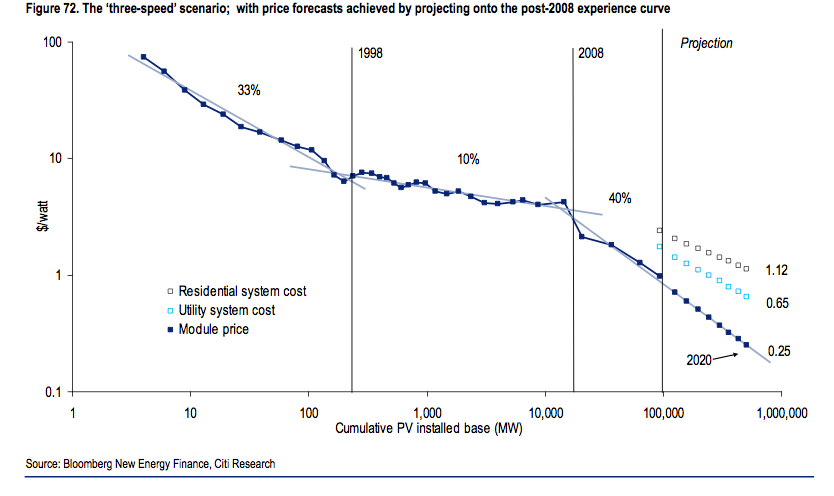  |
|
|
|
|
Lee Dodge
Advanced Member
Posts:714
|
| 28 Apr 2014 06:29 PM |
|
Dana1 said: "In AZ you only get about 50% more out of PV as you do in NS, it's not like it's double or anything."
The original poster gave a value of 1000kWh/kW(rating) typical output for his area of Nova Scotia. For two systems here in sunny but mountainous southern Colorado, I have measured 1817 kWh/kW over the first few years of operation. I would think output in Arizona would be similar to what we get here, which would be about 80% more than in Nova Scotia.
At any rate, when designing a new house, I think it would be very advisable to try to include a roof design compatible with solar PV. My 2010 system is producing power that should result in $0.06/kWh electric power when amortized over a 25-year life. So I think Dana1 and I agree that solar PV looks attractive both now and into the future, so that roof designs that accept solar PV would be advantageous for new houses. |
|
Lee Dodge,
<a href="http://www.ResidentialEnergyLaboratory.com">Residential Energy Laboratory,</a>
in a net-zero source energy modified production house
|
|
|
jonr
Senior Member
Posts:5341
|
| 28 Apr 2014 06:34 PM |
|
As PV solar gets cheaper, people are going to start thinking more about how to store it without expensive batteries or overheating (or over-cooling) passive interior thermal mass (and overheating yourself in the process). Hydronic systems might increase in popularity. |
|
|
|
|
Dana1
Senior Member
Posts:6991
|
| 28 Apr 2014 07:04 PM |
|
Basically, if you design PV out by the roof lines, you are giving up a significant opportunity cost for very low cost power in the not too distant future. Most people who go so far as to design and build a house intend to be in it for at least a decade, maybe two. Any costs for re-desiging the roof lines for more PV now might look pretty cheap compared to the difference in electricity costs you pay to the utilility vs. site-sourced 5-10 years (and forever after.) Even if you don't install it today at about $4/watt (New England regional pricing- I haven't seen a quote more than $4.25 /watt yet this year), it'll be under $2 well before 2020.
The Citi-Group price curve has proved too conservative already, an artifact of underestimating how much solar would be installed in the US last year. Not that the scales are logarithmic, not linear on that first graph. As ofthe end of Q1 2014 there were over 500,000 (cumulative) rooftop PV installations in the US. Their estimated price point across the installed numbers is tracking pretty well, but instead of 700,000 installations by 2020 (indicated by the arrow, at the panel cost of 25 cents, and an installed rooftop cost of $1.12), barring serious disruptions in international trade there will be over a million rooftop PV installations in the US before the end of 2016 (the very end of the horizontal scale.)
The Sanford Bernstein scales are linear, the levelized lifecycle cost against time, which shows just how severe the energy cost trajectory is on PV. In most peoples' minds "solar power" has long been a proxy for "unaffordable and most expensive power", but we have crossed the retail grid-parity for much of the region in the past year or two, with no sign of the cost of PV slowing it's fall. Crossing that price threshold has INCREASED the rate of PV installation regionally, boosted by local and federal subsidies, but the notion that PV will need any subsidy to keep growing post 2017 (when there is a step-back on US Federal tax credits) is pretty silly, given how cheap it is right now.
Lee: The first 5 years' output is considerably more than the last 5 years' output in a 20-30 year lifecycle, and the insolation at 5000' of elevation is considerably more than the lower elevations where most (but not all) people live in AZ. Taking a WAG at 50% is really just the order of magnitude- it won't be twice as much, or really anywhere near twice as much. In MA new PV is putting out 1.25kwh/year per watt and higher, but the 25 year estimated averages are about 1.1kwh/year- comparable to Nova Scotia.
|
|
|
|
|
eljay
New Member
Posts:56
|
| 28 Apr 2014 08:02 PM |
|
Regarding solar, I have attached the proposed hip roof line as opposed to a gable roof and showing the orientation of the house.  The yellow areas I think are the only ones were I can think about solar panels in the future. On the front (left) is a garage attached on the main level, so I'm sure half the roof will be in shade for significant portion of AM sun. The yellow area on the larger roof is 144 sqft in total (SSW orientation), so I figure it will hold two 5x3' 250W panels. The thermal panels from a local supplier are 4x8', so I could likely only fit one on the garage roof for DHW. That's not much of a solar potential. :( It is a small lot (50x100), so I don't have much freedom on house orientation and the back yard is already small. Given those constraints, is it worth making the house "solar ready" now (wiring, roof terminals etc.)? I'd like to say 'yes' because I'd love to have it but don't see much potential in that drawing beyond DHW solar unless you fine folks can suggest a design change that will work (btw, having a gable roof running left to right would look very odd in this neighbourhood). |
|
|
|
|
| You are not authorized to post a reply. |
|
Active Forums 4.1
 |
Membership: |
 |
Latest:
croccohvacusa |
 |
New Today:
0 |
 |
New Yesterday:
0 |
 |
Overall:
35027 |
 |
People Online: |
 |
Visitors:
120 |
 |
Members:
0 |
 |
Total:
120 |
|
|
|