kogashuko

Basic Member

Posts:169
 |
| 14 Dec 2013 03:04 PM |
|
A few people here have been following my home addition project which has basically turned into a whole house renovation. I completely sprayfoamed and insulated the crawl space to R38+ on the outer walls, working on a 38walled addition, insulating the roof deck of my attic, had my old wood siding replaced with vinyl covered with house wrap over the existing 3/4 foam board sheathing, and many many other things. I have run into an efficiency nightmare in my living room which is a brick fireplace. The flue is completely removed and there is a giant dryer vent stile chemney liner that reaches to the top of the old brick chemney. I burn gas logs from time to time as subliminal heat. Mostly, just because my wife likes the room toasty inside while she is sitting in there. She wants a better looking insert but I have already told her that what we would spend on a new high efficiency insert we could install a multiroom VRF system in the entire house and she could use that to make the room toasty.
Here is a description of the fireplace. Traditional brick which stretches to the second story of the house. Only connects to the inside of the house in the living room / family room. The inside area is roughly 6feet wide and 9 feet tall of bare brick. The fireplace insert is vented LP with blower. So, all year long there is a 8inch pipe stretching from my living room to the outside. The bricks are also very cold which makes me think they are sucking heat out of the inside of the house. I have considered two options.
1) completely plug the top of the chimney with the bright orange spray foam rated for hot vent pipes and such. Remove the blocking device and shut the flu sealing it with the same orange foam. Drill a hole through the back of the brick fireplace and connect the vent out the back at the minimum required sizing (I am not sure if my vented logs are rated for that and if I can use PVC or rigid metal, it should be as long as there is a rise to it but will consult the manufacturer.) Cover the entire brick fireplace with 4inches of insulation. Rather it be a hybrid rigid foam / fiberglass or just rigid foam is yet to be determined. Then combination drywall / add some sort of stone or tiles in the area where the manufacturer specifies clearance for the unit.
or
2) rent a jack hammer and take the thing down from the top to the bottom. Add wood wall frame where the fireplace once was with a framed opening for the insert (if the insert is rated for that and the combustible clearance allows.) Then put siding over the giant hole where the chimney once was.
Thoughts ideas? Number 2 seems the most energy efficient but I hate to knock down an old brick structure when it is in very good shape. With option 1 the plug at the top could be removed in the future if anyone ever wanted to convert back to wood buring and the back vent hole easily sealed with concrete or the like.
|
|
|
|
|
|
|
mtrentw
Basic Member
Posts:128
|
| 02 Jan 2014 11:14 PM |
|
GREAT STUFF (TM) Insulating Foam Sealant products should not be used around heaters, furnaces, fireplaces, or recessed lighting fixtures where it contacts heat conducting surfaces. Cured foam is combustible and may present a fire hazard if exposed to flame or temperatures above 240F. |
|
|
|
|
Dana1

Senior Member
Posts:6991
|
| 03 Jan 2014 02:47 PM |
|
Is this brick chimney on an exterior wall, or is it in the middle of the house somewhere?
Single-flue or multiple?
What mtrentw said regarding the can-foam. It's not rated for flue contact, but is designed for air-sealing areas required for meeting fire-blocking codes. (The color is to make life easy for the inspectors. Regular can-foam would work just as well, but since it's the same color as the timber framing it can be more difficult to inspect.)
Code requires a 2" clearance between the brick and combustibles, and may NOT be filled with insulation. It's fine to air-seal where it passes between floors using sheet metal, with the seams & edges sealed with furnace cement or a fire-rated putty such as automotive exhaust sealers/muffler-patch.
On an exterior chimney you can insulate the exterior in full contact with rock wool (batts or rigid) using steel stud framing, and fiberglass faced exterior rated gypsum sheathing (5/8" GP DenseGlass), seams sealed with a fire-rated duct-mastic. You may not use the chimney itself as the mechanical support, so you have to be creative about using steel studs for site-built trusses in order to be able to support the exterior gypsum & siding. It's best to create at least a 3/8" air gap between the gypsum sheathing and siding, and to meet the letter of code it's better to use a fiber-cement siding (non-combustible) rather than wood or vinyl. Steel studs have extremely high thermal bridging, so it's best to install them sideways in the plate-channels, and slit the rock wool so that it fills the sideways stud, with at least 2" of rock wool between the masonry and nearest stud-flange edge. |
|
|
|
|
kogashuko
Basic Member
Posts:169
|
| 04 Jan 2014 04:20 PM |
|
Single flue chemney that is located on the outside of the house. It actually only comes into the house about 2 inches. I have considered insulating it from the inside with spray foam and drywall. As for the foam can application, the stuff I used at the top of the chemney came in a black can and was labled as rated for use with vent pipes to furnaces and log burning stoves. I used it on the outside of the chemney liner over the fiberglass that was already installed to the chemney cap to prevent wasps from getting back in. The stuff was a bright orange color instead of the normal yellow. To my knowledge I have not seen the stuff at the store in a while but I have not looked either.
I have considered attaching furring strips to the chimney in on the inside in the form of 2x3s or 2x4s and spray foaming against the brick and hanging drywal. I would leave the opening for the log insert which is self contained and just slides in the hole. In fact the actual inserts can be placed in a kind of a box and put in a room with only a vent going out the wall. These inserts are warm but I am not in love with them because they still require the vent pipe and burns room air. This concerns me since I am ever sealing this house more. If I hung drywall I would never be able to use the fireplace for anything other than a zero clearance rated insert or pellet stove ever again. I am fine with that.
We have looked at a more efficient mantis insert that requires only PVC for direct vent and intake of outside air. Could technically either drill the holes in the back of the fire place or run two smaller vents up the chemney which could come in contact with combustibles. However, for the price I could install a decent minisplit system for an entire first floor and it would spit out warmer air than our current ducted heat pumps. I also like the idea of a pellet stove but they are equally expensive, everyone of them I have seen are ugly, and they seem like they would be very dirty compared to gas. Again, since we use tanks of propane, it seems like minisplits would be a better idea. |
|
|
|
|
Dana1
Senior Member
Posts:6991
|
| 04 Jan 2014 09:42 PM |
|
With an exterior chimney you will have less thermal bridging and retain the benefit of the thermal mass of the masonry by insulating it on the exterior in an air-tight fashion, protected by siding. But it has to be done safely and to the letter of code. Under any revision of the IRC you can't legally insulate a masonry chimney using plastic foams, period! (Foamed cement, maybe.) That would violate code because spray foams are combustible plastics, and you are required to maintain a clearance between the masonry & combustibles. http://publicecodes.cyberregs.com/icod/irc/2012/icod_irc_2012_10_par061.htm You are also not allowed to fill the clearance gap even with a non-combustible insulation if you use combustible materials in other layers. Code also prohibits using the chimney as a mechanical support- this includes mechanically supporting the insulation and any exterior sheathing:
http://publicecodes.cyberregs.com/icod/irc/2012/icod_irc_2012_10_par037.htm The code-legal solution is to: 1: Build a self-supporting framed box around the exterior of the chimney out of only non-combustible materials (steel studs and steel furring works) that ties into the adjacent walls. 2: Inside that box install only non-combustible type of insulation (rock wool) tight to the masonry. 3: Enclose it in non-combustible exterior grade sheathing (5/8" GP DensGlass works). You can seal the seams with a non-combustible sealer such as fire-rated duct mastic. You may not use a flammable weather resistant barrier such as housewrap or any weight of asphalted felt, so it's important to that the sheathing be suitable as it's own WRB (Densglass cuts it.) 4: Build it with at least a 1/4" rainscreen gap between the non-combustible siding (stucco on metal lath, fiber cement, etc.) For an example of a NON-CODE high-R exterior insulation approach that was done WRONG, with a potential risk of eventual failure (or fire) and needed verification testing to be sure it wouldn't burn the house down, see this. Read the discussion in the responses about what to do about it, and the level of the testing he did to make sure his non-code methods weren't going to create an instant problem. If you build it all of non-combustible materials and don't violate the letter of the code, you don't have to run the engineering tests, and won't have any issues with code-compliance when selling or modifying that part of the house in the future. |
|
|
|
|
kogashuko
Basic Member
Posts:169
|
| 05 Jan 2014 12:15 PM |
|
Why would it matter if I had a zero clearance insert? They mount them in 2x4s now. I never intend to use the chemney for anything else ever again. In fact, if I have to worry about clearances on a stove rated for zero clearance, I might as well rip the whole thing off. Not a fan of some of the restrictions in building codes.
Had several issues with this in our addition. 1 I have a room that will be a shop on the first floor and got them to install a double opening door so I could get large objects into the shop to work on them (ie lawnmower, atv, milling machine.) So I got them to put a very small deck on there with stairs so I could just drop ramps if I needed to roll things up. However, the building code foiled my plans and they had to put relativly narrow stairs with railings on it so there is now absolutely no chance of getting anything into the double doors since the stairs are only as wide as one. Because I have so many mobility challenged people going in and out of my shop that require two railings instead of one. 2 was all the issues I had to deal with to pass inspection. The builder had to come back and replace a 24inch by 36inch window 2 feet from the top of the stairs with safety glass. The window was 4 feet off the ground and somehow they were afraid someone would fall up the stairs and out the window. 3 I had to call the inspector back out because the electrician lost one screw from the panel box and he had to see the actual screw in there from Lowes before passing it. 4 finally the building inspector made all of these observations on his first trip by letting himself in my house while I wasnt home and neither was the builder. He simply came to my house and let himself in and trolled around inside for an hour. I had no idea he was coming and he could have been shot if I was home when it happened. So, not a big fan of some of the codes and how they are implemented.
|
|
|
|
|
Dana1
Senior Member
Posts:6991
|
| 05 Jan 2014 03:42 PM |
|
What you eventually do to your place is between you and the local code enforcement- I'm just reporting what the code has to say regarding masonry chimneys, and possible ways to meet the letter of that code.
With a fireplace insert you still want to insulate on the exterior of the masonry and not on the interior side- the insulation on the back side of the insert isn't exactly high-R for a wall, and the masonry itself is never truly air tight. Most old chimneys are a single wythe of brick filled with masonry rubble for thermal isolation, a method which doesn't offer much R value, and extremely air-leaky. If you're going to keep it, treating the outside is much higher performance. |
|
|
|
|
FBBP

Veteran Member
Posts:1215
|
| 06 Jan 2014 01:53 PM |
|
Exceptions:
1. Masonry chimneys equipped with a chimney lining system listed and labeled for use in chimneys in contact with combustibles in accordance with UL 1777 and installed in accordance with the manufacturer’s installation instructions are permitted to have combustible material in contact with their exterior surfaces.
Any zero clearance fireplace should meet this exception.
2••• combustible materials shall not be in contact with the masonry or concrete wall less than 12 INCHES (305 mm) from the INSIDE surface of the nearest flue lining•••
The code does not allow any additional load to be supported by the chimney that it was not designed for. I thing any s.p. eng. would have no problem stamping a letter saying that the masonary chimney (if it is in good shape) would support the load of the siding. The code is worried about imposing gross loads that the chimney was not designed to carry, such as a second or third floor.
|
|
|
|
|
Dana1
Senior Member
Posts:6991
|
| 06 Jan 2014 04:18 PM |
|
It's the flue LINER, not just the INSERT that would be in question to meet the conditions of the UL1777 exception in the code. A flex-liner in a masonry chimney is not the same as a UL1777 labeled factory-insulated metal flue pipe.
To meet UL1777 in a masonry chimney with a single-wall metal flue liner requires a 1” clearance from metal liner to the masonry (hard to guarantee) AND a 1” clearance from the masonry to the house framing (except where it passes through floors, ceilings, roofs, etc.) Some vendors sell springy mesh sleeves to go over the flex-liner to guarantee the interior spacing, but that still leaves the 1" clearance on the exterior side of the masonry to deal with.
Without these clearances, for the installation to meet UL1777 you'd need a guaranteed minimum non-combustible R (I don't have the actual value) between the flue liner and the masonry. Many/most insert installers in my neighborhood dump rock wool or fiberglass at random thickness between the flue liner & masonry- a "way better than nothing" deal, but it isn't of uniform thickness, and will likely have locations (difficult or impossible to inspect) where it doesn't fully meet the spec. It's usually accepted by the code inspectors, since there is usually at least some clearance between the masonry and framing. But that's not the same as being UL1777 compliant, and thus at the discretion of the inspector.
In my limited experience most existing masonry chimneys have at least some places where the exterior of the liner is less than 12" from the interior of the flue. (I know that to be the case in the flues in my own home, and a few others that I've looked at from an insulation point of view.) I'm sure there are exceptions to prove that rule, and maybe kogashuko's place is one of those.
I would agree that a P.E. would have no issues signing off on the extra load of insulation and siding, depending on the weight of the siding and moment-arm, spacing, & penetration of the fasteners into the masonry. But I'm just a sure that there are many inspectors who wouldn't allow it WITHOUT the engineering sign-off, and in a high-R assembly (like the guy in VT) that can be a fairly hefty construction & moment arm, way more than a couple inches of foam and some furring TapConned into the brick for mounting siding.
The guy in VT in that prior blog link isn't completely out of the woods in the event of a chimney fire (not an issue for kogashuko's propane fired insert), but at least he verified via temperature monitoring that it won't burn down from normal operation. For the time/money/headache it can be easier to just build the insulating overstructure without using the chimney as support in any way, and only of non-combustible materials. That leaves as little as possible to the discretion of the inspectors, and doesn't require an engineer to sign off on it- it simply meets the letter of the code.
|
|
|
|
|
kogashuko
Basic Member
Posts:169
|
| 08 Jan 2014 10:23 AM |
|
My other reason for doing the interior structure is because there is exposed brick in only one room, the living room. I can knock the refit out in a few hours even if I had to use metal studs. No weight or structural issues to deal with and no code compliance. Worst case scenario if someone wanted to go back to wood later they could rip out the liner and a nonstructural wall. Yes there will be heat loss from the rear of the fireplace wall but not like it is now. I looked at this setup 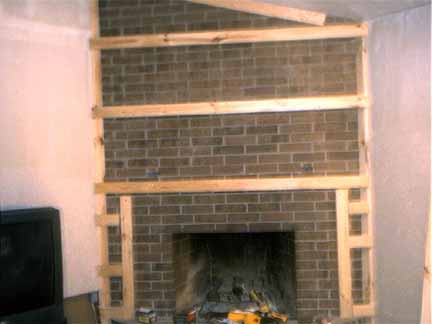 and things like this 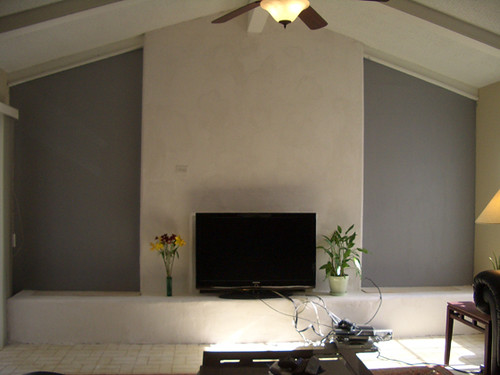 Not that I would put a tv in front of it. Heck even if I had to put metal studs and rockwool on the inside it still would insulate better than it currently is. When the temp is in the 40s the surface of the thing is in the 50s. The wall temp is about 67. Big difference. |
|
|
|
|
Bob I
Veteran Member
Posts:1435
|
| 08 Jan 2014 10:40 AM |
|
My $.02 > Option 2. rip it down. Do it right, do it once. Then install a zero clearance FP if you choose, direct vent out the back. As people learn about energy efficiency, they will want open fireplaces less and less. most folks now would prefer a ZC. I think it adds -0- to the value of the house and having a giant unknown behind the wall probably detracts for a lot of buyers. Three days of messy work and you're done with it. |
|
| Bob Irving<br>RH Irving Homebuilders<br>Certified Passive House Consultant |
|
|
Dana1
Senior Member
Posts:6991
|
| 08 Jan 2014 04:24 PM |
|
And there you have it- the voice of reason!
Putting the insulation on the interior side you'd still be left with the low-R (compared to a high-R wall) back side of the insert, putting the heating unit partially outside of the thermal envelope. Insulating it on the exterior keeps it all inside the thermal envelope where it belongs.
Some people get hung up on the architectural authenticity of the interior side appearance of the old fireplace others, not so much. Either way you can deal with it, but leaving a hole or thin spot in the thermal envelope and putting the heating appliance in that hole guarantees sub-par efficiency of the heater while operating, and an unnecessarily lossy spot when it isn't. If you're going to keep it, insulate from the exterior. |
|
|
|
|
kogashuko
Basic Member
Posts:169
|
| 08 Jan 2014 08:02 PM |
|
Based on the amount of time we used the thing, it took as 6 years to use a 200 gallon propane tank. It was a waste to rent the tank each year and now I run it on 20lb tanks temporarily. When BJs opens their propane fills near here I will just get larger tanks filled there. Even then the 20lb tanks last about two weeks of our use. I am sure we are losing more heat throughout the 24/7 loss than we gain just in the few hours we use the thing.
My concern with ripping the whole thing out is replacing a large hole in the siding and getting the time amongst all my other tasks. I guess I could pay some migrant workers in cash and cervesas and get it done but that is a different discussion.
A few people I have talked to have said to keep the fire place in the event of a large scale disaster / SHTF event/ zombie apocalypse I could go back to wood. My response to that is simple, that event will never happen for more than a week or so because of the nuclear storage problems (but thats another argument.) But seriously, if insulated right I think I could use even a small backup gen and run the fan on the propane stove or a mini split to keep us from freezing. Otherwise we are going to be paying the power and gas companies for now until forever to keep the thing. |
|
|
|
|
Dana1
Senior Member
Posts:6991
|
| 10 Jan 2014 05:35 PM |
|
Insulating it on the interior side would still leave a hole in the insulation the size of the firebox of the insert, and since it's just for decoration you won't sweat the gross hit in heating efficiency. To be sure it shrinks the size of the breach in the thermal envelope by 90%, but I suspect the breach is smaller still if insulated from the exterior. |
|
|
|
|
mlebois

New Member
Posts:1
|
| 01 Jul 2014 07:29 AM |
|
Hi there! If you're interested in finding the best open-fireplace on the market, I'd recommend checking that link: www.archiexpo.com/architecture-design-manufacturer/open-fireplace-1212.html. It really help me chose the ideal solution for my place. |
|
|
|
|
kogashuko
Basic Member
Posts:169
|
| 06 Sep 2014 02:00 PM |
|
So winter is rolling around again and I think I am going to take the easier approach for now and just do the inner wall side. The fireplace will no longer be usable for anything else. Last year I used 2 of the grill type propane tanks all winter. I think ventless fireplace, for as little as we use it, would be ok. I will probably seal the interior brick with a latex mastic and then attach 2x4 metal framing to the inner brick. I will also be permanently sealing the flu and boxing in a smaller fireplace opening that will have full code rated insulation around the hole. The current opening is fairly large so I could just box it in for the next couple of sizes down to allow for code req rockwool. I will be insulting most likely with rockwool and applying a combination of drywall and tile. Here is the real kicker. What I will be saving with going vent free / zero clearance I can put a single head mini split on the top of the mantle to blow into not only the living room but also the kitchen and dining area. At the rated 10000 btu that is equivalent to the current first floor rheem hp at less than 25deg out. In another 5 years or so I will just rip the whole chimney down when I have less going on. I have even considered doing foam instead of rockwool but at this point if I absolutely had to sell I could rip the entire assembly out in a couple of hours and only have the white brick remain to keep the code Nazi happy. |
|
|
|
|