natjwest

New Member

Posts:42
 |
| 06 Apr 2011 04:08 PM |
|
I live in Portland Oregon and I am jacking up my 1905 house and pouring a new footer and ICF walls. I have been completely engrossed in the literature, talking to reps, reading this site and others for the last few weeks. Nonetheless, I have a few questions for the experienced installers. This topic is about bracing.
I am definitely NOT going to cheap out and put no bracing on my 9' tall walls. I need 28 braces. (128 feet of wall, 4 corners, a simple rectangle.) The question is if I should rent a bracing system or build it myself.
I do have time, that is not an issue. The cheapest I could rent a system is about $700 for a month. I think it would be this system: http://www.superioralignmentsystems.com/ or possibly another, depending on who I purchase the block from.
If I were to build a system myself, I could do it for about a $100 less than the rental, but I could reuse all the lumber for the interior walls. If I built it, I would rent turnbuckles from a local concrete supply company for $2.50 each per month.
Because I will be working on the wall with the house above me, a built-in scaffold is not needed since I would be hitting my head on the underside of the first floor. The underside of the existing floor joists will be 10'8" above basement floor and about 5'8" above the outside grade. For the pouring day (hose, not boom) I will set up some inside scaffolding with sawhorses and ladders, but the hose will probably remain outside.
I get the feeling that the consensus is to use a metal bracing system but in my case, I believe it would be a good idea to build myself and reuse the lumber. I'm looking for your opinions. Thank you. |
|
|
|
|
|
|
Chris Johnson

Advanced Member
Posts:878
|
| 07 Apr 2011 07:09 PM |
|
The alignment system for ICF is just that, it is made for ICF, it works well without much thought. If you build your own, will it comply with OHSA regulations?
Call Mike Morrison 541.261.3606 and see what he can do for you
Also, keep in mind, what is your time worth? It takes minutes to install a wall channel and turn buckle, how long will it take you to build the wall channel and turn buckle? How long will it take you to disassemble it? |
|
| Chris Johnson - Pro ICF<br>North of 49 |
|
|
natjwest
New Member
Posts:42
|
| 07 Apr 2011 09:31 PM |
|
Good point Chris. My time is worth much much less than yours or other ICF pros on this board. I'm working on the job myself, I am the homeowner, so no OSHA and reusability is not an issue. Thanks for the advice. |
|
|
|
|
natjwest
New Member
Posts:42
|
| 07 Apr 2011 09:32 PM |
|
Oh and also, I have spoken with Mike the Nudura supplier. He has been very helpful in my project so far. |
|
|
|
|
miformguy
New Member
Posts:43
|
| 07 Apr 2011 10:10 PM |
|
Nat,
In my first few years as an ICF installer I made my own bracing with 2 x 4's. They worked very well. We never walked on them and we used scaffold to pour from. It was very labor intensive and I laugh about it now that I have over 400 sets of metal bracing. For a one time job do it yourselfer, homemade bracing is a good option if you keep in mind that you only get one chance with concrete and never underestimate the power and weight of concrete. Please be careful! |
|
|
|
|
natjwest
New Member
Posts:42
|
| 08 Apr 2011 02:38 AM |
|
Thanks for the sobering reminder miformguy. I have done some concrete pouring, and each time I increase the form bracing. I will, if anything, be over-bracing this job. I just got a follow-up from Mike Morrison who sells Nudura and his pricing is apples-to-apples close to comparable to Fox Blocks. I think the Nudura blocks are stronger so they are back on the table. I will be using wood bracing with proper form turnbuckles. |
|
|
|
|
arkie6

Veteran Member
Posts:1453
|
| 08 Apr 2011 08:12 AM |
|
Here is a thread we had a while back on DIY ICF wood bracing: http://www.greenbuildingweb.com/For...fault.aspxFor my project shown in the link above, the cost for each vertical brace (excluding the treated 2x12 walk board) was ~$6 each in materials and all but ~$1 of that will be reused in the interior framing when the pour is complete. Also, the following is a link to a slideshow for an ICF basement replacement. That might give you some ideas. Note that they put the bracing on the outside of the walls which provided a convenient walkboard for pouring the concrete. http://www.liteform.com/Lite_Form/p...s.html
|
|
|
|
|
arkie6
Veteran Member
Posts:1453
|
|
JosephFearn
New Member
Posts:75
|
| 08 Apr 2011 11:48 AM |
|
If you are going to go the 2x4 route take a look at the Zont braces. It will allow for any settlement of the wall during the pour. And instead of vertical ICF braces; you are bracing horizontally like plywood forms, for straighter walls. http://www.fab-form.com/fastfootMp/...erview.php |
|
|
|
|
eric monkman

Basic Member
Posts:262
|
| 12 Apr 2011 06:51 PM |
|
Natjwest
ICF Distributors usually have bracing to rent on a "per pour" basis. Here it is around $12 per use.
Making your own uprights using a 1x4 screwed to the edge of a 2x4 or 2x6 is what we use. This allows us to customize wall heights cheaply.
Also the block we use does not settle, so firm attachment is OK.
Our adjustable bracing is "homebuilt" and is useful for wood frame walls as well as ICF's
Remember"turnbuckle" systems are pulling on the brace and the screws holding it to the block, so having enough screws is critical.
Also the turnbuckle's foot must be securely attached to the deck or pinned to the subgrade to work in the first place.
What I am coming to is "pushing " a loaded wall can be more effective than "pulling" in some situations.
Carry on :-) |
|
|
|
|
eric monkman
Basic Member
Posts:262
|
|
natjwest
New Member
Posts:42
|
| 12 Apr 2011 07:15 PM |
|
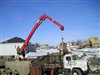
Great call on pushing vs pulling to plumb, eric. I saw the same advice on an Arxx installers video just recently. And thanks for the pictures, that looked like one hell of a pour all the way at the top!
Building my own wood bracing is completely dependent on renting big turnbuckles to attach to the end of the diagonals and then bang into the ground. So far, I've only found one place in town (Portland Oregon) who rents them ($2.50/month) but they only deal to contractors with an account. I'm working that angle now. If I have to buy turnbuckles ($12 online plus shipping) it ruins the economics of the build vs rent. Not using turnbuckles is not an option to me. I need 28-30 units.
I should mention that the ICF distribs who are giving me bids all have systems they want to rent to me for a reasonable amount. It's just that I have time, time isn't money to me, and I'm pinching pennies. If I can build bracing for more time and less money, that's what I should do.
One more question about bracing: How far up the verticals do the tops of the diagonals attach? I'll have 9'4" of ICFs (7 courses), using 10' 2x4s for the verticals (running long). I'm hoping to use 10' 2x4s for the diagonals so A(squared) + A(squared) = 10(squared) says I should put the diagonals 7 feet up the verticals. Does that sound about right? Your pictures appear to show the same thing. |
|
|
|
|
eric monkman
Basic Member
Posts:262
|
| 12 Apr 2011 07:30 PM |
|
You don't necessarily have to use a turnbuckle system in a DYI situation. So long as you are braced both sides of the wall, at the same location,
and have the manpower available during the pour to make adjustments, you'll be fine.
The braces are more effective , if they are higher on the wall.
We prefer our walk plank to be between knee height and mid thigh to the top of wall for easy trowelling and wall alignment,
with braces set at 45 degrees or less.
|
|
|
|
|
natjwest
New Member
Posts:42
|
| 12 Apr 2011 07:49 PM |
|
Okay eric, but to control costs, I was not planning to brace the outside of the wall. The footer will be five feet below grade with a pretty narrow amount of excavation on the outside of the wall (2+ feet or so). It's a pour under an existing home so I'll be bonking my head on the underside of the floor joists if I have any scaffolding on the inside. The pouring will occur from the outside.
If I dont use turnbuckles, would adjustments be made by un-screwing the diagonals from the verticals, plumbing, then re-screwing? Seems like a pain in the ass, but I guess that's what you mean by having sufficient manpower available during the pour. |
|
|
|
|
eric monkman
Basic Member
Posts:262
|
| 12 Apr 2011 08:25 PM |
|
Posted By natjwest on 12 Apr 2011 07:49 PM
If I dont use turnbuckles, would adjustments be made by un-screwing the diagonals from the verticals, plumbing, then re-screwing? Seems like a pain in the ass, but I guess that's what you mean by having sufficient manpower available during the pour. Yep, thats what I mean. Seeing as how you are line pumping, you will need a hoseman and 2 guys plus your wall straightening team Still, we hardly ever pour with less than 5 guys, usually 6. Concrete pours can humble you quickly if your miss something.  |
|
|
|
|
arkie6
Veteran Member
Posts:1453
|
| 13 Apr 2011 11:11 AM |
|
Posted By natjwest on 12 Apr 2011 07:15 PM
One more question about bracing: How far up the verticals do the tops of the diagonals attach? I'll have 9'4" of ICFs (7 courses), using 10' 2x4s for the verticals (running long). I'm hoping to use 10' 2x4s for the diagonals so A(squared) + A(squared) = 10(squared) says I should put the diagonals 7 feet up the verticals. Does that sound about right? Your pictures appear to show the same thing.
My ICF basement wall height is also 9'4". I took 10' 2x4s for the vertical supports and cut 6" off the end to use as a cleat to attach my kicker brace to the floor (drilled & tapcon to the concrete). I used 8' 2x4 braces installed at ~45 deg. I cut a couple inches off at 45 deg from the bottom so that they we set flat on the floor and then screwed them to my floor cleats. The top of the plywood cleats that attach my braces to the vertical supports (shown in one of my previous posts in this thread) are right at 6' high.  |
|
|
|
|
arkie6
Veteran Member
Posts:1453
|
| 13 Apr 2011 11:36 AM |
|
Posted By eric monkman on 12 Apr 2011 07:30 PM
You don't necessarily have to use a turnbuckle system in a DYI situation. So long as you are braced both sides of the wall, at the same location, and have the manpower available during the pour to make adjustments, you'll be fine.
Bracing on both sides of wall? Why? I've never seen that recommendation before. Are you implying that braces on one side of the wall will somehow move, or pull away from the ICF, or what? I've watched/helped on two ICF pours with bracing on one side of the wall similar to what I have shown above, no turnbuckles, and no adjustments to the bracing had to be made during the pour. The wall stayed straight and plumb throughout the pour. |
|
|
|
|
ICFBdr
Basic Member
Posts:238
|
| 18 Apr 2011 09:02 PM |
|
Every time I pour an ICF the wall ALWAYS leans away from the braces. I usually use metal ICF bracing - I have used wood bracing attached to a turnbuckle in the past - worked well, but the 2x4 tends to bend rather than push out the wall on occassion. Easy fix is to push the wall by hand to help it along. This takes a bit longer, but the end result was perfect.
Previous post was right - pushing is MUCH easier than pulling. Start with the wall leaning in (3/4" is not too much on a ~30' wall), since it will lean out during pouring.
I would check online (cragslist, kijiji, etc.) for a set of used ICF bracing. Sometimes you can find them at about half cost of new set - should be able to sell them for same price you paid once you are done (now that sounds economical to me). |
|
|
|
|
JosephFearn
New Member
Posts:75
|
|
FBBP
Veteran Member
Posts:1215
|
|