aa_uk

New Member

Posts:95
 |
| 19 Dec 2011 12:13 PM |
|
Apologies if this has been asked before but T forms are not an easy search term!
I need to create a T junction in a wall by butting the end of some standard Nudura blocks up to a corner block. I am not sure of the best way to do it and would appreciate any thoughts on the following.
On the outside (flat face) of the T I was going to strap the standard blocks to the corner blocks to keep them together (like a vertical stack joint). I'll have to create something on the internal corner to hold it together on the other face. The corner blocks are for an 8 inch core and the wall that butts up to it is a 6 inch core.
The wall does not need to be fireproof so the concrete does not have to be continuous vertically across the junction but, obviously, it would be better if there at least some connection. I was wondering whether I should cut some circular holes (say 4 inch diameter) in the corner block to allow the concrete in the corner block to join the core of the standard block. If I cut the holes in the right place, then I could run some rebar through from the corner block into the core of the standard blocks. I appreciate that I need to brace the outside of the T to withstand the pressure.
Any thoughts? I guess my biggest concern is that if I cut a hole in the corner block then I will weaken it too much.
Thanks for your help
Andrew
PS I know that Nudura manufacture T forms but I haven't got any and I am in the UK so it would a lot of time and expense to get them shipped from Canada.
|
|
|
|
|
|
|
TexasICF

Advanced Member
Posts:622

|
| 19 Dec 2011 01:50 PM |
|
Hello UK - you are doing the right thing. Yes, Nudura has any to any T's e.g. 4" wall to 10" wall etc. etc. However, what you have although technically at T of sorts is actually a bit different. With the standard T you have a horizontal line (top of T) and a vertical line (main of T). Factory pieces can take you from any size ICF top of T-wall to any size ICF main of T-wall. These different walls (sizes) are always perpendicular to each other unless of course your T is just 6" to 6" or 8" to 8" etc where all walls are of the same size.
Therefore, as you already figured out you have an 8" corner with a 6" butt creating somewhat of a hybrid T. where you have one size block (8") in the main and another sized block (6") for half of the top.
Since you don't have a firewall condition, what you are doing with the holes is probably ok especially with the rebar being continous across there. However, you should probably ask an engineer. Better, just cut the 8" block corner the full width of 6" where the intersection occurs. You will want to run 2x4s or something across each course of the back of the 6" to 8" transition.
As with any T-wall (especially if you make them). Keep to 4' per hour or so for concrete placement and always fill the top of T first as this will minimize the hydrostatic pressure. Regards.
|
|
|
|
|
aa_uk
New Member
Posts:95
|
| 19 Dec 2011 04:18 PM |
|
Thanks for your help. AA |
|
|
|
|
Ray Gladstone
New Member
Posts:97
|
| 19 Dec 2011 06:45 PM |
|
Why are you using a corner? Can't you just butt the end of a straight form to the horizontal face of the perpendicular wall section and remove the foam? I feel like I'm missing something. |
|
|
|
|
TexasICF
Advanced Member
Posts:622
|
| 19 Dec 2011 07:10 PM |
|
Ray, it's a bit confusing to describe but it's not a normal T. The corner is all 8" wall and the 6" wall comes off of it. Therefore, there is no 8" wall to but up against a 6" wall. Some would not call this a T at all... rather an 8" corner with a 6" wall coming off of it. Regards. |
|
|
|
|
jeepster

Basic Member
Posts:153
|
| 19 Dec 2011 07:40 PM |
|
Something like this??
------------------------------------------------
6666666 8888888888
-----------------l 8
l 8 l----------------
l 8 l
l 8 l
l 8 l
l 8 l
|
|
|
|
|
aa_uk
New Member
Posts:95
|
| 20 Dec 2011 03:41 AM |
|
Exactly. |
|
|
|
|
ICFHybrid

Veteran Member
Posts:3039
|
| 20 Dec 2011 10:22 AM |
|
I'm with Ray and Tex. I don't even think I've seen a "TEE" used. Here's what we have done at all such intersections, including transitions from 6" to 8" walls.
1. Butt the two blocks together.
2. Saw out the foam completely so there is a clean transition from one concrete to the next Don't leave any sharp angles at the edges to weaken the concrete joint.
3. Use zip ties looped around the webs to suck the two walls together.
4. Use 1/2" OSB or ply patches to stiffen foam surfaces outside. Strongback on surface planes.
5. Make sure your horizontal reinforcing steel passes through the joint.
6. Use can foam to seal the joint edges, but don't let overflow collect inside to weaken the concrete transitions.
You can gain a lot of strength from a joint like this, but 4" holes between the two walls won't do much for that. |
|
|
|
|
TexasICF
Advanced Member
Posts:622
|
| 20 Dec 2011 10:48 AM |
|
ICFHybrid & Ray -- I agree you should cut it all out and not use the holes but the scenario is a bit different from a "T". It looks like what jeepster has drawn above and it's not really a T but rather a wall of size 6" butted up against a corner of size 8". Use of a corner is not optional unless you want to create a lot of work. Use of a standard T (as I regularly do for speed) is not an option either. I'm going to a jobsite later and will bring a picture. Regards. |
|
|
|
|
ICFHybrid
Veteran Member
Posts:3039
|
| 20 Dec 2011 11:24 AM |
|
I'm not going to say the "modification" method I described is faster than using tees (when you can), but if you are accustomed (read equipped and provisioned) to dealing with irregularities like this then it might be pretty close to a wash. Some good ICF builders I have seen don't get too fancy on the block ordering. Just straights and corners, (unless the build has been optimized by design for a particular line of block, of course). |
|
|
|
|
TexasICF
Advanced Member
Posts:622
|
| 20 Dec 2011 07:28 PM |
|
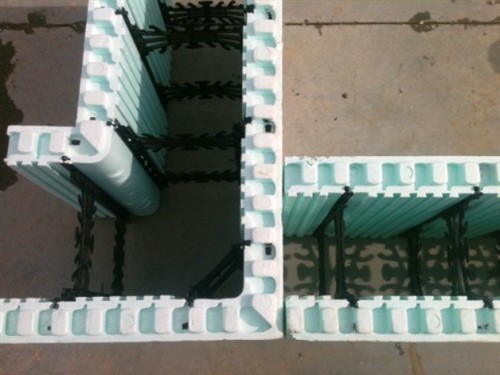 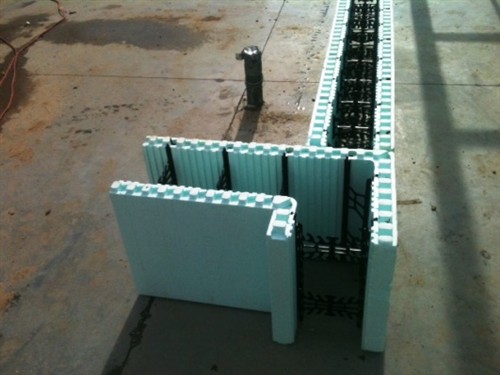
Of course you still have to cut the foam and brace etc. Regards.
|
|
|
|
|
aa_uk
New Member
Posts:95
|
| 21 Dec 2011 02:37 AM |
|
Thanks for the pictures. That's exactly the situation that I need to handle.
As suggested, I will cut the foam away for the whole width of the 6 inch core and then brace, brace, brace.
Thanks everybody for all the comments and suggestions. |
|
|
|
|
ICFHybrid
Veteran Member
Posts:3039
|
| 21 Dec 2011 08:17 AM |
|
And don't neglect the horizontal reinforcing bar. If you consider the bar that you would normally place in a single corner, you should have an equal amount placed to go each way down the "TEE". And it should all have the proper overlap length. |
|
|
|
|
BrucePolycrete
Advanced Member
Posts:524
|
|