Sorbz62

New Member

Posts:6
 |
| 07 Jul 2017 05:32 PM |
|
I am replacing a deck on the side of my 18 year old ICF home. Theold deck ledger was merely screwed on through teh siding and into the black 'spacers in the ICF bu seemed solid enough. Code now instructs that all ledgers must be bolted into the concrete (in this case).
I have registered here to ask advice on how best to attack the ledger. I've removed the siding and see the ICF and black spacers at 8"OC. My options are:
1. Screw the ledger to the black spacers as before but add long bolts which go through the 2" ICF and into the concrete.
2. Cut away the 2" of ICF AND the black spacers and bolt the ledger directly to the concrete, adding a second ledger to bring it out level with the outside face of the wall.
3. Use these 'Maine Brackets' I found online when researching this. http://www.deckbracket.com/
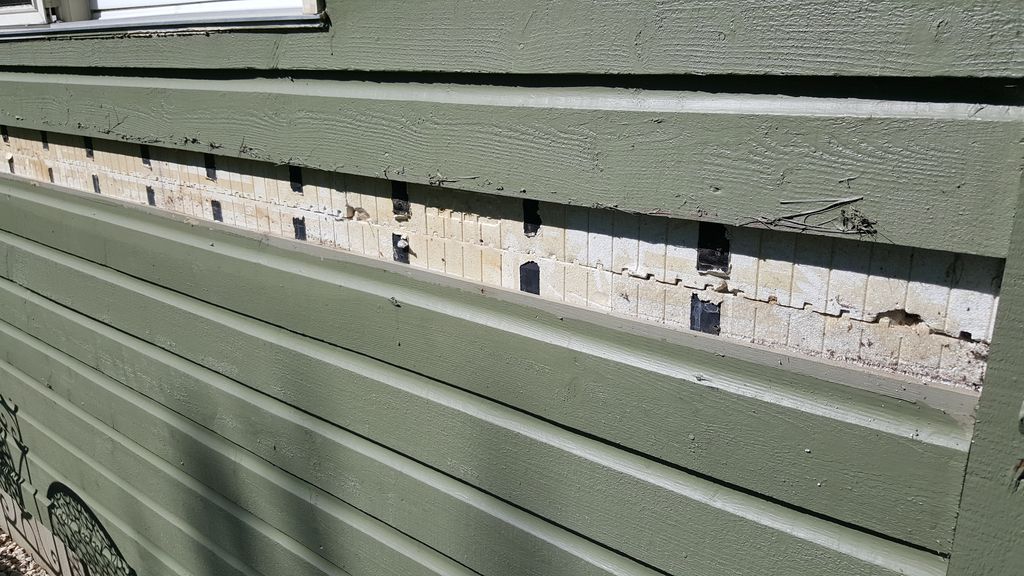
I cannot float the deck as I have some cabling and utility conduits running alongside the house where I would have dug post holes.
Thanks guys in advance!
Cheers,
Jim |
|
|
|
|
|
|
arkie6

Veteran Member
Posts:1453
|
| 07 Jul 2017 06:25 PM |
|
Set some 1/2" or 5/8" anchor bolts in the concrete extending far enough out to capture your ledger board. Cut some heavy wall 2-1/2" or 3" diameter steel pipe or rigid metal conduit the same thickness as your ICF foam, i.e. 2". Hang the pipe piece on the anchor bolt (do not center it on the bolt, but allow the pipe to hang from the bolt), mark and remove enough foam to allow the pipe piece to slide back to the concrete face. Now the face of the pipe piece should be ~flush with the face of the foam. Allowing the pipe piece to hang down below the anchor bolt provides support for the ledger board and reduces or minimizes the cantilever force on the anchor bolt (the bolt being at the top will be primarily in tension as it is intended). Mark and drill your ledger board to fit over your anchor bolts. Fill the cut pipe pieces with canned spray foam prior to installing the ledger board to keep water out and restore some of the insulation value lost by the pipe cutout. If your ledger board is treated, it would be a good idea to protect the cut metal pipe from corrosion by either painting the pipe ends with metal primer and/or providing a barrier between the pipe ends and the ledger board (#30 tar paper, etc.) - I would do both. |
|
|
|
|
z_zk_z
New Member
Posts:19
|
| 08 Jul 2017 03:25 AM |
|
You could also re-build a free standing deck (need to add more posts), which would take the force away from the ledger board. |
|
|
|
|
jdebree

Basic Member
Posts:497
|
| 08 Jul 2017 10:54 AM |
|
That's a good idea Arkie has there. The thing is that the ledger has to be in contact with something solid, not just foam. When I built my house, I bored 5" holes in the foam, and screwed plywood patches over the holes for filling the forms. The J-bolts were held in place by the plywood patches. I've also read of covering the holes with the ledger itself, so then it's already fit in place. In your case, you'll need something like Arkie said. You could alternately build a freestanding deck with inboard support posts and diagonal bracing. |
|
|
|
|
Sorbz62
New Member
Posts:6
|
| 08 Jul 2017 02:24 PM |
|
Thanks guys,
Unfortunately I cannot build a free-standing deck as there are substantial utility cables and conduits where I would have to out the posts. |
|
|
|
|
Sorbz62
New Member
Posts:6
|
| 08 Jul 2017 04:07 PM |
|
Hi again guys,
I just had a thought - can I cut away the foam AND the black 'spacers' to enable me to bolt the ledger directly onto the concrete?
Are the black 'spacers' a structural component of the wall?
Cheers,
Jim |
|
|
|
|
TexasICF

Advanced Member
Posts:622

|
| 08 Jul 2017 05:18 PM |
|
Sorbz62, The furring strips are not structural on any ICF I am aware of. I have seen your approach a number of times and it works fine. I was thinking your wall was already poured so it make sense. You can also use a thin gasket of sorts to "attempt" to thermally isolate your deck (at least somewhat) from the concrete wall.
You might also check out this youtube video: Search for "Advanced ICF" channel and video is "Cantilevered Eyebrow" It's not exactly what your looking for at this point but might prove interesting.
regards |
|
|
|
|
Sorbz62
New Member
Posts:6
|
| 08 Jul 2017 08:13 PM |
|
Thanks.
What about the 'Maine Brackets'? I would think they would enable me to cut away the foam and replace the siding before I attach the ledger. What about structurally? Would they strong enough?
http://www.deckbracket.com/
Jim |
|
|
|
|
z_zk_z
New Member
Posts:19
|
| 09 Jul 2017 02:34 AM |
|
You don't need to remove the entire foam behind the ledger board. just remove the foam where you are going to have the anchor bolts and place 2x4 filler wood behind the ledger board, kind of like this video, except you will have the 2x4 filler wood where that hole with concrete is https://www.youtube.com/watch?v=L7APsUIrqdY
The Maine Brackets would do too, but probably going to be expensive, and you may have to make more holes into concrete.
|
|
|
|
|
ICFBdr
Basic Member
Posts:238
|
| 11 Jul 2017 02:16 PM |
|
The deck brackets look like a good option (although I have never used/seen this product before). A second option could be using a FAST bracket (http://www.ferocorp.com/pages/fast/fast.html). The steel ledger would support the vertical load of the deck ledger. Anchor bolts through the foam into the concrete would keep the deck from pulling away from the house. This would maintain most of your insulation, rather than removing the entire area of EPS for the ledger to attach directly to the concrete. |
|
|
|
|
ICFBdr
Basic Member
Posts:238
|
| 11 Jul 2017 02:29 PM |
|
Another option is to use a retrofit bracket, such as http://www.nudura.com/docs/default-source/tech-bulletins/Retrofit_Bracket.pdf?sfvrsn=4
This would eliminate the need for the ledger all together.
Be sure this is OK to use in exterior application, as many of these types of hangers are not safe for use with PT lumber (or you may have to place poly/WP membrane as a barrier to keep the hangers/lumber from being in direct contact). |
|
|
|
|
Chris Johnson
Advanced Member
Posts:878
|
| 12 Jul 2017 02:55 AM |
|
Find out what you require for a bolt pattern for the ledger board to start with. remove the foam to the face of the concrete at those spots, I'd suggest 2" greater around from the centre of the bolt, so roughly 4.5" square hole is fine. get some 3x PT material, drill a 3/4" hole in the centre - if using a 5/8" anchor, PL Premium the block into the removed foam hole - PL is for temp support only. Use an SDS drill and drill into the concrete if it's a 6" ICF wall, drill 4" if 8" ICF drill 6". Properly brush and blow the hole to clean it. cut threaded rod to the correct length needed either galvanized of stainless steel and epoxy into place
Your ready to set your ledger board, with a solid backing and no chance of sheer on the threaded rod
|
|
| Chris Johnson - Pro ICF<br>North of 49 |
|
|
Sorbz62
New Member
Posts:6
|
| 17 Jul 2017 04:08 PM |
|
If I may, I'd just like to digress and ask about flashing.
As the ICF material is waterproof and there is no evidence of any damage after 18 years, what flashing would I need to add to my ledger board?
Would it be sufficient to just add silicon caulking along the top edge of the ledger?
Cheers in advance,
Jim |
|
|
|
|
Dilettante
Advanced Member
Posts:503
|
| 17 Jul 2017 10:59 PM |
|
You always want to flash your ledger. It prevents any chance of water standing on or getting behind the ledger board and sitting up against the house for long periods.
Even with meticulous attention to detail, the expansion and contraction of the caulking could open up spaces for water infiltration, where a metal plate wouldn't.
|
|
|
|
|
Sorbz62
New Member
Posts:6
|
| 17 Jul 2017 11:17 PM |
|
Thanks for the quick reply.
What would be the best process then for flashing a ledger with an ICF house?
|
|
|
|
|
Titan ICF
New Member
Posts:61

|
| 23 Jul 2017 03:24 PM |
|
You can use composite deck-spacers. They are composite and will work with anchor bolts to space out your rigid mounting space. Google deck2wall spacer. It will also give you a ledger that can dry out depending upon how you mount everything. They have engineering and testing. Number one reason ledgers fail is moisture. If it can't dry it's going to die... |
|
| "If you think it's expensive to hire a professional to do the job, wait until you hire an amateur." Red Adair |
|
|
ICFBdr
Basic Member
Posts:238
|
| 24 Jul 2017 04:53 PM |
|
Flashing can be run along the face of the ICF then sealed with a strip of peel-and-stick membrane prior to exterior finish. Another option is to cut a 45 degree slit up into the EPS and get a flashing that would slide into this cut, down the ICF a couple inches then over top the ledger.
Flashing is important not only to keep the wall/deck ledger dry, but also to keep water from mitigating into the ICF. From there it can travel though the pours in the concrete and potentially find its way to your drywall, causing a wet spot inside the basement below the deck. This is unlikely to happen, but and easy way to protect yourself from this is with a piece of flashing (ounce of prevention....) |
|
|
|
|