|
|
|
ICF vs CBS vs Wood-Frame in Southwest Florida
Last Post 20 Jun 2018 06:34 PM by sailawayrb. 25 Replies. |
Sort:
|
|
 Prev Next Prev Next |
You are not authorized to post a reply. |
|
kfink85

New Member

Posts:6
 |
| 09 Jun 2018 01:31 AM |
|
Hello, my wife and I are building our first home. Our lot is on a salt-water canal (not sure if this matters for this discussion). We just started working with an architect and are still in the design phase. The home is going to be two-stories and between 3000-3500 living square feet with roughly 2000 of it on the first floor. 4000-4500 total square feet for the home when you count garage, lanai, etc.
The standard construction in our area is Concrete Block System (CBS) on first-floor and wood-frame on second-floor.
I have researched Concrete Block System (CBS) vs ICF vs wood-frame for hours and hours. I have gotten a lot of conflicting info from contractors and other forums/sites. Please help me put these questions to rest. Here goes:
- Is it possible to have CBS on first-story and ICF on second-story? Would this even make sense to do? Or if you go ICF, go ICF all the way.
- Is ICF more impact resistant to hurricanes than CBS? By how much? Max wind mph tested? I've heard 200 mph.
- Is it possible my architect can't design an ICF home? He said that it was very uncommon in this area and could cost significantly more to build. He didn't entirely dismiss it but seemed to think it was a bad idea.
- How big of a job would it be for another architect to change my guy's CAD from CBS to ICF prior to building? Are there floor plan design considerations I should be conscious of?
- How much better of an R-value will ICF have vs CBS? I've seen the comparisons to wood-frame but not CBS. I was told the following: "The most energy loss is through glass surfaces, then the roof/ceiling, then the walls. Therefore, the most payback by far is to invest into energy efficient glazing (double or triple) and extra insulation in the ceiling." Is this true?
- Sounds like termites can nest in the foam and they should be pre-treated. Concrete obviously not. How long does that treatment last? Can it be treated a second-time years later? Termites are a big deal here.
- How much is the cost differential between CBS vs ICF vs wood-frame? First-floor will be CBS or ICF, regardless. Wood-frame only a possibility on second-story. I know it depends on a lot of specifics---but ballpark or a range?
- Does our selection of exterior wall have an effect on our floor system? In other words, should the ceiling of first story / floor of second story be concrete/wood/or what? I was told the way to go was a concrete plank for less sound transmission but could cause HVAC difficulties (no space for ducts so extra soffits needed). Would this screw up my R-value in the home?
----------
Thank you so much for any advice that you all can provide. |
|
|
|
|
|
|
sailawayrb

Veteran Member
Posts:2283

|
| 09 Jun 2018 03:00 AM |
|
Firstly, welcome to the GBT forum. We build ICF in Oregon, so that’s our perspective. There are ICF builders who frequent this forum that can provide you with better local guidance and cost. Anyhow, here’s my responses to your questions:
Is it possible to have CBS on first-story and ICF on second-story? Would this even make sense to do? Or if you go ICF, go ICF all the way. My recommendation would be if you go ICF, is to go all ICF.
Is ICF more impact resistant to hurricanes than CBS? By how much? Max wind mph tested? I've heard 200 mph. I don’t have a definitive answer, but I think both would be more than adequate. You can add a metal spiral material to your ICF concrete that can reportedly make it hurricane and tornado proof.
Is it possible my architect can't design an ICF home? He said that it was very uncommon in this area and could cost significantly more to build. He didn't entirely dismiss it but seemed to think it was a bad idea. I would think any architect worth hiring would be able to work with ICF. Personally, I think a good GC is worth more than any architect.
How big of a job would it be for another architect to change my guy's CAD from CBS to ICF prior to building? Are there floor plan design considerations I should be conscious of? ICF is just a 12” thick wall instead of 2 by thick wall. So you need to adjust the interior space plan according. You also need to think about how you want to do your doorways and window openings given the thicker walls. You need to get all your wall penetrations right before you pour the ICF walls. Finishing the exterior/interior ICF walls also requires additional effort and detailing work. In the end, you get a really nice and long lasting building envelope.
How much better of an R-value will ICF have vs CBS? I've seen the comparisons to wood-frame but not CBS. I was told the following: "The most energy loss is through glass surfaces, then the roof/ceiling, then the walls. Therefore, the most payback by far is to invest into energy efficient glazing (double or triple) and extra insulation in the ceiling." Is this true? Dana and others can point you in the right direction with regard to R-value recommendations in your area. The best thing to do is to minimize windows and avoid skylights completely. ICF tends to have lower outside air infiltration than other building envelopes.
Sounds like termites can nest in the foam and they should be pre-treated. Concrete obviously not. How long does that treatment last? Can it be treated a second-time years later? Termites are a big deal here. Yes, that could be the deciding factor on what would be best. I understand there are a lot of ICF and SIP homes in your area, so there must be some good solutions on dealing with this issue.
How much is the cost differential between CBS vs ICF vs wood-frame? First-floor will be CBS or ICF, regardless. Wood-frame only a possibility on second-story. I know it depends on a lot of specifics---but ballpark or a range? You will have to get local bids to sort this out.
Does our selection of exterior wall have an effect on our floor system? In other words, should the ceiling of first story / floor of second story be concrete/wood/or what? I was told the way to go was a concrete plank for less sound transmission but could cause HVAC difficulties (no space for ducts so extra soffits needed). Would this screw up my R-value in the home? A good GC should be able to handle whatever floor you desire. We are big fans of concrete floors as we are big fans of hydronic radiant floor heating and concrete is as good as it gets. However, I suspect mini splits would be a better HVAC solution in your neck of the woods.
Good luck and best wishes with your project! |
|
| Borst Engineering & Construction LLC - Competence, Integrity and Professionalism are integral to all that we do! |
|
|
kfink85
New Member
Posts:6
|
| 09 Jun 2018 05:31 PM |
|
Thank you so much for all the great info. As long as the cost isn't outrageous, I feel like ICF is the way to go. Hope the people down here can handle it! |
|
|
|
|
30FromNowhere
New Member
Posts:24
|
| 11 Jun 2018 10:29 PM |
|
I'm not a builder, but just finished up an ICF, so I can talk about my experience and research that I did.
- Is it possible my architect can't design an ICF home? He said that it was very uncommon in this area and could cost significantly more to build. He didn't entirely dismiss it but seemed to think it was a bad idea.
- How big of a job would it be for another architect to change my guy's CAD from CBS to ICF prior to building? Are there floor plan design considerations I should be conscious of?
Any component architect should be able to handle this. I actually went with a consulting company in my state that provided building materials and working drawings for a set price. They were an ICF distributer, so they were able to get the detail drawings out really fast.
- Sounds like termites can nest in the foam and they should be pre-treated. Concrete obviously not. How long does that treatment last? Can it be treated a second-time years later? Termites are a big deal here.
Termites are an issue here, but sub-slab treatment and borax should be fine I would think. Again, this was something that you could talk to various ICF block manufacturers to get an better idea. The ones I talked to were more than willing to answer my questions without going into any kind of sales pitch.
- How much is the cost differential between CBS vs ICF vs wood-frame? First-floor will be CBS or ICF, regardless. Wood-frame only a possibility on second-story. I know it depends on a lot of specifics---but ballpark or a range?
You WILL be spending more to do ICF than wood frame. Gotta figure the cost of concrete into the price and the slightly higher labor costs if you have a builder that doesn't do ICF regularly. Try to find a builder in the area that has done ICF, and that will speed the process - which will keep the costs down.
- Does our selection of exterior wall have an effect on our floor system? In other words, should the ceiling of first story / floor of second story be concrete/wood/or what? I was told the way to go was a concrete plank for less sound transmission but could cause HVAC difficulties (no space for ducts so extra soffits needed). Would this screw up my R-value in the home?
One thing to remember is that you can build "faux" walls inside the ICF to house HVAC if you want. This also includes the equivalent of a framed out drop ceiling that can house the electrical and HVAC. YOu wonlt ahve to worry about cutting trusses as it won't be structural - just creating a space to stuff things.
Something you may also want to look into at the design phase is if your insurance will give you discounts for building a certified IBHS FORTIFIED Home. Being in Florida, there are lots of specifications on how to build a hurricane-resistant home. The specs apply to any of the construction methods you are considering. |
|
|
|
|
newbostonconst

Advanced Member
Posts:778
|
| 13 Jun 2018 10:53 AM |
|
One thing to remember is that you can build "faux" walls inside the ICF to house HVAC if you want. This also includes the equivalent of a framed out drop ceiling that can house the electrical and HVAC. YOu wonlt ahve to worry about cutting trusses as it won't be structural - just creating a space to stuff things.
Something you may also want to look into at the design phase is if your insurance will give you discounts for building a certified IBHS FORTIFIED Home. Being in Florida, there are lots of specifications on how to build a hurricane-resistant home. The specs apply to any of the construction methods you are considering.
Thanks for the Fortified link. Is this worth doing? Insurance discounts? |
|
| "Never argue with an idiot. They will only bring you down to their level and beat you with experience." George Carlins |
|
|
Titan ICF
New Member
Posts:61

|
| 13 Jun 2018 12:39 PM |
|
Most cinder block (Cmu) or concrete masonry unit design can be converted to ICF rather easily. For energy code now you have to fur out a Cmu wall with a wood framed 2x4 wall of 3 1/2” to meet the R13 requirements. Now there are some towns that are stuck years behind and have grandfathered in Cmu saying it’s higher r value than it is. Most Cmu is around an r 3-4, the biggest value it has is thermal mass. Change is coming as codes are enforcing higher r values and it’s crazy easy to meet everything with Icf. Most Icf falls between r-11 each side plus the concrete core for thermal mass effect. R22 is continuous and not cavity, that is the huge advantage over Cmu. It will perform around an r 30 depending on the core size. 6” is more thermally stable then 4” but 8” is overkill unless you need it for structure. Fortified is starting to get a name for itself in some areas. Most builders don’t like change as it throws off their process. Fortified structures have insurance discounts, which is good for all of us.
Icf is monolithic concrete and is much stronger then Cmu, 5 times?, hard to say depending on design. However most Cmu is not fully filled with concrete. Normally it’s corners, around openings and every 4’ that gets rebar and concrete. Then every 8’ high is a bond beam or u block around the structure to tie it together. Therefore you end up with lots of hollow block. Some situations will be fully filled, but that’s normally for commercial construction.
Termites usually stem from not having 4-6” of clearance from ground clutter and landscaping to your home. Allowing a direct path. Every home should be treated regardless in pretreat of the slab and area. You should also treat it every year for pest control and normally you don’t have issues. Water management and ground clearance solve most reasons termites like. Wet direct paths.
In our area, Cmu is cheap, Icf runs about 8-15% more then wood frame. Cmu gets skimmed with 1/4” stucco and no wrb, inside gets 2x4 fused out and they call it a day. Hard to compare a correct wall system to an non complete wall system. If you do Cmu correctly with 3/4” stucco and some type of weather resistant barrier on the Cmu for water instrusion and apply spray foam, your costs are almost the same or higher then ICF. There are tons of Florida articles on moisture intrusion issues with Cmu.
Concrete plank is very uncommon in residential construction, it’s best used for speed of construction and durability. Most Icf has open wood trusses and 1 1/8” sheathing on the trusses. I prefer 2’ trusses to allow for mechanical room of duct runs and everything else. Icf floors are good for balconies and places you need it, a bit overkill inside the home unless you want it.
Icf can be designed up to 250 mph winds, it depends on your design and budget. Most residential is 150 ish with 6” core walls.
I would budget between 100-120 total sqft for the build from all Icf. High end Interior finish outs can drive this higher, but a good place to start.
|
|
| "If you think it's expensive to hire a professional to do the job, wait until you hire an amateur." Red Adair |
|
|
Dilettante
Advanced Member
Posts:503
|
| 15 Jun 2018 04:04 AM |
|
Posted By kfink85 on 09 Jun 2018 01:31 AM
Hello, my wife and I are building our first home. Our lot is on a salt-water canal (not sure if this matters for this discussion). We just started working with an architect and are still in the design phase. The home is going to be two-stories and between 3000-3500 living square feet with roughly 2000 of it on the first floor. 4000-4500 total square feet for the home when you count garage, lanai, etc.
The standard construction in our area is Concrete Block System (CBS) on first-floor and wood-frame on second-floor.
I have researched Concrete Block System (CBS) vs ICF vs wood-frame for hours and hours. I have gotten a lot of conflicting info from contractors and other forums/sites. Please help me put these questions to rest. Here goes:
(1)- Is it possible to have CBS on first-story and ICF on second-story? Would this even make sense to do? Or if you go ICF, go ICF all the way.
(2)- Is ICF more impact resistant to hurricanes than CBS? By how much? Max wind mph tested? I've heard 200 mph.
(3)- Is it possible my architect can't design an ICF home? He said that it was very uncommon in this area and could cost significantly more to build. He didn't entirely dismiss it but seemed to think it was a bad idea.
(4)- How big of a job would it be for another architect to change my guy's CAD from CBS to ICF prior to building? Are there floor plan design considerations I should be conscious of?
(5)- How much better of an R-value will ICF have vs CBS? I've seen the comparisons to wood-frame but not CBS. I was told the following: "The most energy loss is through glass surfaces, then the roof/ceiling, then the walls. Therefore, the most payback by far is to invest into energy efficient glazing (double or triple) and extra insulation in the ceiling." Is this true?
(6)- Sounds like termites can nest in the foam and they should be pre-treated. Concrete obviously not. How long does that treatment last? Can it be treated a second-time years later? Termites are a big deal here.
(7)- How much is the cost differential between CBS vs ICF vs wood-frame? First-floor will be CBS or ICF, regardless. Wood-frame only a possibility on second-story. I know it depends on a lot of specifics---but ballpark or a range?
(8)- Does our selection of exterior wall have an effect on our floor system? In other words, should the ceiling of first story / floor of second story be concrete/wood/or what? I was told the way to go was a concrete plank for less sound transmission but could cause HVAC difficulties (no space for ducts so extra soffits needed). Would this screw up my R-value in the home?
----------
Thank you so much for any advice that you all can provide.
- Yes. It's possible to have CBS on the first story and ICF on the second. There's almost always a way to mate two different construction techniques. The thing is, SHOULD YOU. With concrete block (the standard two-void type), if you experience cracking in the block at all, you get water infiltration into the wall structure itself. While ICF is generally more expensive, it has the bonus of being a monolithic, solid wall construction. I'd be in favor of ICF or concrete sandwich (with the insulation inside and a ply of concrete on both ends).
- Depends on the concrete block system used. If they're filling the concrete blocks with concrete on every course, maybe? Generally, a solid concrete wall will fare better than a concrete wall with voids inside.
- It's possible that your architect simply has no experience with ICF, and thus, distrusts it.
- You'd be better off asking an architect what would be involved in converting such plans. From what I understand, though, conversion should be relatively straightforward.
- CBS, by itself, has the minimal R-Value (not NONE, but not something you want to just rely on). You need to insulated it to have an appreciable R-Value. By the nature of the product, basic ICF products generally deliver about an R20 or so by default. You can get fancy with thicker blocks and foam inserts and all that. But the baseline is generally around 20.
And yes, the windows are the lowest R-value in generally ANY wall construction. So they tend to bleed the most heat on a per-surface-area. However, you generally have more wall surface area to worry about. So if the wall is bleeding heat as well, that's not a Good Thing. So investing in ultra-high-end windows nets you NOTHING if you're radiating heat out of every wall assembly or through air infiltration. - Yes, while termites won't EAT foam, they use it to burrow towards potential food. So you get termites AND your wall assembly is compromised. You can use borate-impregnated ICFs if you want. But you'll always want to have an "inspection strip" cut from the foam to deliver a 6" clearance from ground clutter/landscaping. It won't STOP termites, but it'll allow you to inspect for dirt tunnels along the wall and (hopefully) catch migration attempts early.
You can't really re-treat ICF foam. And it'll be a more traditional call to the exterminator. - Costs depend on a lot of factors, including proximity. If you get ICFs shipped from a local supplier, it's considerably cheaper than getting them shipped from some manufacturer in Bumsville, Idaho. You'll want to source ICF suppliers/vendors/contractors in your area, talk about what you're looking for and get some general quotes. You'll also want to talk to local concrete suppliers to see if they will deliver what you want.
Generally, after all the shouting, construction, etc. ICFs generally add about 10% to the cost of the project (at least that's what just about every project I've seen has quoted).
YES, it's possible to do ICF on the first level and stick on the second. - No. With ICF, you can have multiple choices of floor system. You can go concrete floors with ICF. You can go standard stick frame flooring, or wood/metal truss flooring or combination flooring. Basically with concrete flooring, you want to PLAN your layouts before the pour. And yes, there are generally no "rafters" to string HVAC through. So something like a dropped ceiling can be put in to simply mimic the space normally left by rafter bays or through trusswork.
If you're worried about concrete and thermal bleed, look at the flooring offerings from various ICF vendors. Essentially pre-insulated forms that you put in place and then pour concrete over/into.
Also, you may or may not want to consider alternatives to forced air heating/cooling. It may be that something like a Ductless system (where all you're running are the refrigerant lines) might be a more sensible and economical option. It all really depends...
|
|
|
|
|
Dilettante
Advanced Member
Posts:503
|
| 15 Jun 2018 04:08 AM |
|
Additionally, a solid concrete system like ICF stand up fairly well to hurricanes (it takes a LOT of energy to blow away that much concrete...)
And there are things that can be done to further strengthen the structure with various types of fasteners. Tie the wall to the foundation, tie the flooring into the wall, tie the roof into the walls, etc. |
|
|
|
|
toddm
Veteran Member
Posts:1152
|
| 16 Jun 2018 09:30 PM |
|
Thermal mass is both poorly understood and highly dependent on local climate. As a general rule, if you're building in an area with wide daily temperature swings that average out to about 70 degrees, and if humidity is low or nonexistent, then thermal mass delivers a lot of comfort for no money. Sadly, we're not describing Florida. I'm not sure you're getting anything from ICF in Florida except R22, and that can accomplished in any number of wall systems. The premium for ICF is also a highly local phenomenon. If you have competitive ICF contractors in your area who have years of experience, you're golden. If you don't, you explore adapting local building methods to your needs, such as filling CMU cavities and adding foam board to the interior. No paths for termites, and exterior walls that can be easily repaired after the blow. |
|
|
|
|
newbostonconst
Advanced Member
Posts:778
|
| 18 Jun 2018 01:37 PM |
|
I agree with toddm, if the temp in your area is most of the time above the your thermostat set point and the heat is always moving in one direction then thermal mass has little advantage.
This includes daily temp swings and seasonal temp swings that never go above and below your optimal therm set point. Is there even a place like this in the US? Southern Arizona?
Like if you set your therm at 70 and the outside air over the course of a day never drops below 70 then heat is always moving into your structure. The thermal mass delays the movement of heat. Could this allow you to use smaller HVAC equipment because the inside temp swings are slowed down? |
|
| "Never argue with an idiot. They will only bring you down to their level and beat you with experience." George Carlins |
|
|
toddm
Veteran Member
Posts:1152
|
| 18 Jun 2018 05:37 PM |
|
Yes, thermal lag can reduce HVAC sizing even in Florida. Late afternoon heat would reach the inside of an eight-inch concrete wall in early morning when the ambient temp might be high 70s instead of 90 plus. As well, there will some days throughout the year that mass could stand in for HVAC, the question being how much energy use is actually offset. This is where humidity enters the equation. In a cool wet spring here in Pa., I had to fire up the woodstove boiler one evening and heat the floor to 75 degrees in order to make the AC run long enough to wring out the air. Arghhh (The dehu cycle on my minsplit merely dials down the fan and delays the donning of the sweatshirt by a few hours.) Concrete is a mixed bag. On the one hand, it's a tight envelope that limits infiltration. On the other hand, it's a tight envelope that holds in household generated moisture. OP's house is large enough to limit this effect (while also weakening his claims of environment stewardship.) But someone living in 1,600sf, as I do, can tell you there is no free lunch. |
|
|
|
|
sailawayrb
Veteran Member
Posts:2283
|
| 18 Jun 2018 06:29 PM |
|
Thermal mass will buffer peak HVAC loads which can be beneficial in sizing HVAC equipment. Thermal mass can significantly increase effective R-value for some daily temperature variations. The effective R-value of thermal mass will not become less than the conventional R-value. We have an ICF performance calculator on our website to determine ICF effective R-value for any given daily temperature profile. In southern Oregon, our 22ish conventional R-value ICF behaves like 60ish R-value during some seasons. During the other seasons, it only behaves like its 22ish conventional R-value.
Borst ICF Performance Software |
|
| Borst Engineering & Construction LLC - Competence, Integrity and Professionalism are integral to all that we do! |
|
|
newbostonconst
Advanced Member
Posts:778
|
| 19 Jun 2018 01:05 PM |
|
Sailawayrb. How much does the effective R-value increase in as concrete thickness increases?
So most ICF is R-22.
thus, ICF with no concrete has an effective R-value of R22,
ICF with 4 inches of concrete has an effective R-value of R40?
ICF with 6 inches of concrete has an effective R-value of R?
ICF with 8 inches of concrete has an effective R-value of R?
So does 10 inches of concrete have an effective R of a really high number?
Wondering if it is linear and the values. I know it is diminishing returns on pay back as you add more concrete.
Thanks in advanced. |
|
| "Never argue with an idiot. They will only bring you down to their level and beat you with experience." George Carlins |
|
|
sailawayrb
Veteran Member
Posts:2283
|
| 19 Jun 2018 02:21 PM |
|
I looked at the effect of changing the amount and the location of the concrete and EPS a couple years ago and put the results/conclusions in the instructions of the ICF performance calculator. Every inch of concrete adds 0.1 to the conventional R-value. So there's not much to be gained there in terms of conventional R-value. However, the thicker the concrete, the greater will be the beneficial thermal mass effective R-value, if there is a benefit which really depends on the actual daily temperature profile. As the concrete thickness increases, the EPS becomes less important for providing this beneficial effective R-value. The maximum beneficial effective R-value was limited to about 3 times the conventional R-value for the southern Oregon daily temperature profiles that I evaluated. |
|
| Borst Engineering & Construction LLC - Competence, Integrity and Professionalism are integral to all that we do! |
|
|
toddm
Veteran Member
Posts:1152
|
| 19 Jun 2018 04:55 PM |
|
The classic use of thermal mass is to build walls thick enough that the diurnal cycle of warming and cooling never penetrates to the interior surface but rather dissipates in sine waves inside the wall. Obviously, that won't happen with eight inches of concrete in Florida. Even so, thermal lag accomplishes a time shift that smooths out the daily delta T. With no HVAC, my house is noticeably cool on the hottest days -- a source of wonderment for tradesmen back when. Alas, at 3 a.m. it is noticeably warmer than outside. By dry bulb measure, I wouldn't need air conditioning here in the mountains on the border of zone 4 and zone 5. Wet bulb tells a different story, but half of the problem is that I know what wet bulb means. People from Baltimore built summer homes here to escape the heat, and AC is by no means crucial if you're sitting under a fan. (Working in these conditions tends to be wetter.)
And that's what missing in the effective R values of thermal mass. In the desert Southwest, when it's 110 outside at 7 p.m. and 40 degrees cooler six hours later, thermal mass offsets a pleasing number of kilowatt hours. My happy period is mid September into November when mass effect substitutes for HVAC and humidity is low as well. This is a much more modest victory than effective R values might suggest in the sense that my neighbors who need HVAC are spinning the meter very fast.
In SailawayRB's neighborhood, summer temperatures swing 30 degrees daily, reaching an average high of 91 on Aug 4 according to Weatherspark. Humidity jumps to 20 percent in the heat of summer from its normal value of 0. These are near-Arizona numbers plus one additional benefit. Her average attentive neighbors* who need HVAC through the summer aren't spinning the meter very fast either.
* Homeowners who avoid west facing windows and other design gaffes. I'm thinking a stud wall home built on slab on grade with careful attention to detail could coast pretty easily through a southern Oregon summer. |
|
|
|
|
sailawayrb
Veteran Member
Posts:2283
|
| 19 Jun 2018 05:49 PM |
|
30F degree swings around 70F degrees is about average. We also have 40-50F degree swings and 115 degree highs too. The indoor temperature in our 2400 sf ground level home runs between 62F and 68F all summer and we don't have any AC at all. We do have HRV and we run a whole house attic fan and open some windows in the evening when the temperature drops below 68F which usually occurs about 7 PM at our 2000' altitude. The design analysis showed that our indoor temperature could reach 78F if we didn't have the effective R60 ICF walls, R60 attic insulation, concrete slab floors and 30' long x 10' high interior masonry thermal mass wall. We have passive solar 4' roof overhangs that fully shade the exterior during Summer and we don't have any west windows at all. Lots of folks have 2x stud walls around here, but they also have AC too. Yes, one could certainly make a 2x stud wall work here or really anywhere, but we highly value the other advantages that ICF can provide like increased fire resistance in our wildfire region. |
|
| Borst Engineering & Construction LLC - Competence, Integrity and Professionalism are integral to all that we do! |
|
|
toddm
Veteran Member
Posts:1152
|
| 19 Jun 2018 06:34 PM |
|
Oy. My neighbors who need hvac in autumn are NOT spinning the meter very fast. |
|
|
|
|
Dilettante
Advanced Member
Posts:503
|
| 19 Jun 2018 07:41 PM |
|
Posted By newbostonconst on 19 Jun 2018 01:05 PM
Sailawayrb. How much does the effective R-value increase in as concrete thickness increases?
So most ICF is R-22.
thus, ICF with no concrete has an effective R-value of R22,
ICF with 4 inches of concrete has an effective R-value of R40?
ICF with 6 inches of concrete has an effective R-value of R?
ICF with 8 inches of concrete has an effective R-value of R?
So does 10 inches of concrete have an effective R of a really high number?
Wondering if it is linear and the values. I know it is diminishing returns on pay back as you add more concrete.
Thanks in advanced.
Concrete is roughly 0.52R/inch. You get greater R-value out of ICF by increasing the thickness of the insulation, not the wall itself. Quadlock's webpage has a fairly explanatory set of images.
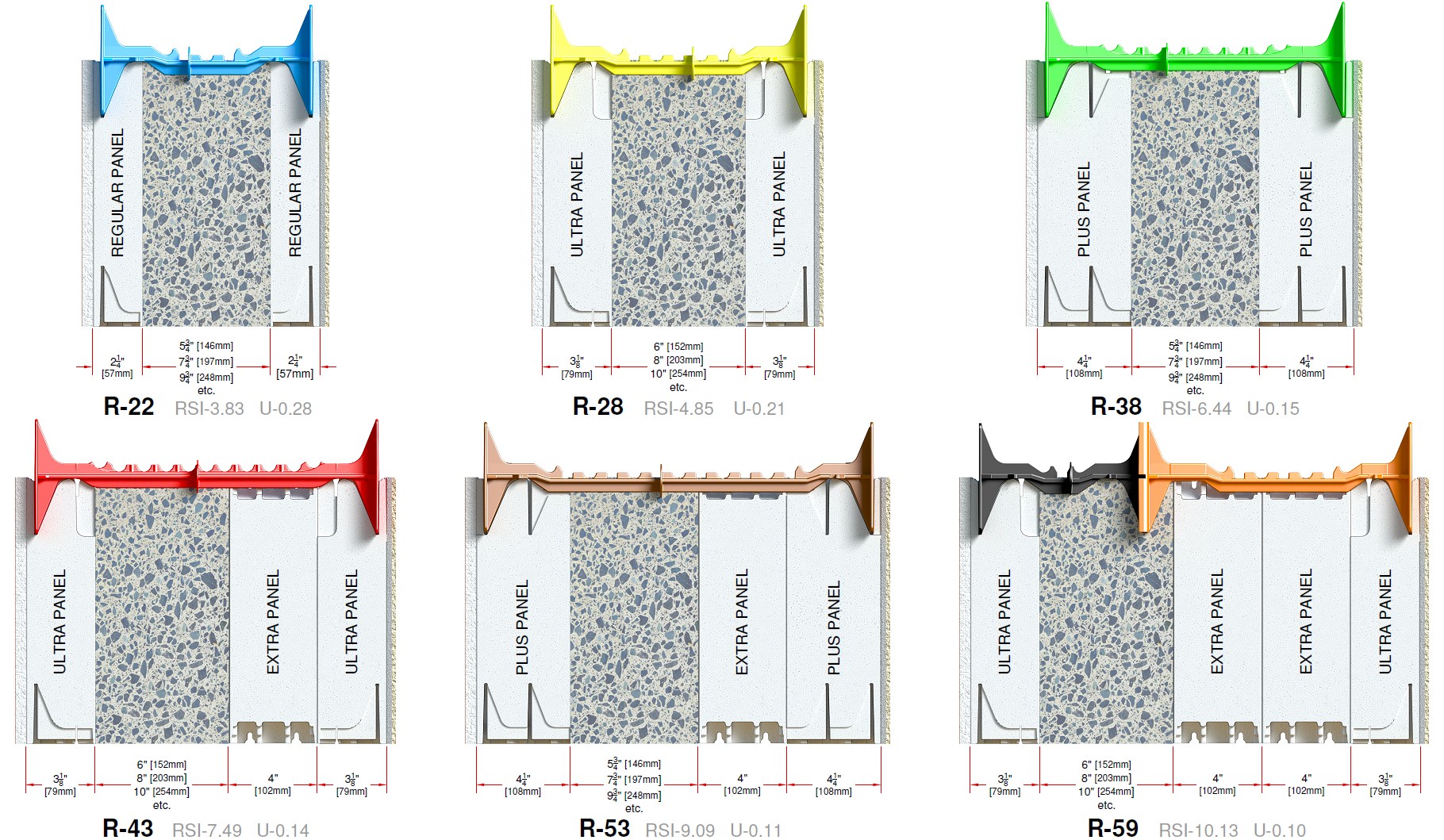

As you can see, it's calling for a nominal 6", 8" or 10" wall thickness at lower R-values. And, as noted above, increasing the thickness of the concrete accrues a small, but insignificant additional R-value. 6" = R3 8" = R4 10" = R5 When you've got 14" of foam on the wall, giving you R59, nobody gives a crap about an extra R or two. |
|
|
|
|
sailawayrb
Veteran Member
Posts:2283
|
| 20 Jun 2018 03:12 AM |
|
Those Quadlock images only show the conventional R-value of their various ICF products and don't consider or include any thermal mass effective R-value benefit. That is entirely appropriate and proper in my opinion as in some locations you simply won't get any thermal mass effective R-value benefit. Concrete has a conventional R-value of about 0.1R-0.15R/inch and therefore it is pretty worthless in terms of significantly increasing the overall conventional R-value of a wall assembly. However, if it’s the thermal mass effective R-value benefit that you are designing for and want to put to good advantage, that comes entirely from the concrete thermal mass effect (i.e., the ability of concrete to absorb, store and release heat) and not from the EPS. So the nice thing about 11” thick standard ICF only having a conventional R-value of about R-22 is that it will behave like about R-60 in some locations that have the right daily temperature profile. Using 14” thick EPS will get you about R-60 all the time no matter what the daily temperature profile does as there is no thermal mass effective R-value benefit at all. However, I haven't heard of anyone using 14" thick EPS in their wall assembly? |
|
| Borst Engineering & Construction LLC - Competence, Integrity and Professionalism are integral to all that we do! |
|
|
Dilettante
Advanced Member
Posts:503
|
| 20 Jun 2018 05:35 AM |
|
In the long run, honestly, I prefer to simply plan for the target R-value via standard measurement and treat any thermal mass benefits as an "extra".
"Well every third Thursday of November, if the temperature is between X and Y and the humidity is between B and C, and there's a Jack-O-Lantern on your doorstep your performance will be Pi cubed, making you the Most Sincere and thus comes The Great Pumpkin"
When you start getting too far off into the weeds, and designing for maximum edge-case performance, you've lost sight of the project's design goals.
|
|
|
|
|
| You are not authorized to post a reply. |
|
Active Forums 4.1
 |
Membership: |
 |
Latest:
croccohvacusa |
 |
New Today:
0 |
 |
New Yesterday:
0 |
 |
Overall:
35027 |
 |
People Online: |
 |
Visitors:
227 |
 |
Members:
0 |
 |
Total:
227 |
|
|
|