north-cooke

New Member

Posts:10
 |
| 15 Oct 2010 12:11 AM |
|
I was looking at the Insulspan website gallery and was surprised at the number of pictures that show the roof panel extending past the exterior wall. Shouldn't there be a way to end the roof panel in line with the exterior wall and frame the overhang with standard stick frame techniques?
By doing this, there must be a significant cost saving measure from reducing the size of each roof panel.
Unless I am missing something.
Any thoughts?
Matthew
|
|
|
|
|
|
|
cmkavala

Veteran Member
Posts:4327

|
| 15 Oct 2010 06:13 AM |
|
Matthew;
Yes what your missing is : using the SIP is simplicity and stronger. By stopping the panel short you create a weak point, add much more labor to accomplish the overhang, and make a simple installation complex |
|
| Chris Kavala<br>[email protected]<br>1-877-321-SIPS<br /> |
|
|
Jelly
Veteran Member
Posts:1017
|
| 15 Oct 2010 08:18 AM |
|
Sure you could frame the overhang with standard stick framing techniques if you wanted to take more time and spend more money!
Wish I had extended my panel overhangs even farther than I did. |
|
|
|
|
wes

Advanced Member
Posts:810
|
| 15 Oct 2010 09:19 AM |
|
Matthew,
The short answer to your question is -YES, it can be done. (I do it all the time)
It is much easier to do with OSB panels than with metal (which Chris uses).
And yes, it does take more manhours to accomplish than just extending the panels, but not many. And I don't think the overall costs are that different, but they are less.
If you are doing jumbo panels on your roof, then the overhangs would be easier. However, I normally use 4' panels, and I normally do 2' overhangs. I don't like cantilevering half of a panel in thin air, either on the gable or eaves, depending on which way my panels run. Also, I have the potential for high winds (re: tornadoes) to deal with. Every wind damaged home I have dealt with has suffered most by the roof being lifted off the walls. My added on overhangs are not as strong as the panels. Therefore, they provide a 'break away' point, giving the main roof a better chance of surviving intact. I don't have any 'engineering' to back my theory, just common sense and experience. |
|
| Wes Shelby<br>Design Systems Group<br>Murray KY<br>[email protected] |
|
|
JeffD

Basic Member
Posts:282

|
| 15 Oct 2010 10:13 AM |
|
Matthew,
Unless there is significant cost savings I would cantilever the panels over the wall to create the home's overhang because it will be a stronger assembly and quicker to build.
There is also a structural principal demonstrated. The weight of the over hang will theoretically help the span of the panel by acing as a counter weight one side of a fulcrum (wall) essentially lifting the center of the panel (like a see saw). So by having an overhang on could calculate an additional span capability of the panel if one wanted to maximize its span. |
|
| Metal SIP Building Designer<br>jeff@panelfusion(dot com) See us on Facebook |
|
|
cmkavala
Veteran Member
Posts:4327
|
| 15 Oct 2010 01:33 PM |
|
Wes;
I was answering it from an OSB perspective, but it would make even less sense with metal SIPs, as the underside of the skin is also the finished soffit. |
|
| Chris Kavala<br>[email protected]<br>1-877-321-SIPS<br /> |
|
|
wes
Advanced Member
Posts:810
|
| 16 Oct 2010 09:00 AM |
|
One other point for consideration. We normally use either 8 or 10" panels for our roofs. These create rather large fascia profiles. By 'adding on' the overhangs, you can downsize the framing to a more normal 4 or 6" fascia. That is actually my original impetus to design the 'add on' overhangs. I had a client who hated the look and refused to use SIPS unless I could 'hide' them. |
|
| Wes Shelby<br>Design Systems Group<br>Murray KY<br>[email protected] |
|
|
rnortman
Basic Member
Posts:112
|
| 16 Oct 2010 09:11 AM |
|
Consider also the issue of ice dams, if you're building in a cold climate. Continuous SIPs for walls and roof, with appropriate attention to details to reduce thermal bridging, is a great way to prevent ice dams. It's not impossible to do it otherwise, but you need to pay close attention to the details.
|
|
|
|
|
SimonD
Basic Member
Posts:167

|
| 17 Oct 2010 09:17 PM |
|
Here's a detail for ya. 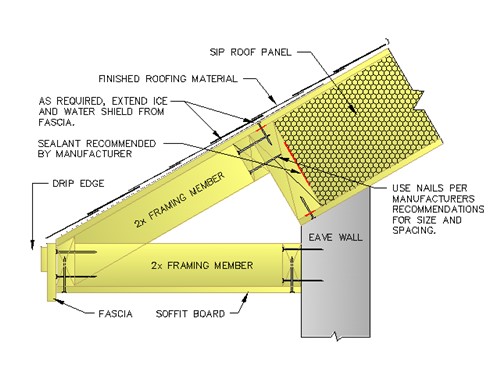 |
|
| Building Designer PANELfusion, LLC Tampa, FL [email protected] "Metal SIP Advocate" |
|
|