|
|
robinnc

Advanced Member

Posts:586
 |
| 06 Dec 2018 06:51 AM |
|
Do you really want the MS bedroom facing the front street?
|
|
|
|
|
1201
Posts:99
|
| 06 Dec 2018 01:15 PM |
|
Posted By robinnc on 06 Dec 2018 06:51 AM
Do you really want the MS bedroom facing the front street?
that was my goal, to use passive solar heating in the winter and have shading in the summer, but Im open to suggestions.
the front of the house will be about 90ft from the street.
here is my uneducated idea of where to put the house. I know all my neighbors have their house in the trees and that may be ideal ,but then I dont get as much passive solar in the winter and wouldnt be able to put the solar panels on the roof
[img]https://i.imgur.com/GOL5Cs7.jpg[/img] |
|
|
|
|
1201
Posts:99
|
| 06 Dec 2018 01:19 PM |
|
lets try this again  |
|
|
|
|
Dana1

Senior Member
Posts:6991
|
| 06 Dec 2018 07:28 PM |
|
I am hoping to run ductless mini splits. 1 for the hall area(living area ) and maybe one or two with multiple heads for the private areas. There will be a pocket door between the living area and the private area.
my goal was to have the mechanical room also be the laundry room and house the : ERV, water heater, electrical panel, solar panel inverter, etc.
Even in a code-minimum type house the heating and cooling loads of typical bedrooms is WELL below the capacity of even a half-ton ductless head. With multi-split ductless the heads do not modulate with the load. A half ton head like the Mitsubishi -FH06NA can modulate down to 1600 BTU/hr out when married to a dedicated single zone compressor, but when tied to a multi-split it can only deliver the nominal 8700 BTU/hr out, which is ~6x oversized for the heat load of my kid's bedroom @ +5F outdoors, 4x oversized for the master bedroom, in a sub-code antique house. The Fujitsu -7RLF delivers 8100 BTU/hr when tied to multi-splits, not much better.
A better solution for the doored off low-load private area rooms is a modulating DUCTED mini-split. The Fujitsu xxRLFCD series mini-ducted minisplits have better blower specs than most (longer duct runs are fine), and is more flexible that others in that it can be installed vertically, taking up less than 8 square feet of floor area. If your 99% outside design temps aren't cooler than -5F this series should be given consideration. If your 99% outside design temp is north of +15F (which it probably is, is in N. Texas) and it's a better than code house a single xxRLFCD may be sufficient for handling the whole thing.
If duct routing seems to be a problem due to a vented attic, consider going with a plenum truss approach in the middle section of the house where there's a ridge. With a better than code house the ducts don't have to extend out to the exterior walls the way traditional systems have done. Small long-throw ceiling registers can be place near the interior walls, directing the flow toward the exterior walls for maximal mixing. eg:
https://s3.amazonaws.com/greenbuildingadvisor.s3.tauntoncloud.com/app/uploads/2018/08/08061123/2015-11-04%2010.35.14-300x300.jpg
https://s3.amazonaws.com/greenbuildingadvisor.s3.tauntoncloud.com/app/uploads/2018/08/08061125/2015-11-04%2010.35.28-300x300.jpg
I believe those pics are from a code-min house in North Carolina that is heated & cooled with a single 1.5 ton Fujitsu.
If you go with a plenum truss approach in the middle of the to accommodate the ducts and air handler unit (mini-ducted or other heat pump) the roof hips will affect the possible locations for ceiling registers with ducts completely inside of the pressure & insulation boundary. Rooms that are completely outside of the truss plenum zone would need to be served by ducts in soffits under the ceiling level, which can affect the floor plan. Changing over to a simple gabled roof could open that up considerably.
Start with a gross but aggressive Manual-J cooling and heating load calculation on whole house loads to see if the Fujitsu series are a real possibility for that series. The 1.5 tonner is good for over 20,000 BTU/hr cooling & heating down to @ +17F, and can still muster something like 18-19,000 BTU/hr even at -5F. It's not rocket science or extra-expensive to design & build a 2500' house that could duck below 20K both heating and cooling in a location with a 1% design temp of ~95F and a 99% design temp of +17F, such as Lubbock or Lamesa TX. (Yes I know it gets both hotter and colder than that in those locations, but it doesn't stay hotter or colder than that more than 87 hours out of an average year, and those are never consecutive hours.) |
|
|
|
|
patonbike

Basic Member
Posts:212
|
| 06 Dec 2018 10:53 PM |
|
what is the actual requirement.. 2500 sq ft of living space or 2500 sq ft of floor space? have you looked at stock plans? can you incorporate a 2 car garage into this plan? with no basement i would definitely want a 2 car garage . can that count as part of your 2500 sq ft? just throwing out a random plan. 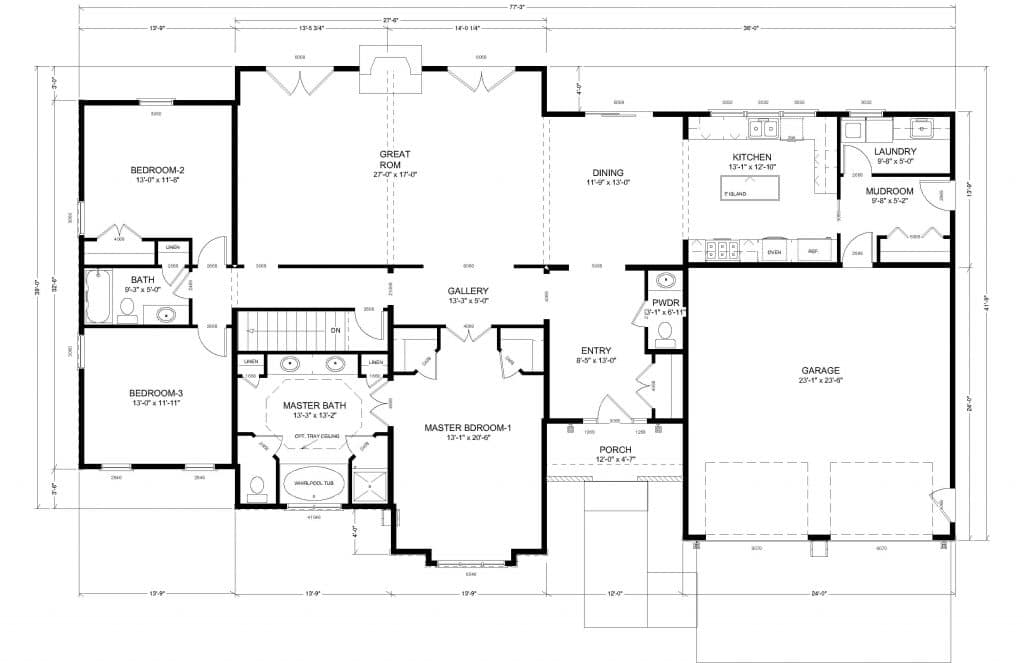 |
|
|
|
|
1201
Posts:99
|
| 07 Dec 2018 06:14 AM |
|
Posted By patonbike on 06 Dec 2018 10:53 PM
what is the actual requirement.. 2500 sq ft of living space or 2500 sq ft of floor space?
have you looked at stock plans?
can you incorporate a 2 car garage into this plan?
with no basement i would definitely want a 2 car garage . can that count as part of your 2500 sq ft?
the covenant calls for interior living space of 2500 sq ft. it was written in 1970 and Ive heard its not really enforced. I dont know if I should take the chance as Ideally I would build something around 1800 sq ft.
I believe that the city measures from the outside so If I have a gross area of 2500 then the city lists it at 2500. the neighbors are not going to come into my house with tape measure to measure interior living area. so I may be able to do 2500 gross area, with 1 ft thick double stud walls and get away with it.
the covenant, and county, count garage space as separate. I dont want a garage. maybe just a carport, and maybe not even that. |
|
|
|
|
1201
Posts:99
|
| 07 Dec 2018 06:21 AM |
|
Posted By Dana1 on 06 Dec 2018 07:28 PM
I am hoping to run ductless mini splits. 1 for the hall area(living area ) and maybe one or two with multiple heads for the private areas. There will be a pocket door between the living area and the private area.
my goal was to have the mechanical room also be the laundry room and house the : ERV, water heater, electrical panel, solar panel inverter, etc.
Even in a code-minimum type house the heating and cooling loads of typical bedrooms is WELL below the capacity of even a half-ton ductless head. With multi-split ductless the heads do not modulate with the load. A half ton head like the Mitsubishi -FH06NA can modulate down to 1600 BTU/hr out when married to a dedicated single zone compressor, but when tied to a multi-split it can only deliver the nominal 8700 BTU/hr out, which is ~6x oversized for the heat load of my kid's bedroom @ +5F outdoors, 4x oversized for the master bedroom, in a sub-code antique house. The Fujitsu -7RLF delivers 8100 BTU/hr when tied to multi-splits, not much better.
A better solution for the doored off low-load private area rooms is a modulating DUCTED mini-split. The Fujitsu xxRLFCD series mini-ducted minisplits have better blower specs than most (longer duct runs are fine), and is more flexible that others in that it can be installed vertically, taking up less than 8 square feet of floor area. If your 99% outside design temps aren't cooler than -5F this series should be given consideration. If your 99% outside design temp is north of +15F (which it probably is, is in N. Texas) and it's a better than code house a single xxRLFCD may be sufficient for handling the whole thing.
If duct routing seems to be a problem due to a vented attic, consider going with a plenum truss approach in the middle section of the house where there's a ridge. With a better than code house the ducts don't have to extend out to the exterior walls the way traditional systems have done. Small long-throw ceiling registers can be place near the interior walls, directing the flow toward the exterior walls for maximal mixing. eg:
https://s3.amazonaws.com/greenbuildingadvisor.s3.tauntoncloud.com/app/uploads/2018/08/08061123/2015-11-04%2010.35.14-300x300.jpg
https://s3.amazonaws.com/greenbuildingadvisor.s3.tauntoncloud.com/app/uploads/2018/08/08061125/2015-11-04%2010.35.28-300x300.jpg
I believe those pics are from a code-min house in North Carolina that is heated & cooled with a single 1.5 ton Fujitsu.
If you go with a plenum truss approach in the middle of the to accommodate the ducts and air handler unit (mini-ducted or other heat pump) the roof hips will affect the possible locations for ceiling registers with ducts completely inside of the pressure & insulation boundary. Rooms that are completely outside of the truss plenum zone would need to be served by ducts in soffits under the ceiling level, which can affect the floor plan. Changing over to a simple gabled roof could open that up considerably.
Start with a gross but aggressive Manual-J cooling and heating load calculation on whole house loads to see if the Fujitsu series are a real possibility for that series. The 1.5 tonner is good for over 20,000 BTU/hr cooling & heating down to @ +17F, and can still muster something like 18-19,000 BTU/hr even at -5F. It's not rocket science or extra-expensive to design & build a 2500' house that could duck below 20K both heating and cooling in a location with a 1% design temp of ~95F and a 99% design temp of +17F, such as Lubbock or Lamesa TX. (Yes I know it gets both hotter and colder than that in those locations, but it doesn't stay hotter or colder than that more than 87 hours out of an average year, and those are never consecutive hours.)
thanks for that info. I think I have decided to go with a gable roof anyway as its less expensive and the overhangs on a gable are growing on me.
I wouldnt mind a ducted minisplit. I would just have to design for it. main thing is the ducts would have to be in the conditioned space.
I will look into the fujitsu you mentioned. where I live we have about 11 days a year under 20 degrees and it almost never falls below 13 degrees.
we can have up to 45 days over 100 degrees but Im not so worried about that as I will be using cool roof/cool wall "technology" aka white paint" and plenty of summer shading.
another question I have is, how much does the efficiency suffer if you have a ductless mini thats oversized but simply turns off an on, like my current AC? |
|
|
|
|
arkie6

Veteran Member
Posts:1453
|
| 07 Dec 2018 05:27 PM |
|
Another idea on HVAC: If you have 9' ceilings throughout the main part of the home, you could do a drop down ceiling in the hallway to 8' or so and place your HVAC / mini-split cassette ducts in this space and provide a supply into each room off the hallway with a supply grill above the door. The return grill would be in the ceiling of the hallway. If you have a cased opening with header between the living area and the hallway, the slightly dropped ceiling in the hallway would not be that noticeable.
Here is sort of some examples of what I'm describing above:
https://ehaugsjaa.files.wordpress.com/2013/05/panasonic-mini-split-heat-pump-ducted.png?w=725
https://cdn8.bigcommerce.com/s-7wqdm8gvmj/images/stencil/original/products/5667/12722/1e2e70dc-2d3b-444d-8228-a272ab36c3e2__49147.1510806290.jpg?c=2
|
|
|
|
|
Dana1
Senior Member
Posts:6991
|
| 07 Dec 2018 07:22 PM |
|
Posted By arkie6 on 07 Dec 2018 05:27 PM
Another idea on HVAC: If you have 9' ceilings throughout the main part of the home, you could do a drop down ceiling in the hallway to 8' or so and place your HVAC / mini-split cassette ducts in this space and provide a supply into each room off the hallway with a supply grill above the door. The return grill would be in the ceiling of the hallway. If you have a cased opening with header between the living area and the hallway, the slightly dropped ceiling in the hallway would not be that noticeable.
Here is sort of some examples of what I'm describing above:
https://ehaugsjaa.files.wordpress.com/2013/05/panasonic-mini-split-heat-pump-ducted.png?w=725
https://cdn8.bigcommerce.com/s-7wqdm8gvmj/images/stencil/original/products/5667/12722/1e2e70dc-2d3b-444d-8228-a272ab36c3e2__49147.1510806290.jpg?c=2
A full service cavity like the one in Erik Haugsjaa's picture isn't really necessary in high R house. (I race against Erik's wife in the local skiing beer-leagues, not that it's relevant here...)
A plenum truss builds-in the service cavity into the middle section of ceiling, designed to be air sealed and insulated over the top of the plenum area:
https://www1.eere.energy.gov/buildings/publications/pdfs/building_america/measure_guide_plenumtruss_air_distribution.pdf
https://www.finehomebuilding.com/membership/pdf/72033/021233086.pdf
Soffited duct runs can work too, but in many ways a plenum truss makes it all a bit easier, with less custom framing & finishing to deal with, and less "visual noise" in the living space ceilings too. |
|
|
|
|
patonbike
Basic Member
Posts:212
|
| 07 Dec 2018 08:33 PM |
|
Keep tinkering. My parents had a great layout with 1 bedroom on left side of house along with master bath and laundry room.... kitchen, great room and dining in the middle. 2 beds on other side with 1 bath in the middle. this is VERY roughly what it was (don't have a house plan program installed).  |
|
|
|
|
1201
Posts:99
|
| 08 Dec 2018 06:14 AM |
|
@ dana and Arkie, thanks for those ideas on the ducted mini splits. either option seems workable. who knows, I may go the industrial route with exposed ducting. @ paton, agree. I keep looking at dozens and dozens of plans. I get some luck when I put in "simple rectangular floor plan" , or search "earth berm" floor plan as those tend to be simple, south facing, and rectangular. here is my most complete plan so far if you could take a look  I also changed to gable roof. would be easier, allow for vaulted ceiling in living area and master bedroom, and be cheaper!  |
|
|
|
|
robinnc
Advanced Member
Posts:586
|
| 08 Dec 2018 06:30 AM |
|
Do you really want the Master bed facing the front street?
|
|
|
|
|
1201
Posts:99
|
| 09 Dec 2018 03:02 AM |
|
Posted By robinnc on 08 Dec 2018 06:30 AM
Do you really want the Master bed facing the front street?
I might do something like this for some privacy
https://www.builditsolar.com/Projects/SolarHomes/91HomesBook/South/S03WythevilleVA.pdf |
|
|
|
|
1201
Posts:99
|
| 10 Dec 2018 05:33 AM |
|
so I discovered something today. at least two people in the subdivision of 10 did not abide by the covenants.
one house was less than 2500 sq ft, the other one did not have enough setback from the street.
Im just going to scaled this back to about 1800 sq ft and build a less expensive, lower tax bill, more energy efficient house.
thanks for all the help guys. |
|
|
|
|
robinnc
Advanced Member
Posts:586
|
| 11 Dec 2018 06:54 AM |
|
I would find out more about the covenants(if enforced by laws in your area) Have you looked at ICF to save on elect bills?....I'm influenced by ICF even thou we don't own an ICF house. I don't know where you are but I personally would think it best if you live in a tornado or hurricane area.
|
|
|
|
|
1201
Posts:99
|
| 11 Dec 2018 09:22 PM |
|
I'll have to look into the covenants thing. I doubt they are being enforced. for the record there is no active hoa in the subdivision.
I have looked at ICF. I would love concrete construction with all the insulation inside, so I dont have to put up siding. but it will all come down to cost. from everything Ive read , a double stud wall would be cheapest. heck, in my area which is climate zone three I believe, 2x6 with additional 2" of insulation on the outside may be all I need. |
|
|
|
|
newbostonconst
Advanced Member
Posts:778
|
| 12 Dec 2018 02:54 PM |
|
Remember now a day square footage is measured from the outside dimensions of the house and is not true living space anymore.
Thicker walls are going to count as square footage. Both a negative for taxes and a positive for selling. |
|
| "Never argue with an idiot. They will only bring you down to their level and beat you with experience." George Carlins |
|
|
Lbear
Veteran Member
Posts:2740

|
| 12 Dec 2018 07:18 PM |
|
Posted By 1201 on 07 Dec 2018 06:14 AM
the covenant calls for interior living space of 2500 sq ft. it was written in 1970 and Ive heard its not really enforced. I dont know if I should take the chance as Ideally I would build something around 1800 sq ft.
I believe that the city measures from the outside so If I have a gross area of 2500 then the city lists it at 2500. the neighbors are not going to come into my house with tape measure to measure interior living area. so I may be able to do 2500 gross area, with 1 ft thick double stud walls and get away with it.
the covenant, and county, count garage space as separate. I dont want a garage. maybe just a carport, and maybe not even that.
You should look at the functional obsolescence of the design. Without a garage, the house will be difficult to sell/appraise and it will cost double later on to try add a garage. People want a garage to store tools, supplies, vehicles, etc. Your first hailstorm or snowstorm will make you rethink not having a garage.
Attached or even detached garages are standard now on builds. It's like leaving out the dinning room. While you might not want it, 99% of other people do. Don't create a design that becomes functionally obsolete from day one.
|
|
|
|
|
1201
Posts:99
|
| 12 Dec 2018 08:19 PM |
|
Posted By newbostonconst on 12 Dec 2018 02:54 PM
Remember now a day square footage is measured from the outside dimensions of the house and is not true living space anymore.
Thicker walls are going to count as square footage. Both a negative for taxes and a positive for selling.
yes, that is a GOOD THING. to build an interior 2500 ft space I would need about 2800sq ft outside dimensions. |
|
|
|
|
1201
Posts:99
|
| 12 Dec 2018 08:22 PM |
|
Posted By Lbear on 12 Dec 2018 07:18 PM
Posted By 1201 on 07 Dec 2018 06:14 AM
the covenant calls for interior living space of 2500 sq ft. it was written in 1970 and Ive heard its not really enforced. I dont know if I should take the chance as Ideally I would build something around 1800 sq ft.
I believe that the city measures from the outside so If I have a gross area of 2500 then the city lists it at 2500. the neighbors are not going to come into my house with tape measure to measure interior living area. so I may be able to do 2500 gross area, with 1 ft thick double stud walls and get away with it.
the covenant, and county, count garage space as separate. I dont want a garage. maybe just a carport, and maybe not even that.
You should look at the functional obsolescence of the design. Without a garage, the house will be difficult to sell/appraise and it will cost double later on to try add a garage. People want a garage to store tools, supplies, vehicles, etc. Your first hailstorm or snowstorm will make you rethink not having a garage.
Attached or even detached garages are standard now on builds. It's like leaving out the dinning room. While you might not want it, 99% of other people do. Don't create a design that becomes functionally obsolete from day one.
I understand where you are coming from but Ive seen some beautiful older houses without garages and they command high dollar.
My original goal was to have a simple carport and build a shed for my woodworking but now I find that the city charges you 100% of base price for shed/barn square footage but only a maximum of 33% of base price for a garage,
so a huge(to me) 1600 sq ft detached "garage" might be in my future plans. |
|
|
|
|