|
|
|
New house - open to suggestions
Last Post 28 Oct 2015 08:32 AM by Stuie. 170 Replies. |
Sort:
|
|
 Prev Next Prev Next |
You are not authorized to post a reply. |
|
|
|
NewHoosier

Basic Member

Posts:163
 |
| 08 Aug 2014 02:00 AM |
|
Posted By BadgerBoilerMN on 07 Aug 2014 06:57 PM
I like a slab. If you have one, you also have a very good heating emitter and as you suggest thermal mass that can used to control temperature flux to your advantage. I put carpet over my office slab for acoustic and ergonomics.
Doesn't carpet greatly reduce the thermal mass effect? Eventually the floor will take ambient temp but likely far to slow because temp swings can occur quite fast. Maybe lots of mass in the internal walls is a better option? I stayed in a old colonial style (I think) house. The internal walls are over a feet thick. Just like the outside walls which, according to the owner have no cavity but are 3 bricks thick. (never heard of that before)
[quote]R-10 rigid insulation below and at the outer edge of the slab.
2x6 walls insulated to R-=19 with another 5 or 10 in exterior rigid insulation such as Thermax.
R-50 blown fiberglass or cellulose, sometime augmented by a 2" layer of 2# foam just over the ceiling sheetrock.[/quote]I don't really like fiber glass. It can get moist, packed to dense, sags etc. All reducing the R value. |
|
| Connersville IN - Lat 39.64 N - Zone 5A (near zone 4) |
|
|
NewHoosier
Basic Member
Posts:163
|
| 08 Aug 2014 03:28 AM |
|
http://sunmatesolarpanels.com/content/view/2/31/
I'm not making any claims about the (lack of) quality and performance of the product.
I googled a bit and found a few panels. The specs are usally a bit vague. Take the above panel for example. It switches off below 90F and on at 110F panel temp. That gives me an idea of the minumum temp range but not the max. The 100 cfm gives me an idea of the max air flow. To calculate the ROI I obviously need to know the number of BTU the panel generates over a heating season. I have no clue how because it's not justy the panel performance but also the local weather |
|
| Connersville IN - Lat 39.64 N - Zone 5A (near zone 4) |
|
|
Eric Anderson
Basic Member
Posts:441

|
| 08 Aug 2014 08:55 AM |
|
I will admit that I am a fan of both solar Hot water heaters and solar air heaters ( I have both), but it is hard to justify the costs of either system today if natural gas is available (on a straight return on investment basis.) I have a 2 panel (your solar home) solar air heater and a single panel AET flat plate solar DHW system.
On the other hand, can you justify the cost of granite counters or a 6 burner wolf range, ROI= never.
Passive solar is easy to justify, as that is just making good design choices, which should have little impact on total costs. What you are looking at is really a sun tempered design, proper overhangs and HIGH shgc windows on the south side.
As a first pass on performance for solar air heaters, assuming it is wall mounted, look up the solar isolation where you want to build.
http://rredc.nrel.gov/solar/pubs/redbook/ for the closest spot in Indiana assuming you want a wall mount use the 90° data table
For a solar air heater I would only count the 6 coldest months
Multiply the value you get by the number of days in the month this gives you insolation per month ie kwh/m^2 /month multiply this by 317 to get btu’s/ft^2/month.
Now you just multiply this value by the square feet of the panel and then by estimated panel efficiency. I would probably assume 60% efficiency as you are indicating some shading
To convert this into weird American units ie BTU’s/ sf^2 use the following conversions 1kwh= 3412 btu’s 1 m2 = 10.76 ft^2 1 kwh/m^2/month = 317 btu’s/ft^2/month
If you want to calculate how much gain per window area for passive solar multiply the shgc coefficient of the window you want * the area and use the same formula above. There are other better methods, but this is quick and dirty and gets you good estimates of what you need
cheers,
Eric
|
|
| Think Energy CT, LLC Comprehensive Home Performance Energy Auditing |
|
|
NewHoosier
Basic Member
Posts:163
|
| 08 Aug 2014 10:10 AM |
|
Found a DIY that seems to do 0.9kWh. (unrealistic if I see the numbers in your sheet) But I need to find an alternative for the pop cans.
I would prefer roof mounted panels. More out of view and more sun because on walls I can have shade from bushes and overhangs.
Calculating ROI is quie difficult because it depends on teh intrest rate I get on my savings account, inflation, rising of energy prices, price and performance development of the panels, rebates, hail destroying the panels etc
You are right that for heating I should count the coldest months only. Unless I can also use the heat for hot water. That's used all the year round. Showering, dishwasher, etc
And during the cold season i remove the insulation from my boiler :-) |
|
| Connersville IN - Lat 39.64 N - Zone 5A (near zone 4) |
|
|
NewHoosier
Basic Member
Posts:163
|
| 08 Aug 2014 10:27 AM |
|
I looks like for heating nothing beats natural gas right now. If that changes I'll switch to whatever is best right then.
Of course I still need something to cool my house.
Maybe this? http://www.gasairconditioning.org/residential.htm
|
|
| Connersville IN - Lat 39.64 N - Zone 5A (near zone 4) |
|
|
Jelly

Veteran Member
Posts:1017
|
| 08 Aug 2014 12:17 PM |
|
Hi NewHoosier, I have read through the rest of the thread and wanted to add some thoughts. I came back to the US after spending a decade in Germany and wanted to use some of the better building techniques I learned in Europe when I built here. But you are likely to run into some culture shock like I did whenever you actually try to make this happen. It will help if you are actually doing the work yourself, but finding someone else willing or capable of performing the work may prove to be challenging. The basic construction method is one example; brick houses are not built here the way they are built in Europe. Real brick is used on the outside, but only cosmetically as a veneer. You could however adapt the basic European masonry type construction method to more common US construction types. Just one example would be to use concrete masonry units (CMU for short, also referred to as concrete block, or sometimes cinder block), with rigid foam screwed to the exterior with modified stucco (like STO for a brand name). Autoclaved aerated concrete (or AAC for short) is another possibility in limited areas. Xella does have a presence in the US, but I don't know about Indiana. Interior walls will be hollow in the US in any post-war construction. Unless you want to dramatically add to the overall cost of your project, you will have to get used to the feel of hollow walls. There are things you can do to make them more comfortable. About the roof, of course ceramic tile roofs are available in the US but they are expensive, especially if you want a nano-glaze on it. They are probably not common in the midwest though. One option is metal tiles that are formed to look like ceramic tiles, but you will be able to tell the difference. Also a 4-in-12 roof pitch is very low, and more prone to uplift forces. If you are building in an area that has high-wind events you should probably consider going up to at least 6-in-12. There are no hurricanes in Indiana, but there are tornadoes. About AC, it will be hard to get used to it but it will be everywhere you go. A major task of the AC is to handle latent loads, not just to cool. If you want to try to do without it you would at least need to consider a dehumidifier so that you don't get mold growing in your house. Later on you could add a window unit AC if necessary. You will be able to build a wonderful efficient house that is very comfortable, but be prepared to adapt and roll with the punches  Why Indiana? I assume you have a reason for picking that spot? |
|
|
|
|
Jelly
Veteran Member
Posts:1017
|
| 08 Aug 2014 12:28 PM |
|
forgot about the foundation - what I saw used often in Germany would be described here as a frost protected shallow foundation (FPSF) if there is no basement.
|
|
|
|
|
jdebree
Basic Member
Posts:497
|
| 08 Aug 2014 12:46 PM |
|
I enjoy a good discussion about theory, but you also have to live in the house. You want a square house for efficiency, but don't get so wrapped up in it that the house doesn't 'live' well. As an example, our ICF house is 33'4" X 43'4", which is how the ICF worked out. That gives 1444 sq ft. To get the same area in a square house, it would be 38' square. Oddly enough, our house is 1430 sq ft of wall area, and the square house is only slightly less, at 1418 sq ft. The difference is negligible. After all, a cylinder is actually the best shape for wall area. A round house the same area as ours works out to only 1257 square feet of wall area. I wouldn't want to try to live in a round house, though. For that matter, you could live totally underground. There would be no effect from wind or sun. It would certainly take a lot less energy to heat and cool, but again, I wouldn't want to live totally underground.
As for orientation, I angled our house, mostly for aesthetics. Our view is due north, but the north side of a house tends to be cold and uninviting, plus it can grow mold or algae, especially in a damp climate. By rotating our house 30 degrees to the east, the back of the house gets morning sun. Trees make a huge difference for cooling. We are in deep woods, and only have filtered sun in the morning and evening. We're in Zone 3, and A/C is a major expense, but due to our trees, there is very little solar gain in the summer. We haven't been through a winter yet, but so far, our mini-splits are working very well. Very low energy use, and nearly silent. Most people don't realize they are running unless I point it out.
We are on a walk-out basement (also ICF), and the temperatures down there range from 55 to 75 F without any HVAC. We have theorized that we could live in the basement if we couldn't afford the power bills. It would also be a reasonable retreat during an extended power outage. |
|
|
|
|
NewHoosier
Basic Member
Posts:163
|
| 08 Aug 2014 12:54 PM |
|
Hi Jelly,
I'll adapt. We have a saying that roughly translates as: Countries wisdom, countries honor. (means accept the customs of the country)
But indeed a culture shock. The fact that (virtually) nobody in the US has a European style home tells me very few if any contractor is skilled enough to do it. Few contractors usally means higher price. That said a brick facade will do too. Maybe I should just accept wooden houses are fine too. Half the US lives in them...
|
|
| Connersville IN - Lat 39.64 N - Zone 5A (near zone 4) |
|
|
Jelly
Veteran Member
Posts:1017
|
| 08 Aug 2014 01:03 PM |
|
It's true, half the US lives in them (probably more than half), but why? It's because of low cost and convention, not because of fitness for purpose. |
|
|
|
|
NewHoosier
Basic Member
Posts:163
|
| 08 Aug 2014 01:10 PM |
|
Very true jdebree, (Dutch name)
a house sould be liveble. I've not applied all effiency rules yet but the square house plan I have now is very liveble. I hope it stays that way.
"For that matter, you could live totally underground."
" I wouldn't want to live totally underground."
Maybe you will :-)
"We have theorized that we could live in the basement if we couldn't afford the power bills"
Just kidding.... But it reminds me of one of my design aims. I try to group all colder area's and group all warmer area's. I put my washer, food storage etc all in a certain part of my house.
I don't like a hot bedroom either. No need to heat guest bedrooms without guests. So roughly put I only have heat half my house. The food storage room in a way also act as extra insulation. Same for smart placement of a garage. I think there's something to gain in smart layout. If util bills can't be paid I can basicaly such of half the house. If I would live in/near a forest I would install a small backup wood stove.
|
|
| Connersville IN - Lat 39.64 N - Zone 5A (near zone 4) |
|
|
Bob I
Veteran Member
Posts:1435
|
| 08 Aug 2014 01:18 PM |
|
Actually, European style building, aka PassivHaus, or Passive House as they are known here, is really taking off in the USA. True, the construction methods are different, but the basic concept is identical to the German. Highest building standard in the world. |
|
| Bob Irving<br>RH Irving Homebuilders<br>Certified Passive House Consultant |
|
|
NewHoosier
Basic Member
Posts:163
|
| 08 Aug 2014 01:20 PM |
|
Posted By Jelly on 08 Aug 2014 01:03 PM
It's true, half the US lives in them (probably more than half), but why? It's because of low cost and convention, not because of fitness for purpose.
That's likely so. Cost is also the reason I only have one Rolls Royce. (in my dreams)
But still I could consider some hybrid.
a] Concrete core. Including those blocks etc
Especially the dense forms of concrete are great thermal mass. Even better as bick.
b] Instead of a cavity wall closed cell foam on the outside and then some siding. Some siding even looks like brick.
https://www.google.nl/search?q=kunstof+steenstrips+voor+buiten&num=100&tbm=isch&tbo=u&source=univ&sa=X&ei=eAblU8fHOYGc0QW2n4C4CQ&ved=0CF4QsAQ&biw=1349&bih=1405 |
|
| Connersville IN - Lat 39.64 N - Zone 5A (near zone 4) |
|
|
NewHoosier
Basic Member
Posts:163
|
| 08 Aug 2014 01:26 PM |
|
About thermal mass. The ideal is black non shining paint. But I'm quite odd. I like wall paper with light tones, and carpet. I'm wondering how that affects performance. I'm not going to install heavy expensive walls that don't act as thermal mass. |
|
| Connersville IN - Lat 39.64 N - Zone 5A (near zone 4) |
|
|
jdebree
Basic Member
Posts:497
|
| 08 Aug 2014 02:34 PM |
|
Good catch on the name! My grandfather came over from the Netherlands around 1890, but never went through immigration. He jumped ship in NYC and swam ashore! So yes, I come from a family of illegal aliens!
You only really need dark paint for solar gain. If you just want to capture and hold warmth, just the mass will do. Our house in FL was concrete, and very slow to change temperature, even though there was no insulation. I've noticed that our ICF house changes temperature very slowly, too. I'm told that ICF doesn't really work as thermal mass, since the concrete core is insulated from the inside air, but the house is very slow to change temperature. Having never lived in an insulated house before (and I'm 60), I'm making a lot of discoveries about life with insulation. Our house is quite open, and a single mini-split head does a very good job of keeping the entire house cool as long as I leave the interior doors open. We run a 12K BTU during the day, and switch to the 9K at night. Even on a day that was 98 F., the fan never ran above 'low' to keep the house cool. Our manual J calc showed 9K BTU for cooling the entire house, and 12K for heating in our climate. We've been averaging 19 KW or less per day in an all-electric household. The resistance electric water heater is the biggest load. I really should play around with solar hot water in our warm, sunny climate in South Carolina. |
|
|
|
|
NewHoosier
Basic Member
Posts:163
|
| 08 Aug 2014 03:00 PM |
|
The meaning of Bree is disbuted. The candidates are: wooden settlement, swamp, demarcated field. de = the (a seperate word)
A open house is great. Nothing beats real daylight. Personally I still need the flip the switch in my head. While every expert is correctly placed big windows is the way to go by mind keeps telling me "only a box without windows and one door is energy efficient"
I'm learning every post I read here. Between posts I'm redaing books. It's a fun hobby.
Your house may lack the possibility of solar gain, but trees shielding you from a blazing sun and bitter winds is also a for of efficiency. If not a form of beauty.
While I lean toward natural gas, electricity seems something to the house needs to designed around because if PV panels become effient and cheap off the grid is reality. Do you have stream on your property? |
|
| Connersville IN - Lat 39.64 N - Zone 5A (near zone 4) |
|
|
Dana1

Senior Member
Posts:6991
|
| 08 Aug 2014 03:48 PM |
|
Posted By BadgerBoilerMN on 07 Aug 2014 06:57 PM
Naturally just the opposite is true when one wants to stay comfortable in cold weather. Dana's estimable math skills not-with-standing, no one here in Minnesota equates 85°F/29°C air at the register to a "warm breeze". Most of the homes, past and present, in the Midwest, use natural gas as the main fuel source with a conventional forced-air (low-velocity) ducted combination heating and cooling system with humidification and air filtration built in. Not my favorite.
...which is why I actually wrote: "Even ground source heat pumps & ducted ASHP systems typically
deliver exit air north of 85F, and while it can be pretty tepid when
sitting in the breeze," Exit air temps of mini-splits are north of 100F, WELL north of 100F, comparable to typical register temps for hydro-air. Mini-split output would only fall as that low when it's both out of capacity and below 0F outside. (A lot of GSHP and a few ducted ASHP systems run register that low no matter what the outdoor temp is- the low temp necessary for hitting their efficiency numbers.) At +5F (the approximate 99% outside design temp in Connersville) a right-sized mini-split would still be putting out ~100F air even at full-speed. Take a peek at the bench-tested temperature data in Table 6 on p.35 (PDF pagination) of this document. At 2.8F outdoors with the head blowing at mid speed the FE12 delivers 119.7F air, and at full speed it delivers 95.3F air- the very high end of the tepid zone. At 22F (quite a bit cooler than the average January temp in Connersville) it delivers 116F air even at max blower speed. That's a reasonably warm breeze. |
|
|
|
|
Dana1
Senior Member
Posts:6991
|
| 08 Aug 2014 04:04 PM |
|
Posted By NewHoosier on 08 Aug 2014 01:26 PM
About thermal mass. The ideal is black non shining paint. But I'm quite odd. I like wall paper with light tones, and carpet. I'm wondering how that affects performance. I'm not going to install heavy expensive walls that don't act as thermal mass.
The interior of your house will range between 290-300 degrees Kelvin. Spectrum of black body radiation at 290-300 degrees Kelvin is all in the very deep-infra-red part of the spectrum. Most house paint paints are still VERY absorptive and emissive in the part of the spectrum that matters, and even bright white paint can be pretty good at moving heat into and out of the thermal mass. The solar spectrum is about 5800 Kelvin black body radiation, which has quite a bit of energy in the visible spectrum (nearly HALF!) which is why good solar collector coatings must have a dark appearance. If it reflected very much of the visible spectrum it would lose efficiency. If you had anything inside your house with a true temperature anywhere near 5800 Kelvin you'd be dead already! |
|
|
|
|
jdebree
Basic Member
Posts:497
|
| 08 Aug 2014 04:43 PM |
|
We love our windows, efficient or not. The only room of the house with no windows is an internal walk-in closet. Being in the middle of the woods, we don't need drapes for privacy, and I love the views and natural light. If it costs me a bit on the power bill, so be it. The advantage is that during daylight hours, we don't use any lights at all.
We don't have natural gas available, and propane proved to be quite volatile this past winter. No stream on our property- we wanted one, but couldn't find the right combination of terrain and affordability. After living in FL for 30 years, we got tired of all of the dire warnings about hurricanes, so we opted for high and dry land.
I like the translations of our name. 'Wooden settlement' is pretty accurate for our place! If you want to chat off-topic (or on) feel free to personal message me. |
|
|
|
|
Dana1
Senior Member
Posts:6991
|
| 08 Aug 2014 04:57 PM |
|
Posted By Bob I on 08 Aug 2014 01:18 PM
Actually, European style building, aka PassivHaus, or Passive House as they are known here, is really taking off in the USA. True, the construction methods are different, but the basic concept is identical to the German. Highest building standard in the world.
The numbers world wide are still fewer than 50,000 houses with PassivHaus certification to date, and in the US it's what, maybe hundred? (Not even that many according to the PassivHaus Institut map.) The vast majority of homes in Europe are nothing like PassivHaus performance don't conflate "European style building", with PHI or PHIUS type building. Flip through some house sale listings take a peek at the EPC labeling (if available) most are an order of magnitude
or higher on kwh/year per meter than the PassivHaus limits. Even
150kwh/meter per year (10x PassivHaus) is in the pale-green zone of the EPC label. Building codes vary a lot by country, and many European homes do not have ANY insulation (though most in NL do.) In Sweden the building codes have energy performance requirements (enforced by actual post-construction measurement, and penalties for failure), but it's still a significant multiple of the PHI's 15kwh/year per square meter. Code minimum construction in most of Europe isn't significantly different from the US, designed on a cost-optimal basis on future energy costs, but since energy is more expensive in Europe, it tends to be SLIGHTLY higher performance than US code-minimums in comparable climates, but not always. "European style" new homes in the Benelux countries would typically be something like brick or tile clad conrete or AAC (sometimes with continuous EPS), decent single hard coat low-E double panes, and a rock wool batt insulated attic under a tile roof with a 4:12 or higher pitch. Flat roofs have become somewhat trendy in the past few decades, (but I'm not sure why) as have homes with lots of odd-angle planes intersecting what would otherwise be a right-rectangular prism, eg: 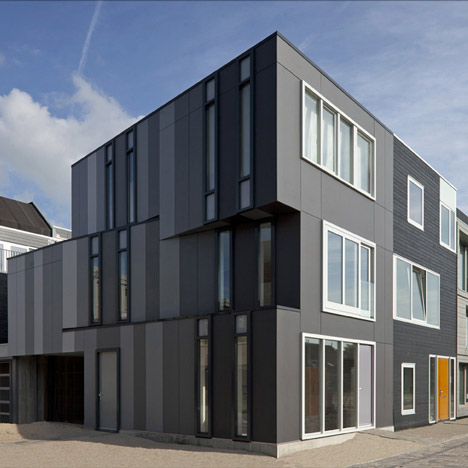 A more typical recent-build northern European house might look something like this:  |
|
|
|
|
| You are not authorized to post a reply. |
|
Active Forums 4.1
 |
Membership: |
 |
Latest:
croccohvacusa |
 |
New Today:
0 |
 |
New Yesterday:
1 |
 |
Overall:
35027 |
 |
People Online: |
 |
Visitors:
183 |
 |
Members:
0 |
 |
Total:
183 |
|
|
|