jonr

Senior Member

Posts:5341
 |
| 23 Jul 2012 05:56 PM |
|
I like the natural look of a large (say 5" average) stone driveway. But in the case I'm looking at, it's a steep slope with major runoff so keeping them in place is likely to be a problem. Would something like this hold up?
1) sparse layer of stones - these will sink into the clay to provide grip
2) woven geotextile fabric - to prevent the clay from rising further and stop clay washout.
3) 8" steel mesh (like a gabion) - helps keep stones in place as vehicles climb up.
4) a full layer of stones
5) 1" layer of 1" gravel to level out the surface a little and provide more interlock of the stones.
If some grass or other plant would grow in it, even better (although I suppose that too much grass gets slippery). |
|
|
|
|
|
|
Drew Reed

New Member
Posts:23
|
| 23 Jul 2012 06:23 PM |
|
How steep is the slope?
I would probably put road cloth down first, then a layer of 2" - 21/2" base stone then your large stone with 5/8" minus as a filler.
This is not a recommended road surface though. Most people will tell you your are asking for trouble with large stones as your road surface. High potential for slipping and rolling out of place with any wheel spin. If your less the 3% and compact the whole system level by level you should be OK. Should look pretty cool
Drew
|
|
|
|
|
jonr
Senior Member
Posts:5341
|
| 23 Jul 2012 06:36 PM |
|
I need to measure the slope. It's steep enough that the whole thing sliding off the hill and/or wheels spinning the stones is a concern. But I don't like concrete and asphalt. |
|
|
|
|
jonr
Senior Member
Posts:5341
|
| 23 Jul 2012 06:42 PM |
|
Here is something similar (notice the black fabric):  |
|
|
|
jonr
Senior Member
Posts:5341
|
| 23 Jul 2012 06:49 PM |
|
Or this:  I'm not adverse to some kind of stakes to anchor everything to the slope. |
|
|
|
|
arkie6

Veteran Member
Posts:1453
|
|
jonr
Senior Member
Posts:5341
|
| 23 Jul 2012 07:46 PM |
|
The Gravel Pavers look nice although they mention "fairly level". Looks like you put geotextile fabric under them to keep the stones from sinking. |
|
|
|
|
ICFHybrid
Veteran Member
Posts:3039
|
| 24 Jul 2012 09:50 AM |
|
There are a number of issues here.
Roadbase stability. You don't want some poor guy out in the propane delivery truck for the first time to cave the road in.
Provision for water runoff. Both subsurface and and surface.
Freeze/thaw protection. Might be great all summer and even next winter, but sometimes problems crop up in spring.
Emergency vehicle access. The Fire Marshal often has something to say about this.
Road surface, general seasonal driveability and maintenance issues.
We don't know anything about the slope or the width of the driveway or the upslope and downslope terrain which affect all of the above.
My preferred driveway construction technique is to excavate to solid subsoil, grading for drainage. This can be as much as 3' or more down from finish.
Next, a woven geotextile helps keep the drainage patent and prevents road base from sinking into subsoil.
Drain pipes are laid, both to pick up local drainage (perfed) and to conduct it away (solid)
The road base can be a number of things, but 4"-8" quarry spalls are pretty nice for locking down and supporting the weight of commercial delivery trucks. Pit run is sometimes used depending on local costs.
Then, I go to a smaller fill like railroad ballast or screened pit run to smooth out the surface some. This is where I usually stop for a year as the road will settle and there is no point in placing the final cap until traffic and weather has compacted it some.
The cap is a 5/8" minus product with lots of fines to create a hard surface. If the surface is going to be fancier like pavers or "ecopavers" or something, you can lay the base that is called for.
When you say "stones, 5" average", are you talking about something like flagstones or river rock or quarry spalls? It seems to me that river rock would be terrifically slippery and the natural action of tires will be constantly digging stones out. You would get similar with quarry spalls or railroad ballast, but you would have to expect that the surface would fill in with local dust and dirt over time.
Those pictures you supplied are of erosion slopes. Don't expect to do the same thing for a driving surface.
|
|
|
|
|
jonr
Senior Member
Posts:5341
|
| 24 Jul 2012 12:19 PM |
|
Good points. With a good base and best case rock (4-8" quarry rock or whatever it is), is there an accepted limit beyond which you must use asphalt or concrete? I see one reference that indicates that crushed rock (wet or dry) is equal to dry asphalt, at least in traction. There is no ice or freezing at my location. |
|
|
|
|
ICFHybrid
Veteran Member
Posts:3039
|
| 24 Jul 2012 12:34 PM |
|
Limit? Do you mean like weight or something? Don't think so. Asphalt or concrete is just for surface treatment. They go to durability and maintenance issues. You can have a terrifically strong road without those coverings. Note logging roads which are unpaved and pass heavy log trucks. Most private driveways don't functionally warrant the extra cost because of the low usage. However, special situations like steep slopes, high runoff, narrow drive, poor vegetation, fill, etc., can change that.
The Fire Chief is worried because of the length and turning radius of his vehicles and not so much the weight. You are worried about the wayward driver who is not considering the weight of his rig. |
|
|
|
|
jonr
Senior Member
Posts:5341
|
| 24 Jul 2012 12:52 PM |
|
I was thinking traction - at what points do your tires spin and/or the rocks get dislodged? I measure a 10% grade overall, perhaps 12-15% in places? |
|
|
|
|
ICFHybrid
Veteran Member
Posts:3039
|
| 24 Jul 2012 01:15 PM |
|
Is there snow and/or ice? Water? They change everything. :-)
An ideal driveway will pass all of those without weakening the sides or base and without building up on the surface. One of those nice "green" grass driveways with costly pavers could become impassable on nearly any slope with just a light frost. |
|
|
|
|
BabyBldr

Basic Member
Posts:123
|
| 29 Jul 2012 11:57 PM |
|
I built a 900 ft long gravel driveway under much easier conditions than you describe (very gentle slope, good soils) so my advice may be limited, but I thought I would toss this in FWIW. I found the following resource helpful even thought it went way beyond what I needed, and it may be somewhat outdated (?). The diagrams and explanations were useful background, especially the sections on geotextiles - which I was totally unfamiliar with at the time. A Land Owner's Guide to Building Forest Access Roads http://na.fs.fed.us/spfo/pubs/stewardship/accessroads/accessroads.pdf
As a result I used geo under our driveway and it was money (and effort!) well spent. The drive has stood up to all sorts of fully loaded construction trucks for building a shop and a house, and has been through several freeze/thaw cycles with no issues. We will add our final 2" layer soon. [construction: strip top soil, compact, lay geo, 3" large stone, compact, 2" crusher run, compact, complete construction, 1 yr later, add 2" crusher run to top off] Laying the geo was a DIY effort intermixed with hired excavators. The excavators told me before hand they hated working with geo and didn't want to lay it, but had no problem with me doing it. It was a busy day (sometimes a full-out run) maneuvering the 12' roll, positioning and staking the geo down in the time between when the compactor was done and before the stone truck arrived. From the OP, in reference to having: " 1) sparse layer of stones - these will sink into the clay to provide grip" - My laymen's experience is that you would need to add lots of stone each year to account for what sinks too far to be of use and also that wet clay is very slick indeed.  |
|
|
|
|
jonr
Senior Member
Posts:5341
|
| 30 Jul 2012 09:01 AM |
|
Thanks, I've also had good experience with geotextile. My concern with geotextile sitting directly on a slope of smooth, compacted, sometimes wet soil is that it might slide right off. Enough stakes might solve that but an initial sparse layer of 4" stones that will soon sink down into the soil might prevent that slippage. Ie, rocks above and below the fabric would interlock, giving it some texture and some grip on the soil. I see that exposed aggregate concrete has a more natural look. I've only seen it with 1/2" stones, but perhaps some resist/release + an overlay of self consolidating concrete would flow through and lock together larger (say 2-4") stones while maintaining the look of stones on the surface. Certainly concrete is the standard solution for steep slopes. I just don't like the look (and the expense). Just found this (looks very nice):
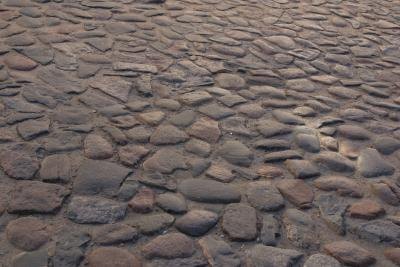 |
|
|
|
|
ICFHybrid
Veteran Member
Posts:3039
|
| 30 Jul 2012 09:26 AM |
|
Hmmmm...steep slope, major runoff.....a road like that is nothing to fool around with. Maybe an engineer is in order.
Surfaces like the two you've shown are fine until the ice and snow comes, then they are horrible and can't be plowed.
|
|
|
|
|
jonr
Senior Member
Posts:5341
|
| 30 Jul 2012 09:30 AM |
|
I agree. But it often helps to get some background and a good idea of what you like first. |
|
|
|
|
jerkylips
Basic Member
Posts:359

|
| 31 Jul 2012 10:37 AM |
|
I saw a couple questions about freeze/thaw & snow/ice, but no response. If this is going to be in an area that gets snow it looks like it would be a nightmare to shovel/snowblow & probably impossible to plow. I'd be concerned with ongoing maintenance as much as the initial install..
It reminds me of those river rock shower floors that everyone wanted a few years ago. They look cool, but once you stand on them you realize that they SUCK. |
|
|
|
|
jonr
Senior Member
Posts:5341
|
| 31 Jul 2012 04:45 PM |
|
Sorry - lots of rain but never freezing or snow at the location. River rock is easily available, crushed is much more expensive.
Most people there slant or crown the steep driveways and put ditches on one or both sides. I've never understood why a reverse crown isn't more common - let the water flow down the middle (as long as it eventually gets somewhere safe). |
|
|
|
|
Alton
Veteran Member
Posts:2164
|
| 31 Jul 2012 05:49 PM |
|
Jonr,
I like the idea of using the driveway as the storm gutter as long as there is no mud to wash onto the driveway. |
|
Residential Designer &
Construction Technology Consultant -- E-mail: Alton at Auburn dot Edu Use email format with @ and period .
334 826-3979 |
|
|
ICFHybrid
Veteran Member
Posts:3039
|
| 31 Jul 2012 09:30 PM |
|
let the water flow down the middle I can't think of anything but concrete that would stand up to that for long. |
|
|
|
|