|
|
|
Spring time humidity control
|
Sort:
|
|
 Prev Next Prev Next |
You are not authorized to post a reply. |
|
|
|
Geo junkie

New Member

Posts:11
 |
| 04 May 2010 08:30 AM |
|
I believe your statement about the demand for products to control humidity during milder seasons is accurate. Conversely, there are available many different humidity control devices on the market, but most are for larger loads than a normal dwelling. There are dessicant devices that absorb moisture but when they are saturated they must be "recharged" which requires heat which carries and expense. The refrigeration based devices also have an operating cost. In your situation, you actually need a third system beyond the heating system and cooling system which are for extremes. That will require an equipment purchase and the AprilAire whole house dehumidifier is probably the device you need. Check their website, www.aprilaire.com, click on whole home products and then dehumidifiers. You will have a great deal of information available. |
|
|
|
|
Clark

Basic Member
Posts:248
|
| 04 May 2010 11:44 AM |
|
Thanks, Geo. I read the AprilAire information that you referenced. It addresses the exact problem that I raised in this thread. Their whole house dehumidifiers should work in conjunction with my HRV and A/C to control indoor humidity nearly automatically with greater efficiency and with less noise than using a portable dehumidifier, although at a much higher initial cost. I'm not yet sure what size unit to get. The 1730A has a capacity of 65 pints/day for ~$1000, while the 1750A is 90 pints/day for ~$1300. I think I can estimate my needs by measuring the amount of water extracted with my portable unit when the HRV is producing the recommended 0.35 ACH/hr. I'll wait until I install the sub-slab depressurization fan for radon gas ventilation, which I recently purchased, to make sure I'm under the 4 pCi/l limit set by the EPA when these measurements are made. |
|
|
|
|
Geo junkie
New Member
Posts:11
|
| 04 May 2010 12:14 PM |
|
You are welcome. I trust that all goes well. keep us informed. |
|
|
|
|
Clark
Basic Member
Posts:248
|
| 04 Jun 2010 09:00 PM |
|
So, I bought a Honeywell DR90 dehumidifier which I'll install next week. It seems that even when outdoor temperatures get up to where the A/C is running along with the portable dehumidifier, I can't keep my indoor relative humidity <50%. I bought the smallest A/C I could, but still, it can't wring out enough water vapor.
The DR90 is a 90 pint capacity dehumidifier, big enough to handle my 2100 sf house + basement. My question now is how do I best hook it up? Unlike the Aprilaire and other whole house dehumidifiers, the DR90 has an optional 6" fresh air intake. Not sure I need it though.
My thinking thus far is to connect the DR90 between the return air trunk and the supply plenum of the air handler. This will pull moist air from the house (and from the HRV) through the DR90, injecting drier air into the ducts that supply conditioned air throughout the house. I'll install a motorized damper that automatically closes off the intake to the dehumidifier whenever the dehumidifier is off to prevent air flow short circuit when the A/C is running. I don't see a need to use the DR90's fresh air intake port. My HRV will provide for my fresh air supply needs on a preprogrammed operating cycle plus whenever the HRV is forced on under manual control from the bathrooms.
Does this make sense? Any suggestions/ comments will be helpful.
Clark |
|
|
|
|
Clark
Basic Member
Posts:248
|
| 17 Jul 2010 08:16 AM |
|
I now have good control over my indoor humidity (45-50%). I installed the Honeywell 90 pint (DR90) dehumidifier on the return air side of my air handler. The discharge air from the dehumidifier is injected before the A/C coil, eliminating the need for a damper. Here's what it looks like: 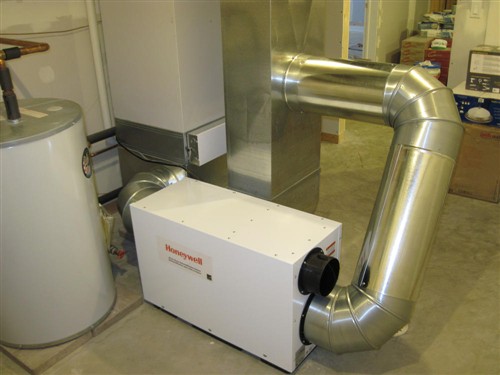 The extracted water runs into a floor drain. This was not an inexpensive solution -- over $1K --- but in a very energy efficient (ICF) house, the new high efficiency central A/C units don't run long enough to extract much moisture. The nice thing about keeping the RH under 50% is that I can let the indoor air temperature rise to 78 deg. and still feel comfortable. A strategy that I'm investigating is to program my thermostat to run the A/C overnight to cool the house down to 72 deg when my electric rate is low (typically < $0.03/KWH.) During the daylight hours I allow the temperature to rise to 78 deg. Even during these 90 deg days, the A/C is does not run during the peak demand hours (>$0.10/KWH) as the indooor temperature slowly rises. Running the A/C overnight also drives down the RH to the low end of its range so the dehumidifier doesn't kick in until the afternoon to maintain the 50% RH set point. Although the DR90 runs during the peak demand period, it draws only 6.9A vs. 8.9 for the A/C. I haven't got a handle on the operational costs yet, but I'm expecting savings comparable to those achieved during the heating season which were about 60%. |
|
|
|
|
jonr

Senior Member
Posts:5341
|
| 17 Jul 2010 10:03 AM |
|
I didn't understand the dehumidifier air flow path when the A/C is off. Also, If you return dehumidified air just before the A/C coil, then the A/C coil becomes less effective at removing humidity.
At $.10 vs $.03, it makes sense to do as much storage of heating/cooling as possible.
|
|
|
|
|
Clark
Basic Member
Posts:248
|
| 17 Jul 2010 11:49 AM |
|
Posted By jonr on 17 Jul 2010 10:03 AM
I didn't understand the dehumidifier air flow path when the A/C is off. Also, If you return dehumidified air just before the A/C coil, then the A/C coil becomes less effective at removing humidity.
At $.10 vs $.03, it makes sense to do as much storage of heating/cooling as possible.
In my system, the air handler circulates the air at low speed continuously, so the dehumidifier runs independently of the A/C. One can also install the system to turn on the fan when there's a call for dehumidification. Honeywell shows two methods for installing the DR90. 1) dumping the dehumidifier discharge air before the A-coil or, 2) after the A-coil. Method 1 will minimize the discharge air temperature (DAT) while Method 2) will maximize water vapor removal as you stated. I thought long and hard about which arrangement to use. Method 2 was my first thought. Then, I noticed that almost no water was draining from the A-coil drip pan when the A/C was running. The A/C just doesn't run long enough to appreciably dehumidify the air. Any condensate that forms on the A-coil re-evaporates once the A/C turns off (with constant air recirculation.) This is apparently a characteristic of the new high SEER units. I also noticed that the discharge air from the dehumidifier was quite warm, as is to be expected as latent heat is released. It's better, in my opinion, whenever possible, to reduce the DAT by passing it through the A-coil before distributing it throughout the house. With my new strategy of running the A/C at night when electrical rates are very low, the A/C now runs for long periods and becomes effective as a dehumidifier, often reducing the RH to <45% with no help from the DR90. What I've taken away from all this is that the HVAC system for a tightly built, energy efficient house must be designed differently than for standard construction. It's not just a matter or installing an HRV/ERV. You either have to learn the principles and apply then yourself, or find a HVAC contractor with that knowledge and experience. |
|
|
|
|
JohnyH
Basic Member
Posts:114
|
| 17 Jul 2010 01:45 PM |
|
Hello Clark
Just curious as to whether you run an HRV/ERV for a fresh air supply in the summer humid months at the same time, if not is there any fresh air brought in?
John |
|
|
|
|
Clark
Basic Member
Posts:248
|
| 17 Jul 2010 02:43 PM |
|
Posted By JohnyH on 17 Jul 2010 01:45 PM
Hello Clark
Just curious as to whether you run an HRV/ERV for a fresh air supply in the summer humid months at the same time, if not is there any fresh air brought in?
John Yes, I do, but to a limited degree. The bathrooms are ventilated via an HRV intermittently throughout the day. There's a control in each bathroom to turn the HRV on and off. If left on, it shuts off automatically after 20 min. The humidifier control can be programmed to ventilate the house to ASHRAE standards based on the house square footage and the number of bedrooms. I use this feature to ventilate the house in the early morning hours when outside air temperatures are moderate. Add to that the ventilation attained by normal opening and closing of exterior doors plus measures to reduce indoor pollutants such as an electric fireplace, induction cooktop with hood vented to the outdoors, electronic air cleaner, and low VOC construction materials and I think I'm providing enough ventilation. I'm sure that I'm coming up short of the recommended 0.35 ACH during the afternoon hours, so as not to increase the A/C and dehumidification loads, but I don't sense any problem, as yet. I can always boost the fresh air intake if there's a need. I'd be interested to hear what others do for ventilation in the mid-summer. |
|
|
|
|
JohnyH
Basic Member
Posts:114
|
| 17 Jul 2010 06:29 PM |
|
Thanks for the reply Clark.
Since my biggest cost is heating, Ottawa ON. Canada, usually late September to mid May I still do not use a stove top hood vented to the outdoors. This is one thing that can be an isssue since my wife really wanted a gas stove, but, not to be. I agree with the bathroom fan switch hooked up to the HRV and I also would have a return vent to all of the bedrooms. The kitchen has a vent that is several feet away from the stove top hood fan. In an after thought I should have hooked up the same type of timer switch to it, live, read, and learn!
John |
|
|
|
|
TexasICF

Advanced Member
Posts:622

|
| 17 Jul 2010 07:39 PM |
|
Clark,
I am very impressed with your approach to this project and detail.
Food for thought....
per your statement above: "but in a very energy efficient (ICF) house, the new high efficiency central A/C units don't run long enough to extract much moisture."
This statement is 100% correct --- however i maintain if they don't run long enough then you are overtonned -- see my previous post some time ago. Why bother with all this? Because I have jury rigged my house to 1500 square feet per tonne and """now that i have lost most all humidity in the wood floors -- and it took a year """ i can cool fine in Texas high 60s with no problem. I've now been in my house 3 years.
My theory is that your house is only now reaching equilibrium and if you put a timer of some sort on your appartus (dehumidifer) it will run less and less as the outside influence continues to go down. Interesed in your thoughts. I think you said you had wood floors -- if so did you paint your baseboard and does it continue to receed as the wood floors continue to dry out? Regards
|
|
|
|
|
TexasICF
Advanced Member
Posts:622
|
| 17 Jul 2010 07:39 PM |
|
Clark,
I am very impressed with your approach to this project and detail.
Food for thought....
per your statement above: "but in a very energy efficient (ICF) house, the new high efficiency central A/C units don't run long enough to extract much moisture."
This statement is 100% correct --- however i maintain if they don't run long enough then you are overtonned -- see my previous post some time ago. Why bother with all this? Because I have jury rigged my house to 1500 square feet per tonne and """now that i have lost most all humidity in the wood floors -- and it took a year """ i can cool fine in Texas high 60s with no problem. I've now been in my house 3 years.
My theory is that your house is only now reaching equilibrium and if you put a timer of some sort on your appartus (dehumidifer) it will run less and less as the outside influence continues to go down. Interesed in your thoughts. I think you said you had wood floors -- if so did you paint your baseboard and does it continue to receed as the wood floors continue to dry out? Regards
|
|
|
|
|
Clark
Basic Member
Posts:248
|
| 19 Jul 2010 12:00 PM |
|
Posted By TexasICF on 17 Jul 2010 07:39 PM
Clark,
Food for thought....
per your statement above: "but in a very energy efficient (ICF) house, the new high efficiency central A/C units don't run long enough to extract much moisture."
This statement is 100% correct --- however i maintain if they don't run long enough then you are overtonned -- see my previous post some time ago.
I can't disagree with you, Texas. The load analysis I did at planning called for 1 ton of cooling capacity. However, since I installed all HVAC equipment myself, the smallest central A/C available to me was a 1-1/2 ton unit (many manufacturers will only sell to dealers.) My house is 2200 sf + that much basement, so I would have expected better dehumidification performance than I'm getting with this relatively small system. This Goodman SEER 13 system was extracting only about 8 pints of water per day, running the A/C 24/7 at 72 deg set point at an indoor RH of 55-60%. The AHU fan speed was also reduced for maximum water extraction. This is what I mean when I say that the HVAC for tight, well-insulated houses needs to be carefully engineered. |
|
|
|
|
Clark
Basic Member
Posts:248
|
| 19 Jul 2010 12:23 PM |
|
Posted By TexasICF on 17 Jul 2010 07:39 PM
Clark,
Why bother with all this? Because I have jury rigged my house to 1500 square feet per tonne and """now that i have lost most all humidity in the wood floors -- and it took a year """ i can cool fine in Texas high 60s with no problem. I've now been in my house 3 years.
Why bother with all this? Because the dehumidifier allows me to control indoor RH between 45 - 50% year round. This is the ideal comfort level. Once you experience it, you won't want to do without it. Also, I know that my hardwood floors are going to be protected. Hardwood flooring expansion/contraction cycles, due to changing indoor humidity levels, cause the formation of cracks between the boards which fill up with dirty, widen over time, loosening the cleats and eventually causing squeaks. If you install expensive hardwood floors, you should plan to control indoor humidity. |
|
|
|
|
Clark
Basic Member
Posts:248
|
| 19 Jul 2010 12:27 PM |
|
Posted By TexasICF on 17 Jul 2010 07:39 PM
Clark,
My theory is that your house is only now reaching equilibrium and if you put a timer of some sort on your appartus (dehumidifer) it will run less and less as the outside influence continues to go down. Interesed in your thoughts. I think you said you had wood floors -- if so did you paint your baseboard and does it continue to receed as the wood floors continue to dry out? Regards
I have already noticed that the dehumifier runs less than when it was first installed. This I expected as more and more moisture is pulled out of the interior materials. Initially, the dehumidifier was running at 60% duty cycle, it's now down to less than 30% and stabilizing. No, the painted baseboard is not receding, but that may be because the flooring and trim material was acclimated for 2 months before installation. |
|
|
|
|
galnar
New Member
Posts:83
|
| 19 Jul 2010 11:49 PM |
|
If you had to do it all over again from scratch, would you just go with an ERV instead? I'm hoping that I'll be able to keep my new ICF home well under 50% RH during the summer. The dump I'm renting now is easily under 40% unless it's raining. The ancient central AC runs for hours on end, though. |
|
|
|
|
Clark
Basic Member
Posts:248
|
| 20 Jul 2010 07:42 AM |
|
Posted By galnar on 19 Jul 2010 11:49 PM
If you had to do it all over again from scratch, would you just go with an ERV instead? I'm hoping that I'll be able to keep my new ICF home well under 50% RH during the summer. The dump I'm renting now is easily under 40% unless it's raining. The ancient central AC runs for hours on end, though. No, the HRV is necessary for energy efficient ventilation during the winter months. Here, in northeastern Illinois, that's November through March. It's remarkable how well a tightly built house traps humidity. Without regular fresh air exchange, indoor RH will rise to dangerous levels in the winter. Ventilating with an ERV would defeat the advantages of building an energy efficient house in northern climates. I think that, depending on where you build, maintaining the RH <50% in the summer will be a challenge. Even if you size your A/C correctly, these new high SEER systems don't seem to remove moisture from the air very well. The higher the efficiency rating of the A/C, the poorer the dehumidification ability. That's how the manufacturers achieve high SEER ratings, as I understand it. The further south you live, the more the scale swings toward using an ERV. But remember that even if you can justify installing an ERV, it doesn't dehumidify the interior air. It simply reduces the humidity of the incoming fresh air. You may still require supplemental dehumidification. I would plan for it as a contingency. |
|
|
|
|
galnar
New Member
Posts:83
|
| 21 Jul 2010 10:45 AM |
|
I'm building just south of you in Peoria. I guess I'll stick with the HRV and go with the whole-house dehumidifier along the lines of what you did. Thanks for posting your experiences, we're close enough geographically that I'm taking your lessons learned to heart. If you've got any other words of wisdom, please share them! :)
|
|
|
|
|
Dana1
Senior Member
Posts:6991
|
| 22 Jul 2010 03:00 PM |
|
In my less than perfectly tight stick-built antique, at low ventilation rates a mid-sized room dehumidifier in the basement is sufficient to keep up with the whole-house humidity even when the outdoor dew points are in the 70s. (I leave it in the basement because A: that's where the temps tend to be the coolest, ergo the highest RH, and B: That's where the temps are the stablest over a daily cycle.) Keeping the basement at 60% RH, the rest of the house (same air mass, higher air temp) stays in the 45-58% RH level right on through warmer & more humid weather. The house is tight enough that the RH stays in the 30-35%RH range throughout the winter unless I'm actively ventilating, but not so tight that active ventilation is a requirement. (I'll be re-testing the natural ventilation rates after I spray-foam insulate some of the cathedralized ceilings in the attic spaces this fall, but I'd be surprised if it drops even as low as 1ACH/50pa).
The duty cycle on the ~500Watt dehumidifier is pretty low- less than 20% even with 70F outdoor dew points. In my 300-350CDD central MA climate, at my current insulation & shading levels, with the t-stat set to 78F the central AC runs fewer than 25 hours/year, but summertime dew points are often well above 60F- the latent load is pretty much ALL of my air conditioning load. But with the indoor humidity at 50-55% RH it's comfortable at 78F as long as I'm not working out or doing anything requiring exertion. Even when I could achieve sensible cooling with nighttime ventilation I keep the windows closed whenever the dew points indicate that it would only add to the latent load. (Nighttime ventilation strategies only work for me a few 10s of days/year at most.)
Ventilating with an ERV isn't about north/south or AC load, it's all about summertime dew poins- the more humid the summer climate, the more important the ERV/HRV distinction is. In winter the ventilation rates need go up a tiny amount relative to an HRV, but the cost of that modest extra loss of heat from that ever so slightly higher winter ventilation rate rarely exceeds the savings you get from reduction in latent load the other 1/2- 3/4 of the year. In relatively dry heating dominated climates HRV is a net-winner over ERV, but that wouldn't include IL. (But yes, even with ERV mechanical dehumidification would still be necessary in IL much of the summer.) The humidity exchange efficiency of an ERV isn't nearly as high as it's sensible heat exchange, and the amount of unwanted humidity being returned by an ERV with the drier outdoor air of winter as compared to the zero humidity return of an HRV isn't very consequential.
The dew point of 50% RH 78F air is ~ 58F. If your summertime average outdoor dew points are above 58F, ERV is a clear net winner by far, quite independent of the sensible air conditioning load. If the summertime average dew points are below 50F, not so much. Peoria's July average dew point this far has been ~54.5F: http://www.wunderground.com/weatherstation/WXDailyHistory.asp?ID=KILPEORI7&graphspan=month&month=7&day=22&year=2010
In June the average was 56.5F: http://www.wunderground.com/weatherstation/WXDailyHistory.asp?ID=KILPEORI7&graphspan=month&month=6&day=22&year=2010
... but with significant stretches with dew points in the 70s.
If this is typical of the region (I'd have to dig up the 10 or 25 year history to figure that out), and ERV might still be a better way to go, but not essential.
The average dew point in my neighborhood this past month has averaged 59.7F- manageable with a single small dehumidifier & low ventilation rates despite significant stretches with dew points in the low 70s, but springing a bit extra for an ERV rather than an HRV would probably be still cost-effective in a 10 year NPV analysis of 40-50% lower dehumidification energy cost against the modest increase in winter heating cost. (YMMV)
The average dew point in Gainesville FL this past month was 74.7- definitely ERV territory, no finely tuned accounting necessary. |
|
|
|
|
Clark
Basic Member
Posts:248
|
| 22 Jul 2010 04:14 PM |
|
Posted By Dana1 on 22 Jul 2010 03:00 PM
... In relatively dry heating dominated climates HRV is a net-winner over ERV, but that wouldn't include IL. ...
But, I think it includes the northern two-thirds of Illinois, including Peoria, based on these recommendations from FanTech. |
|
|
|
|
| You are not authorized to post a reply. |
|
Active Forums 4.1
 |
Membership: |
 |
Latest:
croccohvacusa |
 |
New Today:
0 |
 |
New Yesterday:
0 |
 |
Overall:
35027 |
 |
People Online: |
 |
Visitors:
190 |
 |
Members:
0 |
 |
Total:
190 |
|
|
|