|
|
jonr

Senior Member

Posts:5341
 |
| 09 Dec 2012 04:25 PM |
|
http://www.stratfordboilerstoves.co.uk/
(allows storing excess heat in a water tank) |
|
|
|
|
ICFHybrid

Veteran Member
Posts:3039
|
| 10 Dec 2012 01:40 AM |
|
I am thinking the f3 would be more reasonable. It appears that the f3 is an unsealed unit that operates with an open door. That would not be the unit for a tight home. The Jotul webpage claims that a "fresh air kit" is an accessory, but did not see anything in the manual about how it would be possible to install it or exactly what it was. The f3 manual itself does not list the fresh air kit as an accessory. |
|
|
|
|
Dana1
Senior Member
Posts:6991
|
| 10 Dec 2012 03:44 PM |
|
Posted By onesojourner on 09 Dec 2012 10:04 AM
Wow thanks for the reply. We have quite a few windows and doors. The total is about 285. Many of the doors are going to be full glass, but they will be low-e and argon also. Our windows are rated at u .24. I am coming up with 4788 there.
The rafters will be spray foamed. I think that runs at about r6 per inch and they will guarantee at least 4-6 inches. So r-24 up there. the roof pitch is 6/12. I am not sure how that would figure into everything.
I believe all of Jotuls classic line offer outside air kits excepts the 602, At least all the stoves I have looked at (f100 (currently own) F3 and f400). I put in a 4 inch pvc sleeve before the pour so there is a straight shot through the floor joists for the outside air line.
ICFhybrid could you give me some more info on your house? size, location roof insulation ect?
With rafters 24" o.c. and 5" nominal fill of closed cell foam you'll have a ~9% framing fraction of R5 thermally shorting the ~R30 foam and it would come up a bit shy of R24, -closer to R22. If you assume the assembly averages R22, use a U-factor of (1/22=) 0.045 for the cathedralized roof area. With a 6/12 pitch the roof has about 12% more the surface area than the floor area, so for a 1620' of upper floor you have ~1800' of roof area. In SW MO your design temps are probably a lot warmer than -10F I used in my example case. Your design temp is probably closer to +10F, (Springfield's 99% design temp is +9F), so your delta-T is more like 60F degrees, not 80F as in my throwaway example. That makes your roof losses: 1800 x 0.045 x 60F= 4860 BTU/hr. The 285' of U0.24 windows will be losing (0.24 x 60F x 285 =) 4104 BTU/hr. Seriously, do this in a methodically and build spreadsheet using the real surface areas & U-factors on your house, and doing it on a room-by-room basis helps you tweak the design to avoid building-in colder than average rooms, but it doesn't sound like your total is going to be high enough to warrant anything close to a 50KBTU/hr stove, even if your wall-losses are of a similar or slightly higher magnitude to the window or roof losses. With infiltration you might be pushing 20KBTU/hr or a hair more, but do the math- it counts. Also, like others, I couldn't find a outside air kit for the F3 either. BTW: R30 center cavity on the rafters barely makes code-min for "compact roof", and the blowing agents used for closed cell foam has more than 1000x the greenhouse potential of CO2, and more than 100x the greenhouse potential of open cell foam at any given R value. Taking it to R38 or even R50 with open cell foam would be both cheaper and greener. If you have 2x6 rafters and only 5.5" of rafter to work with, using 2.5" of rigid roofing iso (R15) above the roof deck and a full 5.5" (~R20) of cavity fill you'd have a thermal break over the rafters, for a center cavity R of R35, and a whole-assembly R-value of R32 after thermal bridging for a U-factor of about 0.031. (That would bring your roof losses down to 3424 BTU/hr at the heating design temp, and it would be noticeably more comfortable under the July sun too.) There are a few different approaches to a foam-over, but the cheapest approach is something such as figure 3 on this page. By through-screwing the nailer deck with timber-screws 24" o.c. (biting 1.5" in to structural roof deck & rafter) the thermal bridging of the fasteners are minimized. The installed cost of rigid polyiso is comparable at equivalent R to closed cell spray polyurethane, but unlike the high density sprayed goods it's blown with pentane, with only 7x CO2 (or less than 1% that of the closed cell polyurethane.) The combined cost of the exterior foam and open cell on the interior comes out about the same, but both higher-performance and a more resiliant assembly, since the roof deck can now dry toward the interior, yet has sufficient exterior-R to prevent wintertime moisture accumulation through the more vapor permeable open cell foam. With the closed cell foam approach you're building in a lifecycle
greenhouse gas potential worth a few decades of the fuel use it offsets, but
with lower-impact blowing agent foam the fuel savings in a handful of
years cover the lifecycle emissions of the foam. These are squishy number, since the type of heating & cooling energy sources will factor in, as well as the passive solar aspects of the whole house design (PLEASE limit the west facing glass to keep the air conditioning loads bounded!), but it's still worth going with the lower impact goods when it has no performance down-side, and little to no cost-adder. |
|
|
|
|
onesojourner

New Member
Posts:30
|
| 10 Dec 2012 05:31 PM |
|
from http://www.jotul.com/en-US/wwwjotulus/Main-menu/Products/Wood/Wood-stoves/Jotul-F-3-CB/
"Popular options include: Fresh air kit, short leg kit for fireplace installations, Leg leveler kit, screen for open door fire viewing and a choice of two enamel colors in addition to our Classic Matte Black paint."
Unfortunately it is to late to add any additional insulation on the roof. The metal is currently being installed. I made a mistake, I will be using an open cell spray foam. Here is what my contact has given me thus far:
"I am sorry it has taken me a few days to take a look at these but to give you a good performance value of R-44 you would be looking in the range of about 2,850. I would happily make a site visit and write you a firm proposal. Please let me know if we can answer any questions or if you need anything from us. Thank you Sir. " and "Yes Sir, Open Cell Spray Foam 5" "
and the company website:
http://www.ozarkfoam.net/
|
|
| http://icftfsystemshome.blogspot.com/ |
|
|
onesojourner
New Member
Posts:30
|
| 10 Dec 2012 05:48 PM |
|
I have tried to minimize the windows on the north and west walls. East  South  West  North  |
|
| http://icftfsystemshome.blogspot.com/ |
|
|
ICFHybrid
Veteran Member
Posts:3039
|
| 11 Dec 2012 08:49 AM |
|
"Popular options include: Fresh air kit, short leg kit for fireplace installations, Leg leveler kit, screen for open door fire viewing and a choice of two enamel colors in addition to our Classic Matte Black paint." Not to belabor this, but in order to avoid surprises, I always look at the installation manual. It is not uncommon for the marketing department to be on a different wavelength from the engineering department. |
|
|
|
|
Dana1
Senior Member
Posts:6991
|
| 11 Dec 2012 10:54 AM |
|
Most open cell foam @ R44 would be sufficiently low-permeance to not create a wintertime moisture load problem in your climate zone, and would be sufficiently permeable to allow the roof deck to dry toward the interior.
Is there going to be any rigid foam going on the outside of the ZIP wall sheathing?
Foundation insulation = ?? |
|
|
|
|
onesojourner
New Member
Posts:30
|
| 11 Dec 2012 12:01 PM |
|
No there wont be any rigid foam going on. The basement floor is insulated (unheard of in this area) and no foundation insulation. 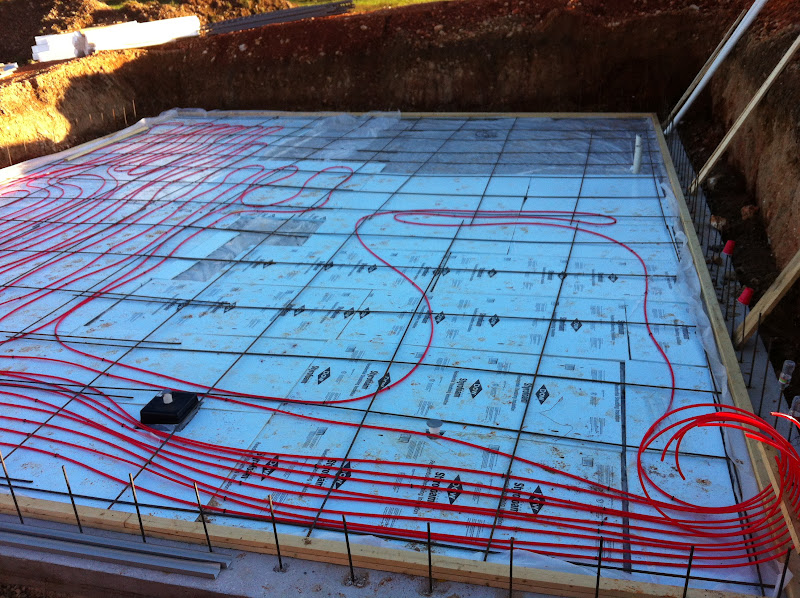 |
|
| http://icftfsystemshome.blogspot.com/ |
|
|
Dana1
Senior Member
Posts:6991
|
| 11 Dec 2012 01:54 PM |
|
With 2x6 framing w/o.c. foam or cellulose cavity fill, U0.24 windows, and an R44 compact roof, the exposed uninsulated foundation wall will likely DOMINATE the heat loss numbers! It's silly to spring for U0.24 windows if you're going to leave a gaping hole in the thermal boundary!
The U-factor for a 12" thick foundation wall is about 1.0, the U-factor for an 8" wall is about 1.3. If you have 200' of 24" foundation above grade that's 400 square feet. At a delta-T of 60F @ design condition that's (400' x U0.1 x 60F= ) 24,000BTU/hr of heat load!
At the very least put 1.5-2" of EPS against the concrete held in place by furring through-screwed to the foundation with TapCons on which you can hang the gypsum. Alternatively 1" of EPS trapped to the foundation with a non-structural 2x4 studwall insulated with UNFACED fiberglass or rock wool batts brings the U-factor down to about the same level as the above-grade walls. You need the rigid foam between any wood and the foundation to control ground moisture accumulation in the wood, and at R4 you'll have no wintertime condensation issues in the fiber at the above grade portion. The studwall approach makes it easy to route wiring etc. Use the same foam as was used in the above grade walls or roof to insulate and air-seal the band joist to the foundation insulation.
With 2" of EPS the U-factor for the above grade section of the foundation drops from 1.0 -1.3 to about 0.1, and the heat loss of 400' would be a much more reasonable 2400 BTU/hr.
If you go with the 1" foam + studwall w/batts solution the U-factor would run ~0.07, and the loss out 400' of exposed foundation would be ~ 1700 BTU/hr
There's an argument for putting an inch of rigid EPS or poly iso outside the ZIP too, which will better control moisture accumulation in the ZIP while cutting the heat loss from walls by about 25-30% . Anything over ~R3 is sufficient for dew-point control in your neighborhood, so at an absolute minimum half-inch is "worth it", but the labor is about the same whether it's half-inch or 1" and the up-charge for the higher-R is tiny and offers a higher thermal break on the framing, and real margin on the dew-point control at the sheathing.
The type of siding and how you attach it matters too, and may affect the type of any exterior foam treatment on the ZIP.
With an inch of iso on the ZIP the wall and o.c. foam or cellulose in the cavities you'll have a very comfortable ~R20-ish wall (~U- 0.05), which is an appropriate level for the roof-R and window-U. With 2" of basement EPS the total R (including concrete & gypsum) would run about R9, which isn't terrible. With the inch of EPS + studwall w/R13s you'd be at R15, which isn't over-the-top for your climate.
See the row for climates zone 4 of whole-assembly R-values recommended in Table 2, p.10 of this document as a sanity-check:
http://www.buildingscience.com/documents/reports/rr-1005-building-america-high-r-value-high-performance-residential-buildings-all-climate-zones
If it becomes an either/or thing on sheathing vs. foundation insulation, insulate the basement- it's hands-down the most glaring sin of omission on an otherwise decently high-R house!
|
|
|
|
|
onesojourner
New Member
Posts:30
|
| 11 Dec 2012 02:55 PM |
|
There really is no above grade foundation. At least not much. I think you may be seeing the garage there. The actual house is a walk about basement and it is ICF all the way to the roof. |
|
| http://icftfsystemshome.blogspot.com/ |
|
|
onesojourner
New Member
Posts:30
|
| 11 Dec 2012 02:57 PM |
|
The garage is the only framed part of the house. It is just 2x4 framing, no 2.6.
Here are the windows:
http://www.miwd.com/individual-product-display/1043924-9770
low-e with argon
http://www.miwd.com/uploads/docs/1340927698-2aa8001eb78e8684e/Thermal%20Test%20Information-MIWD%20East%20Vinyl%20NC_GA%20Codes%20SSB%20Thermal%20Data%202-2-2012%20New%20Construction%20-%20East%20%28SSB%29.pdf |
|
| http://icftfsystemshome.blogspot.com/ |
|
|
Dana1
Senior Member
Posts:6991
|
| 11 Dec 2012 03:36 PM |
|
Posted By onesojourner on 11 Dec 2012 02:55 PM
There really is no above grade foundation. At least not much. I think you may be seeing the garage there. The actual house is a walk about basement and it is ICF all the way to the roof.
What was I THINKING!? The title of the thread says it all!  I think the pictures of the timber framed garage sent me down that silly side-track. (Feels like it's only the second Monday this week... it has to get better from here, eh?) |
|
|
|
|
onesojourner
New Member
Posts:30
|
| 11 Dec 2012 06:13 PM |
|
HAHA I sure hope so!
So do you think the jotul F3 with a Maximum heat output of 42,000 BTU/hr would be a good fit? I have confirmed with my local dealer that this stove does have the outside air kit option.
We currently own and use the Jotul F100 with a Maximum heat output of 35,000 BTU/hr and we heat about 600 sqft,but that is in a 90 year old house with uninsulated walls. |
|
| http://icftfsystemshome.blogspot.com/ |
|
|
Dana1
Senior Member
Posts:6991
|
| 12 Dec 2012 06:46 PM |
|
Posted By onesojourner on 11 Dec 2012 06:13 PM
HAHA I sure hope so!
So do you think the jotul F3 with a Maximum heat output of 42,000 BTU/hr would be a good fit? I have confirmed with my local dealer that this stove does have the outside air kit option.
We currently own and use the Jotul F100 with a Maximum heat output of 35,000 BTU/hr and we heat about 600 sqft,but that is in a 90 year old house with uninsulated walls.
I'm not at all convinced that the F3 is a good fit- where did you end up for a total on your spreadsheet heat loss calc after all of this U-factor guesstimatin'? (I'm thinkin' it's probably still too big, even if it's better than a 55KBTU stove.) Trust me, I'm just stabbing in the dark on surface areas, but the U-factors are and outside design temps are within reason. This is something that YOU have to do, even if it's a full page of pencil & paper to nail the area and U-factor of every window, door, etc. Most non-catalytic EPA stove run pretty dirty below 1/3 of their rated max, so you'd want to be able to run it at least that high whenever you can. If your heat load came in at 20,000- 25,000 BTU/hr, great- running the F3 at (42,000/3=) 14,000BTU/ would take awhile to over heat the house even if the average heat load over the burn period was something like 8000BTU/hr, and you wouldn't be overfiring the stove even at design condition. But if your spreadsheet heat load calc comes in at <15,000 BTU/hr you should be looking for a smaller or higher-mass soapstone or ceramic stove. The concern is not that you'll have too little stove to stay warm, but that you'll have too BIG a stove to burn cleanly & efficiently without roasting your family. The fact that the only slightly smaller stove heats a house that probably has more than 3x the heat load of you ICF house is pointing to the likelihood that the F3 will be too big. A stove with a max-fire BTU rating 2x your calculated heat load should
be considered something of an upper bound, or you'll have to run it in
the dirty range to avoid the sweat-lodge/sauna problem. And that's why you do a heat load calculation- it's CRITICAL to getting the right stove! I can lead you to the calculation methods-pool, but you're the one who has to dive-in. It's not a 3 hour chore, but it's probably more than 30 minutes. |
|
|
|
|
Dana1
Senior Member
Posts:6991
|
| 13 Dec 2012 04:07 PM |
|
FWIW: These people claim their catalytic soapstone woodstoves run within EPA emissions rates at about 25% of full fire, which is a bit better than most. (It's safer to assume ~35% of full fire to be the low end for good efficiency & low-emissions for non-catalytic stoves like the F3, not 25%.) Their heat-load methods are still a bit cruder- much cruder than a spreadsheet using U-factors, but are better than most "heats xxxx square feet" type specs. Eyeballing their "average home" nomograph for your zone (zone 4) an average house your size might take ~40K to heat on design day, if I derate the square footage of the walk-out basement by more than half since ~3/4 of the wall area will be below grade. But since your house is way better than an average house it's going to be under 30K, and probably under 25K. Continue with the spreadsheet load calculation exercise to verify, but by their methods with my adjustments for a ~20-30K heat load WAG the F3 would still be fine. But if the spreadsheet comes in under 20K the F3 is too big (but a similar sized soapstone stove might not be.) |
|
|
|
|
onesojourner
New Member
Posts:30
|
| 13 Dec 2012 06:32 PM |
|
OK so this is what I am getting:
I used 10 degrees for my temp, We might see 0 - -5 once or a couple times a winter at most. Is that reasonable? I can remember one time in my life it got down to -10.
Floor
9720 BTU
Roof
4374 BTU (I Used and R22 for this - most spray foam is R3.6 per inch)
Windows
4104 BTU
Above Grade Walls
5000 BTU
Below Grade Walls ( I figured a ground temp of 50 degrees and I figure the garage space in this too)
1514 BTU
For a total of 24,712 BTU. How does that sound? |
|
| http://icftfsystemshome.blogspot.com/ |
|
|
Eric Anderson

Basic Member
Posts:441

|
| 14 Dec 2012 08:24 PM |
|
Small woodstoves for the super insulated:
http://www.marinestove.com/
Got to love a stove that takes 6" LONG logs.
cheers, Eric |
|
| Think Energy CT, LLC Comprehensive Home Performance Energy Auditing |
|
|
jdebree
Basic Member
Posts:497
|
| 15 Dec 2012 08:15 AM |
|
Those are really cute! They would look odd in a living room- like you had swiped your kid's dollhouse furniture. I wonder how long a burn you get with 6" logs? I can't see it going all night. |
|
|
|
|
ICFHybrid
Veteran Member
Posts:3039
|
| 15 Dec 2012 08:57 AM |
|
I'd like to take this opportunity to point out that wood, as a fuel is nowhere near as consistent as gas or oil. The "output" of all these units need to be taken with a great big dose of reality in terms of the fuel that is available. I wonder what the testing standards are when they determine the stove's output? Whatever they are, I'm pretty sure it involves dry, well-seasoned fuel.
Just saw an example a few weeks ago, during a "house warming" where the homeowner confided that their new wood stove wasn't working as well as it was when first installed. A little investigation revealed that the two cords of "seasoned maple" they bought off Craig's List was more like a cord of cottonwood and a 1/4 cord of maple. Once they got into the cottonwood, it just didn't burn as well as the maple.... |
|
|
|
|
jonr
Senior Member
Posts:5341
|
| 15 Dec 2012 10:44 AM |
|
Remember, the weather varies all over the place. So you are often going to find it very difficult to burn slow enough to prevent overheating (unless you use a boiler+tank or some other type of active thermal mass). |
|
|
|
|