Bob Shirley

New Member

Posts:13
 |
| 30 Dec 2015 12:56 PM |
|
Anyone got a rough idea how many BTUs I might expect from 10' of 1/2" PEX wound into a wall panel area of 24" x 30". Water temp is 104F and flow could be as much as 1gpm. Not sure if the output would be worth the trouble. Trying to get some extra BTUs into a bathroom that came up short. Thanks |
|
|
|
|
|
|
jonr

Senior Member
Posts:5341
|
| 30 Dec 2015 01:02 PM |
|
Consider a wall/ceiling mounted radiator instead. Or maybe the interesting look of: 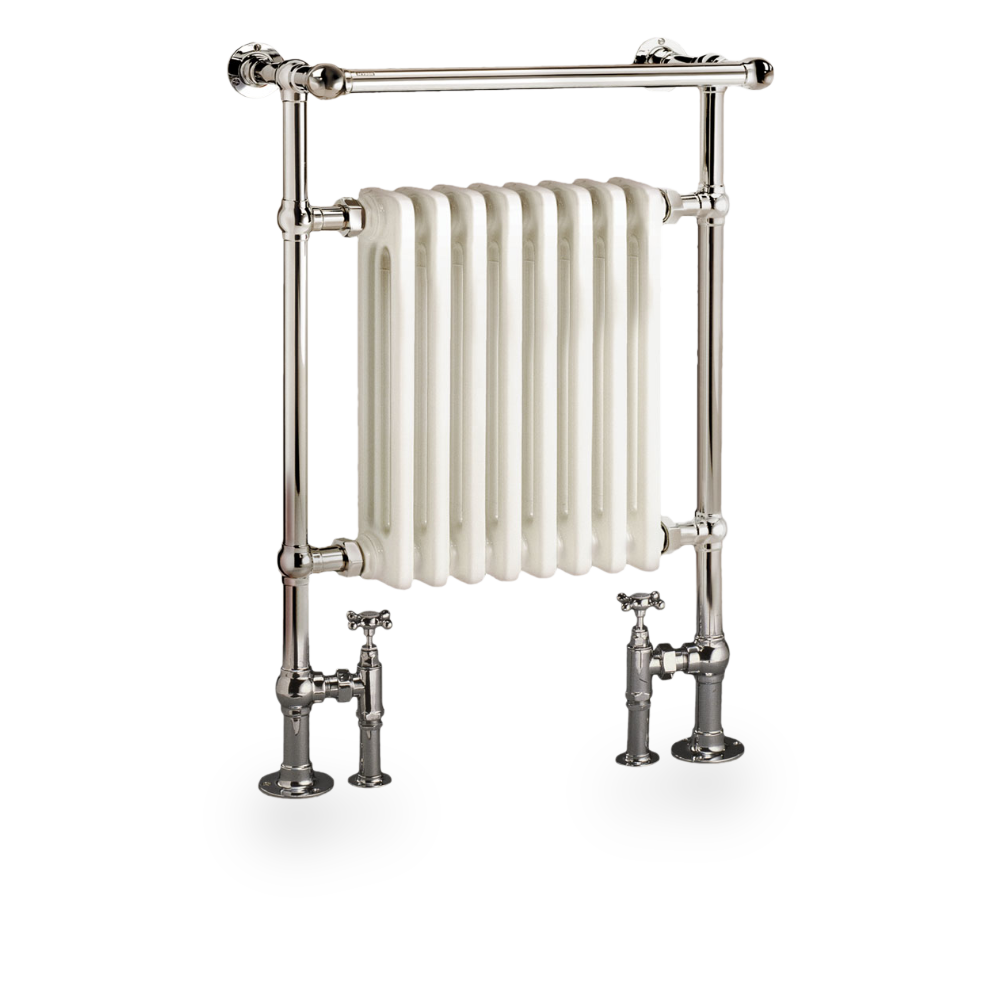
A wild guess for your plan (depending greatly on details): 100 btu/hr. |
|
|
|
|
Bob Shirley
New Member
Posts:13
|
| 30 Dec 2015 01:20 PM |
|
Thanks for the quick reply. Your radiator is a cool, well hopefully hot, concept. What kinda cost? A towel warmer had been suggested but cost of a decent one is outta my league as is your radiator probably. You suggest maybe a 100 BTU; how much would that radiator or a towel warmer put out with 100 degree water. Thanks |
|
|
|
|
ronmar

Basic Member
Posts:479
|
| 30 Dec 2015 04:07 PM |
|
BTU, per sq/ft, per deg F temp difference, per hour 75F room, 95F warm wall(20 degree delta)? 30" X 24" = 5 SQ/FT? 1/2" drywall = R.45/2.2U So 2.2U X 5 SQ/FT X 20F = 222 BTU/HR? About 60W or so? Providing you can get most of the wall surface to near that temp. a 95F wall would probably feel moticiable in a normally cold bathroom  It would probably require some aluminum sheet metal to spread the tube heat out to the wall surface. Looks like the energy is there. At 1GPM/480 pounds per hour, 222 BTU/HR would lower the temp 2+ degrees? More tube would be better if you could fit it, as the transfer from tube to wall will probably be the choke point. I have contemplated something similar, just in case I need to fine tune the master bathroom comfort level... |
|
|
|
|
jonr
Senior Member
Posts:5341
|
| 30 Dec 2015 08:32 PM |
|
I'd throw in some R value for air film too.
I don't know cost (probably high) - but a classic look used radiator or a DIY towel rack from pipes might be options. Also consider radiant heat lamps (1700 btu) - efficient because they quickly heat the occupant and only when in use. Not to mention that in milder conditions (most of the time), you have enough capacity. |
|
|
|
|
Bob Shirley
New Member
Posts:13
|
| 30 Dec 2015 10:48 PM |
|
Thanks for all the good info. If I should decide to go this route the area behind the pex would be packed with R14 Roxul. The 1/2 Pex would be set in aluminum heat transfer plates attached to furring strips. The pex would be covered by a 1/4" cement board and then 3/8 Porcelain Tile. Whatever heat is in the Pex should project out into the room fairly well, just not sure if it would be enough to make a difference. |
|
|
|
|
Dana1
Senior Member
Posts:6991
|
| 31 Dec 2015 08:48 AM |
|
It's silly to spec a solution to a problem of unknown magnitude. Simply "...some extra BTUs into a bathroom that came up short..." isn't exactly a heat load calculation.
How many BTUs short are you? Or is this just a retrofit hack because it's a bit cooler than you'd like in there? If the latter, you could experiment with a very small electric space heater and a Kill-a-Watt to come up with an order of magnitude estimate of what it would take, and work from there.
In the unlikely event that you can get as much as 25 BTU/hr per square foot out of the radiant wall with 104F water, that's still only 125 BTU/hr. To put that in perspective:
A conscious upright adult human is good for at least 300 BTU/hr.
A couple of 11 watt LED lights is good for 85 BTU/hr.
A 2' x 2' convecting panel radiator such as a Biasi B-24.24 ECO delivers about 1000 BTU/hr (at 104F AWT into a 70F room.)
http://www.qhtinc.com/wp/wp-content/uploads/2013/01/EcostyleTechnical-Booklet-011713.pdf
|
|
|
|
|
jonr
Senior Member
Posts:5341
|
| 31 Dec 2015 09:05 AM |
|
Even a heated toilet seat can add 50 btu/hr (and IMO adds more to comfort than 100 btu into the air). Looks like $211 for the radiator. |
|
|
|
|
Bob Shirley
New Member
Posts:13
|
| 31 Dec 2015 11:29 AM |
|
Thanks for the good comments especially from Dana1. This gives me a new perspective on things and makes me think I should reconsider my project. 'a bit short' was a polite way of saying 2100 btu but this may not be accurate as the original heat loss calc of 5000 came from the samy guys who specified 5/16 Pex. I believe that is giving me 2874 btu ((10F*479)*.6gpm) This seems to be almost enough, especiall in the milder weather (14F) -13F is when we notice it a bit cool.
The radiator is a good suggestion but I don't think the B 24-24 model (2751 BTU @ 140F) will put out anywhere near 1000 BTU. The correction factor for 120F & delta T of 30F is .26 which leaves 687 BTU. 104 F @ delta T of 10 is going to leave even less unless my calcs are way off. |
|
|
|
|
Dana1
Senior Member
Posts:6991
|
| 31 Dec 2015 03:24 PM |
|
The 0.26 factor @ 120F EWT is when feeding heat to a 76F room at a delta-T through the radiator of 30F, for an AWT of 105F. That's a whopping delta T that would require extremely low flows to achieve with a tiny radiator like that.
Are you really keeping it that warm?
For a 68F room and an EWT of 120F it's 0.32 at a 30F delta, (AWT= 105F) and would be 0.38 at a 25F delta, or an AWT of 108F.
Even at 1 gpm you're going to see a tiny smaller delta-T than that, about 2F: 1gpm is about 500 lbs/hr, so when the thing is emitting (order of magnitude) about 1000 BTU/hr the delta T is 1000 BTU/500 lbs= 2F. Drop the flow to 0.5gpm and the AWT is still going to be north of 100F. So your factor into a 68F room is going to be a bit under 0.32, but probably not lower than 0.30.
The derating is from the 180F number, not the 140F number (look for the 1.00 at the intersection of 180F EWT and 68F room temp). The 180F rating is about 4550 BTU/hr. 4550 x 0.30 would be about 1360 BTU/hr. If you're looking at keeping the bathroom at 72F it'll still be well over 1000 BTU/hr.
Even if you're keeping the room at 76F your factor would be something like 0.24-0.25, or about 1100 BTU/hr. This might be mildly optimistic, but not wildly so.
A bathroom with a heat load north of 2000 BTU/hr is bit unusual, unless it's a corner room with a lot of window area.
|
|
|
|
|
Bob Shirley
New Member
Posts:13
|
| 01 Jan 2016 05:17 AM |
|
Dana 1. You're right I was basing my correction off of the 140F rather than 180F. and I looked at the high delta T. When I look again using 72F as the IDT and 15f for the delta T it looks like the correction factor drops .1 for every 10F. To drop from 180F to 104F the correction factor looks like about .19 which still leaves about 864 BTUs which is probably a good boost.
As I said before I am a bit skeptical about the heat loss calc they did for me on my ensuite. I double checked and they actually projected 5500 BTUs. Now the room is almost 140 sq. ft. with two exterior walls and 24 sq. ft. of glass but the house is super insulated, the space above is conditioned and the glass is triple glaze, double gas (r9) so I think the heat loss will be higher than 2000 but 5500 may be high. I think I will see what the price of that 24-24 is. we're in Saskatchewan, Canada so I expect the price will be higher than $211 that JonR suggested. Either way, if I can add approx 800 btu to the room that would help.
By the way, with low temp geothermal systems high flow, low delta T is the secret to getting btus out of the system. At .6 gpm my delta T is 10F in that particular room, mind you that is with 5/16 Pex. again, thanks for your good input and Happy New Year |
|
|
|
|
Dana1
Senior Member
Posts:6991
|
| 01 Jan 2016 08:58 AM |
|
The better comparisong is the AWT (average water temperature) not the EWT (entering water temperature). You won't have anything like the delta-Ts in the correction factor table, but output changes very little with AWT, across a wide EWT range. You'll be getting a lot more than 864 BTU/hr out of it with a 104F EWT and an ~103F AWT, which is where it would be at 1gpm flow. At 0.5gpm you'd still have a 102F AWT.
Looking at only the 72F column, at 120F in / 100F out, (110F AWT) you get factor of 0.41, and at 120F in /90F out (105F AWT) it's 0.34. That's a difference of 0.07 in factor over a difference of 5F, or (0.07/5F=) 0.014 per degree. An AWT of 102F is 3F below the 105F point in the table, so at 0.5 gpm you'd be looking at a factor of
0.34 - ( 3 x 0.014)= 0.030
4550 BTU/hr x 0.30 = 1365 BTU/hr.
Note: 0.6 gpm is about 300 lbs/hr, times a 10F delta-T is 3000 BTU/hr, which is a LOT of heat for most bathrooms.
R9 windows are a U-factor of about 0.11 BTU per degree F per square foot. Assuming a 99% outside design temp of -25F and an interior design temp of 72F that's a difference of 97F. With 24 square feet of glass that's
24' x U0.11 x 97F= 256 BTU/hr for the glass.
A US climate zone 7 code minimum house has a wall U-factor 0.048 (R21 whole-wall, not superinsulation). Assuming you have about 100 square feet of exterior wall in that room the wall losses are:
200' x U0.048 x 97F= 912 BTU/hr
Assuming it has 140' of U0.026 code-min attic above it, that's
140' x U0.026 x 97F= 353 BTU/hr
Add it all up and you're still only at ~1500 BTU/hr. Thats at IRC code-min for the walls & attic, but better than code windows. Where is the other (3000 BTU/hr -1500 BTU/hr =) 1500 BTU/hr going?
Even if it's a VERY leaky room, sucking in 10 cfm (600 cf/hr) of outdoor air, the infiltration losses add up to no more than
0.018 x 600cfh x 97F= 1048 BTU/hr, for a total heat load of only about 2500-2600 BTU/hr.
Something seems really off if you're losing half the heat (or more) in distribution losses.
BTW: A 5500 BTU/hr heat load for a 140' room is about 40 BTU/hr per square foot of conditioned space. That's a higher ratio than you would have with reasonably tight 2x4 construction and low performance clear-glass double-panes. The rules of thumb (no real heat load calculation) heating contractors in central Alaska assume 25 BTU/square foot for 2x6 construction houses, at an outside design temp of -50F, and that rule reliably oversizes the equipment.
|
|
|
|
|
jonr
Senior Member
Posts:5341
|
| 01 Jan 2016 10:43 AM |
|
Also consider how much of the heat being delivered to the bathroom is escaping to adjacent rooms (which might be cooler). Especially in the case of radiant heat (eg, floor leaking to basement or crawlspace). Some insulation might be an easy solution. Concrete slabs will interfere with heat delivery during rapid drops in temperature.
|
|
|
|
|
Bob Shirley
New Member
Posts:13
|
| 01 Jan 2016 02:40 PM |
|
Some interesting comments Dana & Jon.
I have r14 Roxul in the joists under the radiant floor. The ensuite has a connecting door to the 225 sq. ft. bedroom and that door is open most of the time. The bedroom has two air heat ducts so it's pretty warm. I always assumed that there would be some mixing of heat between the two rooms although I did read somewhere that radiant floor heat won't migrate to other areas. Might be the same place they had me believing the heated basement would have no effect on the upstairs temperature in spite of mostly un-insulated floor joists and a big open staircase.
I do find your heatloss calcs very interesting and am inclined to lean towards your calcs which is why I dug deeper.I looked at one of the whole house calcs and that had the master bedroom at 435 sq. ft. My actual measurement of the bedroom, ensuite and adjacent closet puts the total @ 410 sq. ft. That same document has the total heat loss at 6800 btu (3226 air heat & 3571 radiant) These numbers are closer to yours and well within your 'Alaska Rule'
Like I said I really do think that radiator, even with the low temp water, will add enough extra heat. A bit of research suggests the cost is $425 CAD. Wholesaler, if I can find one, might be a bit cheaper.
Again Thanks and Happy New year.
PS: Dana, you seem to have a pretty good handle on these heat-loss calcs. I'm assuming you do this for a living? |
|
|
|
|
jonr
Senior Member
Posts:5341
|
| 01 Jan 2016 04:29 PM |
|
You might find it cheap and easy to move some of that ducted hot air into the bathroom. With an in-line duct booster fan if necessary. I prefer warmer bathrooms, cooler bedrooms. |
|
|
|
|
Dana1
Senior Member
Posts:6991
|
| 02 Jan 2016 11:27 AM |
|
Biiasi rads are usually a lower priced more utilitarian type option compared to Buderus or Runtal et al. A price of $425 CAD seems a bit of a gouge. Online US pricing is $211 USD online from this source (whom I haven't done business with.)
http://www.ecomfort.com/Ecostyle-B-24.24-ECO/p24160.html
I suspect the 24 x 24" Biasi can heat the whole bathroom by itself at 100F AWT, especially if "superinsulated" = "better than IRC code min".
You might be better off supplementing with a 24 x 30" heated towel rack. Haven't dealt with these folks, don't know the pricing, but they have a reasonable range of radiator & heated towel rack options:
http://www.expressradiant.ca/pdfs/product_catalogue.pdf
I'm not a professional hydronic designer, but I do at least the napkin math versions of both load calcs & system changes on any HVAC spec before diving in blindly, which saves a lot of money and frustration.
Another option that might be reasonably affordable is a small aluminum or bi-metal convecting radiator, eg:
http://www.canarsee.com/heating/radiators-convectors/radiators/aluminum-heating-radiators/aluminum-heating-radiator-22x19x4-6-section-bimetal-white
|
|
|
|
|
BadgerBoilerMN

Veteran Member
Posts:2010
|
| 02 Jan 2016 11:40 AM |
|
Posted By jonr on 31 Dec 2015 09:05 AM
Even a heated toilet seat can add 50 btu/hr (and IMO adds more to comfort than 100 btu into the air). Looks like $211 for the radiator.
The classic radiator pictures is over $1000.00. We just installed one in a 110 year old house here in St.Paul, MN.
We also heated the shower walls, seat and floor to come up with the required Btuh and used the existing design water temperature matching output of old cast iron radiators and the radiant ceiling with floor warming in the remodeled kitchen. |
|
| MA<br>www.badgerboilerservice.com |
|
|
Bob Shirley
New Member
Posts:13
|
| 02 Jan 2016 01:14 PM |
|
Thanks for the additional information.
FYI I tried a real world test to see what it takes to heat the bathroom. Unfortunately I picked a bad time to do this because we are having very mild weather (23F last night). I am also assuming that a 1500 Watt heater puts out 5,000 BTU. So I turned off the radiant floor heat and put a 1500W oil filled radiator in the room running at 3/4 speed (approx. 3750 btu) and that maintained the room at 72F . This more-or-less supports the information I have received to date. The only thing that still troubles me is what the requirement will be when we get to the often encountered temperatures of -13F.
Again thanks for the pointers to various options. |
|
|
|
|
Dana1
Senior Member
Posts:6991
|
| 02 Jan 2016 02:22 PM |
|
On a typical IRC 2015 code-min house the outdoor temperature heating/cooling balance point is about 60F/16C. For a higher-R house the balance point occurs at about 55F/13C, sometimes 50F/10C in truly superinsulated houses PassiveHouse style.
Heat load grows fraily linearly with temperature difference below the balance point. If you assume the house's balance point is 15C and the average overnight outdoor temp is -5C that's a 20C temperature delta. You can measure the amount of energy it took to maintain temp over that time period an convert that in to an energy rate (watts, or convert to BTU/hr). At a 40C delta, or -25C/-13F), the load would be about 2x whatever it is at -5C.
Unless you actually metered the amount of power that went into the space heater you really have no idea how much heat went into the room if it was cycling on/off with it's own thermostat. It could have averaged 3750 BTU/hr or it could have averaged 1500 BTU/hr, or even less. A Kill-a-Watt meter (~ $15-20 USD at internet pricing, $17.57 USD at the big orange box store) and a clock would give you much more precision on the average overnight heat output. It's also important to start out at the desired 72F, and close the door to that room during the measurement interval to better isolate where that heat went. |
|
|
|
|
Bob Shirley
New Member
Posts:13
|
| 02 Jan 2016 09:31 PM |
|
You certainly have a way of putting a different spin on things. I hear what you're saying, and agree, I don't know how long the radiator was running and when it was off. The way I was thinking, if that heater is capable of putting out 5000 BTUs( and I'm assuming that's per hour), it's no different than having a radiant floor system that's capable of 5,000 BTUs per hour. Both will be on some of the time and both will be off some of the time, I don't really know unless, like you say, I put a meter on the electric radiator or the circulating pump, whichever the case may be. The way I looked at it I had a 3750 BTU/hr system that was thermostatically controlled and managed to keep the room at 72F. Maybe I'm all wet but I don't see the difference; both are heating systems capable of a certain output. My concern at this point is I'm wondering what that all electric system would have done had it been colder. Maybe it would have still kept the room at temp, just run longer, or would it not be able to keep up? I must admit, until your comments I had not considered that at 3750 BTUs it would just run longer and still keep the room at temp. Which brings us full circle and leaves me thinking that adding another 700-800 will keep things warm and cozy. I appreciate your challenges, it keeps me thinking and gives me a better understanding of the problem I am looking at. Once again Thanks Dana1. |
|
|
|
|