|
|
|
Ontario’s plan to tackle Climate Change and how it will affect you…
Last Post 12 Aug 2016 06:41 PM by smartwall. 12 Replies. |
Sort:
|
|
 Prev Next Prev Next |
You are not authorized to post a reply. |
|
Rizeqco

New Member

Posts:5
 |
| 04 Aug 2016 05:25 PM |
|
Last time I have posted a Globe and Mail article about Ontario’s plan to shift to electric heating for all new residential building, I thought today I would share some thoughts you about this plan.
After successfully phasing out coal, Ontario is moving forward with tackling other fossil fuels as part of the liberal government’s plan to fight Global Warming.
According to the article published in the Globe and Mail on May 16, 2016 that I posted last time, Ontario will be working on phasing out natural gas for residential heating, and has a target of 12% electric cars of newly sold cars by 2025.
Since I am in the construction industry, I will be sharing my opinion about the effects of this plan on people who have to pay their own energy bills, which is basically most Ontarians, whether they are tenants or home owners. And I leave the electric cars part of the plans for the auto-dealer to discuss.
So as part of the government plan, all new homes will be heated by electricity by 2030 and virtually all homes by 2050. How is this going to be done? A big budget for incentive programs to encourage people to move forward with it.
But the bigger question is: how will this affect people and the construction industry?
Let’s start with people, as their reaction to this news is what will pressure the construction industry to adapt.
Since the electricity rates in Ontario are famously high, heating a 2000 sqft home with electricity maybe not the most feasible way of doing things for the average Ontarian. Understandably, people won’t be happy about spending more money to secure their basic needs. So naturally they will want to have alternative ways to save on their energy consumption. Consumers will quickly reach the conclusion that having a well-insulated home is one way, and maybe the best way, to save on energy. Besides that, renewable energy sources and innovative, non-conventional heating technologies will also find its way in the marketplace.
Having said all that, the construction industry will have to adjust to the new reality; they will strive to meet new building codes, which are going to be inevitable, and consumers’ demands. Chances are if you are a professional in the construction industry who is trying to design and build better buildings than the code, you will be having a head start in this ever changing environment. |
|
|
|
|
|
|
Dana1

Senior Member
Posts:6991
|
| 05 Aug 2016 03:36 PM |
|
Most people in Ontario could heat reasonably economically with heat pumps if the house is at current code-minimums for thermal performance on the building envelope, but bumping it a bit more would still be economic.
Ontario electricity rates are downright cheap compared to most US New England state averages, though higher than some other Canadian provinces. |
|
|
|
|
smartwall

Veteran Member
Posts:1209
|
| 05 Aug 2016 07:24 PM |
|
Since 25% of the Earths' population has no electricity , tell them they can't have a coal fired power plant. If the Earth is heating up we are powerless to stop it. |
|
|
|
|
smartwall
Veteran Member
Posts:1209
|
| 05 Aug 2016 07:29 PM |
|
Sorry it's 16 %. Now I feel better. Let the eat cake. |
|
|
|
|
smartwall
Veteran Member
Posts:1209
|
| 05 Aug 2016 07:37 PM |
|
I just read 79% had, and another said 25% didn't. I'm confused. Hope they call Solar City and Tesla. If they don't it's better for the rest of us. |
|
|
|
|
jdebree

Basic Member
Posts:497
|
| 06 Aug 2016 06:52 AM |
|
If I were living in that climate and under those rules, I would think about having more of the house under ground, and use geothermal for HVAC. AFAIK, Ontario gets pretty darn cold; I'm not sure if heat pumps can fully function in weather that cold. We're in a mild climate (SC), and our small ICF all-electric home is pretty darn cheap to run. In fact, HVAC is only a small percentage of our power bill- probably around 20%. We probably spend more running the electric dryer, water heater, and range. Do they plan to do away with gas appliances, too, or just central heating? |
|
|
|
|
Dana1
Senior Member
Posts:6991
|
| 10 Aug 2016 06:22 PM |
|
In areas that have no pre-existing grid infrastructure solar micro grids are cheaper than coal and getting cheaper every year. Even in high population countries with some amount of grid infrastructure utility-scale solar is cheaper than any fossil-fired or nuclear option.
Any thermal power generation requires a substantial amount of cooling water, which isn't always reliably available, and may be more critically needed for other purposes (what, we have to support agriculture too?) In heavily coal-fired India curtailment of coal fired plant output due to water resource issues is an increasing problem, and bringing power to the the 300 million or so Indians via coal or nukes simply isn't an option even if they WERE cheaper than renewables. Under the current regime some amount of electricity has been promised for EVERY Indian household by 2020. Much of the at will be pretty paltry 1-house solar lantern type power, but they are planning to add more utility-scale solar by 2025 in India than the entire installed base of solar worldwide.
They haven't forgotten wind either, which is scalable and requires no water resources, and getting cheaper every year.
For coastal cities there may be ocean water cooled nuclear options once the fail-safe higher temp molten salt reactor technologies are proven and cost-reduced, but nobody should be hanging their national energy future on that just yet.
Most of the population of Ontario lives in climates suitable for cold climate heat pumps can operate just fine. Both Mitsubishi & Fujitsu have heat pumps with specified capacity at -25C/-13F. Gree has a specified output at -30C/-22F for their Crown series mini-splits. I know a guy in Quebec who heats his place with four Fujitsu RLS2H mini-splits who sailed through -28F temps a couple of winters ago just fine without backup, despite unspecified output at that low outdoor temp.
|
|
|
|
|
smartwall
Veteran Member
Posts:1209
|
| 12 Aug 2016 08:38 AM |
|
It's 10 PM and your on solar,where does your electricity come from? |
|
|
|
|
Bob I
Veteran Member
Posts:1435
|
| 12 Aug 2016 08:42 AM |
|
it comes from your battery backup! A Tesla battery is possible or lead acid. More solutions in a few years.
The electric utility on one of the Hawaii islands is installing a large commercial solar array with with a 6MW Tesla array, so they think it's possible. |
|
| Bob Irving<br>RH Irving Homebuilders<br>Certified Passive House Consultant |
|
|
smartwall
Veteran Member
Posts:1209
|
| 12 Aug 2016 01:28 PM |
|
My daughter has an investment banking relationship with that utility, mainly because it's run by women. Hawaii being an island is a mostly fuel oil fired generation system, so their in a much different position than other areas. Second reason is it's all about the government cheese and not the real world viability of the process. Tesla doesn't do anything without government largess |
|
|
|
|
Bob I
Veteran Member
Posts:1435
|
| 12 Aug 2016 01:47 PM |
|
using electric heat pumps for heat ends up less expensive than oil, regardless of what the government does. Batteries can be used to store electricity, although they are not yet at a point where off grid houses are commonly feasible. Wind power, photovoltaics and hydro will be less expensive forms of generation within a decade regardless of cheese; in some places it's already happened. |
|
| Bob Irving<br>RH Irving Homebuilders<br>Certified Passive House Consultant |
|
|
Dana1
Senior Member
Posts:6991
|
| 12 Aug 2016 03:56 PM |
|
Posted By smartwall on 12 Aug 2016 08:38 AM
It's 10 PM and your on solar,where does your electricity come from?
In Ontario Canada that would traditionally be from nukes & hydro and a bit of gas, and to some extent wind, with a smidge of coal (which has probably already been retired?). In India it would be currently be coal, nukes, hydro and wind, but the grid peaks in that country are always during the daylight hours, the slow ramping stuff just runs at baseload levels. Even if they meet their 10 year solar goals, it won't eliminate their nukes or coal plants, but it'll cut substantially into the capacity factors of those plants. At Hawaiian, Australian, or even California levels of penetration the slow ramping stuff becomes a grid operation problem in mid-day until/unless smarter load management is in place. You can dump a LOT of excess mid-day solar power into grid-aware electric hot water heaters. At some point the glacially slow ramping legacy stuff is going to have to go. But nobody is seriously talking about taking the grid to an all-solar + battery scenario except for some micro-grids in very sunny places, but by 2030 that's likely to be a financially rational and totally viable option in much of the currently grid-attached US. The learning rate of lithium ion battery technology is more than 15% cost reduction per doubling (trending around 21-22% in most recent 5 years), and the doubling rate of production worldwide is already fast, and it's accelerating rapidly.. Right now it's financially rational for commercial customers assessed with demand-charges as part of the rate structure to buy smart storage simply to reduce their peak draws, but by 2030 it'll be financially rational in most of the US for residential customers who are not net-metered to buy storage rather than export to the grid at some paltry (or even zero) remuneration. That is the situation in much of Australia right now, with residential rates 2x that of the US, with low/no remuneration for exports in many parts. Australia is now the nation-sized test lab for residential scale grid-attached storage for self-consumption of on-site solar- even bigger than the German market (where the feed in tariff is still rich enough for most home PV installations.) In the US currently the bulk of the grid load occurs during the daylight hours, and it doesn't take a lot of storage to keep the grid stable with intermittent sources. California, Oregon, and recently Massachusetts have all mandated statewide storage targets designed to reduce grid upgrade or new centralized generation capacity, and those mandates are technology neutral- it's not an all lithium-ion show by any means. But by the time 10% of all cars on the road are plug-in (hybrid or all-electric) the supply of used automotive batteries suitable for small scale grid storage applications will soar. Nissan is already onto that game in Europe with re-purposed Leaf batteries. But in 15 years even new, purpose built grid batteries are going to be at least an order of magnitude cheaper than they are right now. With the portable electronics, power grid, and automotive industries all investing heavily in battery production and R & D the learning curve is accelerating, currently much faster than the 40 year trend line. 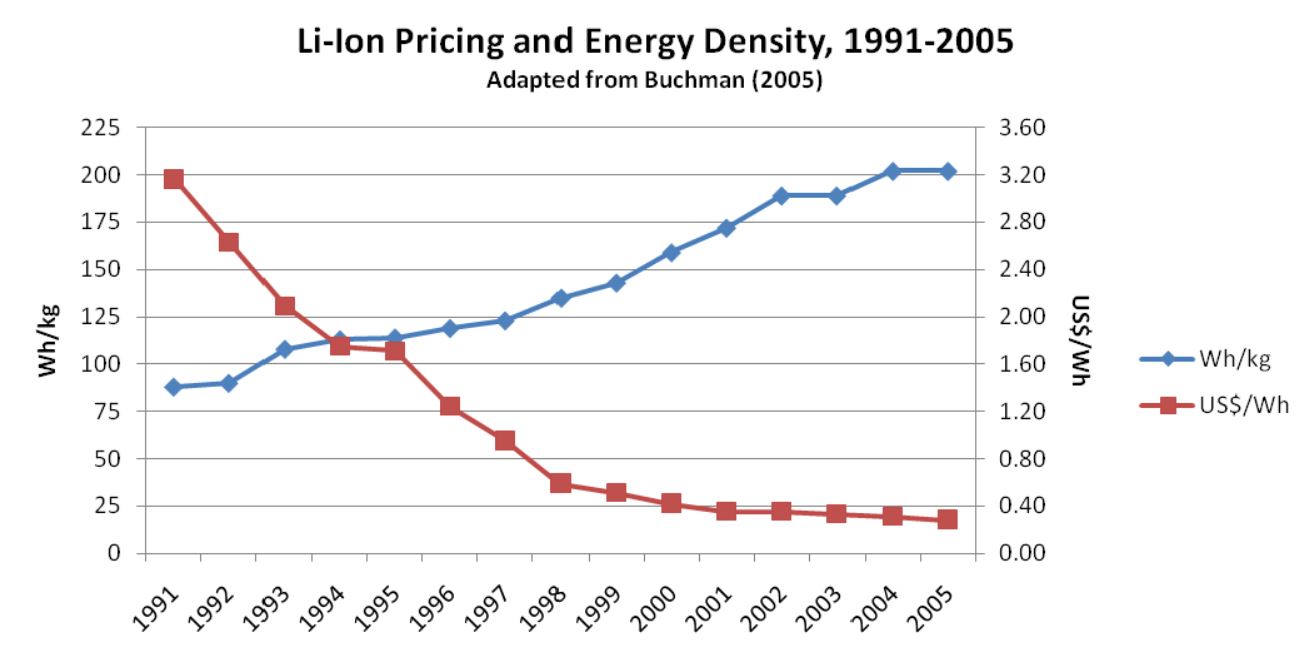 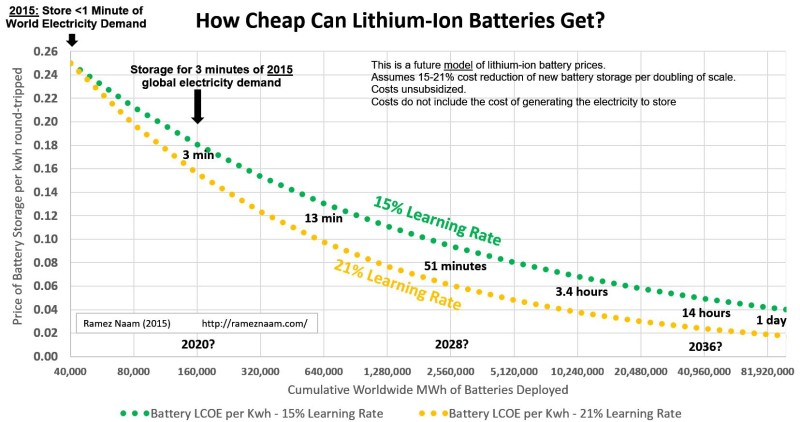 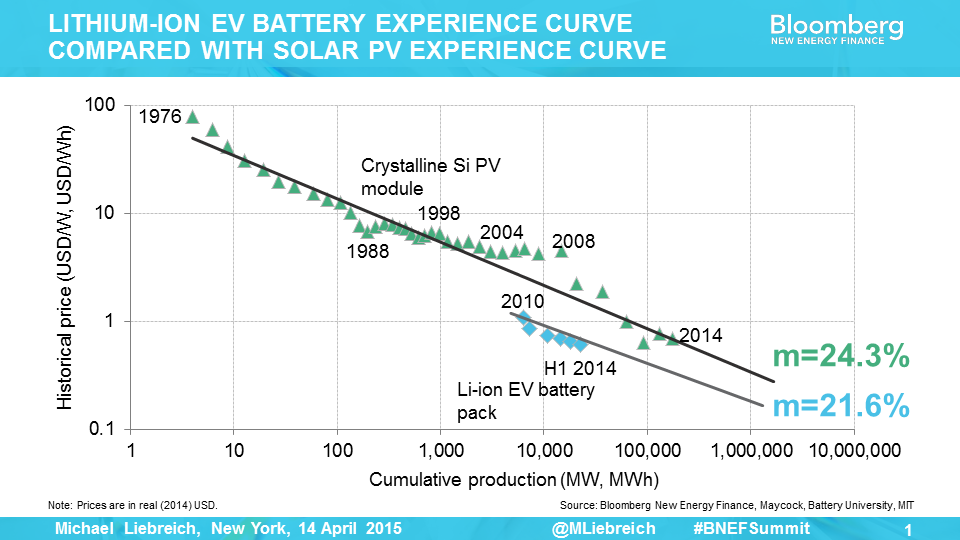 |
|
|
|
|
smartwall
Veteran Member
Posts:1209
|
| 12 Aug 2016 06:41 PM |
|
All this is great stuff, but back to my original point. Increase in population means increase in power need. The UN said 2 years ago, in order to combat global warming we need to get back to pre industrial revolution co2 levels. You first. |
|
|
|
|
| You are not authorized to post a reply. |
|
Active Forums 4.1
 |
Membership: |
 |
Latest:
croccohvacusa |
 |
New Today:
0 |
 |
New Yesterday:
0 |
 |
Overall:
35027 |
 |
People Online: |
 |
Visitors:
128 |
 |
Members:
0 |
 |
Total:
128 |
|
|
|