ricky_005

Basic Member

Posts:313
 |
| 13 Jul 2015 02:25 PM |
|
If constructing a 2x6 exterior wall in the south eastern US, why would you not utilize a staggered 2x4 studded wall design with 2x6 sill plate to eliminate bridging at the wall studs?
The labor and material cost is very minimal.
|
|
|
|
|
|
|
Dana1

Senior Member
Posts:6991
|
| 13 Jul 2015 03:53 PM |
|
For one, it doesn't "...eliminate thermal bridging...", it only reduces it and only reduces it at the studs, which is less than half the framing fraction. It does not thermally break stud plates or window/door headers, etc. that comprise the rest of the framing fraction, nor does it thermally break penetrating sub-floors and band-joists, etc.
For the structural studs to be 2x4s they have to be 16" o.c., whereas with 2x6 you can go 24", and you end up using about the same number of board-feet of framing lumber as a SINGLE 2x4 16" o.c studwall, with fewer boards to cut, and it'll have about the same structural capacity. Doubling up the number of studs is substantially more wood, using 24" o.c. spacing requires that both sets of studs be structural, and it's still a lot more wood, since there's a stud at least every 12", instead of every 16".
And, it requires you go with blown or sprayed insulation, not batts, since there is nothing designed to fit that non-standard cavity configuration.
I'm guessing that's why they don't build that way.
For the southeastern US, using an insulated structural panel like 1.5" ZIP-R sheathing on 2x6 24" o.c. studs with R20-R23 fiber cavity-fill thermally breaks ALL of the framing, and ends up being higher performance than 2x4 staggered-studs on 2x6 plates, with a lot less complexity. (And is dead-easy to air seal!) It's not exactly a super-insulated wall, but it's well above IRC code-min prescriptive R-value performance for US climate zones 3A & 4A, and 2x code min for walls in US climate zones 1A & 2A. ZIP-R on standard framing is a lot easier to build & insulate than a staggered 2x4s on 2x6 plates approach that delivers lower thermal performance.
One might be tempted to use nailbase roofing panels with even thicker foam, but that would require doing the engineering analysis and a fastener spec for the sheathing to be the structural shear-strength element, or you'ld have to install cut-in bracing or interior side shear panels at the corners to keep the thing from failing in a hurricane.
|
|
|
|
|
ricky_005
Basic Member
Posts:313
|
| 13 Jul 2015 04:40 PM |
|
I'm not a fan of advance framing but it does eliminate bridging at the studs by spacing them further apart. Guess I should have gave you the wall stack out to give you the whole picture. One Story home with 24" Soffit. - 1/2" Drywall
- Staggered 2x4 studs 16" O.C. with 2x6 plates
- Blown in insulation
- 5/8" Plywood Sheathing
- Liquid Applied Membrane
- 2" 1.5# EPS
- EIFS Finish
|
|
|
|
|
jonr
Senior Member
Posts:5341
|
| 13 Jul 2015 08:10 PM |
|
An alternative is 2x6 plates and 2x6 studs, 24" OC and a little more EPS. Or use 2x4 plates and 2x4 studs, 16" OC and much more EPS. Which is best - I'd want to know cost and R for each. I'd review the info here and consider a wall design that breathes reasonably well in both directions. |
|
|
|
|
ricky_005
Basic Member
Posts:313
|
| 13 Jul 2015 10:20 PM |
|
Here some rough numbers on the cost of materials only. 9' Exterior walls - 300 liner feet of double 2x4 stud wall 16" o.c. with 2x6 plates
$2021.00
- 300 liner feet of 2x6 stud wall 16" o.c.
$1951.00- 300 liner feet of 2x6 stud wall 24" o.c.
$1501.00
- 300 liner feet of 2x4 stud wall 16" o.c.
$1140.00
|
|
|
|
|
Dana1
Senior Member
Posts:6991
|
| 14 Jul 2015 05:27 PM |
|
How do you think you are going to blow insulation of consistent & correct density in a staggered studwall? With double-studwalls the usually have to partition them with blowing mesh to come anywhere close. MAYBE you can damp-spray cellulose or Spider in there and get it sorta-right and at least the adhesives may keep it from settling over time, but it's not a sure thing.
Staggered 2x4 studs 16" o.c. on a 2 x 8 bottom plate with 1/4" fan-fold XPS (detailed as an air barrier) between the stud rows would allow use of R15 rock wool or fiberglass batts on both sets of studs for cheap, and you'd end up at better than R20 whole-wall even without the R6 EPS. The inner studs would be non-structural, with only a single top-plate and could be on 24" spacing, the exterior wall structural, with doubled 2x4s, with only a few framing ties between the top plates of the two stud rows to keep them aligned. If you use only the interior studs for the wiring & plumbing runs the exterior batts can be as close to perfection as it can get with batts. With the 1/4" fan-fold separating the stud rows the nominal 2 x 3.5" of the 2x4s an plus the 1/4" XPS adds up exactly to the nominal 7.25" of a 2x8 sill plate. With the fan-fold in place you could also blow insulation into the exterior set of studs, followed by blowing in mesh on the interior set, if you preferred that to batts, since each set of studs would have discrete and isolated stud bays.
|
|
|
|
|
ricky_005
Basic Member
Posts:313
|
| 14 Jul 2015 06:32 PM |
|
Exterior walls would be netted and blow with fiberglass and dens packed. Spider would be my first choice in fiberglass for this application. Would love to use cellulose, but fear it would have a MUCH higher chance of settling at top of cavities than a dense packed fiberglass wall.
A 2x8 sill and top plate would be nice, but I think it would make it much harder to keep the sheathing warm in the winter time, would rather add more EPS on a 2x6 wall. Here is the south east we can have winter nights in the 20's for weeks at a time.
As for the stick framing and the back of sheathing it will be sprayed with a cheap Borax water mixture to help prevent mold growth etc. if those conditions where to occur in the future.
|
|
|
|
|
Liebler
Basic Member
Posts:334
|
| 18 Jul 2015 06:35 PM |
|
Ricky in your cost estimates you neglected what to me is the best option, 2 separate 2x4 24" OC walls. It should come out about $1500. To keep the sheathing warm, put it on the outer face of the inner wall. With mid wall sheathing it's best to stick with aligned studs. If you space the walls with a 2 1/2" gap from inner sheathing to outer stud line you can insulate with Roxul comfort bats and have an r30+ wall (r40 cavity)l that's 10" thick with a quality air barrier at the sheathing Cover the outside with Tyvec and apply vynil siding directly to the outer studs. |
|
|
|
|
jonr
Senior Member
Posts:5341
|
| 19 Jul 2015 12:23 PM |
|
I agree, a good way to avoid any issues with condensation on mold susceptible exterior sheathing is to not have any. Either by moving the sheathing inward (as above) or eliminating it (eg, foam exterior sheathing and diagonal steel strapping). |
|
|
|
|
ricky_005
Basic Member
Posts:313
|
| 10 Aug 2015 01:50 PM |
|
Keeping in mind the home would be in the hot humid rainy Atlanta Ga area. If I changed the wall stack out to included the Intello vapour retarding and air-proofing system on the interior, do you think the moisture levels can be controlled? I have read a few articles talking about the Intello system which claim the durability of thick highly insulated wall systems with no exterior foam insulation can greatly improve the durability of the wall system by reducing humidity in the wall cavities to a very safe level. One Story home with 24" Soffit. - 1/2" Drywall
- Intello vapour retarding system
- Staggered 2x4 studs 16" O.C. with 2x8 plates
- Blown in insulation
- 5/8" Plywood Sheathing
- Tyvek or equivalent air and water barrier
- 7/16” Cor-A-Vent Rain Screen or equivalent
- Hardie Fiber Concert Artisten Siding
Exterior sheathing and interior stud cavities treated with borax.
The objective is to reduce cost and improve efficiency at same time. I know if I used a typical two layer polyisocyanurate exterior sheathing with wood furring strips, I would not have the time to perform the work myself due to tight schedules during that stage of the build. I would essentially have to hire a sub to do the install and air sealing on the exterior. I'm also wanting to use the Hardie Artisten Siding which is twice the weight of the typical Hardie siding and want to eliminate the cantilevering of a typical thick exterior insulated sheathing system.
If I do blown in insulation and the Intello system with no exterior rigid insulation, I would have plenty of time to perform the install myself with a helper, therefore saving a nice sum of cash.
|
|
|
|
|
Dana1
Senior Member
Posts:6991
|
| 10 Aug 2015 02:18 PM |
|
Intello is great and all, but it's 3x the cost of MemBrain. In a GA climate the somewhat lower vapor permeance of Intello vs. MemBrain doesn't really buy you anything. Since the goal is to reduce cost, improve efficiency, and save time... Using 1.5" ZIP-R instead of standard CDX sheathing on standard 2x6 framing has about the same thermal performance as the staggered studs on 2x6 approach since it thermally breaks the subfloor & stud plates. It's a lot less framing time- it's half the number of studs and about the same number of board-feet of lumber, and has sufficient exterior R outside the fiber insulation to eliminate the rationale for interior side vapor retarders. You could also use R23 rock wool batts with that stackup (if you promise to be obsessive about the batt installation, tucking in all corners & edges, trimming & splitting around wires & plumbing rather than cramming, and tugging the surface out to be just proud of the interior stud edges before applying the next layer. You could use MemBrain detailed as an air barrier if you like, or detail the gypsum as an air barrier. With ZIP-R you can also skip the Tyvek. If you want more thermal break than that and don't mind the extra framing time, build with 1.5" ZIP-R, 2x4s w/R15 batts, insert a layer of MemBrain, then install 2x2s or 2x3s horizontally to the studs with split R15s compressed into the 2x2 cavities (or split R23s, if 2x3) "Mooney Wall" style. It's the same wall depth of a 2x6 + ZIP-R, but adds another R4-R6 or so of thermal break beyond the R6 of the ZIP-R. 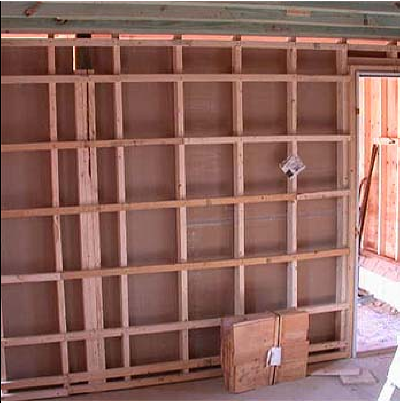 If you go with 2x3s you can use the 2x3 cavites as a wiring chase, reducing the number of penetrations of the MemBrain to detail. |
|
|
|
|
ricky_005
Basic Member
Posts:313
|
| 10 Aug 2015 03:05 PM |
|
Using the 1.5" ZIP-R as the sheathing would require a 4 1/2" long nail for Hardie Artisten Siding attachment? |
|
|
|
|
jonr
Senior Member
Posts:5341
|
| 10 Aug 2015 05:21 PM |
|
I'm interested in why ZIP-R wouldn't perform similarly to the low ranked sheathing over foam wall simulated in "rr-1014-high-r-walls-pacific-northwest-hygrothermal-analysis" (site seems to be down right now so I can't look). |
|
|
|
|
Dana1
Senior Member
Posts:6991
|
| 10 Aug 2015 05:23 PM |
|
Posted By ricky_005 on 10 Aug 2015 03:05 PM
Using the 1.5" ZIP-R as the sheathing would require a 4 1/2" long nail for Hardie Artisten Siding attachment?
I don't think so. It takes longer fasteners for installing the sheathing, but nothing unwieldy. If you're adding furring to establish the rainscreen (highly recommended) you can probably even skimp on the ZIP-R nails, since the screws necessary for the furring will exceed the mechanical strength of the nails. 1.5" ZIP-R is 1" polyiso factory-laminated onto 1/2" OSB sheathing, with the OSB on the exterior. If you install 1x4 furring to establish the rainscreen gap, the furring needs to be screwed to the studs 24" o.c. with 1.5" penetration of the studs with pancake-head timber screws. A 3.75" FastenMaster HeadLok or similar (about $111 for a bucket of 250 screws) would do it. Use 1x4 furring, not 1x3, and ONLY pancake heads, or the furring will split. You then nail the Hardie to the furring + OSB. If only 1.25" of furring + OSB is a problem for nail retention (I don't know that it is- consult Hardie), using ring-shank nails would be MORE than enough. |
|
|
|
|