rogerius

New Member

Posts:53
 |
| 09 Oct 2016 10:54 AM |
|
We are planning to build an ICF house in the spring of 2017. The house will be a bungalow with a basement with walk out; the frost depth in our area is 48”. Below I attached the wall height plan but still debating if I can pour it in 2 or 3 steps. I’m planning to go with Amvic 3.3 so the height of the form is 16”. I’ll need 16 rows in total, so if I’ll pour in 2 steps, I need to go above the first floor flooring level which will result in an over 14’ height wall. I’m concern about this height and I didn’t see anybody mentioning doing this. Is this doable?
The second option is to pour 6 rows then another 6 and the last 4. Is this a good idea? Any concern about cold seam in foundation? Pros, cons or any other idea is appreciated.
Thank you |
|
|
|
|
|
|
TexasICF

Advanced Member
Posts:622

|
| 09 Oct 2016 01:54 PM |
|
Rogerius,
I've been involved on countless NUDURA pours of 14-15 feet - generally, I don't like to go much above 16 due to consolidation challenges (you need internal and external vibration) - Proper consolidation is always the key. You'll need to do about 4 feet per pass to properly consolidate each pass. Smaller passes will dirty rebar too much.
I personally have not used Amvic but hear from installers that have that it is a pretty good block. You should be fine with two pours as you have defined ( with an experienced installer).
You didn't mention core size - I wouldn't do it with a 4 inch core. 6 inch core and above should be fine. A couple more things -- make sure your slump is 6-7, trucks are properly spaced (I don't know how large your pour is). Also make sure you have an experienced installer and that you vibrate -- and have safe and adequate and appropriate bracing). Put up all hand rails etc. as required. Be safe.
You also did not mention your rebar schedule which can sometimes be challenging enough to require smaller pours.
Regards |
|
|
|
|
TexasICF
Advanced Member
Posts:622
|
| 09 Oct 2016 02:10 PM |
|
Rogerius,
I did not see the attachment you refer to above. For a number of reasons (mostly consolidation) I suggest you not let anyone talk you into one pour. Reducing pump trucks costs are not worth the additional incurred challanges.
Regards |
|
|
|
|
rogerius
New Member
Posts:53
|
| 09 Oct 2016 08:25 PM |
|
Posted By TexasICF on 09 Oct 2016 02:10 PM
Rogerius,
I did not see the attachment you refer to above. For a number of reasons (mostly consolidation) I suggest you not let anyone talk you into one pour. Reducing pump trucks costs are not worth the additional incurred challanges.
Regards
Looks like I can load the file but I can't attach it to the post? Not sure why. It's just 63Kb.
I'm planning for 6" core size, and the house is just 1800sqft, around 180ft linear wall.
The biggest issue wich I see for me in pouring a 14' wall is properly bracing on the top. My bracing are just 10', so I need to build some extension!
Do you see any potential issue in having the foundation wall in 2 pours? Cold pour joint in the ground can be a problem in time? |
|
|
|
|
arkie6

Veteran Member
Posts:1453
|
| 09 Oct 2016 09:06 PM |
|
This is a basement wall pour correct? You mention 48" frost depth, but that would only be a concern on the walk-out side. On the non-walk out side of the basement, your footing could be at the same height as the bottom of your basement slab so your ICF wall on that side will be 9-10' high? I assume you would step your footings around the basement to maintain the 48" frost depth without digging any deeper than necessary. How do you typically do footings in your area? Around here, footings are typically dug 16"-24" wide with a backhoe to the required depth, horizontal rebar is placed as required and rebar grade pins are placed to set the top of the footing, and then the entire trench is filled with concrete. On the walkout side, you could do something similar with 4x8 sheets of rigid insulation placed on the outside of the trench for insulation and just extend your footing to the bottom of the basement slab. It would cost you a bit more in concrete than ICF on that side, but overall costs should be roughly a wash.
Also, do you have windows and doors on the walkout side of the basement? If so, you can and should fill part of your ICF wall on that side from openings in the bottom of the window bucks.
When I did my ICF build, I brought my footings up to the bottom of my walkout basement slab, but note that our frost depth is only 12" here. I then attached wood forms to the top of my footing and poured my basement slab. Then I built my ICF walls off the footing with bracing resting on and achored to the basement slab with tapcons. The cold joint between my ICF basement wall and footing occurred below my basement slab with perforated drain pipe and gravel installed on both sides of the footing. |
|
|
|
|
ronmar

Basic Member
Posts:479
|
| 09 Oct 2016 10:52 PM |
|
How much above the first floor level are you thinking?
I agree with Arkie, you could do the frost wall and stepped footing(taller footing on walkout side). A little more CC on the walkout side, but would probably break even on the cost not using ICF for that frost wall. This has the advantage of a level footing all the way around to stack the wall off of(simpler details) and two 10' ish sections of wall to pour(no modifying bracing). Your basement cold joint would be on top of a footing which is common.
Uuuh since this is a walkout I am assuming a basement CC slab? If so you are actually looking at 4 pours: 1.Footings. 2.Basement Wall. 3.Basement slab, and after floor system install and backfill. 4.Main wall pour... |
|
|
|
|
rogerius
New Member
Posts:53
|
| 10 Oct 2016 09:44 AM |
|
Great feedback guys.
Arkie gave an excellent idea about raising the walkout footing all the way to the basement floor. More CC then an ICF wall but will prevent issue later. Based on that I'll need to isolate better the basement slab from the footing to break the thermal bridge. The footing here is poured in forms with rebars and dowels as required; the inspector doesn't like the trench to be used as a form.
The basement wall will be 9ft and will be a CC slab in the basement with heat flooring (4"compressed ravel+4" EPS+foil+4" slab with PEX). In total will be 5 pours: footing + basement slab + basement walls + main floor walls + main floor slab (just 2" over the subflorr for floor heat).
Any trick/advice how to attach a picture? How I said, I keep the file small under 100K. I can loaded but I can't attach it. Can somebody try a test when reply at my post?
|
|
|
|
|
FBBP
Veteran Member
Posts:1215
|
| 10 Oct 2016 10:35 AM |
|
rogerius
Consider pouring the walkout portion with the footing pour, as in monopour. http://www.fab-form.com/fastfootMp/fastfootMpOverview.php
Probably not worth doing the whole house mono pour but can be quite cost effective for walkouts.
Another option is to do only 18" (or what ever height your block is) deep frost wall and then putting insulation out horizontally to get the required frost protection. Google frost protected shallow foundation. |
|
|
|
|
rogerius
New Member
Posts:53
|
| 10 Oct 2016 12:00 PM |
|
Posted By FBBP on 10 Oct 2016 10:35 AM
rogerius
Consider pouring the walkout portion with the footing pour, as in monopour. http://www.fab-form.com/fastfootMp/fastfootMpOverview.php
Probably not worth doing the whole house mono pour but can be quite cost effective for walkouts.
Another option is to do only 18" (or what ever height your block is) deep frost wall and then putting insulation out horizontally to get the required frost protection. Google frost protected shallow foundation.
Monopour the basement slab with the frost foundation can be an option but in that case the cold from the frost wall will be transfer direct inside to the slab so I'm thinking to isolate the slab from the frost wall to create a thermal barrier.
The second idea with pouring just one height of one ICF block and isolate well the footing, I don't think will be accepted by the inspector. The question will how he will know the insulation will be enough to prevent he frost to lift the walkout portion of the house. |
|
|
|
|
FBBP
Veteran Member
Posts:1215
|
| 10 Oct 2016 12:34 PM |
|
rogerius - you have not indicated where you are building so we don't know what code applies. Calling for four feet of frost protection would indicate northern states or Canada. The Canadian codes covers frost protected shallow foundations so the inspector should not have a problem with it.
You cannot practically monopour a basement slab to a frost walls as you will have the excavation to deal with. And as you say, it is a thermal bridge. You can monopour the frost wall with the footings. This would eliminate one pour or the tall wall scenario. Some people also crib up their footings, prefab the walk out frost wall block and as soon as the footings are poured, set the prefabbed section on the footing and pour it. If you have enough manpower on site, the pump does not have to wait. Either mono pour or prefab and wet set works well for this scenario as when the footings and frost wall are complete, the walkout excavation can be backfilled and then the main walls can be done as one level. Just 9 feet.
If you close in the building without doing the backfill, all this backfill will need to be done by hand unless your design has some big openings in it. We also normal place our underslab drainage materials after the footings are in place but before the walls are stacked. This way we can do it with a skid steer and you also have a nice clean site to stack your block. |
|
|
|
|
smartwall
Veteran Member
Posts:1209
|
| 10 Oct 2016 01:03 PM |
|
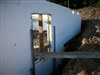
The picture with my post is a 4' frost wall and a 7 course foundation wall on top, poured with the footing and wall in one step. So you a have 13'4" pour. You pour the lowest point {door} first. By pouring the footing and wall together you take away the problem of graveling that is the main problem with tall wall pours. |
|
|
|
|
FBBP
Veteran Member
Posts:1215
|
| 10 Oct 2016 06:07 PM |
|
smartwall - how do you backfill the inside of the frost wall? |
|
|
|
|
smartwall
Veteran Member
Posts:1209
|
| 11 Oct 2016 09:05 AM |
|
You back fill after the wall is poured and the footing form is pulled. Is this a trick question? |
|
|
|
|
FBBP
Veteran Member
Posts:1215
|
| 11 Oct 2016 09:17 PM |
|
Posted By smartwall on 11 Oct 2016 09:05 AM
You back fill after the wall is poured and the footing form is pulled. Is this a trick question?
No not a trick question ;-) I just find it a pia to backfill and compact the excavation inside the building after the wall is up. Though maybe you had an ingenious solution for this problem. For us, it is cheaper to pay an extra pump charge to pour the footings and the walkout separate from the wall. This way we can get a skid steer in and backfill the excavation and install the underslab drainage stone, prior to stacking the walls. |
|
|
|
|
smartwall
Veteran Member
Posts:1209
|
| 12 Oct 2016 08:23 AM |
|
Almost every walk out I've been involved with was a sliding door. Back fill the door area and your skid steer is in the building. You can skip the extra drainage step by using Form a Drain like I use. I wouldn't build a house for myself without it. Too much radon in the area of upstate NY that I cover. Again another step skipped. Just trying to save time which saves money. If we pour the floor along with the footing and wall with one pour, then we use Form a Drain. |
|
|
|
|
FBBP
Veteran Member
Posts:1215
|
| 12 Oct 2016 09:49 AM |
|
Yeah but we require a minimum of 4" of drainage rock under the whole slab for soil gas mitigation so just forma a drain would not cut it. Also the evacuation point has to be right under the slab and pull from the middle of the house so anything happening four feet down doesn't work.
We never use sliding doors as they leak like sieves after the first year. |
|
|
|
|
smartwall
Veteran Member
Posts:1209
|
| 13 Oct 2016 08:49 AM |
|
Since most excavators cut the floor material to the level of the bottom of the footings I would love to get away with 4" of stone under the floor it's usually 8" or 10". I'm not sure what your 4' down means. |
|
|
|
|
emmetbrick
New Member
Posts:90
|
| 06 Dec 2016 09:08 AM |
|
I'm not sure of your situation but in our area when a customer has a walkout/frost wall condition, I advise them to pour the frost wall separate from the above walls. There are two ways we can do this. First if they can pour it directly out of the truck, we do it the day after we pour the footings. If this can't happen, rather than to incur another pump truck cost. We pump the lower footings and as we are pouring the rest of the footings we "wet set" the ICF frostwall and finish pouring it prior to the pump leaving job site. It takes a little pre-planning but it works pretty well. |
|
|
|
|
newbostonconst
Advanced Member
Posts:778
|
| 07 Dec 2016 10:58 AM |
|
From memory, when installing horizontal insulation for a frost protected footing the code shows no insulation under the interior slab. I am guessing this is to help provide heat keep the ground under the footing from freezing. Not sure horizontal insulation on both sides of the footing will protect it from freezing. |
|
| "Never argue with an idiot. They will only bring you down to their level and beat you with experience." George Carlins |
|
|
newbostonconst
Advanced Member
Posts:778
|
| 07 Dec 2016 10:58 AM |
|
From memory, when installing horizontal insulation for a frost protected footing the code shows no insulation under the interior slab. I am guessing this is to help provide heat keep the ground under the footing from freezing. Not sure horizontal insulation on both sides of the footing will protect it from freezing. |
|
| "Never argue with an idiot. They will only bring you down to their level and beat you with experience." George Carlins |
|
|