rszimm

New Member

Posts:29
 |
| 15 May 2020 11:44 PM |
|
OK, so I've got my walls stacked, all the rebar in, etc. I'm ready to pour. I've been checking plumb as I stacked, but I had always been checking at the back of the brace at about 5' off the ground. I happened to throw a level on the brace as I was up on the planks and noticed it was off. Odd I thought. Then I looked down the back of the brace and noticed a definite bow right where the support for the planks attaches to the diagonal kicker. I could also watch and see it flex a little bit as I put my body weight on the platform directly above the brace. Finally, I noticed that there are three braces that don't have any weight on the support (planks just laid out that way) and those ones are dead straight.
So what do I do? FYI, I put up two rows of planks (standard OSHA 8' planks) and a handrail because my wife and I felt a bit more confident with the extra walking area and the handrail there. However I'm now thinking that may have been a mistake as it's putting a lot of weight on the braces.
Is this normal? I was thinking of shimming between the brace and the wall to account for the bow, or maybe just remove the second row of planks and handrail. |
|
|
|
|
|
|
rszimm
New Member
Posts:29
|
| 16 May 2020 12:19 AM |
|
To quantify how much bow there is. With someone standing on the plank the 10' braces see about 0.180" (approx 3/16"), the 12' braces see about 0.255". Without someone standing on the plank you're at about 0.080" on the 10' and 0.110" on the 12'. |
|
|
|
|
sailawayrb

Veteran Member
Posts:2283

|
| 16 May 2020 01:04 AM |
|
Something isn't right. We use braces with steel strongbacks (Nudura) and we have never seen any bowing with double plank walkway and handrails. What are you using for braces? Photos? |
|
| Borst Engineering & Construction LLC - Competence, Integrity and Professionalism are integral to all that we do! |
|
|
rszimm
New Member
Posts:29
|
| 16 May 2020 12:06 PM |
|
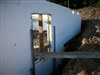
The 10' braces are these. The 12' braces are big steel things where the kicker and the plank support all fold down inside the steel channel for transport. I'll see if I can snap a photo of those today. The way all these things seem to be designed, the plank platform creates a moment right in the middle of the brace. I find it difficult to imagine there NOT being at least a little bow. |
|
|
|
|
smartwall
Veteran Member
Posts:1209
|
| 16 May 2020 02:27 PM |
|
Are the blocks plumb? Is the top of the wall where it should be? Is your exterior string line where you want your final wall to be? I've had bracing bend but I usually check the straightness of the strong back before I install. When they go out for rental the get abused and have to be adjusted. If the top of the wall is impacted you can add more screws and ease back on the top of the wall screws and ditch the railing and extra plank you don't need them for pouring, don't tell OSHA but I never used them. Also don't screw the plank to the underside of the plank bracket it makes it hard to adjust the wall. Now you know why I brace from the outside, among other reasons. |
|
|
|
|
sailawayrb
Veteran Member
Posts:2283
|
| 16 May 2020 03:19 PM |
|
Those braces look fine, but maybe the steel strongbacks are not as thick/robust as the Nudura braces we use. Or maybe they were damaged and bowed to begin with as Smartwall cautioned. I assume you screwed the strongbacks to the ICF block studs as called for. Once there is concrete in the wall and there is no one standing on the walkway while the concrete cures, I think you will be fine. The important thing is to make sure your walls end up plumb, straight and square after you are all done. |
|
| Borst Engineering & Construction LLC - Competence, Integrity and Professionalism are integral to all that we do! |
|
|
arkie6
Veteran Member
Posts:1453
|
| 17 May 2020 04:26 PM |
|
Are you going to frame the interior walls with wood or steel studs? If so, buy some now of the correct length for your interior stud walls. Stand a stud up vertically adjacent to each ICF brace kicker and screw it to the outside edge of the walk plank or the handrail, whichever fits better. This will prevent downward deflection at that point when a person is standing on the walk plank at that point. When done with the pour, the studs will be reused for the interior stud walls, so there is no waste other than the little time it took to install and remove the studs from ICF braces. |
|
|
|
|
rszimm
New Member
Posts:29
|
| 17 May 2020 11:33 PM |
|
The interior walls will be drywall direct to the FoxBlock.
The blocks are as plumb as I can make them given that the braces are bowed a bit. The tops are where I want them with the stringline, but I can visibily see the wall bow inward as I walk down the planks (especially if I concentrate my weight on the outside near the railing). I didn't check the plumbness of the braces before installing, but given the two braces that have zero weight on them are dead straight, I'm willing to assume that the braces were plumb before putting weight on them.
So I'm thinking I might try plumbing the walls on pour day while trying to minimize the weight on the planks. Although it occurs to me that the walls will be quite a bit more rigid once they're filled with concrete (even though it's fresh), so I'm guessing they won't bow much when I put weight on the planks. I'm |
|
|
|
|
arkie6
Veteran Member
Posts:1453
|
| 18 May 2020 05:12 PM |
|
I was talking about the interior room partition walls. Is this a home or a completely open structure such as a shop or warehouse? |
|
|
|
|
rszimm
New Member
Posts:29
|
| 18 May 2020 08:10 PM |
|
Oh. It's mainly a shop. There's two short walls in the corner to frame out a bathroom. Those are framed with wood. I understand what you're saying now that I re-read it. That's a great idea. It might be a bit tricky given I don't have a pad yet, so I'll be standing against dirt with the stud. Won't that make adjusting the walls on pour day a bit trickier? |
|
|
|
|
arkie6
Veteran Member
Posts:1453
|
| 19 May 2020 12:12 PM |
|
I would wait until you have the wall plumb, straight, and string lined and just before the pour to place the vertical support studs. I'm assuming the wall braces spring back to vertical if you aren't standing on the walkboards? If you have the ground prepared (smooth and flat and maybe even lightly tamped or a brick or patio block to set the stud on), I can't imagine it taking more than an hour to place and secure the studs in place. That way the wall won't be moving during the pour while there may be multiple people on the walkboards at any given time. Even with the studs in place, I would bet you could still adjust the top of the wall +/- 1/4" or so in or out with kicker braces if needed, and if necessary, remove the screw holding the stud to the walkboard long enough to make an adjustment and then screw it back in if you will be getting back up on top of the walkboards. A 1/4" impact driver would make this quick work. |
|
|
|
|
ICFBdr

Basic Member
Posts:238
|
| 20 May 2020 05:50 PM |
|
From the pics of the braces you sent it looks like there are 2 potentially issues causing your problem:
1) Channels are simply too light gauge - most ICF channels are fairly robust meaning they will not flex under normal conditions (ie, force of wind, weight of installers on catwalk, etc)
2) It looks like the catwalk is attached to the channel above the point where the turnbuckle is attached (correct me if I am wrong). This would cause the channel to pull from the wall from the weight of the installer (pivot point would be just below the catwalk bracket where turnbuckle is attached to channel). It would be better to have the catwalk and turnbuckle attached on the same pin/bolt. This way the force of the catwalk bracket is not fully absorbed by the channel, but will be transferred down the turnbuckle. |
|
|
|
|
Chris Johnson

Advanced Member
Posts:878
|
| 20 May 2020 11:17 PM |
|
I went through the same issue with Reachcraft way back in the early 2000's, their braces are light, but without the additional bent lip on the front side they are weak and aren't heavy duty enough for my liking
If you have to do any serious pushing/pulling during the pour, it will be a challenge, just keep checking as you pour and keep the wall straight
Keep in mind a mm one way or the other is acceptable, definitely straighter then wood framing, any minor bow/deflection like that will disappear with drywall/stucco/etc |
|
| Chris Johnson - Pro ICF<br>North of 49 |
|
|
justdave
New Member
Posts:1
|
| 24 Sep 2020 09:46 PM |
|
So how did the pour go?
From my understanding is you want the wall plumbed in just slightly and once pumped in you push the wall to plum, VS trying to Pull the wall. |
|
|
|
|
ICFconstruction
Veteran Member
Posts:1324

|
| 30 Sep 2020 12:32 PM |
|
I could have guessed it was PanelJack, although others can bow, especially aluminum and tall walls with someone on the scaffolding bracket. We noticed it years ago, we put our braces closer together, lean them in, then when you push them plum, no more bow. |
|
| Brad Kvanbek - ICFconstruction.net |
|
|
smartwall
Veteran Member
Posts:1209
|
| 30 Sep 2020 01:17 PM |
|
One reason I have started to switch to zonts and zuckles is the fact that you can put the diagonal support at the top of the wall where it's needed. All other bracing systems attach the leg below the platform bracket so your trying to keep the bracing from bending with the most important part of the system 3' to 4' below where it's needed. It's amazing that you can get better results from 2x4's |
|
|
|
|
smartwall
Veteran Member
Posts:1209
|
| 30 Sep 2020 01:27 PM |
|
I have to correct myself. The Plumwall all in one system attaches the brace to the end of the plank bracket which is better. The Zont and Zuckle system is still better. |
|
|
|
|