NewHoosier2

New Member

Posts:24
 |
| 15 May 2016 01:42 PM |
|
A not yet built area that will be about 21x45 feet and very likely will be heated by a natural gas unvented wall heater.
a] What is the best location for a wall mounted natural gas heater?
b] The best location for a (ceiling) fan to mix hot and cold air?
Placing the heating halfway of the 45ft wall looks like the most common placement but I can imagine that smart use of fans may change that.
I'm thinking about something like the following setup but have no idea it actually works....
The heater on the 21ft wall.
A ceiling ventilator on the other end of the room that blow the hot air down. Perhaps that causes some sort of airflow over the whole area with also completely open. (pool table chairs, tables, cabinets against the walls)
Or is the best way simply placing the heater halfway the 45ft wall and 3 or 4 ceiling fans?
The room will only be occupied part of the day.
The time likely varies a lot. Like 2-12 hours.
What will be the most energy efficient way to heat this room?
When not occupied allow the temp to drop to 40F?
The building will be 2x4 framed so the thermal mass is very low. |
|
|
|
|
|
|
jonr

Senior Member
Posts:5341
|
| 15 May 2016 10:44 PM |
|
IMO, unvented is a horrible idea - nobody should be breathing that stuff. Use direct-vent.
If you need a fan at all, have it blow on the heater and avoid having it blow on people (ie, maximize mixing/dilution, minimize drafts). |
|
|
|
|
Dana1
Senior Member
Posts:6991
|
| 16 May 2016 02:10 PM |
|
Placing the wall furnace near the point of biggest heat loss is typically the best compromise, since it reduces cold spots and cold drafts. That location is typically near or under large windows.
Ceiling fans break up stratification, but induce wind-chill, and are a lousy solution in occupied spaces.
A 1-ton Fujitsu 12RLS3H mini-split can probably heat this place just fine, and has a "minimal heat" mode for holding the line somewhere in the 40s F for freeze control, and it would not have the indoor air pollution & humidity issues of an unvented fossil-burner. If a floor unit (sort of looks like a wall furnace) is preferable, the AGU12RLF would work as well or better in heating mode than a wall coil type. With a mini-split it's more efficient to "set and forget" if the space is going to be used within the next 12-24 hours. A mini-split has the benefit of high efficiency air conditioning as well, assuming the place might be in use during the summer.
|
|
|
|
|
NewHoosier2
New Member
Posts:24
|
| 17 May 2016 07:39 AM |
|
I'm aware fans cause a draft which indeed isn't comfortable. But unmixed air might cause hot and cold spots in the room, which isn't comfortable either. BTW don't mini-splits cause a draft too?
Good point about humidity of an unvented heater. The reviews about those little $200 wall heaters are good. I wonder why nobody mentions the humidity issues...?
I've considered, and still am considering, a mini-split. The problem is $$$. This is a low budget project. For example all wood and boards for the framing is free. Trying to find good polyiso boards for cheap/free.
Right now I want to use 2" poluiso on both sides of the framing. Good choice?
I've been looking into sips but their new price seems to be a secret and I can't find any reclaimed or factory seconds.
Another major problem for me is calculating the BTUs for the mini-split. I know there are all sorts of fancy programs which I don't master. And even if I don't I wonder they would be of much value. We have reclaimed windows and doors. They are double pane and in good state but I know nothing about the R-values.
Good programs usually use weather data etc. Very useful if the house is occupied at night when it usually is coldest. In my situation the building won't be occupied at night. Likely is only occupied 11a-11p or less.
Meaning it's no issue the heating of any type can't handle the very cold nights. A simple electric/gas heater may be a backup solution is extreme situations.
|
|
|
|
|
jonr
Senior Member
Posts:5341
|
| 17 May 2016 09:08 AM |
|
Insulate and air seal the building reasonably well and in your open room, the heat will distribute itself.
Not clear how many people will be in there and what they are doing, but in all cases, provide ventilation air (perhaps 15 cfm per person). |
|
|
|
|
Bob I

Veteran Member
Posts:1435
|
| 17 May 2016 12:38 PM |
|
"BTW don't mini-splits cause a draft too? "
yes! Don't install them 3' away from your dining table, but over 6' there really isn't much of a "breeze". |
|
| Bob Irving<br>RH Irving Homebuilders<br>Certified Passive House Consultant |
|
|
Dana1
Senior Member
Posts:6991
|
| 17 May 2016 03:50 PM |
|
Mini-splits modulate the cfm with load, and are usually running on "low", which is about the same amount of breeze you get out of your refrigerator's external coils when it's running.
No whining ! Calculating the heat load isn't rocket science! How were you intending to size your gas-chamber-of-horrors unvented fossil burner?
A 2x4 /R13 wall loses about 0.1 BTU/hr per square foot per degree of difference. (That's called it's "U-factor" or "U-value". A clear glass double pane about U0.5 (0.5 BTU/hr per square foot). An attic with R30 of fluff runs about U0.035 (0.035 BTU/hr per square foot per degree F). If it's cheapo R19s in 2x6 joists, blow 3-5" of cellulose on top of it, rake it smooth, and call it R30.
In Indiana the 99% outside design temps are above zero everywhere, and above 10F in many locations, but for yuks call it 0F, witn an indoor design temperature of 70F, which is a 70F difference.
You have about 1000 square feet of attic, x 0.035 x 70F= 2450 BTU/hr of attic losses.
You have about 130 feet of perimeter wall, and assuming 10' walls that's 1300 square feet of wall x 0.1 x 70F= 9100 BTU/hr of wall losses.
Assuming 150 square feet of U0.5 windows & door that 5250 BTU/hr of window & door losses.
Add it up and you're at 16,800 BTU/hr. Throw in a 25% fudge factor for slab losses and air infiltration and you're at 21,000 BTU/hr. That's about the output of a 1,25-1.5 ton mini-split at max speed.
Odds are your actual outside design temp is quite a bit warmer than that (or at least during the hours you would be using it), and you may have less window area or better windows than that. If your windows are U0.35 code-min that knocks over 1000 BTU/hr off the window losses. If your outside design temp is more like +10F (say Jeffersonville), your temperature delta is 60F not 70F, and the design load is more like 18,000 BTU/hr, which is roughly the max output of 1 ton mini-split @ +17F outdoors.
I haven't even bothered to subtract out the window & door area from the wall figures, but you should. Run some numbers, with and without the infiltration fudge-factor. If you want to get better U-factors, tell me what the exact wall layer stackup is from exterior paint to interior paint, and actual ceiling insulation depth.
You can get the components for installing a pretty-good 1 ton LG mini-split with reasonable capacity at +10F for about $1.5K, (and pay a refrigeration tech to do the final charging and test.) A 1-ton Fujitsu 12RLS3 would run about $2K for a mostly DIY install, but would be more efficient, have more low temp capacity and would probably be more reliable.
|
|
|
|
|
NewHoosier2
New Member
Posts:24
|
| 17 May 2016 05:38 PM |
|
"No whining ! Calculating the heat load isn't rocket science! How were you intending to size your gas-chamber-of-horrors unvented fossil burner?
No calculations. There is only a $39 price difference between a 10k and 20k BTU wall furnace. So I would take the bigger one. The price difference between two mini-splits of that size is much bigger.
" tell me what the exact wall layer stackup is from exterior paint to interior paint, and actual ceiling insulation depth."
I can't because the final design isn't fixed yet. Input from this forum will be part of the design.
Anyway the plan as it is right now:
Siding, 2" polyiso, 2x4 frame with likely no insulation between it, 2" polyiso, wallpaper.
I haven't really thought about the ceiling yet.
The floor is concrete (existing) |
|
|
|
|
jonr
Senior Member
Posts:5341
|
| 17 May 2016 09:22 PM |
|
Not heating all the time greatly increases the BTU needed (you want fast warm-up). Luckily, this is cheap to do with nat gas. |
|
|
|
|
NewHoosier2
New Member
Posts:24
|
| 18 May 2016 07:22 AM |
|
Posted By jonr on 17 May 2016 09:22 PM
Not heating all the time greatly increases the BTU needed (you want fast warm-up). Luckily, this is cheap to do with nat gas.
I'm wondering if that decreases the efficiency of a mini-split. Obviously it varies with outdoor temperature but I'm wondering how running the mini-split at full capacity for an extended period of time to 'quickly' reach 70F.
How long does it take to increase the temp with 25F?
Do mini-splits usually have timers so I can program them?
My own house has a learning thermostat. I just enter at what time I want a certain temp and the thermostat calculates when should start heating.
A nat gas heater would indeed be helpful in this case. Obviously you mean a vented heater :-) I haven't found one below $800. That's a big extra on a low-budget project. That $800 also buys quite a bit of electricity for the mini-split during the time it runs at max.
Ignoring the fact that mini-splits also can cool would a vented natural gas heater be a better option for my project? |
|
|
|
|
jonr
Senior Member
Posts:5341
|
| 18 May 2016 01:33 PM |
|
As Dana says, if you go with a mini-split, you probably want to set-and-forget, at least in colder weather (where there is little reserve capacity). You would need all the numbers to calculate which is less expensive (oversized nat gas + large setback vs. heat pump and little to no setback). My guess is that nat gas wins.
$2K (or $1200 net) saved by not getting a mini-split buys quite a bit of nat gas. |
|
|
|
|
Dana1
Senior Member
Posts:6991
|
| 18 May 2016 02:35 PM |
|
Posted By NewHoosier2 on 17 May 2016 05:38 PM
"No whining ! Calculating the heat load isn't rocket science! How were you intending to size your gas-chamber-of-horrors unvented fossil burner?
No calculations. There is only a $39 price difference between a 10k and 20k BTU wall furnace. So I would take the bigger one. The price difference between two mini-splits of that size is much bigger.
" tell me what the exact wall layer stackup is from exterior paint to interior paint, and actual ceiling insulation depth."
I can't because the final design isn't fixed yet. Input from this forum will be part of the design.
Anyway the plan as it is right now:
Siding, 2" polyiso, 2x4 frame with likely no insulation between it, 2" polyiso, wallpaper.
I haven't really thought about the ceiling yet.
The floor is concrete (existing)
If your heat load is 15-18K and you're using deep setbacks you'll need a heluva lot more than 20K of wall furnace to have
reasonable recovery ramp times. It's never a good idea to specify the mechanical systems before you've finished designing the thermal envelope and run at least the crude load numbers. Putting polyiso on both sides of a studwall is bad practice, since it creates a moisture trap surrounding the moisture-susceptible wood. Any moisture that finds it's way in can't leave in a reasonable amount of time and it'll be susceptible to mold/rot. A comparable performance and cheaper wall would be: siding | 2" polyiso | housewrap or #15 felt | 1/2" OSB/ply sheathing | 2x4/R13-kraft or unfaced | 1/2" wallboard | latex paint or wallpaper (but not foil or vinyl wallpaper) A kraft faced batt is a "smart" vapor retarder that becomes vapor open if the moisture inside the studwall is high enough to support mold, and 2" of exterior polyiso is sufficient for dew point control at the sheathing even for a high occupancy rate building. There is no moisture trap, and the average temp at the sheathing when occupied will be above the dew point of the conditioned space air, making it fairly moisture-resilient. The U-factor of that wall stackup comes in at around U0.050 BTU/hr per square foot per degree (About R20 "whole-wall" ), which is literally half the wall losses previously estimated, which means you may be able to get by with an 3/4 tonner if you don't have a square mile of sub-code windows. Insulating the slab edge will also be important. Code min for zones 4A (southern IN) or 5A (northern IN) is the same R10 foam down to 2' below grade. The cheapest way to go is 2.5-3" of EPS with Quikrete Foam Coat to protect it. You can't use polyiso below grade, so you'll have to use some EPDM flashing tape for less thermally conductive Z-flashing so that the housewrap/felt drains to the exterior of the EPS. If the windows are mounted "outie" with the glass roughly co-planar with the siding rather than the sheathing, the housewrap goes on the exterior of the polyiso, with the window flashing properly lapped to it. Indiana has pretty cheap electricity, and running a Fujitsu in "minimum heat" mode delivers much higher than the nameplate HSPF of 14 efficiency, due to the smaller average temperature difference between indoors & outdoors. An HSPF of 14 means it delivers 14000 BTU per kwh of power over an average season with normal indoor temps in a zone 4 climate. But at 50F indoors it'll beat that (by a lot!), even in a zone 5 climate. I'll bet it's competitive with natural gas on average operating cost, but not necessarily lower carbon, at least not yet. But unlike a wall furnace, it can also air condition. Using a standard metric of million BTU (MMBTU), that's 71kwh/MMBTU, which at the IN average residential retail price of 10.5 cents/kwh that's about $7.45/ MMBTU, or the equivalent of ~75 cents/therm for a 100% efficient gas-burner. And it'll actually do better than that if a significant fraction of the time it's operating in minimum-heat mode. A mini-split running at full-on during a recovery ramp delivers 7000-8500BTU/kwh depending on the outdoor temperature, which is roughly half it's average efficiency while modulating, and that's why you don't run it on timers or use setbacks if you're expecting to be using the space within the next dozen hours or more. But if leaving it for a day or more the savings of a deep setback are enough to make up for the lower efficiency during the recovery ramp. During the shoulder seasons when it's 40F or higher outside it's almost never an advantage to set back even if it's going to be unoccupied for a couple of days, since with the warmer temps the modulating efficiency soars to well above the HSPF average. |
|
|
|
|
NewHoosier2
New Member
Posts:24
|
| 18 May 2016 07:26 PM |
|
"Insulating the slab edge will also be important."
That might cause a problem because it's an existing slab of a former garage. No insulation at all. The plan is using tiles (we have most very cheap). I think tiles on foam isn't going to work.
"You can't use polyiso below grade"
The concrete floor is a little above grade with a 4" high concrete 'wall' on it. So the polyiso walls will be well above grade.
"Code min for zones 4A (southern IN) or 5A (northern IN)"
I'm on the border of climate zone 4 and 5 according to this map:
https://cdn2.hubspot.net/hub/88935/file-30568645-jpg/images/iecc-climate-zone-map-energy-code-warm-moist-line-800.jpg
I'm on the border of climate zone 2 and 3 according to this map:
http://energyiq.lbl.gov/EnergyIQ/images/climzonenew.gif
"siding | 2" polyiso | housewrap or #15 felt | 1/2" OSB/ply sheathing | 2x4/R13-kraft or unfaced | 1/2" wallboard | latex paint or wallpaper (but not foil or vinyl wallpaper)"
I just accept that the above is 100% correct for regular priced polyiso; which is about $31 for a 2"x4'x8' board.
I can get factory seconds for $18.
http://www.discountfoaminsulation.com/
Or a little cheaper but I'm not sure about the quality, but would be ideal because they also sell shingles.
http://www.discountinsulation.net/insulation-board.html
What about 4" polyiso on the outside and drywall on the inside? I must add we have lots of plywood for free so I would prefer to use that instead of drywall but I guess that will trap vapor. |
|
|
|
|
NewHoosier2
New Member
Posts:24
|
| 18 May 2016 10:11 PM |
|
Posted By jonr on 18 May 2016 01:33 PM
As Dana says, if you go with a mini-split, you probably want to set-and-forget, at least in colder weather (where there is little reserve capacity). You would need all the numbers to calculate which is less expensive (oversized nat gas + large setback vs. heat pump and little to no setback). My guess is that nat gas wins.
$2K (or $1200 net) saved by not getting a mini-split buys quite a bit of nat gas.
Indeed. Is the added bonus of cooling worth it..
Spending a little extra on insulation may mean a smaller and cheaper mini split might make the choice easier.
Another option may be a backup electric heater for the coldest month. That way I may need lower tonnage. I've seen a few $900 mini-splits (Pioneer). That's close to the price of a vented nat gas stove.
OTOH I likely can get a used nat gas stove for much less.
The mini-split comes with additional cost because I have to hire a tech to hook up de refrigeration line. |
|
|
|
|
NewHoosier2
New Member
Posts:24
|
| 19 May 2016 07:35 AM |
|
Do nat gas stoves require a drain for water?
My central heating at home is so efficient that the used air that goes out the chimney is so cold it hardly can 'carry' water vapor. Most of the water just drips into a drain pipe. |
|
|
|
|
Dana1
Senior Member
Posts:6991
|
| 19 May 2016 04:06 PM |
|
Slab edge foam is on the exterior, not under the slab, and not between the slab and the finish floor. Whether grade-beam or stem wall with footing, the insulation goes between the edge of the concrete down into the dirt by at least two feet:  The D.O.E. zone map is the only one used by the IRC building codes:  Using 4" of polyiso on the exterior with or without cavity fill fluff is just fine. Installing foam that thick usually requires 1x4 furring through-screwed to the studs with 6"-7" pancake head screws 24" o.c. hanging the siding on the furring. The screws get to be more expensive as the foam gets thicker, so even at $18/sheet it may be cheaper overall to go with contractor-roll R13s in the cavities, and only 2" on the exterior. Some good tips on installing exterior foam (including links to many details) lives here.Plywood & OSB are not a vapor barriers, they are "smart" vapor retarders the become more vapor open if the humidity rises to mold levels and cannot create a moisture trap on their own. Thus it's fine to use plywood on the interior instead of drywall: 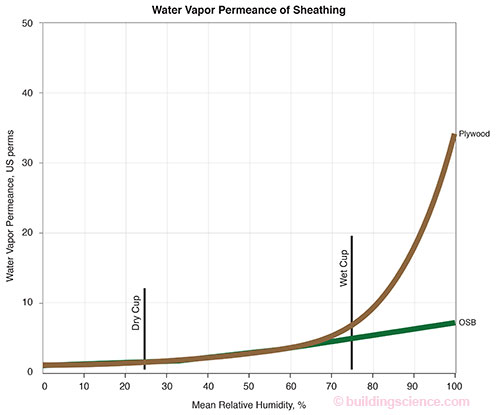 |
|
|
|
|
NewHoosier2
New Member
Posts:24
|
| 19 May 2016 05:58 PM |
|
Good news about plywood on the interior wall.
The drawing shows polyethylene and granular capillary breaks. The floor is existing and very likely has no such thing. I have no way of checking it. I just assume because it's a very simple garage floor.
No grade beam. The floor is 7" thick everywhere. No under grade beam.
So there is nothing to insulate for most of that 2 ft insulation.
So I fear the floor will be cold and damp.
Tiles may fix the damp but not the cold.
It's not only my project.... but I'm thinking about covering the floor with plastic. Perhaps a thin layer of insulation and put a carpet in.
"so even at $18/sheet it may be cheaper overall to go with contractor-roll R13s in the cavities, and only 2" on the exterior."
But the R-value would be quite a bit lower I guess. The wood acts as thermal bridges. The bats hardly ever fit exactly. They tend to sag. So an overall a lower R-value.
Of course everything is a trade-off between cost and energy efficiency.
BTW ignore the size of the building in my first post. Likely it will get quite a bit bigger.
|
|
|
|
|
NewHoosier2
New Member
Posts:24
|
| 19 May 2016 05:58 PM |
|
Please tell me if my calculation is correct.
http://www.builditsolar.com/References/Calculators/HeatLoss/HeatLoss.htm
Nat gas.
1200 sqft
R13 walls and ceiling.
All other value's are the defaults.
$1159/year.
Both R values 6 = $1612
Both R values 9 = $1332
Both R values 13 = $1159
Both R values 26 = $965
Both R values 40 = $898
I'm not considering the extreme values... :-)
Above R13 the earn back period for the extra insulation gets quite long when using natural gas because during unoccupied times the temp is allowed to drop to a value the model used on that side very likely doesn't use. Meaning the difference between fuel costs drops. And the earn back period gets very long.
With a mini-split that's less so if I understood correctly.
The uninsulated R-2 floor is a major concern. |
|
|
|
|
chrs

Basic Member
Posts:136
|
| 19 May 2016 10:26 PM |
|
The uninsulated floor is not only a problem for heat loss steady state--the 7" thick slab's thermal mass will also be a problem for rapidly raising the temperature after you've let it drop while you are away. So I think it's worth looking at insulation over the slab. The usual would be 2" of EPS foam followed by 3/4" plywood or osb sub floor, followed by whatever finish floor you like. You can also put a poly vapor barrier between the slab and the EPS. |
|
|
|
|
NewHoosier2
New Member
Posts:24
|
| 20 May 2016 06:55 AM |
|
" followed by whatever finish floor you like"
Also tiles? The floor you suggested looks a little 'flexible'. I fear the tiles will crack.
Can I also use XPS or polyiso instead of EPS? If the amswer is yes I'll get what's cheapest. |
|
|
|
|