|
|
jonr

Senior Member

Posts:5341
 |
| 20 May 2016 11:12 AM |
|
You can also put down foam and them pour more concrete over it and acid stain it. But thermal mass would remain an issue.
My WAG based on very little data is that it would take > 500 pounds to possibly crack a 12x12 tile over 3/4 T&G plywood + 2" type I EPS foam. Type IX would triple that. |
|
|
|
|
Dana1
Senior Member
Posts:6991
|
| 20 May 2016 01:26 PM |
|
Posted By NewHoosier2 on 19 May 2016 05:58 PM
Good news about plywood on the interior wall.
The drawing shows polyethylene and granular capillary breaks. The floor is existing and very likely has no such thing. I have no way of checking it. I just assume because it's a very simple garage floor.
No grade beam. The floor is 7" thick everywhere. No under grade beam.
So there is nothing to insulate for most of that 2 ft insulation.
So I fear the floor will be cold and damp.
Tiles may fix the damp but not the cold.
It's not only my project.... but I'm thinking about covering the floor with plastic. Perhaps a thin layer of insulation and put a carpet in.
"so even at $18/sheet it may be cheaper overall to go with contractor-roll R13s in the cavities, and only 2" on the exterior."
But the R-value would be quite a bit lower I guess. The wood acts as thermal bridges. The bats hardly ever fit exactly. They tend to sag. So an overall a lower R-value.
Of course everything is a trade-off between cost and energy efficiency.
BTW ignore the size of the building in my first post. Likely it will get quite a bit bigger.
There's PLENTY to insulate with that 2' of slab edge insulation. Dirt has R-value, and when it has a heated building above it the losses to the ground are TINY compared to what is going out the edge of the slab to the 10F outdoors. You deep subsoil temps in your area are in the mid-50s, and with the heated building above it the floor temps shouldn't be lower than that even if you're only heating it to 50F most of the time. If the average indoor temp is in the 60s, the floor temp will likely run around 60F. Only if you skip the slab-edge foam will you run into serious comfort issues, since the perimeter of the slab could even grow frost on it during cold snaps. Skipping the slab edge insulation would pretty much waste the otherwise better than code performance of the walls above. 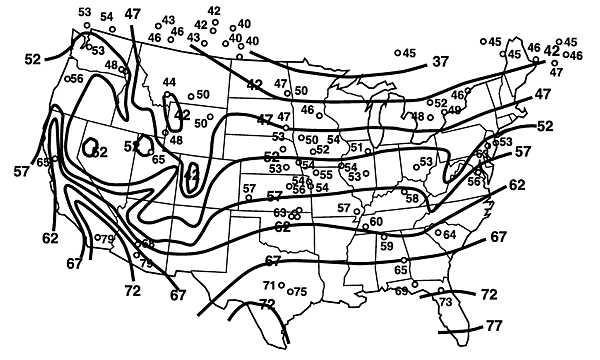 You can seal the slab with any number of products. A skim coat of
Xypex and finishing the floor with an epoxy paint designed for garage
floors adds up to a pretty good moisture retarder. If you are going to insulate the floor, an inch of EPS (or XPS, but not polyiso) and a sheet of 10mil poly under the subfloor works, which will keep the moisture-susceptible subfloor above the summertime ourdoor dew points, keeping dry enough to avoid mold in the rug or wood. Make it a continuous sheet of foam- no sleepers. TapCon the subfloor to the slab. To avoid the "potato chip curl" of the subfloor from normal seasonal moisture changes, it's common to do a double layer of half-inch with the seams staggered by a foot or so. In a double layered approach you can glue the layers to each other with construction adhesive as you go, and apply TapCons 24" o.c. to keep it tight to the slab, no waves or bouncy sections. Bolted to the slab the subfloor is FAR more rigid than subflooring suspended on 16" o.c. joists. Far from being flexible, it's extremely rigid compared to any other floor other than a concrete slab. You'll need some sort of capillary break between the bottom plate of the studwall and the slab. EPDM gaskets would be the best approach, but 10 mil polyethylene and a bead of can-foam to air seal it isn't terrible for doing it on the cheap. If you frame it precisely it's possible to get reasonable installation & performance out of batts. If you're sloppy with both the framing and the batts, not so much. The performance you ultimately get out of it really up to you, or (whomever you hire). With all due respect to Gary Reysa, the BuildItSolar heat load calculator is pretty lousy, not suitable for even code-minimum type construction heat loads. The best you can say for it is that it's better than a WAG (but it's not a whole lot better.). You can do a better job of it by c alculating your own U-factors based on the wall's actual stack-up, and build a spreadsheet to run an I=B=R type heat load calc. |
|
|
|
|
NewHoosier2

New Member
Posts:24
|
| 20 May 2016 02:13 PM |
|
I'm mostly adressing dana1 but my questions are also partly based on answers from others.
The way I understand things....
The floor and dirt act like a heat sink and thermal mass. But at the same time both have a R-value. When using insulation that covers the top of the slap until (at least) 2 feet deep, winter cold can't reach the dirt under the floor. The concrete and dirt then act as 2 feet thick insultor.
Correct?
Because that 'insulation' has so much mass and the soil temps at 2 feet deep never are really low the floor usually stays around 60F all year around.
Correct?
Another method would be insulating the floor on the inside. That likely would be less labor intensive because digging a 2 feet deep trench for the insulation is quite a bit of work with a shovel if there are quite bit of rocks in the soil.
I liked that heat load calculator....
I can calculate R-values of a stacked wall and heatloss per degree F.
What I don't know how to include climate data. Well I have an idea but if the BuildItSolar calculator is lousy I very much doubt my knowledge is good enough to build a more acurate calculator.
|
|
|
|
|
Dana1
Senior Member
Posts:6991
|
| 20 May 2016 02:37 PM |
|
Yes, the slab edge foam insulates the slab and soil under it from the great outdoors. If the average temp in the room is in the 60s, the slab will likely coast along at about 60F, losing some heat to ~55F subsoil. If the room interior stays at 50F most of the winter the slab will stay about 50F most of the winter.
If insulating only on top of the slab with only an inch of foam you'll still want at least some slab-edge foam, but it doesn't need to be as deep. A couple of inches of EPS down to 8-12" below grade (or even 6") would be fine. |
|
|
|
|
NewHoosier2
New Member
Posts:24
|
| 21 May 2016 04:39 AM |
|
EPS, XPS, polyiso, fiber bats all have a different price and R-value. Some are and some aren't allowed to be used below grade.
Very thick insulation will be more expensive to attach to walls. All things to keep in mind.
What I would like now, is simple list stating which insulation is allowed to go in what part of the building. Suggested R-values would be a bonus.
Edge of the slab, in the dirt.
Ceiling.
On top of the concrete floor.
Walls.
As for the walls it may matter how the wall is built
a] siding - insulation - framing - plywood - wallpaper
b] siding - plywood - framing - insulation - wallpaper
Optionally insulation between the framing.
I would prefer option a because that allows me to fasten small things to the wall.
With that info, the materials freely available to me, prices of insulation, I'll figure out what works best for me. |
|
|
|
|
NewHoosier2
New Member
Posts:24
|
| 21 May 2016 08:35 AM |
|
Please delete. |
|
|
|
|
Dana1
Senior Member
Posts:6991
|
| 23 May 2016 05:37 PM |
|
Option A keeps the moisture-susceptible wood entirely inside of conditioned space.
As long as you have at least an inch of exterior foam, installing cheap fiber insulation in the 2x4 stud bays is going to be "worth it", and has no moisture risk down side. The "contractor rolls"of R13s at the ~$12.50/roll for 32' or ~$15/roll for 39' box store pricing comes in at about 29-30 cents per square foot of wall area, and would roughly double the whole-wall performance of 1.5" exterior polyiso on an empty-studs studwall.
Can you get 1.5" polyiso for under $10 per 4'x8' sheet? Can you even get 1" that cheap?
EPS (any density) or XPS (any density) is fine to have in direct contact with the dirt. Any part that is above grade needs to be protected from degradation by sunlight. Quikrete Foam Coating is a pretty easy DIYer friendly protective finish to apply:
https://www.quikrete.com/productlines/foamcoatingpro.asp
Caulking the sheathing to the studs & top/bottom plates in every stud bay is the cheapest performance enhancement you can buy.
|
|
|
|
|
jonr
Senior Member
Posts:5341
|
| 23 May 2016 10:59 PM |
|
I don't think that foam insulation then wallpaper meets code (because it is a fire hazard). |
|
|
|
|
Dana1
Senior Member
Posts:6991
|
| 25 May 2016 03:23 PM |
|
Posted By jonr on 23 May 2016 10:59 PM
I don't think that foam insulation then wallpaper meets code (because it is a fire hazard).
That would be correct- stackup B would require an thermal barrier against ignition between the foam and the conditioned space, such as half-inch plywood or half-inch wallboard. |
|
|
|
|
NewHoosier2
New Member
Posts:24
|
| 26 May 2016 04:22 PM |
|
Dana 1: A comparable performance and cheaper wall would be:
siding | 2" polyiso | housewrap or #15 felt | 1/2" OSB/ply sheathing | 2x4/R13-kraft or unfaced | 1/2" wallboard | latex paint or wallpaper (but not foil or vinyl wallpaper) In last years thread you wrote it's best not to put polyiso on the outside because its performance drops when temp drops below 15C/59F You advised siding-XPS/EPS-polyiso-etc Still valid? I like ridgid boards but am looking into bats. http://www.homedepot.com/p/Owens-Corning-15-in-x-93-in-R15-Kraft-Faced-Insulation-Batts-10-Bags-BF30/205470821 http://www.homedepot.com/p/Owens-Corning-R-13-Kraft-Faced-Insulation-Roll-15-in-x-32-ft-RF10/202585857 http://www.homedepot.com/p/Owens-Corning-R-30-Foil-Faced-Insulation-Batt-16-in-x-48-in-8-Bags-A18/205469829?MERCH=RV-_-OD_SearchPLP_rr-_-205470821-_-205469829-_-N -> Ceiling Any good use for that stuff? Maybe something like this: Siding 1" XPS - 1" polyiso - OSB/plywood - framing with Kraft faced insulation - drywall
This for a R49 ceiling: http://www.homedepot.com/p/GreenFiber-Cellulose-Blow-in-Insulation-INS541LD/100318635?keyword=greenfiber |
|
|
|
|
NewHoosier2
New Member
Posts:24
|
| 26 May 2016 04:27 PM |
|
Dana1 Can you get 1.5" polyiso for under $10 per 4'x8' sheet? Can you even get 1" that cheap? 1" for $7 1.5" dunno because it's out of stock. |
|
|
|
|
NewHoosier2
New Member
Posts:24
|
| 26 May 2016 04:28 PM |
|
Jonr I don't think that foam insulation then wallpaper meets code (because it is a fire hazard). Understood. That plan was shot down by dana1 because of moisture anyway :-) |
|
|
|
|
NewHoosier2
New Member
Posts:24
|
| 27 May 2016 03:07 PM |
|
I need some advice on how to insulate the slab edge.
I know I need to dig the boards 2ft deep around the outer edges.
The slab itself is about 2" above grade. On top of the slab is a small 'wall' of 3" high. Making a total of 5" above grade.
That would mean the insulation boards I dig into the ground are sticking out 5". I think they are to fragile to be left exposed. They would break off where performance hurts most.
The framed wall stands on the 3" concrete 'wall' and mostly covering it. Mostly... I fear some concrete will stay exposed and create a massive thermal bridge. How do I solve that problem? |
|
|
|
|
jonr
Senior Member
Posts:5341
|
| 27 May 2016 04:27 PM |
|
If it works out that you can apply foam sheets to the framed wall and they can extend down over the concrete, great. If not, bevel the edge of the foam. In either case, apply a stucco-like coating such as Quikrete Foam Coating. |
|
|
|
|
NewHoosier2
New Member
Posts:24
|
| 27 May 2016 04:39 PM |
|
So basically you say my wall insulation should start 2ft deep in the ground?
I've thought about that but am a bit scared of 2 things:
a] Moist rising from the soil gets behind the sheets.
b] Cold from the concrete gets injected behind the insulation. |
|
|
|
|
jonr
Senior Member
Posts:5341
|
| 27 May 2016 07:12 PM |
|
Yes. The sill gasket as shown here addresses what I understand of a). Regarding b), the whole idea is that the concrete is no longer cold. insulinstall8_BSC-ISC513_5-3-13r.jpg) |
|
|
|
NewHoosier2
New Member
Posts:24
|
| 31 May 2016 04:19 PM |
|
http://www.ecohome.net/guide/choosing-right-insulation-pros-cons-applications
From previous posts I've understood that at least one side of the wall should vapor pass through.
Drywall and plywood do.
Polyiso is a vapor barrier.
XPS is a vapor barrier.
EPS isn't a vapor barrier.
Drywall isn't a vapor barrier.
Plywood isn't a vapor barrier.
OSB isn't a vapor barrier.
I want to put 2" EPS on the exterior side of the wall and without a break let it go 2ft deep to insulate the slab edge.
Is that a good idea? Wick effect perhaps causing moist problems in the wall. Or loss of R-value of the EPS board?
The wall would be: siding - R9 EPS - plywood - frame with R15 Roxul (stone wool) - drywall => Total R24.7
What would be the best place for the house wrap? On the plywood or EPS?
I wondering, if I use XPS and tape all the seams; do I still need house wrap?
|
|
|
|
|
Bob I

Veteran Member
Posts:1435
|
| 31 May 2016 04:32 PM |
|
Best place for the house wrap IMO is outside of the foam. And no, you do not NEED the house wrap, but I use it anyway simply to keep bulk water off the foam. Yes, I know the foam is not harmed by water, but it's a small cost ($.10-.15/SF) and it may help to keep everything dry. I assume you are installing strapping over the foam also?
RE: running the foam into the ground...Do you have carpenter ants or termites? They LOVE to chew through and nest in foam, so they would be very happy if you bring it down to where they live & save them the commute! |
|
| Bob Irving<br>RH Irving Homebuilders<br>Certified Passive House Consultant |
|
|
NewHoosier2
New Member
Posts:24
|
| 01 Jun 2016 12:44 PM |
|
Sure it's always best to keep foam dry. I'm just wonder if the R-value is reduced when it's wet.
I have an existing uninsulated concrete slab I have to insulate somehow. Dana1 suggested 2ft foam.
Are slabs usually insulated with something else, something bug resistant?
/Edit both bugs live happily all over the yard.
Termites ate 24 windows.
Right now wood bees are eating a pillar on the porch. |
|
|
|
|
Bob I
Veteran Member
Posts:1435
|
| 01 Jun 2016 01:24 PM |
|
Water would probably trump foam, but if it's not in standing water foam should add insulation value. Slabs are usually insulated with foam. The only good alternatives are foam glass which is expensive and hard to get, or trying other materials. I've heard that Roxul is being used, but it does absorb water so seems less practical than foam. |
|
| Bob Irving<br>RH Irving Homebuilders<br>Certified Passive House Consultant |
|
|