|
|
|
Anyone know of <.3gpm start up for on demand water heater?
Last Post 21 Feb 2011 02:21 AM by matteo. 21 Replies. |
Sort:
|
|
 Prev Next Prev Next |
You are not authorized to post a reply. |
|
bemana81

New Member

Posts:1
 |
| 05 Jan 2010 05:44 PM |
|
I've got my bathroom faucet and showerhead down to .5gpm, kitchen to 1.5, high efficiency washer and dishwasher, and I need an on demand tankless that has the lowest startup flow-rate. To date, I'm only finding 1.0gpm?
|
|
|
|
|
|
|
egouin

Basic Member
Posts:126
|
| 06 Jan 2010 01:56 PM |
|
Interesting issue. Most people size these things for their - maximum - flow rate. Try Noritz - www.Noritz.com. I am pretty sure they go down to 0.5 GPM. I own one and think it is great, but my water flow rate is higher than yours is.
Perhaps there are point-of-use units you could use at each fixture? I looked quickly and found this: http://www.stiebel-eltron-usa.com/dhc-e.html. Minimum flow rate is 0.29GPM.
Good luck,
Ed
|
|
| http://www.GouinGreen.com<br>Superinsulated SIP/Modular House (HERS = 30)<br>GSHP w/SCW, ERV, Passive Solar, Solar HW |
|
|
bemana
New Member
Posts:11
|
| 06 Jan 2010 05:07 PM |
|
Thanks for the response Ed - I've chatted with you in the past about your great house project, I recognize the name! Yep, it's kind of an odd predicament. I'll take a look at your links for sure! Interestingly enough we're looking into building this summer (moving from my river house...), so all things similar to the path you took are high in mind!! looking at www.sunplans.com, etc....budget will be key. I've got a builder friend whom can build a very traditional stick built home for me for $60/sq ft, so now I need to see if my naive "affordable for the average joe green home" is a reality eh? I always thought about it, but now it's glaring me in the face! New baby on the way, need a two babies in dipes convenient house! |
|
|
|
|
bemana
New Member
Posts:11
|
| 06 Jan 2010 05:16 PM |
|
Did a little digging and quite a few of those Stiebel units have very low initial flow rates. The hard part for me is the whole electricity usage piece if we're to add PV some day. The counterpoint to that is safety with no gas appliances in the house. Hmm.. |
|
|
|
|
egouin
Basic Member
Posts:126
|
| 06 Jan 2010 05:24 PM |
|
Like you, I am not a big fan of heating hot water with electric, but as you pointed out it is probably safer than a fuel burning appliance. Combine solar HW with the little units and you will likely have a win-win. You'd only need these units to "top off" your hot water to final temp (when needed). |
|
| http://www.GouinGreen.com<br>Superinsulated SIP/Modular House (HERS = 30)<br>GSHP w/SCW, ERV, Passive Solar, Solar HW |
|
|
bemana
New Member
Posts:11
|
| 06 Jan 2010 05:27 PM |
|
Agreed, that's what I'm thinking is the Solar DHW with a very well insulated storage tank for them, then basically I could get away with the smallest electric point of use units. I'm at .5gpm for bath showerhead and faucet, 1.25 gpm for kitchen faucet/dishwasher, and 1.0gpm for laundry. |
|
|
|
|
Stormchaser
New Member
Posts:11
|
| 10 Jan 2010 08:42 AM |
|
I installed a tankless Noritz in my last house and I loved it, looking forward to one here sooner or later.
What I did was turn the temp on the unit down to 115 and just turn on the hot water in the shower, it would loose several degrees in the 40' of line. Have you tried that?
Otherwise I noticed that somebody is making a propane tankless for RV's. If you are using propane that could be made to work with a small battery and solar panel to run it. |
|
|
|
|
Dana1

Senior Member
Posts:6991
|
| 11 Jan 2010 04:13 PM |
|
Posted By Stormchaser on 01/10/2010 8:42 AM
I installed a tankless Noritz in my last house and I loved it, looking forward to one here sooner or later.
What I did was turn the temp on the unit down to 115 and just turn on the hot water in the shower, it would loose several degrees in the 40' of line. Have you tried that?
Otherwise I noticed that somebody is making a propane tankless for RV's. If you are using propane that could be made to work with a small battery and solar panel to run it. Did you INSULATE that 40' of distribution? If not, y'oughtta- roughly 15% of hot water heating energy gets wasted in distribution in an average home. If you insulate it to R2 (the cheapo 3/8" wall stuff available at big orange or blue box stores) it increases both the peak temp and gives you at least 10minutes before that 115F drops to a too-cool-to-use level inducing the user purge the line with fresher-hotter water. Insulated to R4 it gives you more like 20 minutes between draws:  The R4 stuff (5/8" wall closed cell) or higher can be had online, or from some plumbing supply houses or Grainger. 40' of 3/4" PEX or copper has about 8lbs of water in it, so if you're heating it to 115F from say 55F, then abandoning it, flushing & replacing the tepid remainders on subsequent draws, that's ~475BTUs down the drain every time it happens. If that's occurring 10-20x day, it starts to add up- 10x/day would use ~20 therms/year in a 0.82EF tankless, 20x/day costs you ~40therms of input-fuel. Insulating to R4 typically cuts that down to to 3-5x/day for 6-10 therms/year. Noritz has better than average ability to regulate temp well at very low flow, but no gas or propane fired "whole house" unit will strike or even stay lit at 0.3gpm. In any water heating system it's more efficient to run it at the lowest temperature that's sufficient for the task at hand. For showers-only bathers people often crank their tankless all the way down to 105-110F and don't bother mixing in cold at the shower. For any tank storage you need to keep it over 120F to mitigate legionella hazard, since over time it can colonize in tanks stagnating between ~85F and ~120F, peaking in activity around 100-110F. In tankless systems it's not an issue- no matter what the output temp is set to, the stagnation temp will be very close to room temp most of the time, and between more frequent draws 100% of the water in the heat exchanger is purged at every draw.
|
|
|
|
|
guy_davis
New Member
Posts:50
|
| 11 Jan 2010 05:32 PM |
|
Posted By Dana1 on 01/11/2010 4:13 PM
For any tank storage you need to keep it over 120F to mitigate legionella hazard, since over time it can colonize in tanks stagnating between ~85F and ~120F, peaking in activity around 100-110F. In tankless systems it's not an issue- no matter what the output temp is set to, the stagnation temp will be very close to room temp most of the time, and between more frequent draws 100% of the water in the heat exchanger is purged at every draw.
Sorry, if this is off-topic but the above comment made me wonder... What is the risk of legionella in a solar/geo-x buffer tank? My understanding is that the water in the buffer tank could spend some time below 120F if the sun isn't out or the geo-exchange desuperheater isn't running.
We plan to feed the buffer tank through a tankless unit to heat the DHW up to final temp, but now I'm worried about legionella in the buffer tank? I haven't seen anyone else post about this so I must be missing something which mitigates the risk.
|
|
Homeowner - Built in Calgary, Canada<br>Project Details: http://www.guydavis.ca/mphouse<br>
Live System Status: http://welserver.com/WEL0381/ |
|
|
Dana1
Senior Member
Posts:6991
|
| 12 Jan 2010 01:14 PM |
|
If the potable water going to spend several days/weeks between 85-120F there's some risk of getting something started. But if it's then pumped up to well over 140F on the next blazing sunny day it's likely to die off. In absolute numbers the risk is difficult to assess- I doubt there's been any really good studies of it in solar/geo situations.
One of the protocols for killing it off in the distribution plumbing biofilms once a system has been tested positive is to purge all the lines at full flow for a half hour at 160F (measured at the water heater) temps, to guarantee all lines have gotten hot enough long enough for reliable kill. Some parts of the US now require storage temps to be set at 140F with a thermostatic mixing valve/tempering valve at the output by code for any new tank-heater installations, including replacements. (This seems excessive and wasteful to me, given that the risk is quite low at 120F storage.) A flash-heating to 140F and down-mixing isn't enough to kill though- it takes hours at 140F to do the job.
It's useful too look at various established protocols for risk abatement & remediation that have been established when designing a water heating system eg:
http://www.health.sa.gov.au/pehs/PDF-files/legionella-guidelines-2008.pdf
http://www.legionella.org/
http://www.aerotechpk.com/resources/PDF/TP_SamplingControlingLegionellaBacteriaInDomesticWater.pdf
In general, if the heat is stored in water isolated from the potable water via heat exchangers the risk is quite low, since the volume of potable water is low and constantly being replaced. It's when you have larger volumes of tepid water intermittently used that the risk begins to rise. Pre-heating to tepid temps using "reverse indirect" water heaters (eg. TurboMax, Everhot EA series, ErgoMax, etc.) are lower risk than using standard indirects for this very reason- the potable volume is quite small and purged often. (They are a bit more expensive than standard indirects though.) |
|
|
|
|
greenfin
New Member
Posts:25
|
| 12 Jan 2010 11:00 PM |
|
All of my best wishes are with you, Good Luck buddy. |
|
| <a href="http://www.epdmcoatings.com/">Liquid Rubber</a> |
|
|
DallasBill
New Member
Posts:84
|
| 15 Jan 2010 02:44 PM |
|
Our Takagi T-K2 (had it 5 years now) activates at only 0.6 GPM. The T-K3 that has replaced it activates at 0.5 GPM. Remember that, the longer the run, the more cool water it has to push out before the hot reaches you.
Additionally, the ground water temp will affect the hot water flow rate. At a delta T of 60 degrees F in warmer areas -- for example, where the
winter ground water is 60 degrees F and with the output set at 122
degrees F -- the new T-K3 will provide hot water at 5.4 GPM, or 324 GPH. In colder
areas where the input temperature may be 40 degrees F or less, expect a
flow rate about 4.1 GPM, or 246 GPH. |
|
|
|
|
fortunat
New Member
Posts:11
|
| 16 Jan 2010 12:54 PM |
|
You don't specify what fuel source you are considering.
If you are talking about an electric on demand, it should be easy to find one to activate that low.
If you are talking about propane or NG, consider the Navien, which is kind of a pseudo on demand because it includes a tiny little tank. The up side is that there is no minimium flow requirement (and it is a condensing water heater, so super efficient).
hope that helps,
~Fortunat
|
|
|
|
|
bemana
New Member
Posts:11
|
| 17 Jan 2010 08:44 AM |
|
Thanks fortunat, I wasn't aware of the Navien units, and they've what looks to be a tankless unit with no minimum flow rate and 98% efficient! I was hoping to use gas rather than electric, but the flow rates weren't facilitating so I was looking into the Stiebel electric ones. I'm going to do some more research on costs etc...but thinking with our overall low daily water use the Navien may be the ticket above traditional tank, heat pump tank, and electric tankless. Thanks! |
|
|
|
|
Dana1
Senior Member
Posts:6991
|
| 18 Jan 2010 02:09 PM |
|
Posted By bemana on 01/17/2010 8:44 AM
Thanks fortunat, I wasn't aware of the Navien units, and they've what looks to be a tankless unit with no minimum flow rate and 98% efficient! I was hoping to use gas rather than electric, but the flow rates weren't facilitating so I was looking into the Stiebel electric ones. I'm going to do some more research on costs etc...but thinking with our overall low daily water use the Navien may be the ticket above traditional tank, heat pump tank, and electric tankless. Thanks! Don't kid yourself (or be sucked in)- it isn't within Navien's power to re-write the laws of physics! In order to even get the raw combustion efficiency up to 98% requires incoming water temps under 60F (which isn't your situation- far from it!), and with micro-burns below the lowest modulation level to support the internal mini-buffer you may be able to control it from wild temperature fluctuations, but every flue purge & ignition will throw away a significant amount of heat- probably about as much or more as the heat you're adding to the water with low delta-Ts.  With incoming water at 100F the best you'd do is ~93% efficiency in a long burn. At 110F you'd get ~91%. The minimum modulated input on Navien is 15-17KBTU/hr (depending on which model), so at low delta-Ts & low flow it's be short cycling like crazy, with major cycling losses despite the mini buffer. According to their literature, it takes a minimum of 0.5gpm to initiate an ignition cycle, whether that 0.5gpm is from the draw, or induced by the internal circulation pump for re-heating the mini-buffer. At 15KBTU modulation it'll suffer a ridiculous number of ignition/purge cycles supporting a 0.3gpm flow with incoming water temps over 90F (or even 2gpm with incoming temps over 100F!), but the output temps will remain fairly stable. But the as-used efficiency operating in this mode will be off a cliff- no better than 50-60% best-case. You'd do much better using an 80-85% efficiency tankless to maintain temp on a REAL buffer (10 gallons or more), and get a real 80% efficiency out of it. And for the money you'd spend on a condensing tankless you could probably buy the power upgrades for an electric tankless with lower space & maintenance requirements. Navien's use of steady-state efficiency numbers is fairly misleading IMHO. In the real-world, used as a residential hot water heater with residential patterns of use the "98% efficiency" turns out to be somewhere in the mid-high 80s, and then only if there's a preponderance of large-volume draws (showers & baths.) The DOE EF test masks the cycling losses of all tankless units, since each draw in the test is 10.2 gallons, which is exactly how you use hot water, right? (Yeah, I thought so...  ) The only time a Navien gets anything like 98% efficiency is in large volume/continuous flow situations like industrial washing or pool heating apps- never in houses. For solar backup/tanke mainenance situtaions it's efficiency is ~8-10% lower (best case) due to the higher temps of the water entering the heater. If the difference in installed cost is less than $100 between a Navien and a non-condensing tankless there may be a financial rationale for it, but if it's supplying only 20-25% of your hot water energy, there will be less than 5 therms/year difference in fuel use. At current fuel cost that would take 20 years to pay back the $100 in simple terms (but never on a net-present value analysis, taking into account lost interest on the $100.) If it's a $1000 difference in installed cost, that could buy you another 30 square feet of flat panel and a heat-dumping controller, with much bigger net payback.
|
|
|
|
|
fortunat
New Member
Posts:11
|
| 18 Jan 2010 09:09 PM |
|
Dana,
For what it's worth, i agree. Though I like the Navien unit, I wouldn't suggest it as a backup to a solar hot water system (i generally wouldn't suggest any gas fired on-demand for the same reason as you stated, namely that if the SHW is sized right, the remaining water heating load is so small it really can't justify an expensive backup.)
In this case, I was just answering the question:
"Anyone know of <.3gpm start up for on demand water heater?"
Cheers,
~Fortunat
|
|
|
|
|
Dana1
Senior Member
Posts:6991
|
| 19 Jan 2010 02:39 PM |
|
Posted By fortunat on 01/18/2010 9:09 PM
Dana,
For what it's worth, i agree. Though I like the Navien unit, I wouldn't suggest it as a backup to a solar hot water system (i generally wouldn't suggest any gas fired on-demand for the same reason as you stated, namely that if the SHW is sized right, the remaining water heating load is so small it really can't justify an expensive backup.)
In this case, I was just answering the question:
"Anyone know of <.3gpm start up for on demand water heater?"
Cheers,
~Fortunat
I was just pointing out the as-operated issues, since he seemed to be going for it over the other options discussed. As a primary HW heater Naviens are pretty good (but the condensing Noritz models have tighter temperature controls and some other nice features.) A buddy of mine uses a Navien as his solar backup using a circulation pump for maintaining the solar store. (This system was a space heating & hot water retrofit to an existing home in Utah, replacing a hot air furnace and gas-fired tank.) In his case that choice had more to do with the fact that where it needed to be located the expense of stainless Z-vent for a standard-efficiency unit made the condensing Navien & PVC venting both cheaper and slightly more efficient: 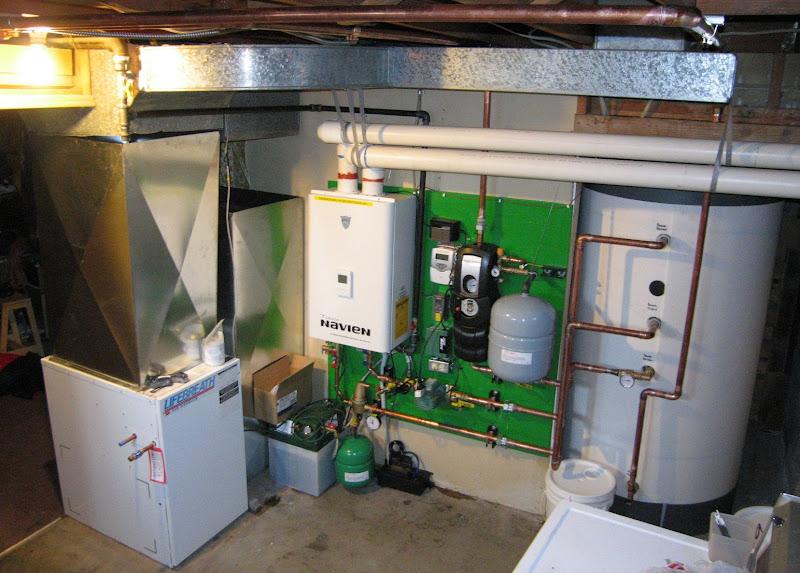 (Note the length of the vent pipe!) I didn't do the design and am not privy to all of the design constraints, but I suspect for slighly less money he might have gotten as-good or better efficiency for less money with a ~50KBTU condensing boiler, given the size of the solar store. In this mode the modulating & finer temperature control of the tankless on-demand is somewhat wasted (much as it is in my combi system, based on a Takagi on-demand heater.)
|
|
|
|
|
Stormchaser
New Member
Posts:11
|
| 06 Feb 2010 10:48 AM |
|
Dana; that install I did was a retrofit in a home with lines in the slab.
I do need to insulate the line to my masterbath in my current (1959) home, it has a long run in the crawlspace and my wife says she runs out of hot water.
It does take an extremely long time to get hot water to the masterbath so I'd like to add a small unit to service it.
The kitchen, hall bath, half bath & bar are all very close to the existing water heater. |
|
|
|
|
peter_ac
New Member
Posts:4
|
| 18 Feb 2011 10:06 PM |
|
Posted By bemana81 on 05 Jan 2010 05:44 PM
I've got my bathroom faucet and showerhead down to .5gpm, kitchen to 1.5, high efficiency washer and dishwasher, and I need an on demand tankless that has the lowest startup flow-rate. To date, I'm only finding 1.0gpm?
Most gas tankless water heaters have minimum activation flow of 0.4 gpm. For example Prestige tankless water heaters from Rheem allows you to reduce the flow to 0.26 gpm, once the heater is activated.
A good comparison chart for tankless water heaters parameters, including start-up flow or minimum flow to activate, I found here:
http://www.tanklesswaterheatersbuyingguide.com/ |
|
|
|
|
peter_ac
New Member
Posts:4
|
| 18 Feb 2011 10:07 PM |
|
Posted By bemana81 on 05 Jan 2010 05:44 PM
I've got my bathroom faucet and showerhead down to .5gpm, kitchen to 1.5, high efficiency washer and dishwasher, and I need an on demand tankless that has the lowest startup flow-rate. To date, I'm only finding 1.0gpm?
Most gas tankless water heaters have minimum activation flow of 0.4 gpm. For example Prestige tankless water heaters from Rheem allows you to reduce the flow to 0.26 gpm, once the heater is activated.
A good comparison chart for tankless water heaters parameters, including start-up flow or minimum flow to activate, I found here:
http://www.tanklesswaterheatersbuyingguide.com/ |
|
|
|
|
| You are not authorized to post a reply. |
|
Active Forums 4.1
 |
Membership: |
 |
Latest:
croccohvacusa |
 |
New Today:
0 |
 |
New Yesterday:
0 |
 |
Overall:
35027 |
 |
People Online: |
 |
Visitors:
121 |
 |
Members:
0 |
 |
Total:
121 |
|
|
|