agagent3

Basic Member

Posts:134
 |
| 02 Apr 2015 07:20 PM |
|
My son is still in the planing stage for a new build in Iowa. Preliminary heat loss calculations indicate a mini-split heat pump should do the job. The question arises will one head to the trick, or are two head better?
The home is 30 by 48 open concept with bedrooms at the east end. It seems logical to put a head in the kitchen/dining/living-room area. Would one need to be installed in the far bedroom? And, oh yes, I'm getting conflicting positions from the "professionals'. |
|
|
|
|
|
|
Lbear

Veteran Member
Posts:2740

|
| 02 Apr 2015 09:14 PM |
|
After you get the calcs from the Manual J that should let you know the loads for each room/area of the home.
South and west facing rooms with a lot of windows/doors will have higher loads depending on your climate and time of year.
One or two strategically placed minis in a home that is AIR TIGHT and has a HIGH R-Value envelope can be done. One has to leave the room doors open and/or undercut the door.
Is the home 1,440 square feet?
|
|
|
|
|
jdebree
Basic Member
Posts:497
|
| 03 Apr 2015 06:35 AM |
|
We have two minis in a similar sized home. The main one is a Mitsubishi Hyper Heat 12K, centrally located in the open LR/DR/kitchen. We also have a 9K in the master suite. We keep our doors open all the time, and have found the following: The 12K works well 99% of the time. On a few cold nights (5 F.) we ran both units, as the house got a little cool with just one. During A/C weather (in SC), the 12K does just fine. As a matter of fact, the 9K does a pretty good job throughout the house, but the humidity seems to creep up a bit. I have them on timers, so the 12K runs during the day, and switches over to the 9K at night. Our house is ICF, R-50 attic, with decent windows and air sealing. We also put study into siting it on the lot to keep summer solar gain to a minimum. The whole house stays within about 1 degree F., and summer A/C only adds about $20/month to our power bill. Winter was more like $50/month, but we only have about 2-3 months of real winter. I think we could get by just fine with one unit, and we could get a cheap space heater if it got a little cool, but I like the idea of having a 'spare' if one of the units failed at an inconvenient time. Our Manual J indicated 9K for A/C, and 12K for heat, but that's at a design low of 21 F. At 0 F., the demand increases to 18K. Pay attention to the low end; just as the heating demand rises, heat pumps start producing less heat. |
|
|
|
|
Dana1

Senior Member
Posts:6991
|
| 03 Apr 2015 03:58 PM |
|
Unless a room has a heat load of a LEAST 4500 BTU/hr even the smallest ductless heads will be cycling on/off rather than modulating. If you're talking a separate 3/4 ton mini-split make that 7000 BTU/hr min. A 9000 BTU wall coil type cold climate Mitsubishi or Fujitsu can deliver 10-11,000 BTU/hr @ +5F, and 8-9000 BTU/hr @ -13F. It's way oversized for the typical heat load of a bedroom in a high-R house. Oversizing the output capacity of modulating mini splits to the 99% design loads by 1.25-1.5x improves the operating efficiency of most mini-splits, but much beyond that it leads to lower comfort, less stable air temps, and at 2x+ oversizing, slowly falling efficiency. In an Iowa climate the Fujitsu xxRLFCD series mini-ducted mini splits will still work at high efficiency (higher efficiency & capacity than the Mitsubishi mini-duct units), and you can split the output between 2-4 rooms. That makes it more reasonable for heating a few bedrooms in a high-R house than the wall-coil type mini-splits, even if you're heating the open spaces at the other end of the house with a wall-coil mini-split. http://www.btureps.com/fujitsu/fujitsu-literature/2014-rlfcd-rlfcc-brochure.pdf http://www.fujitsugeneral.com/duct_specs.htm Even the 1.5 ton unit delivers an HSPF north of 11, and the 3/4 tonner is over 12. As recently as 3 years ago efficiencies that high with mini-splits was only for the wall-blobs. A competent Fujitsu installer would have access to the extended temperature capacity ratings tables to be able to size them correctly to your 99% outside design temp loads, but they all have a specified capacity at -5F/-20.5C and will keep on chugging away at temps well into the -20s at some unspecified output. Just be sure to bracket-mount them on a wall, protected by roof overhangs, above the historical snowpack depth. I can't tell you how many mini-split installers still mount them out in the open or where they'll get clobbered by roof avalanches, as if they were only air-conditioners and didn't need to keep running when the snow flies. It's a common installer error, but one that you can direct them NOT to make. Even with a mini-dog house shed roof, ground mounting is a mistake: 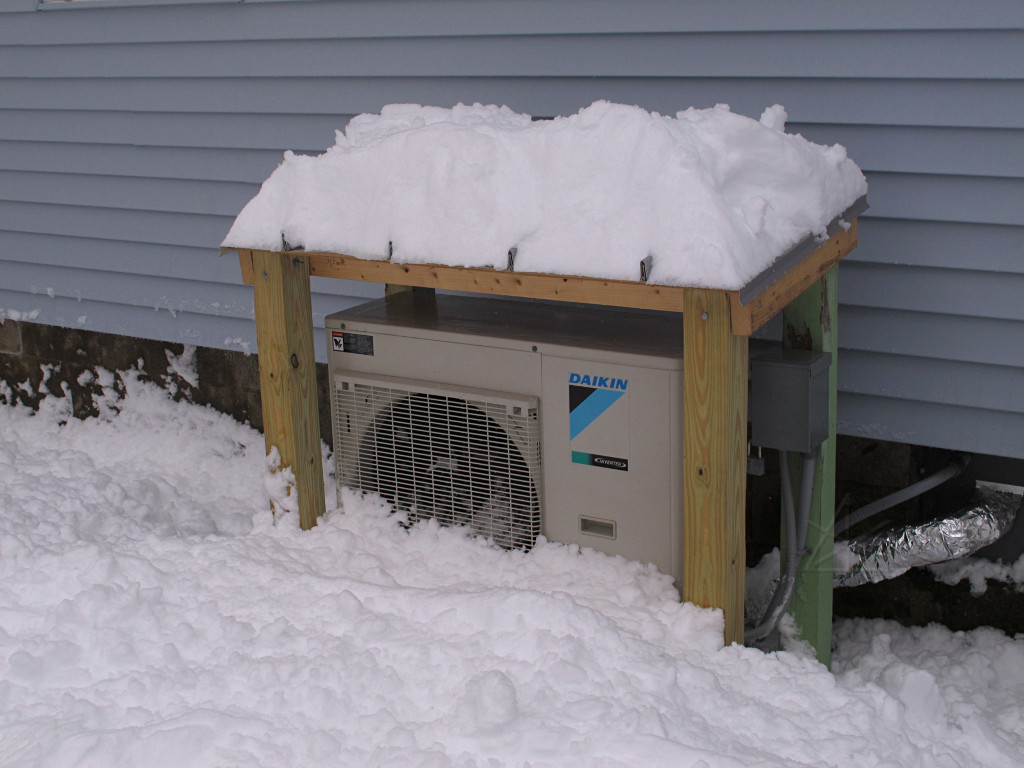 As is mounting them in the path of a roof avalanche, not fully protected by the roof overhangs:  Mounting protected under the rake of a roof is better than under the eaves, and you don't have to mount it as high on the wall to be above the snow depth. http://www.greenbuildingadvisor.com...-blizzards |
|
|
|
|
Lbear
Veteran Member
Posts:2740
|
| 03 Apr 2015 04:30 PM |
|
Dana,
You really seem to favor Fujitsu but the Mitsubishi is also a reliable and performing unit. They make 13.5 HSPF and 30.5 SEER units also.
I know of some areas that have Mitsubishi Diamond Dealer service with 10-year warranties while they offer ZERO Fujitsu service. It sometimes comes down to what is available in that area in regards to install/service. I believe you can't go wrong with EITHER unit, both are well performing units and beat any ducted old-school HVAC 13 SEER AC unit.
In Arizona when you walk into a building during winter or the swing months you are met with cold frigid conditions. The AC systems are designed with one of two settings (ON or OFF). So the same 10 TON A/C unit that is pumping away during August when it's 115F outside is running full speed during March when it's 85F outside. You end up freezing to death inside the place and people will actually put on sweaters because these buildings get so cold during the winter months. They can't turn them off either because it will get "stuffy" inside.
The units don't modulate and they are either at WOT or on the brake. There is no "cruise control" or part throttle like a mini heat pump would have. The old school units end up short cycling during the winter and swing seasons and then run non-stop during summer. They ALWAYS install oversized units into these homes and buildings.
|
|
|
|
|
Dana1
Senior Member
Posts:6991
|
| 03 Apr 2015 05:34 PM |
|
For the wall-coil units I tend to favor Mitsubishi (and Daikin, in warmer climates than Iowa). I'd have no problem specifying a MSZ-FHxxNA wall coil unit for the big zone, but it would be a crap shoot to spec an SEZ/SUZ Mitsubishi mini-duct system in that climate since they have no specified capacity below +5F (and pretty lousy capacity at that temp. See: page 26 for the abbreviated capacity tables for the Mitsubishis:
http://usa.mylinkdrive.com/uploads/documents/4297/document/17_8_SEZ_Ducted_Heat_Pump_Systems.pdf At +5F outdoors with a 70F room temp the 3/4 ton unit only delivers 5200 BTU/hr. That's less than half what it delivers at +45F. That's also less than half what their MUZ/MSZ-FH09NA wall-blob version delivers at +5F! The 99% outside design temps in Iowa run between -10F to +1F. The Fujitsu RLFCD mini-duct units of equivalent cooling rated size have more heating capacity at -5F than the Mitsubishi SEZ/SUZ units deliver at +5F, and run at higher nominal efficiency. (HSPF11-12 rather than HSPF 10.) This makes them a more appropriate choice in this climate. In a US climate zone 4 locations the SEZ/SUZ are fine on capacity, but the RLFCD will still get beat on efficiency. The Daikin FDXS_ _LVJU mini-duct series are only compatible with compressors with a min operating temp of +5F too, which puts them out of the running here too. |
|
|
|
|
jdebree
Basic Member
Posts:497
|
| 04 Apr 2015 06:40 AM |
|
Good points about mounting the outdoor units. I mounted mine about 3 feet off of the ground to keep it free of leaves and red dirt splash-up. Heavy snow isn't usually an issue here, but mine are fully under the roof overhangs. It also makes them a LOT easier to commission and service. My installer would have had to stand on his head to adjust the refrigerant amount if I had placed them on the ground. |
|
|
|
|
Lbear
Veteran Member
Posts:2740
|
| 04 Apr 2015 07:16 PM |
|
Building Departments will sometimes want to see some type of system that will bring in airflow or condition the room. So small rooms or rooms that have low heating/cooling loads that don't have minis in them will require venting of some sort. I got around this by installing a fresh air discharge duct from the ERV.
Each building dept will be different but there is a learning curve on their end when it comes to tight homes with high R-Values.
|
|
|
|
|
BadgerBoilerMN
Veteran Member
Posts:2010
|
| 04 Apr 2015 09:35 PM |
|
Here in Minneapolis, where all heating contractors are licensed and the code strictly enforced, ever inhabited room must have it's own heat source e.g. radiator or ducted register. A variance must be granted for systems such as those suggested here. You have to build the home around the mechanical system with this train of thought. |
|
| MA<br>www.badgerboilerservice.com |
|
|
sailawayrb
Veteran Member
Posts:2283

|
| 04 Apr 2015 11:17 PM |
|
The need for more heads and room zoning decreases significantly as the building envelop insulation and tightness is increased. So for the low load, energy efficient buildings that we typically discuss on this forum, I think one mini split head per 1000 SF would typically be plenty adequate. Of course you still have to do the room-by-room heat gain/loss analysis to insure you don’t have a situation requiring more attention, but this occurrence is more the rare exception and not very common. |
|
| Borst Engineering & Construction LLC - Competence, Integrity and Professionalism are integral to all that we do! |
|
|
Lbear
Veteran Member
Posts:2740
|
| 05 Apr 2015 12:55 AM |
|
Posted By BadgerBoilerMN on 04 Apr 2015 09:35 PM
Here in Minneapolis, where all heating contractors are licensed and the code strictly enforced, ever inhabited room must have it's own heat source e.g. radiator or ducted register. A variance must be granted for systems such as those suggested here. You have to build the home around the mechanical system with this train of thought.
Minneapolis is a Zone 6 climate and close to a Zone 7 climate. I can see why a heat source is required in each room BUT in a tight/high-R home it really is not necessary for every room. A room by room analysis is of course needed but if the calcs come in under 1,000 Btu, I don't see the need for a heat source for that room if it is not closed off in some way from the rest of the home. |
|
|
|
|
Lbear
Veteran Member
Posts:2740
|
| 05 Apr 2015 01:07 AM |
|
Posted By sailawayrb on 04 Apr 2015 11:17 PM
The need for more heads and room zoning decreases significantly as the building envelop insulation and tightness is increased. So for the low load, energy efficient buildings that we typically discuss on this forum, I think one mini split head per 1000 SF would typically be plenty adequate. Of course you still have to do the room-by-room heat gain/loss analysis to insure you don’t have a situation requiring more attention, but this occurrence is more the rare exception and not very common.
Sailaway, My calcs came in at around 1 unit per 1,000 SF. They used Wright Soft/Manual J to do the loads. The guy doing the inputs claims the program has a built in "safety" factor of 25%. |
|
|
|
|
sailawayrb
Veteran Member
Posts:2283
|
| 06 Apr 2015 01:18 PM |
|
Lbear, as I am sure you know by now, I generally dislike rules of thumb. However, I have found 1000 SF to be nearly always on the mark for energy efficient homes. As Dana mentioned earlier, you really don’t want to put an oversized head in a room with a low load. It is far better to work the internal room air infiltration, or at least so I think. Some jurisdictions are slow to adopt their prescriptive codes to changing HVAC technology. However, a design with a PE stamp will nearly always enable an appropriate deviation to the code to be approved and accomplished. |
|
| Borst Engineering & Construction LLC - Competence, Integrity and Professionalism are integral to all that we do! |
|
|
agagent3
Basic Member
Posts:134
|
| 06 Apr 2015 03:18 PM |
|
Thanks for all the great information.
I have done heat load calculations with three different spreadsheets I found on line and come up with heat loss values from 16,776 to 17,734. However, the "ACCA speedsheet" is way off. The foundation will be a slab foundation using standard Fox Blocks for the frost wall and 4" of type IX esp beneath the concrete. The ACCA sheet asks for an F-Value. ACCA says the F-value is the Btus/foot of exposed edge. Huh? Anyone know what that value would be for my son's home in Iowa? The heat loss from a slab I'm describing can't be all that great.
As far as head placement is concerned the logical location would be on the North wall of the kitchen/dining/living room. The next largest room is the master bedroom. If a second head were located there would it have any impact on the joining bath and bedroom?
If my calculations are correct we should be looking at about a 20,000 Btu unit. And would it be okay to locate the outside unit on the North wall?
|
|
|
|
|
Dana1
Senior Member
Posts:6991
|
| 06 Apr 2015 03:53 PM |
|
Posted By BadgerBoilerMN on 04 Apr 2015 09:35 PM
Here in Minneapolis, where all heating contractors are licensed and the code strictly enforced, ever inhabited room must have it's own heat source e.g. radiator or ducted register. A variance must be granted for systems such as those suggested here. You have to build the home around the mechanical system with this train of thought.
In most jurisdictions the only requirement is that the heating system be able to heat every room in the house to 68F or higher at the 99% outdoor design temp. In a high-R house with high performance windows of sufficiently small size in the doored-off rooms this requirement can often be met with point source heating, by raising the temp of the room(s) with the heat source(s) to 72-73F or so. On a deep energy retrofit on a 3-floor building I was involved with in MA a few years ago this issue came up, but the math showed that those requirement would indeed be met with a single 1-ton ductless head per floor. They installed 1.5 tonners instead, since one of the floors was a bit marginal, and the owner wanted more margin for colder than 99% design temp loads. |
|
|
|
|
Dana1
Senior Member
Posts:6991
|
| 06 Apr 2015 04:11 PM |
|
Posted By agagent3 on 06 Apr 2015 03:18 PM
Thanks for all the great information.
I have done heat load calculations with three different spreadsheets I found on line and come up with heat loss values from 16,776 to 17,734. However, the "ACCA speedsheet" is way off. The foundation will be a slab foundation using standard Fox Blocks for the frost wall and 4" of type IX esp beneath the concrete. The ACCA sheet asks for an F-Value. ACCA says the F-value is the Btus/foot of exposed edge. Huh? Anyone know what that value would be for my son's home in Iowa? The heat loss from a slab I'm describing can't be all that great.
As far as head placement is concerned the logical location would be on the North wall of the kitchen/dining/living room. The next largest room is the master bedroom. If a second head were located there would it have any impact on the joining bath and bedroom?
If my calculations are correct we should be looking at about a 20,000 Btu unit. And would it be okay to locate the outside unit on the North wall?
Again, what are the individual heat loads of the rooms that can be doored-off from the spaces with the ductless heads? What is the heat load of the larger more open space? The raw square footage of the rooms are not a reliable way to estimate
the relative heat loads, which is why the calculations on a room-by-room basis. What was the indoor & outside design temperatures used when determining that ~17K-18KBTU/hr load? Is the outside design temp the 99% temperature bin, or the 99.7% bin, or something else? The output capacity of air source heat pumps falls with outdoor temperatures, and even with cold-climate mini-splits it falls off pretty significantly at temps below +5F. If we don't know the temperature at which it needs to deliver than 17-18K we can't really specify which units might cut it, and which ones definitely don't. This is not a mere academic exercise or a WAG- we need to know the
answers in order to figure out how many and what size ductless heads (or
mini-duct cassette) would be appropriate. If you want credible answers, spill the beans on those details! It makes no difference whatsoever which outside wall(s) the compressor unit(s) get installed on, as long as the lengths of the refrigerant lines aren't longer than the maximum specified in the installation manuals. You may be able to still meet the loads with longer-than-spec refrigerant lines, but longer lines reduce both capacity and efficiency. The capacity derating of longer lines can usually be calculated, but it's better to not have to go there. |
|
|
|
|
agagent3
Basic Member
Posts:134
|
| 06 Apr 2015 07:55 PM |
|
The heat loads are as follows;
Great Room 9792
Master BR 2980
BR 2 2542
BR 3 1678
Bath 3/4 379
Bath full 415
Total 17788
So in the dead of a miserable winter day (-10) how would this home be managed?
Thank you. |
|
|
|
|
agagent3
Basic Member
Posts:134
|
| 08 Apr 2015 11:28 AM |
|
I submitted the room by room heat loss. The question again, how many head s and where to locate? Or do we put a head and smaller minisplit in for the great room and an even small minisplit with 2 cassettes in the master bedroom and another bed room? |
|
|
|
|
Dana1
Senior Member
Posts:6991
|
| 08 Apr 2015 12:03 PM |
|
You didn't state the outside design temp, and it kinda matters, at least for how you're going to manage the smaller room loads. I'll assume for now that your outside design temp is -5F. The Great Room load at -10F & or lower can be handled with a 1-ton - 1.25 ton mini-split like the Mitsubishi -FH12NA or FH15NA or the Fujitsu -12RLS2-H or -15RLS2-H, which will would be somewhat oversized for the load, but in the optimal 1.25-1.5x oversizing range (that actually improves the average operating efficiency.) The capacity curves of the FH and FE Mitsubishi units are pretty similar. The FH12 can deliver 13.6K @ +5F, and about 10K @ -5F. The -FH15NA is good for about 13.5K @ -5F.  The approximate Fujitsu -_ _RLS2-H series capacity curves can be found here. If you're really worried about falling short at temps below -10F, go with either of the 1.25 ton units for the Great Room. Then there's the rest... The loads in the bathrooms are barely more than the output of a conscious adult human- nothing required there. If code officials give you a hard time about it, install a single 150 watt panel electric panel radiator in each bath, and operate it under a combination line-voltage thermostat plus occupancy/vacancy sensor control. Alternative, install 150W of electric radiant floor on a thermostat- set the thermostat a few degrees lower than the temps in the adjacent spaces if you feel it's using too much power. None of the bedroom loads are large enough to warrant an individual ductless head, which would only cycle on/off rather than modulate (even at -10F). That type of operation has comfort issues due to widely fluctuating room temps during cold weather, and sometimes even short cycling. While that might be curable with wall-thermostat control, it's more expensive and sub-optimal. The combined load of the three bedrooms is ~7200BTU/hr, which can be handled by a single Fujitsu -_ _RLFCD mini-duct cassette. It may work with the 1-ton, but it will probably take the 1.5 ton to cover the load at -10F. With a decent duct design and a bit of flow-balance tweaking it would work pretty well. The installer should have to consult the extended temperature charts for capacity (which I don't have, and don't appear to be available online) to figure out which is the most likely prospect at your actual outside design temp. Though the capacity at temps below -5F are not specified, a linear approximation of the fall-off in capacity between 0F and -5F would be good enough for figuring out it's performance a -10F. If I had to guess (not a perfect way to engineer the solution), the max output capacity @-5F is about half it's specified maximum capacity in the submittal sheets, or possibly a bit lower. If that WAG is correct, the 1-ton would be good for over 9K @ -5F, the 1.25 ton over 12K@ -5F. But a certified Fujitsu installer would be able to spell it out with greater accuracy. The 1.25K unit might be actually sub-optimally oversized for the 7200 BTU/hr load or it may be perfect- it's important to look at the real numbers rather than guessing. |
|
|
|
|
Bob I
Veteran Member
Posts:1435
|
| 08 Apr 2015 04:53 PM |
|
how many head s and where to locate?
depends partly on the layout; without that it would be entirely guesswork. |
|
| Bob Irving<br>RH Irving Homebuilders<br>Certified Passive House Consultant |
|
|